This Florida turkey season guide pulls together everything from official FWC regulations to license requirements to actual hunting knowledge you can use.
Florida’s got two turkey subspecies: the Osceola turkey on the peninsula and Eastern wild turkeys up north. That makes it a big deal for anyone chasing the turkey slam.
Here’s what we’re covering:
- 2026 season dates for youth and general seasons in both zones
- What licenses and permits cost for residents versus non-residents
- Where to actually hunt: public WMAs, guided options, and private land
Let’s get into the dates and regulations first.
Quick Overview
This table has all the key 2026 Florida spring turkey season info straight from the Florida Fish and Wildlife Conservation Commission.
| Season Type | Zone | Start Date | End Date | Bag Limit | Notes |
|---|---|---|---|---|---|
| Youth | South of SR 70 | Feb 27, 2026 | Mar 2, 2026 | 2 bearded turkeys/gobblers (season) | Youth 15 and under; adult supervision required |
| Youth | North of SR 70 | Mar 13, 2026 | Mar 16, 2026 | 2 bearded turkeys/gobblers (season) | Youth 15 and under; adult supervision required |
| General | South of SR 70 | Mar 7, 2026 | Apr 12, 2026 | 2 bearded turkeys/gobblers (season) | Daily limit: 2 (private land), 1 (WMAs) |
| General | North of SR 70 | Mar 21, 2026 | Apr 26, 2026 | 2 bearded turkeys/gobblers (season) | Daily limit: 2 (private land), 1 (WMAs) |
Before you head out, make sure you’ve got:
- Hunting License: $17 resident / $151.50 non-resident
- Turkey Permit: $10 resident / $125 non-resident
- Management Area Permit: You’ll need this for WMA hunting
- Hunter Safety Course: Required if you were born on or after June 1, 1975, and you’re 16 or older
- Harvest Reporting: You have to report every turkey you harvest
If you want to know about Florida’s other hunting seasons, the state’s got opportunities year-round for different game.
Turkey Season Guide Florida
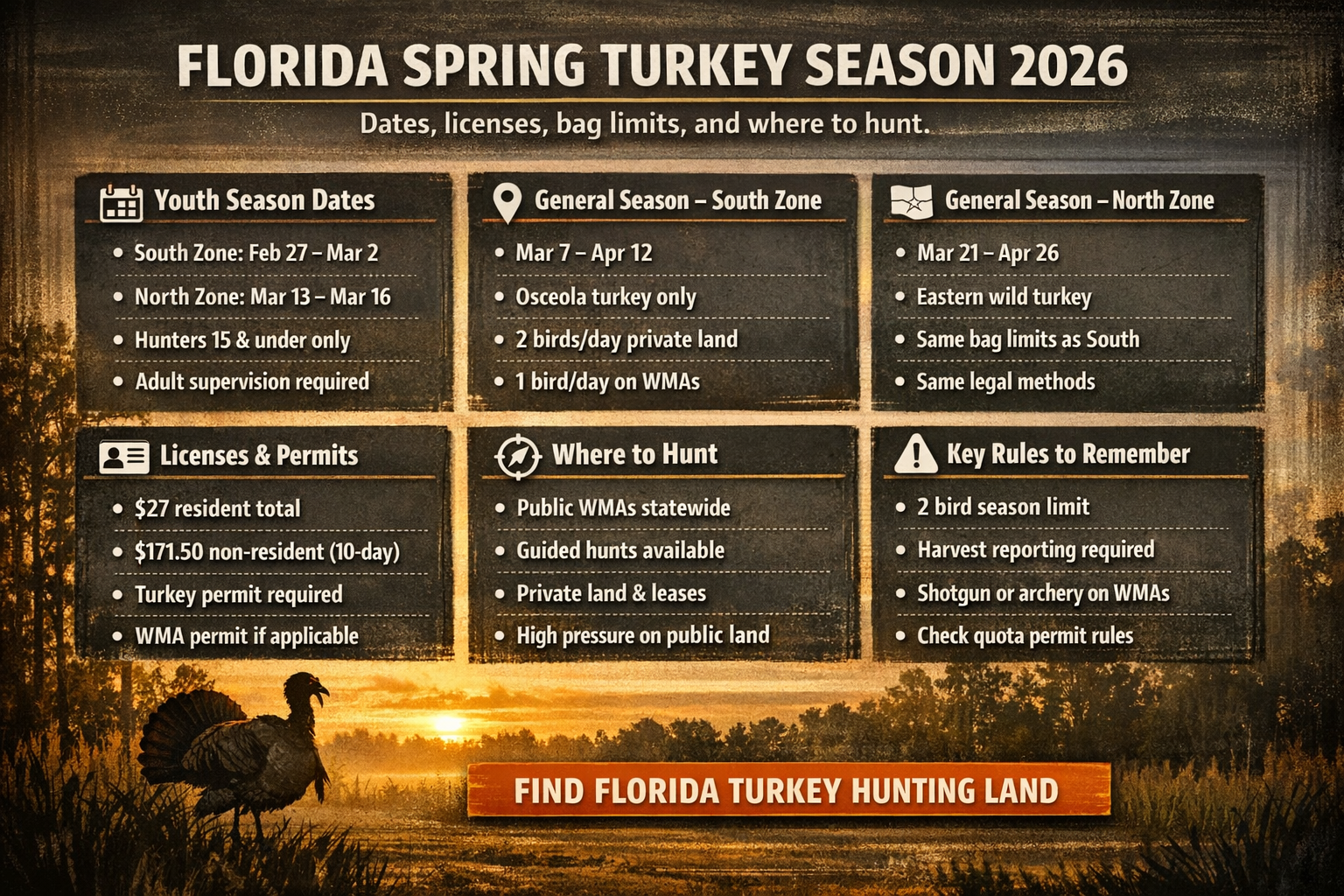
Florida splits the spring turkey season into two zones using State Road 70 as the dividing line. South zone (the peninsula) is where you’ll find the Osceola turkey—only exists in Florida. North zone (panhandle and north Florida) has Eastern wild turkeys. Youth seasons come first in both zones, giving young hunters a chance before everyone else shows up.
Youth Turkey Season
FWC regulations say youth turkey hunts are open to hunters 15 and younger on many WMAs and other lands.
South Zone: February 27 – March 2, 2026
North Zone: March 13 – 16, 2026
Key Requirements:
- Youth has to be 15 or younger
- Adult 18 or older has to supervise
- Youth and supervising adult don’t need a license or permit
- Adults with a hunting license and turkey permit can call turkeys but can’t shoot
- Adult supervisors need a management area permit for WMA hunting
- Only the youth can harvest birds, and those count toward their two-bird season limit
Youth season means way less hunting pressure, which is huge when you’re teaching someone to hunt. Twenty-three WMAs don’t require a youth spring turkey quota permit, including Apalachicola, Aucilla, Blackwater, Osceola, and Three Lakes.
General Season – South of SR 70
The 2026 spring turkey season south of State Road 70 runs March 7 through April 12. This is Osceola turkey country—Florida’s only endemic subspecies.
Dates: March 7 – April 12, 2026
Species: Osceola turkey
Bag Limits:
- Private land: 2 per day, 2 bearded turkeys/gobblers for the season
- WMAs: 1 per day, 2 for the season
Shooting Hours: Half-hour before sunrise to sunset on most WMAs (some cut you off at 1 p.m.)
Legal Methods: On private land you can use any legal rifle, shotgun, PCP air guns (.20-caliber minimum), muzzleloader, crossbow, bow, or pistol. On WMAs it’s shotgun with #2 or smaller shot, PCP air guns shooting a bolt/arrow, crossbow, or bow.
The Osceola’s limited range is exactly why South Florida draws hunters chasing the turkey slam. Starting with the 2026 spring turkey season, non-residents can’t hunt wild turkey during the first nine days of the zonal spring turkey season on five specific WMAs—check FWC regulations for which ones.
General Season – North of SR 70
North of State Road 70, the 2026 spring season goes March 21 through April 26. This zone includes the Florida Panhandle and counties north of SR 70, where you’re hunting Eastern wild turkeys.
Dates: March 21 – April 26, 2026
Species: Eastern wild turkey
Bag Limits: Same setup as South zone (2 daily/season on private land, 1 daily on WMAs)
Shooting Hours: Same as South zone
Legal Methods: Same as South zone
You have to report your harvest if you’re hunting deer or turkey in Florida—report it right away to stay legal.
Florida Turkey Licenses and Permits
Turkey hunting in Florida means you need both a hunting license and a turkey permit. What you pay depends a lot on whether you’re a resident or not.
Florida Hunting Licenses
Every turkey hunter needs a valid Florida hunting license before you can even buy a turkey permit.
| License Type | Resident Cost | Non-Resident Cost |
|---|---|---|
| Annual Hunting License | $17.00 | $151.50 |
| 10-Day Hunting License | N/A | $46.50 |
Non-residents can grab a 10-day license for $46.50 if you’re just coming for a shorter trip—saves you some real money.
If you were born on or after June 1, 1975, and you’re 16 or older, you need to pass a hunter safety course before buying a license. You can buy licenses at GoOutdoorsFlorida.com, local sporting goods stores, or Walmart.
Florida Turkey Permits
On top of your hunting license, you need a turkey permit specifically for hunting wild turkey.
| Permit Type | Resident Cost | Non-Resident Cost |
|---|---|---|
| Turkey Permit | $10.00 | $125.00 |
Total Cost:
- Resident: $27.00 (license + permit)
- Non-resident: $276.50 (annual license + permit) or $171.50 (10-day license + permit)
WMA Quota Permits: A lot of WMAs require a quota permit for spring turkey season. But around 40 WMAs don’t require a quota permit for all or part of the season. You typically apply for quota permits in November for the next spring.
Florida Turkey: Where to Hunt
Finding good hunting land is honestly the hardest part. Florida turkey hunters have three main options: public Wildlife Management Areas, guided hunts with outfitters who know what they’re doing, and private land through leases or if you own it.
Best Public Lands
Florida’s got tons of public land hunting through the WMA system, but the popular spots get hammered—especially those first couple weeks. Turkeys have been reported in 66 of Florida’s 67 counties, so both subspecies are pretty widespread.
Best WMAs for turkey hunting:
- Apalachicola WMA – Big panhandle area; no quota permit needed for parts of the season
- Osceola WMA – Named after the subspecies; no quota permit required
- Three Lakes WMA – Central Florida; good Osceola turkey habitat
- Blackwater WMA – Northwest Florida; Eastern turkey population
- Big Cypress National Preserve – Over 729,000 acres of tropical and temperate zones; prime Osceola habitat
- Kissimmee River Public Area – Central Florida; solid Osceola hunting
Remember many WMAs need quota permits you apply for in November. Those 40 or so WMAs that don’t need quota permits give you more flexibility but probably more hunters too.
Be real about the pressure: the Osceola and the turkey slam draw serious attention, which means Florida gets hit hard, especially on public lands during opening weeks. If you want to skip the crowded public spots, Hunting Locator connects you with landowners who have lease opportunities all over Florida.
Guided Hunts
Guided hunts make a lot of sense for out-of-state hunters who don’t know Florida terrain, or anyone who wants better odds without the trial-and-error learning process. Professional outfitters bring local knowledge, private land access, and equipment that can seriously boost your chances.
Price Range: Semi/self-guided packages run around $2,700 per hunter; fully guided hunts with lodging and meals vary by outfitter
What’s Included: All hunts are 3 days, fully guided, with lodging and meals. Most packages include decoys, blinds, chairs, and guide services.
Success Rates: Some outfitters put up impressive numbers—God’s Country Outfitters has had a 98% success rate over the past 16 seasons, while Everglades Adventures reports 100% success over the past decade.
Booking Timeline: Book early as you can to lock in your preferred dates. Some outfitters take deposits and reservations once Florida sets season dates in June.
Terrain Considerations: Osceola turkeys love swampy areas, cypress ponds, and wetlands. Bring a thermacell because mosquitos are brutal during March and April. Get comfortable waterproof boots that are at least knee high.
For gear that actually works in Florida’s conditions, check out the Hunting Locator store.
Private Land Hunting
Private land hunting has real advantages: way less pressure, exclusive or semi-exclusive access, and usually better habitat management. You’ve got two main options: leasing or buying.
Leasing Private Land: Hunting leases get you seasonal or annual access to private property for a fee. Lease prices are all over the place depending on property size, game quality, amenities, and whether it’s exclusive—anywhere from a few hundred bucks for shared access to several thousand for exclusive rights on premium land.
Buying Private Land: If you’re serious about hunting long-term, buying hunting property gives you permanent access and control over how the habitat’s managed. Florida’s got everything from pine flatwoods to cypress swamps, with property prices varying by region and how many acres.
The Access Challenge: Finding quality private land has always been about who you know and word-of-mouth. Lots of hunters lose access when landowners sell, change lease terms, or stop farming.
Hunting Locator Solution: Hunting Locator connects hunters directly with landowners all over Florida who’ll lease or sell their property for hunting. The platform gives you a searchable database of private hunting opportunities, cutting out all the guesswork and networking headaches of finding quality land access. Whether you want a Florida hunting lease or you’re looking to buy, Hunting Locator makes it way easier to secure your next hunting spot.
Turkey Hunting Tips
Success hunting Florida turkeys means adjusting your tactics for the state’s unique terrain and how these subspecies actually behave.
- Scout Water Sources – Osceola turkeys prefer roosting over or close to water, using dense swamp and marshland to hide from predators. Focus your scouting on cypress ponds, creek bottoms, and wetland edges where turkeys feel safe.
- Adjust Your Calling Strategy – Osceola turkeys can be super vocal and eager to gobble on the roost but tend to be quiet and stealthy once on the ground because of heavy predator pressure. Be aggressive when they’re roosted, then dial it back to subtle calling once they hit the ground.
- Hunt Early Season – First few days usually give you the best gobbling before hunting pressure ramps up. Youth season is even better with almost no competition.
- Prepare for the Environment – Florida spring means heat, humidity, and mosquitoes. Bring lightweight, breathable clothing, lots of water, and bug spray. Thermacells aren’t optional for dealing with mosquitoes.
- Use Decoys Strategically – In Florida’s thick vegetation, turkeys often commit fast once they see decoys. Set up decoys in small openings where birds coming in will have clear shooting lanes.
- Know Your Subspecies – Osceola turkeys in South Florida adapted to swamp environments and act different than Eastern turkeys in North Florida. Research the specific subspecies you’re after and adjust accordingly.
- Consider Private Land – With all the hunting pressure on public WMAs, private land access can completely change your success rate. Less competition and better habitat management on private property often make it worth the cost.
More Resources from Hunting Locator
Expand your Florida hunting knowledge and opportunities:
- Florida Turkey Hunting Season – Year-round guide to turkey hunting in Florida, including fall season and subspecies details
- Florida Hunting Season – Complete overview of all Florida hunting seasons, dates, and regulations for every game species
- Florida Deer Hunting Season – Plan your deer hunting around turkey season
- Florida Waterfowl Hunting Season – Extend your hunting opportunities with Florida’s waterfowl hunting
- Florida Alligator Hunting Season – Explore Florida’s unique alligator hunting
- Florida Hunting Leases – Browse available hunting leases throughout Florida and connect with landowners
- Hunting Locator Store – Find the right gear for Florida turkey hunting
FAQ
When does Florida turkey season start in 2026?
Florida’s 2026 spring turkey season has different start dates by zone and hunter type. Youth season south of SR 70 opens February 27, while youth season north of SR 70 opens March 13. General season south of SR 70 opens March 7, and general season north of SR 70 opens March 21.
How much does a non-resident turkey hunting license cost in Florida?
Non-residents need both a hunting license and turkey permit. The annual hunting license is $151.50 (or $46.50 for a 10-day license), and the turkey permit is $125.00. Total comes to $276.50 for annual licenses or $171.50 with the 10-day option. You might need additional WMA permits for Wildlife Management Areas.
What is the bag limit for turkey hunting in Florida?
Season bag limit is 2 bearded turkeys or gobblers statewide. Daily limits are different depending on where you hunt: on private land outside the WMA system, you can take 2 birds per day, while on WMAs you can only take 1 bird per day. You have to report all harvests per FWC regulations.
Do I need a quota permit to hunt turkeys on Florida WMAs?
A lot of WMAs require a quota permit for spring turkey season, but about 40 WMAs don’t require quota permits for all or part of the season. Popular non-quota WMAs include Apalachicola, Osceola, Three Lakes, and Blackwater. You typically apply for quota permits in November for the next spring. Check FWC’s website for the complete list.
What’s the difference between Osceola and Eastern turkeys in Florida?
The Osceola turkey only exists on the Florida peninsula (south of SR 70) and is darker with more iridescent feathers and longer legs compared to Eastern turkeys. Eastern wild turkeys live in North Florida and the Panhandle (north of SR 70). The Osceola’s limited range makes it one of the most sought-after subspecies for hunters chasing the turkey slam.
Can youth hunters participate in Florida turkey season without a license?
Yes, during designated youth turkey hunt weekends, youth hunters (15 and younger) and their supervising adult don’t need a license or permit. But if the adult supervisor wants to actively participate by calling turkeys, they need a hunting license and turkey permit. Youth have to be supervised by an adult 18 or older at all times.
The Final Shot
Florida’s 2026 spring turkey season is a solid opportunity whether you’re a resident or traveling specifically for the Osceola subspecies. Season dates are set and permits are available, so if you’re going to plan your hunt, now’s the time. Whether you go for youth season with less pressure, hit the prime early general season dates, or take advantage of the extended opportunities later in April, it all starts with preparation.
Knowing regulations matters, but getting quality hunting access matters just as much. Public WMAs are free but come with serious pressure, especially opening weekends. Guided hunts give you professional expertise and private land access with success rates that speak for themselves. For hunters who want something in between, private land leases through platforms like Hunting Locator get you exclusive or semi-exclusive access without paying for full guided services.
Don’t wait until the last minute to lock down your hunting spot—prime locations and guided hunt dates fill up fast. Start planning today and make 2026 the year you add a Florida gobbler to your collection.


