Here’s what you’ll learn in this Delaware turkey season guide:
- Complete 2026 season dates including Youth & Non-Ambulatory hunt (April 4-5)
- License and permit costs for residents ($39.50) and non-residents ($199.50)
- Public land options, guided hunt considerations, and private land access strategies
Let’s start with the essential dates and costs you need to lock in your plans.
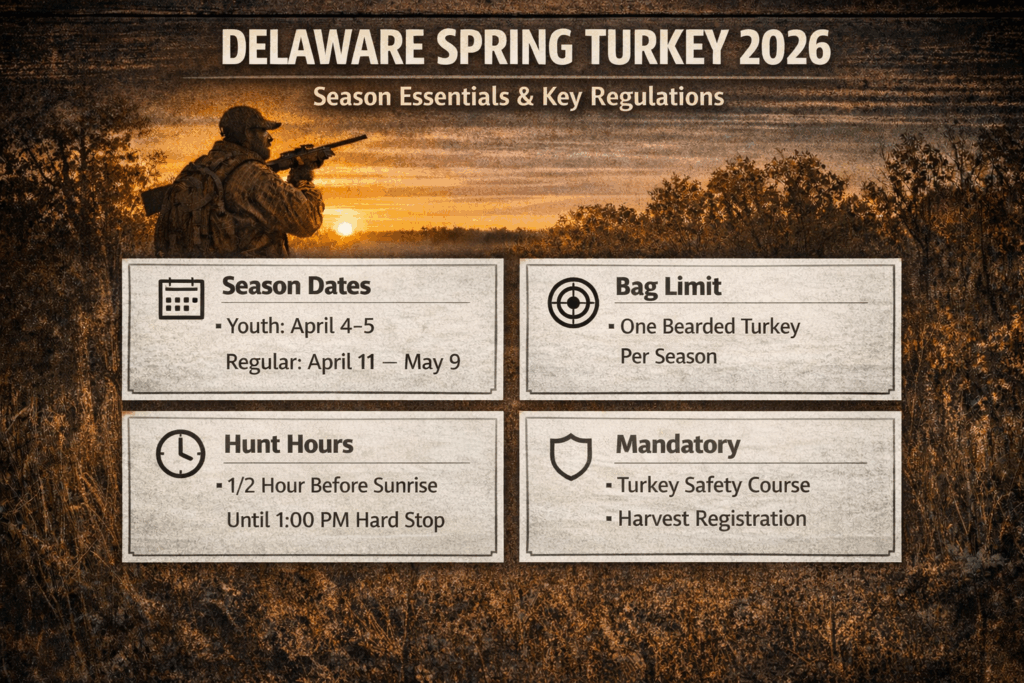
Quick Overview
Need quick answers? This section covers the essentials. Detailed breakdowns follow in subsequent sections.
| Key Information | Details |
|---|---|
| Season Dates | April 11 – May 9, 2026 (Segments A-D) |
| Youth/Non-Ambulatory Season | April 4-5, 2026 |
| Bag Limit | One bearded turkey per season |
| Legal Hours | ½ hour before sunrise until 1:00 PM |
| Resident License Cost | $39.50 (Adult), $5.00 (Junior 13-15) |
| Non-Resident License Cost | $199.50 (Adult), $50.00 (Junior 13-15) |
| Conservation Access Pass | $32.50 (Resident), $65.00 (Non-Resident) |
Critical Compliance Reminders:
- Bearded turkeys only – Harvesting a turkey without a visible beard is illegal
- 1:00 PM hard stop – Hunting hours end at 1 p.m., not sunset
Before you head afield, make sure you have these requirements covered:
- Valid Delaware hunting license (resident or non-resident, age-appropriate)
- Completion of Delaware-approved turkey hunter safety course (required for all first-time turkey hunters)
- Public land permit (if hunting State Wildlife Areas or State Forests—obtained via lottery)
- Conservation Access Pass (required for vehicle access to State Wildlife Areas)
This information comes directly from eRegulations.com and DNREC, Delaware’s authoritative sources for hunting regulations.
Delaware Turkey Hunting Seasons
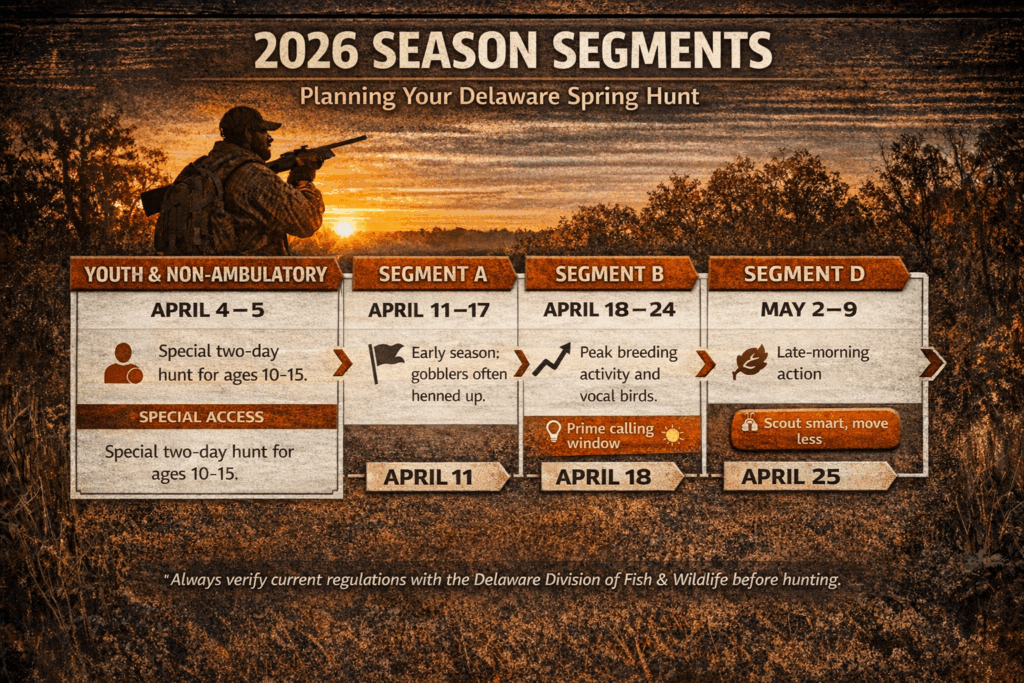
Delaware splits its spring turkey season into four one-week segments (A-D) plus a special Youth & Non-Ambulatory weekend. This setup spreads hunting pressure across public lands and gives you flexibility in planning around work schedules and travel.
| Season Segment | Start Date | End Date | Notes |
|---|---|---|---|
| Youth & Non-Ambulatory | April 4, 2026 | April 5, 2026 | Ages 10-15 and non-ambulatory hunters; no public land permit required |
| Segment A | April 11, 2026 | April 17, 2026 | First week of regular season |
| Segment B | April 18, 2026 | April 24, 2026 | Second week |
| Segment C | April 25, 2026 | May 1, 2026 | Third week |
| Segment D | May 2, 2026 | May 9, 2026 | Final week of season |
Youth & Non-Ambulatory Season (April 4-5, 2026)
According to eRegulations.com, “A special two-day hunt for youth and non-ambulatory hunters will occur on Saturday April 4th and Sunday April 5th.” This dedicated weekend gives young hunters and non-ambulatory individuals a less-pressured shot at Delaware’s Eastern wild turkeys.
Who Qualifies:
- Youth hunters ages 10-15 years old
- Non-ambulatory individuals who use a wheelchair for mobility
- Youth must be of sufficient size and physical strength to safely handle a firearm
Supervision Requirements:
Youth hunters must be under direct supervision by an adult 21 years or older. Adult companions may NOT possess a firearm during the hunt. Adult supervisors must be licensed to hunt in Delaware and must have completed a Delaware-approved turkey hunter safety course.
License Requirements by Age:
- Ages 10-12: No license required, but must have a License Exempt Number; no turkey education course required but must be supervised
- Ages 13-15: Must have valid Delaware junior hunting license ($5 resident / $50 non-resident), must complete Basic Hunter Safety course AND Delaware-approved turkey hunter safety course
Public Land Access Advantage:
Hunters participating in the special turkey hunt for youth and non-ambulatory hunters may hunt without a public land permit on state wildlife areas and state forests open to turkey hunting during the regular season. This eliminates the lottery requirement that applies during the regular season. In 2020, 19 birds were harvested by youth hunters during the special youth/non-ambulatory hunt day, proving this dedicated weekend provides real opportunities for success.
Regular Season Segments A-D (April 11 – May 9, 2026)
The four-week regular season gives you multiple options for planning your Delaware turkey hunt. When you apply for public land permits, you select a specific segment, but private land hunters can hunt any segment (or multiple) as long as they haven’t filled their one-bird bag limit.
Segment Selection Considerations:
- Segment A (April 11-17): Early season. Gobblers often still henned up but responsive to calling. Cooler weather typically prevails.
- Segment B (April 18-24): Peak breeding activity. Gobblers becoming more vocal as hens begin nesting.
- Segment C (April 25-May 1): Hens actively nesting. Gobblers more willing to respond to calls and decoys.
- Segment D (May 2-9): Late season. Reduced hunting pressure but gobblers may be call-shy. Warmer weather.
Sunday Hunting Expansion:
Sunday turkey hunting is now allowed for the first time since 1991, though it’s limited to private properties with landowner permission and on designated State Wildlife Areas. This expansion gives you additional days to pursue birds, especially valuable if you’re balancing work schedules.
Harvest Registration:
After a successful hunt, you must register your turkey through the Digital DNREC app or by calling 855-DEL-HUNT. Complete your harvest report card before moving the bird from where it was harvested. This is a legal requirement.
Delaware Turkey Licenses and Permits
Understanding Delaware’s licensing requirements is essential for legal compliance and trip budgeting, especially for non-residents facing significantly higher costs than neighboring states.
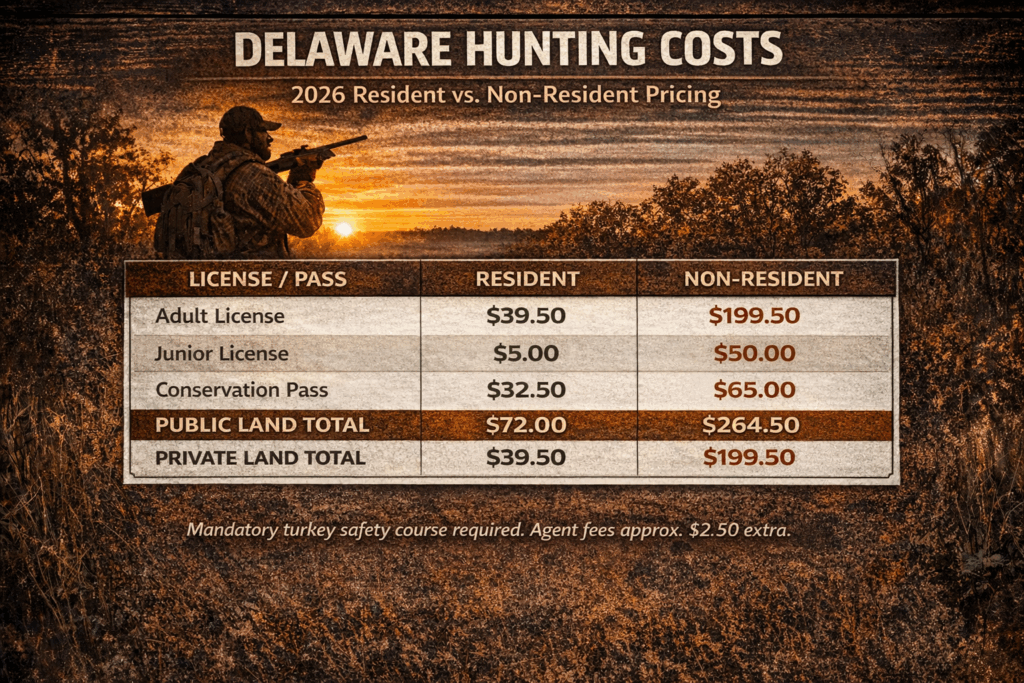
Delaware Hunting Licenses
Delaware’s license structure is straightforward, with clear age-based categories and a substantial price difference between resident and non-resident hunters.
| License Type | Description | Resident Fee | Non-Resident Fee |
|---|---|---|---|
| Adult Hunting License (Ages 16-64) | Required for general hunting of small game and birds | $39.50 | $199.50 |
| Junior Hunting License (Ages 13-15) | Required for youth hunters | $5.00 | $50.00 |
| Non-Resident 3-Day Hunting | Valid for 3 consecutive days; small game only (not valid for deer or turkey) | N/A | $75.00 |
| Senior Exemption | Residents age 65 and older are exempt from purchasing a general hunting license | Free (Must obtain a License Exempt Number) | N/A |
You can purchase licenses online through Delaware’s licensing system, at authorized agents throughout the state, or at DNREC offices. Agent/transaction fees of approximately $2.50 may apply depending on where you purchase.
First-Time Turkey Hunter Requirement:
Both resident and non-resident hunters must pass a turkey hunting course approved by the DNREC Division of Fish and Wildlife before they can legally hunt turkeys in Delaware. This requirement applies even if you’ve hunted turkeys in other states. For traveling hunters, completing this course before your trip requires advance planning. DNREC offers courses periodically, so check their schedule well ahead of your planned hunt.
Delaware Turkey Hunting Permits
Beyond the basic hunting license, public land hunters face an additional layer of requirements through Delaware’s permit lottery system.
Public Land Permit Lottery:
The DNREC Division of Fish and Wildlife conducts an annual lottery to issue permits allowing hunters to hunt turkeys on state wildlife areas during the spring season. The Delaware Department of Agriculture issues separate permits for State Forests. Hunters may only receive ONE public land permit per season—either a State Wildlife Area, National Wildlife Refuge, OR State Forest permit.
Lottery Statistics:
For the 2025 season, 834 valid applications were entered into the lottery with only 544 permits available. Of those, 488 permits (89.7%) went to Delaware residents and 56 permits (10.3%) went to non-residents from 20 different states. These numbers show that while non-residents can draw permits, resident hunters receive priority in the allocation.
Application Timeline:
Applications are typically due in late fall or early winter, with the lottery conducted in early January. Check DNREC’s website for exact 2026 application deadlines. Missing the deadline means no public land hunting opportunity.
Private Land Exception:
If you’re hunting on private land with landowner permission, you do NOT need a public land permit—only the appropriate hunting license and completed turkey safety course.
Conservation Access Pass:
Most State Wildlife Areas require a Conservation Access Pass for vehicles. The cost is $32.50 for residents and $65.00 for non-residents. This pass can be purchased alongside your hunting license.
Total Cost Summary:
- Private Land Minimum (Resident): $39.50 (license only)
- Private Land Minimum (Non-Resident): $199.50 (license only)
- Public Land (Resident): $72.00 ($39.50 license + $32.50 pass)
- Public Land (Non-Resident): $264.50 ($199.50 license + $65.00 pass)
These figures exclude agent fees and don’t account for the turkey safety course fee if you haven’t already completed it.
Delaware Turkey: Where to Hunt
Delaware’s compact geography creates both challenges and opportunities for turkey hunters. The Division of Fish & Wildlife manages approximately 68,000 acres across 19 public wildlife areas—substantial for Delaware, but limited compared to neighboring states. For hunters interested in pursuing multiple species throughout the year, check out our complete Delaware hunting season guide for more information.
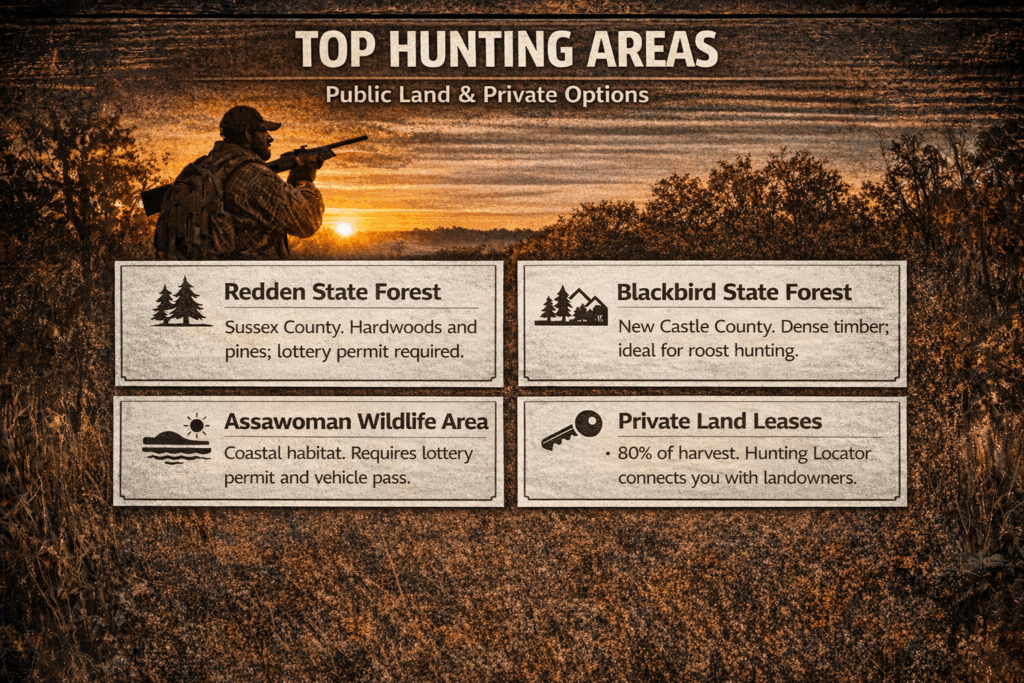
Best Public Lands
Public land turkey hunting in Delaware requires navigating the permit lottery system, but several areas consistently produce birds for hunters who draw permits.
Recommended Public Hunting Areas:
- Redden State Forest (Sussex County): Mix of hardwoods, pines, and open fields. Varied terrain suitable for different hunting strategies and calling setups.
- Blackbird State Forest (New Castle County): Dense woods and open clearings. Good for hunters who prefer timber hunting and working birds off the roost.
- Assawoman Wildlife Area (Sussex County): Coastal habitat with agricultural edges. Requires Conservation Access Pass for vehicle access.
- C&D Canal Wildlife Area (New Castle County): Northern Delaware option with mixed habitat types along the Chesapeake & Delaware Canal corridor.
- Trap Pond State Park area (Sussex County): Wooded environments with adjacent farmlands where turkeys are frequently spotted feeding.
Public land hunters must have an annual permit from the Division if hunting on a State Wildlife Area or from the Delaware Department of Agriculture if hunting on a State Forest.
Hunting Pressure Reality:
With only 544 public land permits issued and strong resident participation, expect other hunters on public lands—especially during Segments A and B when enthusiasm runs highest. Successful public land hunters scout thoroughly before the season, locate roosting areas away from obvious access points, and often hunt weekdays when pressure is lighter.
Guided Hunts
Guided hunts offer an alternative for hunters—especially non-residents—who want local expertise and guaranteed land access without navigating the permit lottery.
Guided turkey hunts in Delaware typically include land access, guide services, and local knowledge of turkey patterns and behavior. Prices vary significantly based on hunt duration, amenities, and whether success is guaranteed. Non-residents should inquire about whether the outfitter provides assistance with licensing requirements, particularly the mandatory turkey safety course.
Due Diligence Recommendations:
Before booking a guided hunt:
- Verify the outfitter’s credentials and reputation through reviews and references
- Confirm exactly what’s included in the package (lodging, meals, transportation, field care)
- Ask about youth hunter accommodations if planning a family hunt
- Understand the cancellation policy and what happens if weather impacts your hunt dates
- Clarify whether the guide will call for you or if you’ll be expected to work birds yourself
Private Land Hunting
In 2020, over 80% of wild turkeys harvested in Delaware were taken from private lands. This isn’t surprising. Private land offers distinct advantages that public areas simply can’t match.
Why Private Land Matters:
- Reduced hunting pressure: You’re not competing with dozens of other hunters who drew the same public land permit
- Ability to scout and pattern birds: You can visit the property multiple times before season to locate roosting areas, feeding patterns, and strutting zones
- Flexible timing: Hunt any segment that works for your schedule, not just the one you drew in the lottery
- Better access control: You know exactly who else might be hunting the property and can coordinate to avoid conflicts
Leasing Private Land:
Many Delaware landowners lease hunting rights to responsible hunters. Lease arrangements vary widely—some are seasonal, others annual. Typical lease agreements specify which parcels you can access, whether the lease is exclusive or shared, liability and insurance requirements, rules about guests and trail cameras, and harvest reporting expectations.
Buying Private Land:
For dedicated hunters with long-term commitment to Delaware turkey hunting, purchasing hunting property represents the ultimate solution. Delaware’s agricultural lands with wooded edges provide ideal turkey habitat, and owning your own ground means complete control over habitat management, hunting pressure, and access.
Finding Private Land Access:
Hunting Locator connects you directly with Delaware landowners who want to lease or sell their hunting properties. Instead of spending weeks driving rural roads hoping to find the right property, you can search Delaware hunting leases by location, acreage, game species, and price range. Our platform gives you access to private land opportunities that never get advertised publicly, connecting serious hunters with quality properties throughout the First State.
Turkey Hunting Tips
Success in Delaware’s spring turkey season requires more than just showing up with a license and a shotgun. Here are proven strategies that consistently produce results:
- Scout before the season: Locate roosting areas by listening for gobbles at dawn and dusk in the weeks before opener. Knowing where birds sleep gives you a massive advantage on opening morning.
- Set up close to the roost: Position yourself within 100-150 yards of where turkeys are roosting, but not so close you spook them off the limb. Let them fly down naturally, then work them with calls.
- Call sparingly and realistically: Overcalling is the most common mistake. Use soft yelps and clucks to sound like a single hen, not an entire flock. Less is often more with pressured Delaware birds.
- Use decoys strategically: A hen decoy or hen-jake combo can pull a gobbler those last crucial yards into range. Position decoys where you have a clear shooting lane and the bird will approach from a predictable direction.
- Hunt the 10 a.m. to 1 p.m. window: Many hunters leave by mid-morning, but Delaware’s 1 p.m. closing time means late-morning hunting can be productive. Gobblers often move and vocalize again after hens go to nest.
- Pattern your shotgun: Know exactly where your gun shoots at 20, 30, and 40 yards with your chosen turkey load. Pattern on paper before the season—not in the field on a live bird.
- Stay mobile on public land: If you’re not hearing birds where you set up, don’t be afraid to move. Cover ground, call periodically, and listen for responses.
- Respect the 1 p.m. deadline: Delaware’s early closing time is strictly enforced. Plan your hunts to be off the property with time to spare. Getting caught afield after 1 p.m. can result in serious penalties.
Check out the Hunting Locator store for turkey hunting essentials including calls, decoys, and camouflage suited for Eastern hardwood environments.
More Resources from Hunting Locator
Hunting Locator provides resources for Delaware hunters pursuing multiple species throughout the year:
- Delaware Hunting Season Guide: Complete overview of all Delaware hunting seasons, regulations, and planning information
- Delaware Deer Hunting Season: Detailed guide to Delaware’s archery, muzzleloader, and shotgun deer seasons
- Delaware Waterfowl Hunting Season: Duck and goose seasons, including coastal and inland hunting opportunities
- Delaware Small Game Hunting Season: Information on rabbit, squirrel, and other small game seasons
- Delaware Migratory Bird Hunting Season: Dates and regulations for dove, woodcock, and other migratory bird hunting
- Delaware Coyote Hunting Season: Year-round coyote hunting information and predator management strategies
- Delaware Turkey Hunting Season: Additional turkey hunting resources and historical season information
FAQ
When does Delaware’s 2026 spring turkey season open?
Delaware’s spring wild turkey hunting season runs from April 11, 2026, through May 9, 2026, divided into four one-week segments. A special Youth & Non-Ambulatory season occurs April 4-5, 2026, giving young hunters and non-ambulatory individuals a dedicated weekend before the regular season opens.
How much does a non-resident Delaware turkey hunting license cost?
Non-resident adult hunting licenses cost $199.50, while junior licenses (ages 13-15) cost $50.00. If you’re hunting public land, you’ll also need a Conservation Access Pass ($65.00 for non-residents), bringing your total minimum investment to $264.50 before any permit lottery fees or turkey safety course costs.
Can I hunt turkeys on Sundays in Delaware?
Yes. Sunday turkey hunting is now allowed for the first time since 1991, though it’s limited to private properties with landowner permission and on designated State Wildlife Areas. This recent regulation change gives hunters additional opportunities throughout the season.
Do I need a special permit to hunt turkeys on Delaware public land?
Yes. Public land hunters must have an annual permit from the Division if hunting on a State Wildlife Area or from the Delaware Department of Agriculture if hunting on a State Forest. These permits are issued through a lottery system conducted in early January, and you may only receive one public land permit per season.
What are Delaware’s turkey hunting hours?
Legal shooting hours are half an hour before sunrise to 1:00 p.m. This applies to all season segments and is strictly enforced. Delaware is one of the few states with an afternoon cutoff for turkey hunting, so plan your hunts accordingly.
How many turkeys can I harvest in Delaware?
Delaware’s bag limit is one bearded turkey per season. Regulations stipulate that only bearded turkeys may be harvested, and you cannot harvest a second bird even if you hunt multiple segments or both public and private land.
The Final Shot
Delaware’s 2026 spring turkey season offers real opportunities for both resident and non-resident hunters willing to do their homework. The segment-based season structure provides flexibility for trip planning, and recent harvest numbers prove Delaware’s turkey population is strong, with record harvests in recent years.
Public land access is limited and competitive, but that’s exactly why understanding all your options matters. Whether you’re applying for the public land lottery, booking a guided hunt, or pursuing private land access through Hunting Locator’s Delaware lease listings, success starts with solid planning and accurate information.
Get your licenses squared away early, complete that mandatory turkey safety course if you haven’t already, and start scouting locations well before April. Delaware’s Eastern wild turkeys are out there. Your job is to put yourself in position to connect with one when the season opens. Ready to secure your Delaware turkey hunting access? Visit Hunting Locator today to explore private land opportunities that give you the edge over crowded public areas.


