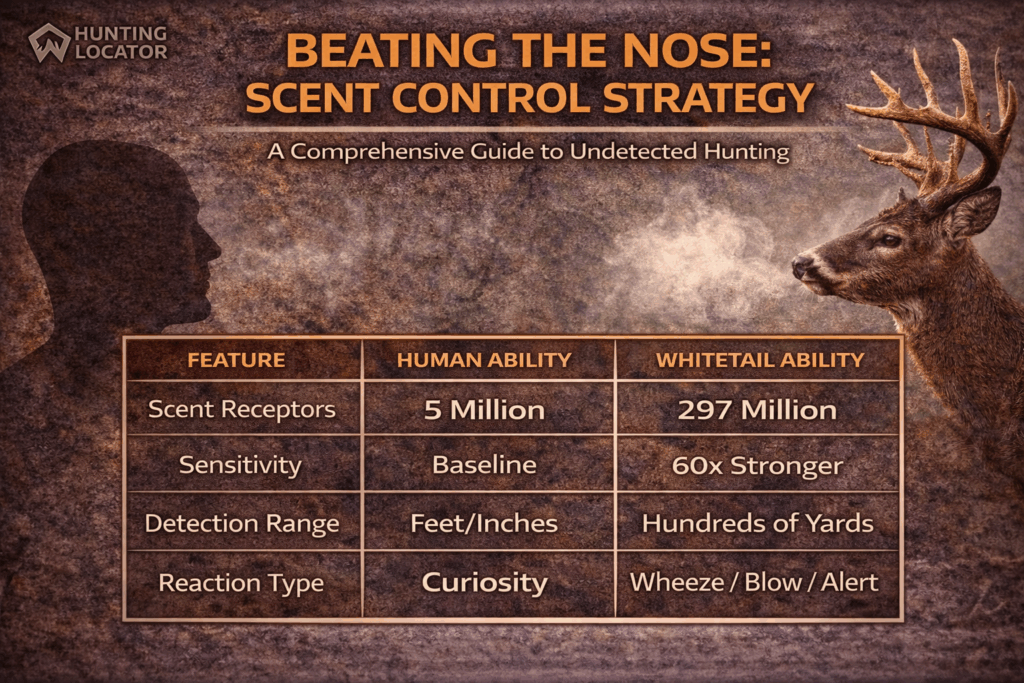
Research shows that whitetail deer possess an acute sense of smell with noses equipped with up to 297 million scent receptors, compared to a human’s 5 million. When you’re up against odds like that, you need every advantage you can get. Let’s be honest: no product eliminates scent completely, and you will not fool every deer in the woods, and yes, you will have a deer smell you periodically if you spend enough time hunting. But with the right combination of knowledge, technique, and gear, you can dramatically improve your odds of staying undetected when it matters most.
Here’s what you’ll learn in this complete guide to beating the nose:
- Why wind management is your non-negotiable foundation—and why it’s not enough on its own
- The real difference between scent elimination and cover scents, and when to use each approach
- A complete gear and technique system that actually works in the field
Understanding the problem is the first step to solving it, so let’s start with why that deer’s nose is so incredibly effective at detecting your presence.
Why Deer Always Smell You: Understanding the Problem
Whitetail deer possess an acute sense of smell with noses equipped with up to 297 million scent receptors, compared to a human’s 5 million. That’s nearly 60 times more sensitive than your own nose. Even if you could eliminate 95% of your scent—which no product can do—you’d still be broadcasting enough odor molecules for a deer to detect you from hundreds of yards away.
The challenge goes deeper than just sensitivity. Spraying down controls odors on clothing and gear, yet scent freed from your body continues to release odors that spook deer. Every breath you exhale, every pore on your skin, every piece of gear you touch continues to release scent molecules into the air. This is why hunters who do everything “right” still get busted—they’re fighting a biological reality that no single product can overcome.
When deer detect human scent, their reaction is unmistakable. When deer smell humans, they start to walk stiff legged and wheeze, and they usually walk quickly away rather than taking off running. Sometimes an ornery old doe might stand out and blow like crazy, alerting every deer within a half-mile that she smells a rat.
Common Scent Control Mistakes
Even experienced hunters make critical errors that sabotage their scent control efforts. One of the top reasons hunters accumulate unwanted odors is not keeping hunting clothing and gear scent-free before the hunt. Many hunters wash their clothes in scent eliminating detergents but then get dressed and jump inside their vehicles where foreign odors are fierce.
Your truck’s interior absorbs sweat, food smells, fuel odors, and countless other foreign scents that transfer to your gear the moment you climb in. Other overlooked contamination sources include:
- Gear contamination: A glove on a release can become stinky after all the dirt, sweat and skin oil from years of use
- Breath odors: Many people’s breath has a noticeable odor that deer can smell
- Over-hunting areas: Hunting an area too much, hunting the wrong wind, bad entry and exit, and checking trail cameras too often contribute to scent control failure
- Poor storage practices: Storing clean hunting clothes with everyday items or in areas exposed to household odors
Once you understand these pitfalls, you can build a system that addresses each one systematically.
Wind Management: Your Non-Negotiable Foundation
Before discussing any product you can buy, let’s establish the foundation that no amount of money can replace: wind awareness. By far, the best scent control practice is hunting the wind, and experienced guides will tell you that the only thing that works all the time is being downwind.
We recommend this approach not because we don’t sell scent control products—we do—but because no product can fully replace wind awareness. Wind management is free, always available, and when done correctly, it’s the most reliable scent control method you have.
Reading Wind and Thermals
Wind isn’t just about prevailing direction—it’s about understanding how air moves through specific terrain. Low spots often present swirling winds no matter what the predominant wind direction is, making scent control exponentially more challenging in valleys, creek bottoms, and other terrain features that create turbulence.
Thermals add complexity. Morning hunts feature cooling air creating downward thermals that carry your scent toward valley floors. Evening hunts feature rising thermals that lift scent upward and outward. Understanding these patterns helps you position yourself where your scent will cause the least disruption to deer movement.
When picking a tree, you need to determine where to put your wind and scent so you’ll alert as few deer as possible, as a mature buck might circle in somewhere downwind and smell you. This is why stand placement requires thinking beyond just where you expect to see deer—you need to consider where your scent will travel and how deer might approach from unexpected angles.
Using GPS and mapping apps during pre-season scouting helps you identify terrain features that affect wind patterns, allowing you to plan stand locations and approach routes that work with natural air currents.

Why Wind Alone Isn’t Enough
Perfect wind conditions are rare, especially on pressured land where deer have learned to circle downwind of suspected danger. Even when you’ve done everything right with wind management, swirling conditions and the reality that a mature buck might circle in somewhere downwind and smell you means you need backup plans.
This is where a complete scent control system becomes your insurance policy—not a replacement for wind awareness, but a complement to it.
Scent Elimination vs. Cover Scents: Know the Difference
One of the biggest sources of confusion in scent control is understanding when to eliminate scent versus when to mask it. Masking odor isn’t the same as eliminating it, and using the wrong approach can actually make things worse.
Scent Elimination focuses on removing or neutralizing human odor molecules before they can be detected. This is your primary defense—reducing the amount of scent you’re putting into the environment.
Cover Scents work by introducing natural odors that mask or confuse your human scent signature. Think of this as camouflage for your nose—you’re not eliminating your scent, you’re trying to make it blend in with what deer expect to smell.
Scent Elimination Products: How They Work
Modern scent elimination technology works through three primary mechanisms:
Enzyme-based formulas break down the bacteria that cause human odor, attacking the source rather than just masking the smell. These products continue working over time as the enzymes remain active on your clothing and gear.
Ozone generators use oxidation to destroy odor molecules at the molecular level. Some products work by eliminating an animal’s ability to smell without using enzymes, cover scents, chemicals, or ozone, representing newer approaches to scent elimination technology.
Activated carbon clothing physically adsorbs odor molecules into its porous structure, trapping them before they can escape into the air.
The key insight is that the trick isn’t to eliminate your scent, but to reduce it. No product eliminates 100% of human odor, but reducing your scent signature by 70-80% can make the difference between detection and remaining unnoticed.
When you’re ready to build your elimination system, our scent elimination collection includes enzyme sprays, scent-free detergents, and storage solutions that work together as a complete system.
Cover Scents: Strategic Masking
Cover scents can be effective when used correctly, but they require strategy beyond simply spraying something that smells like the woods. Deer know what smells are natural to their habitat, and they are not easily fooled. It is important to use a cover scent that occurs naturally in your hunting area.
The most effective cover scents match your specific hunting environment:
- Earth scents work well in agricultural areas and open timber
- Pine and cedar scents are effective in coniferous forests
- Acorn and apple scents match well with hardwood environments
- Deer urines can be effective during specific times, particularly doe estrus during the rut
However, deer will quickly associate you with a cover scent if you overuse the same scent in the same area. Rotation and strategic application are crucial for long-term effectiveness.
Browse cover scents and attractant lures matched to your hunting region and season for the best results.
Your Complete Scent Control System
The most successful hunters don’t rely on any single product or technique. Instead, they layer multiple approaches to create redundancy in their scent control strategy. Here’s how to build a system that gives you the best possible chance of staying undetected.
Pre-Hunt Preparation
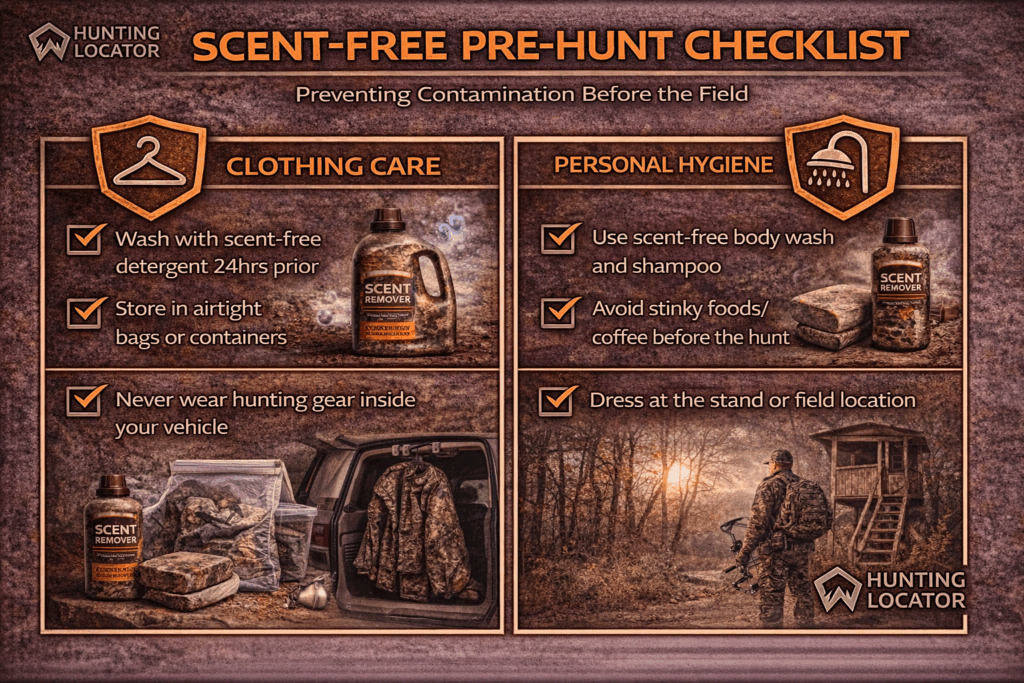
Your scent control routine should begin days before your hunt, not when you’re getting dressed in the truck:
- Wash all hunting clothing in scent-free laundry detergent at least 24 hours before your hunt
- Store clean clothes in airtight containers or scent-proof bags away from household odors
- Prepare your body with scent-free body wash and shampoo on hunt morning
- Dress at your hunting location, not at home where you’ll pick up contaminating odors
Hunters should be very particular about the clothing they wear while deer hunting, storing outer layer hunting clothing in an airtight bag and never putting it on until reaching the hunting location. This single change eliminates the vehicle contamination that sabotages so many hunters’ efforts.
Field Application Gear
Once you’re in the field, your scent control system needs to be portable and effective throughout your hunt:
- Scent elimination spray for field touch-ups on clothing, gear, and stand areas
- Activated carbon clothing systems that continuously adsorb odor molecules
- Rubber hunting boots to minimize ground scent transfer and make scent-free cleaning easier
Material choice matters significantly. Merino wool base layers will not hold a lot of smell, while synthetics will. This makes merino wool an excellent foundation layer even if you’re not investing in full carbon clothing systems.
Advanced Technology Options
For hunters looking to maximize their scent control investment, advanced technologies offer additional layers of protection:
- Portable ozone generators that can treat clothing and gear in the field
- Ozone storage bags for maintaining scent-free gear between hunts
- Premium carbon clothing systems with higher adsorption capacity and longer effectiveness
These represent upgrades for serious hunters rather than necessities. The foundation elements—proper washing, storage, and field sprays—will handle the majority of your scent control needs.
Ready to build your scent control system? Explore our curated collection—we’ve done the research to bring you gear that actually works.
Tactics & Strategy: Putting It All Together
Scent control products are only as effective as the tactics you pair them with. Here’s how to integrate everything you’ve learned into a complete hunting strategy that maximizes your chances of staying undetected.
Stand Placement and Entry Routes
Your stand location should be chosen with scent dispersal as a primary consideration. Hunting an area too much, hunting the wrong wind, bad entry and exit, and checking trail cameras too often contribute to scent control failure.
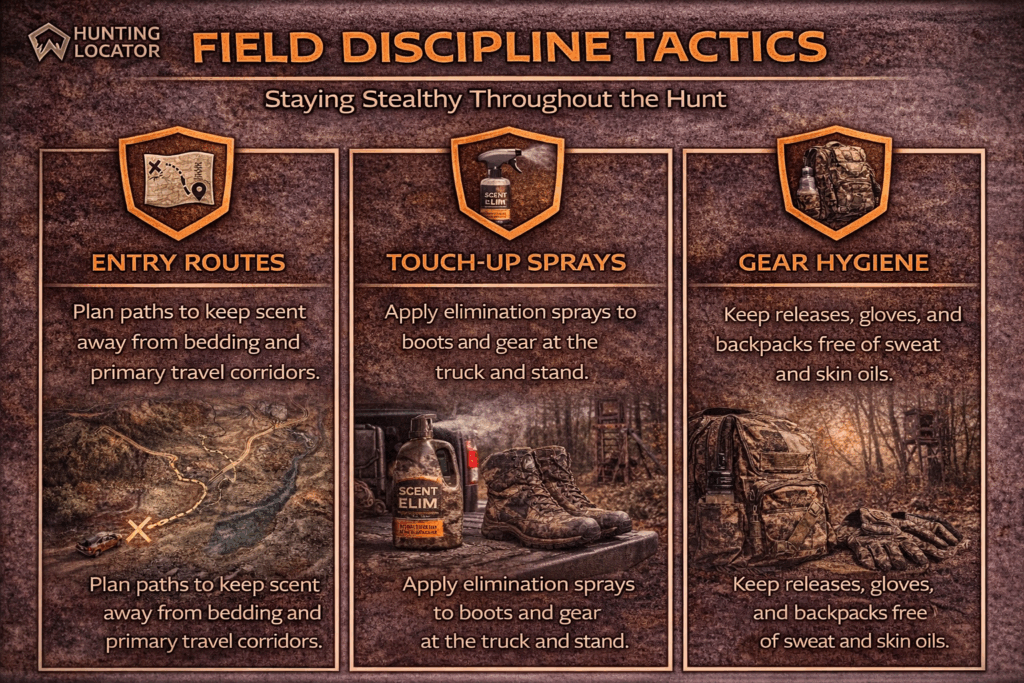
Plan your approach routes to keep your scent away from bedding areas, primary feeding locations, and travel corridors deer use regularly. This often means taking longer, more difficult routes to your stand, but the payoff in reduced pressure on your hunting area is worth the extra effort.
Consider multiple stand locations for different wind conditions rather than trying to make one location work in marginal conditions. Having options allows you to always hunt with favorable wind while avoiding the temptation to hunt poor conditions just because you want to be in the woods.
The Approach: Minimizing Scent Trail
Your approach to the stand is where many hunters undo all their preparation work. Key principles for a scent-conscious approach:
- Dress at the truck, not at home, to avoid picking up household and vehicle odors
- Use rubber boots to minimize ground scent and make cleaning easier
- Apply scent elimination spray at the truck and again at your stand
- Move efficiently to minimize the time you’re depositing scent in your hunting area
The goal is to create the smallest possible scent signature between your vehicle and your stand, then maintain that discipline throughout your hunt.
Your tactics are only as good as your gear. Make sure you’re equipped with reliable scent control products and effective cover scents before your next hunt.
Post-Harvest Care: Scent Considerations After the Shot
Your scent control discipline shouldn’t end when the shot connects. Field dressing and meat care create new scent challenges that can affect future hunts in the same area if not handled properly.
Field Dressing and Scent Management
Field dressing creates significant scent that deer in the area will investigate and remember. Having the right field dressing tools makes the process cleaner and more efficient, reducing the amount of scent contamination in your hunting area.
Consider these post-harvest scent management practices:
- Process the animal away from active hunting areas when possible
- Clean up thoroughly and pack out all waste materials
- Apply scent elimination spray to yourself and your gear after field dressing
- Change clothes before continuing to hunt if you plan to stay in the field
Transport and Storage
Proper meat care and transport prevent your vehicle from becoming contaminated with game scents that could affect future hunts. Use game bags, coolers, and proper storage techniques to contain odors during transport. This protects your meat quality while preventing your truck from becoming a mobile scent contamination source.
More Resources from Hunting Locator
We’ve built our platform to support every aspect of your hunting success, from finding the right property to getting equipped with gear that works. Here are additional resources to help you plan and execute successful hunts:
- Hunting Accessories – Complete selection of hunting gear including scent control, navigation, and field processing equipment
- Hunting Backpacks – Organize and transport your scent control gear efficiently
- Hunting Knives – Essential tools for field dressing and meat processing
- Hunting Face Paint – Complete your concealment system with scent-free face camouflage
- Hunting Survival – Safety gear for remote hunting locations
- Hunting Flashlights – Navigate to your stand in darkness without compromising scent control
FAQ
How long does scent elimination spray remain effective on clothing?
Most enzyme-based scent elimination sprays remain active for 24-48 hours under normal conditions. However, effectiveness decreases with moisture, physical activity, and time. For best results, apply spray immediately before your hunt and reapply during long hunting sessions or after significant physical activity.
Can I use regular laundry detergent if I rinse clothes thoroughly?
Regular detergents contain fragrances, brighteners, and other additives that can actually attract deer attention even after thorough rinsing. Deer possess up to 297 million scent receptors compared to a human’s 5 million, making them capable of detecting trace amounts of these chemicals that you can’t smell. Scent-free detergents are specifically formulated without these additives.
Do cover scents actually work or just give hunters false confidence?
Cover scents can be effective when used strategically, but deer know what smells are natural to their habitat, and they are not easily fooled. The key is using scents that naturally occur in your hunting area and avoiding overuse in the same location. Deer will quickly associate you with a cover scent if you use the same scent repeatedly in the same area.
Is expensive activated carbon clothing worth the investment?
Activated carbon clothing provides continuous odor adsorption and can be highly effective, but it’s not necessary for successful hunting. The trick isn’t to eliminate your scent, but to reduce it. A complete system using scent-free washing, proper storage, and field sprays will handle the majority of your scent control needs. Carbon clothing is an upgrade that provides additional protection for serious hunters.
How do I know if my scent control routine is working?
The best indicator is deer behavior. When deer smell humans, they start to walk stiff legged and wheeze, and they usually walk quickly away rather than taking off running. If deer are continuing normal behavior patterns around your stand, your scent control is likely effective. However, remember that you will not fool every deer in the woods, and yes, you will have a deer smell you periodically if you spend enough time hunting.
Should I use different scent control strategies for bow hunting versus rifle hunting?
Bow hunting typically requires closer encounters with game, making scent control even more critical. However, the fundamental principles remain the same—wind management, scent elimination, and strategic use of cover scents. The main difference is that bow hunters need to be more disciplined about every aspect of their scent control routine since they can’t rely on long-range shots to compensate for detection.
The Final Shot
Beating a whitetail’s nose isn’t about finding the perfect product or the magic solution that eliminates all human scent. It’s about understanding the challenge you’re facing, building a systematic approach that addresses multiple aspects of scent control, and maintaining the discipline to execute that system consistently.
Remember that by far, the best scent control practice is hunting the wind, and no product can replace wind awareness. But when you combine smart wind management with proper scent elimination techniques, strategic use of cover scents, and the right gear, you dramatically improve your odds of staying undetected when that mature buck finally steps into range.
The hunters who consistently succeed aren’t the ones with the most expensive gear—they’re the ones who understand that scent control is a system, not a product. Every element from your pre-hunt preparation to your post-harvest cleanup works together to minimize your scent signature and maximize your opportunities.
Ready to gear up for your best hunting season yet? Visit our store today! We stock the best scent elimination products, cover scents, and hunting accessories to ensure your success in the field.


