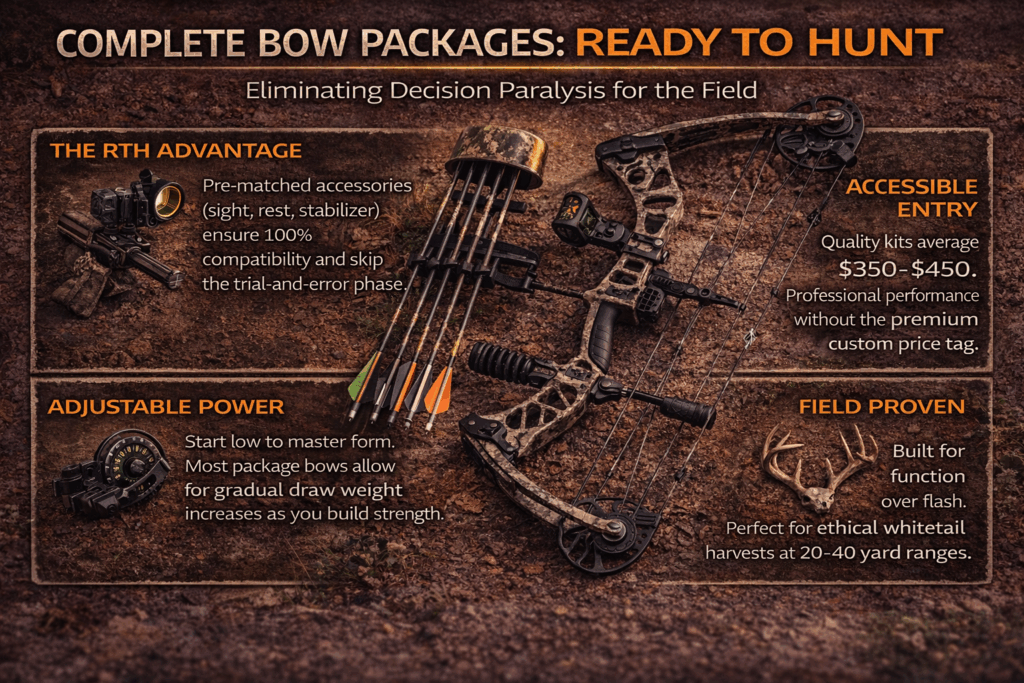
Complete bow packages (sometimes called Ready-to-Hunt or RTH kits) eliminate the guesswork entirely. As Field & Stream explains, “some of these best beginner compound bows come fully equipped and ready to shoot, eliminating the headache and expense of choosing and buying accessories.” Whether this is your first bow or you’re upgrading what you’ve got, our archery selection gives you a visual reference for everything we’ll cover.
Here’s what this guide covers:
- What comes in complete bow packages and why they work for hunters at any skill level
- The prep work that separates successful hunts from expensive mistakes (licensing, scouting, gear)
- Field tactics and post-harvest care that complete your hunting knowledge
But before we talk gear, you need to handle the legal stuff that keeps you hunting instead of paying fines.
Know Before You Go: Essential Prep
The fanciest bow package won’t help if you can’t legally hunt. Getting your paperwork straight shows respect for the sport, the land, and the animals—whether you’re hunting close to home or planning a trip across state lines.
Regulations Check
Hunting rules change dramatically between states, sometimes even between counties in the same state. Out-of-state hunters deal with extra layers that residents never see. Iowa’s Department of Natural Resources breaks down the costs: “To hunt in Iowa, nonresidents need to purchase a hunting license ($131.00) and a nonresident habitat fee ($15.00). To hunt deer you will also need your tags, sold as an any-sex tag and antlerless tag combination ($498.00).”
That’s almost $650 just for the legal right to hunt, before you factor in travel, lodging, and gear. Some states want bowhunter education certification from non-residents even if you’re certified back home. Others have specific draw weight minimums, broadhead restrictions, or hunter orange requirements that might surprise you.
Quick tip: Bookmark your destination state’s wildlife agency website and sign up for their regulation updates. Rules change every year, and what worked last season might get you in trouble this year.
Action: License and Tag Acquisition
Popular hunting spots often require planning six to twelve months ahead, especially in draw states where tags get handed out through lottery systems. Some premium units need years of preference points before you’ll draw successfully.
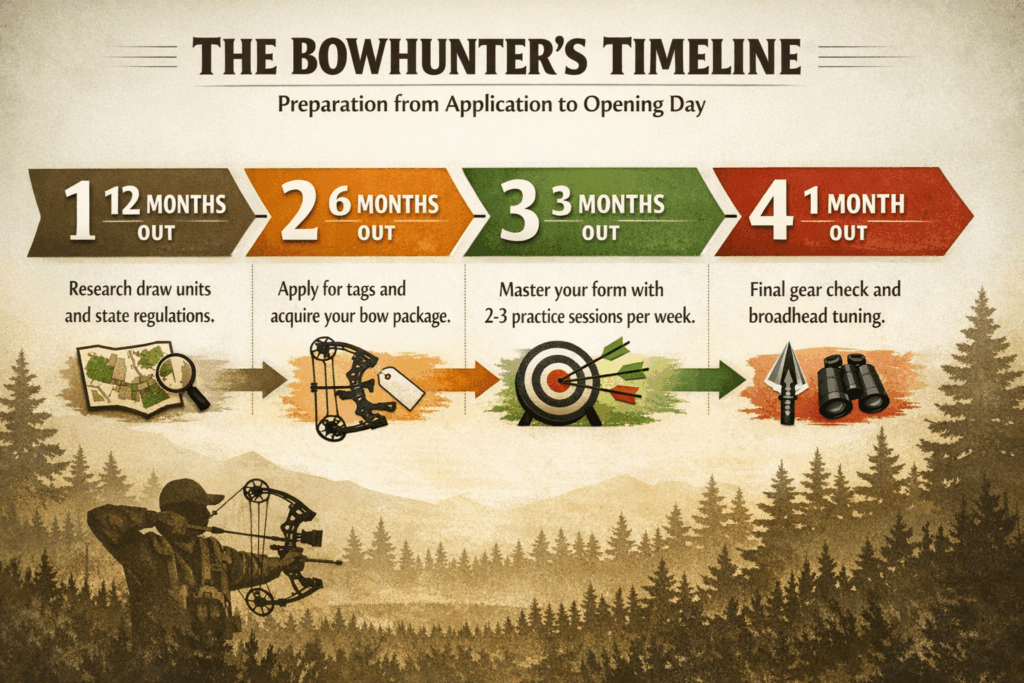
Here’s your timeline:
- Pick your target state and species (12+ months out for premium units)
- Find application deadlines (often 6+ months before season)
- Finish any required hunter education (some states don’t accept out-of-state certifications)
- Buy licenses and apply for tags (application fees are separate from tag costs)
- Double-check everything before you travel (keep physical copies plus digital backups)
Out-of-state hunters should carry physical copies of all licenses and tags, plus digital backups saved offline on your phone. Cell service gets sketchy in good hunting country, and game wardens need to check your credentials whether technology cooperates or not.
Scouting & Habitat
Successful bowhunting starts way before opening day. Knowing where your target animals live, eat, and travel gives you the foundation for smart stand placement and real shot opportunities.
Early bow season usually lines up with late summer patterns when deer focus on food sources. Look for transition zones between bedding and feeding areas—these travel corridors give you the best chances. Oak ridges dropping acorns, field edges, creek bottoms with browse, and fence lines connecting cover to food all funnel deer movement.
Signs that matter:
- Fresh tracks in soft dirt near water or food plots
- Rubs on trees where bucks mark territory (look for fresh wood chips)
- Scrapes with torn-up dirt and overhanging licking branches
- Fresh droppings showing recent feeding activity
- Well-worn trails connecting bedding to feeding spots
- Browse lines showing feeding pressure on plants
Digital scouting with onX Hunt or HuntStand lets you study aerial photos, spot terrain features, and mark waypoints before you ever step foot in the woods. Combine computer work with boots-on-ground verification for the complete picture.
Physical & Gear Readiness
Bowhunting demands more from your body than rifle hunting. Drawing a 60-pound bow, holding at full draw for shot opportunities, and potentially tracking wounded game through nasty terrain all require preparation. Practice with your complete setup regularly—not just a quick sight-in session before season.
Field & Stream’s research confirms that “Most new bowhunters don’t know how to set a bow up with all the accessories by themselves, so it’s a big deal that these models often come all decked out with a rest, sight, quiver, and peep sight designed for that bow.” This compatibility advantage goes beyond convenience—when components are designed to work together, you skip the trial-and-error that can eat up weeks of practice time.
The Gear Advantage: Why Complete Bow Packages Make Sense
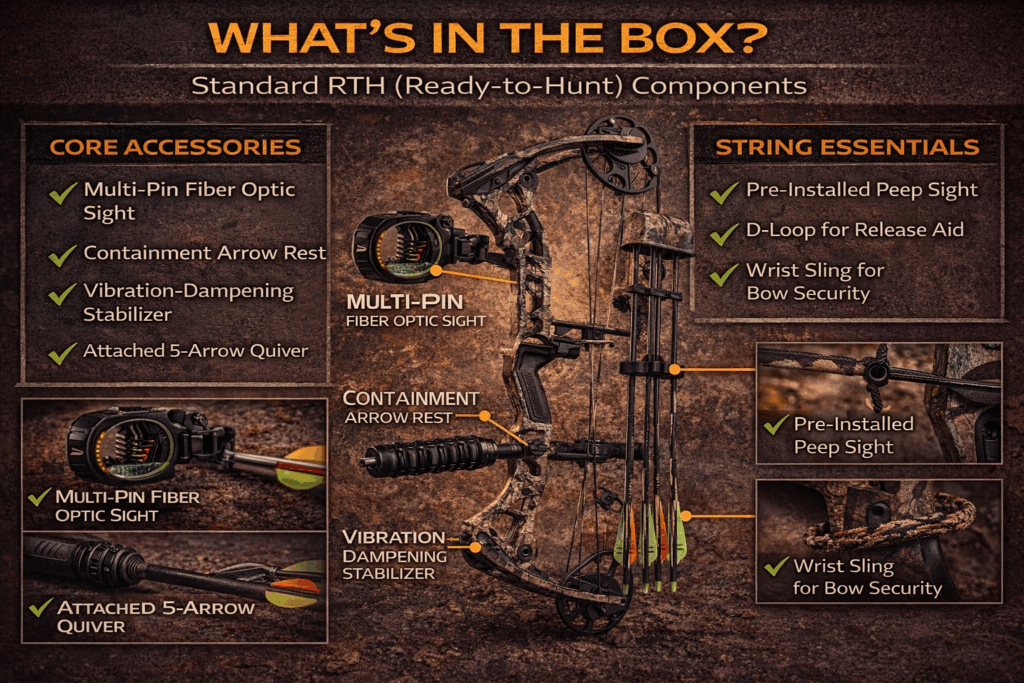
We’ve talked with hundreds of hunters who felt overwhelmed by archery choices—bow models, sight options, arrow rest styles, stabilizer lengths, quiver setups, release aids, arrows, and broadheads. Complete bow packages exist because manufacturers saw this problem and created a solution that eliminates decision paralysis while delivering functional performance.
A complete bow package (also called Ready-to-Hunt or RTH) is a compound bow that comes loaded with essential accessories—typically a sight, arrow rest, quiver, stabilizer, and peep sight—all matched to work together. Lancaster Archery explains that “A compound bow package can be a ‘RTH’ package meaning ‘Ready to Hunt’ and will usually include a rest, sight, stabilizer, quiver, and wrist sling.”
Bear Archery’s RTH specs show exactly what hunters get: “The RTH package consists of a full Trophy Ridge accessory setup including a sight, rest, quiver, stabilizer, d-loop, and peep sight.” This comprehensive approach means you’re not guessing about compatibility or spending hours researching which parts work together.
Current market data shows “Most compound bow packages are $350-$450,” putting them within reach for hunters at different budget levels. Think of a complete bow package like a fully-loaded truck—everything you need is already installed.
Industry experts are honest about expectations: “Package bows are often designed with ‘okay’ accessories, and you will many times save money, but have nothing more than an ‘okay’ bow.” This sets realistic expectations—package accessories focus on function over premium performance, which works perfectly for most hunters while they develop their skills.
Core Gear Checklist: Our Top Recommendations
Having the right gear and practicing with it consistently separates successful hunts from frustrating experiences. This complete checklist covers everything you need to get field-ready.
Clothing & Layering
Early bow season often means warm temps and high humidity, making moisture-wicking base layers essential. Late season requires insulation planning for long sits in cold weather. Your clothing system should regulate temperature while keeping you stealthy and mobile.
Layering system basics:
- Base layer: Moisture-wicking synthetic or merino wool against your skin
- Mid layer: Insulation for warmth (fleece, down, or synthetic fill)
- Outer layer: Weather protection and noise reduction
Camo pattern selection: Match patterns to where you hunt—woodland patterns work best in eastern hardwood forests, while sage and brown tones suit western terrain. The pattern matters less than breaking up your outline and matching the dominant colors where you’ll be hunting.
Boot priority: Comfortable, quiet boots matter more than most hunters think. Rubber boots provide excellent scent control for ground hunting, while insulated options become critical for long cold-weather sits.
Weaponry & Ammunition
Draw weight guidelines: Research confirms that “Even fit adults should start with lower draw weights to ensure proper form, and many bows offer adjustable draw weight, which you can increase gradually.” For whitetail deer, 40-50 pounds minimum is generally recommended, while elk and bigger game need 50-70 pounds for ethical penetration.
Arrow selection: Arrow spine (stiffness) must match your bow’s draw weight and your draw length. Too stiff and arrows fly left; too weak and they fly right. Most pro shops will spine-match arrows to your specific setup.
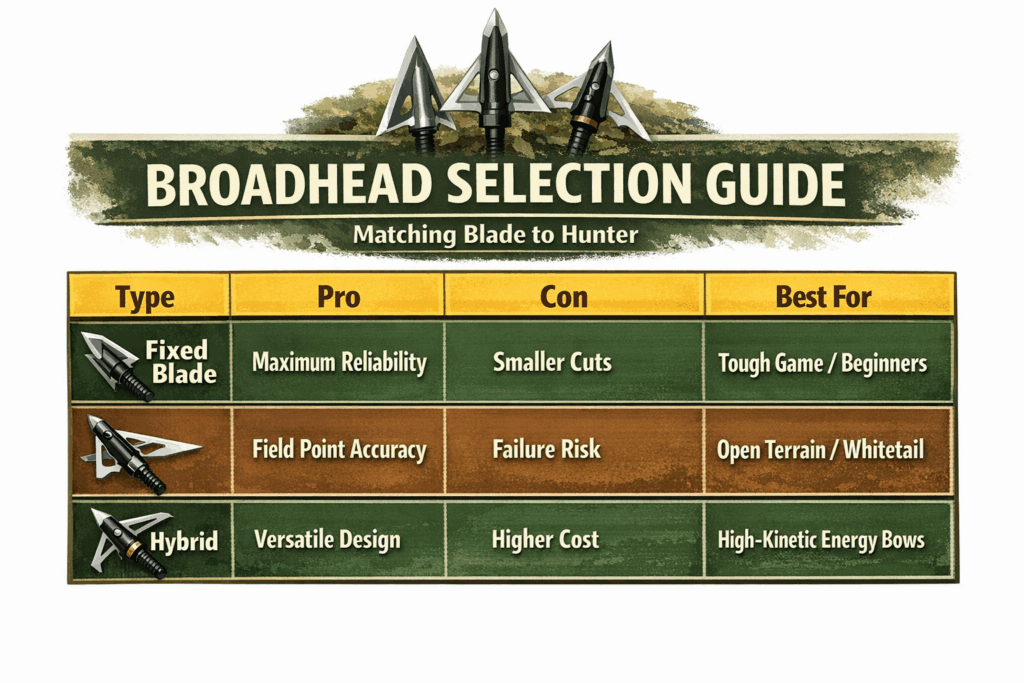
Broadhead categories:
| Type | Advantages | Disadvantages | Best For |
|---|---|---|---|
| Fixed Blade | Reliable, no moving parts, better penetration | Smaller cutting diameter, more practice needed | Experienced hunters, tough game |
| Mechanical | Larger cutting diameter, field point accuracy | Potential mechanical failure, less penetration | Whitetail, accurate shooters |
| Hybrid | Combines fixed and mechanical features | More expensive, complex design | Versatile hunting situations |
Practice emphasis: Shoot the same arrows and broadheads (or field points of identical weight) you’ll hunt with. Many hunters practice with field points then switch to broadheads for hunting—this often changes point of impact and costs shot opportunities.
Quality broadheads and field points matched to your arrow setup make the difference between clean harvests and lost animals.
The Essentials: Navigation & Safety
Navigation tools:
- Primary: GPS device or smartphone with offline maps downloaded
- Backup: Compass and paper maps (batteries die, screens break)
- Waypoint marking: Mark your stand, truck, and blood trail starting points
Safety gear checklist:
- First aid kit with blood-clotting agent
- Headlamp with extra batteries
- Emergency whistle
- Fire-starting capability
- Emergency shelter (space blanket minimum)
Field dressing tools:
- Sharp fixed-blade knife (4-5 inch blade works best)
- Game bags for meat protection
- Latex gloves for sanitary processing
- Small bone saw for quartering large game
- Paracord (multiple field uses)
Tactics & Strategy: Hunting with Your Bow Package
Having the right equipment is step one; knowing how to use it effectively in the field fills tags. These proven tactics work regardless of your bow package’s price point—success comes from understanding animal behavior and applying consistent fundamentals.
Peak Activity Times
Prime movement windows:
- Early morning: First light to 9 AM (deer moving from feeding to bedding areas)
- Late evening: 4 PM to dark (deer moving from bedding to feeding areas)
- Weather fronts: Increased activity 24-48 hours before major weather changes
Season variations: Early archery season focuses on food sources as deer stick to predictable feeding patterns. During the rut, midday activity increases dramatically as bucks search for does. Late season concentrates on thermal cover and high-energy food sources.
Plan your stand time around these peak windows rather than burning yourself out with all-day sits. Two focused 4-hour sessions often produce better results than 10 hours of unfocused hunting.
Wind & Scent Control
Wind direction drives every tactical decision in bowhunting. Deer can smell human scent from hundreds of yards away, making wind awareness critical for consistent success.
Wind strategy fundamentals:
- Always hunt with wind in your face or crossing (never at your back)
- Check wind direction every 30 minutes (thermals change throughout the day)
- Have multiple stand locations for different wind directions
- Use terrain features to predict wind behavior (valleys, ridges, water)
Scent control protocol:
- Scent-free storage: Keep hunting clothes in sealed containers with earth scent wafers
- Pre-hunt shower: Use scent-eliminating soap and shampoo
- Field application: Spray down with scent eliminator before and during hunts
- Boot care: Rubber boots or scent-eliminating sprays on leather boots
Browse our scent control products to build an effective scent management system.
The Approach: Stand Placement & Shot Opportunities
Stand placement priorities:
- Wind advantage: Position for prevailing wind patterns in your area
- Natural funnels: Terrain features that concentrate deer movement
- Shooting lanes: Clear paths for 20-40 yard shots (most bow kills happen within 30 yards)
- Escape routes: Plan your exit strategy to avoid spooking deer
Ethical shot placement: Bowhunters must wait for broadside or slightly quartering-away shots that expose the vital zone. The ideal aiming point is tight behind the front shoulder, one-third up from the bottom of the chest. Avoid head-on, straight-away, or steep quartering-toward angles that don’t give clear access to heart and lungs.
Range limitations: Practice extensively at 20, 30, and 40 yards, but limit hunting shots to distances where you can consistently hit a 6-inch circle. For most hunters with complete bow packages, this means 30 yards or less until skills develop.
Post-Harvest Care: The Work After the Shot
A successful shot is just the beginning. Proper tracking, recovery, and meat care determine whether your harvest becomes table fare or a learning experience.
Tracking & Recovery
Immediate post-shot protocol:
- Mark your shooting position with flagging tape or GPS waypoint
- Note the deer’s reaction and last-seen location
- Wait 30-60 minutes for good shots, 4+ hours for marginal hits
- Mark blood trail with flagging tape as you track
Blood trail reading:
- Bright red, frothy blood: Lung hit (excellent shot, deer usually dies within 100 yards)
- Dark red blood: Liver hit (wait 4+ hours before tracking)
- Sparse blood trail: Muscle hit (may require extensive tracking)
Move slowly and quietly while tracking. Wounded deer often bed down within 200 yards if not pressured. Mark each blood spot with flagging tape so you can backtrack if the trail goes cold.
Field Dressing
Essential steps:
- Position deer on slight incline with head uphill
- Make initial incision from sternum to pelvis, avoiding puncturing organs
- Remove organs carefully, starting with windpipe and esophagus
- Cool the carcass quickly by propping open body cavity
Temperature management: Meat spoilage starts immediately after death. In temperatures above 50°F, you have 2-4 hours to begin cooling. Below 40°F, you have more time but should still work quickly.
Transport & Processing
Field to freezer:
- Hang or quarter the deer based on temperature and transport options
- Keep meat clean using game bags to prevent dirt and fly contamination
- Maintain cold chain with ice or refrigeration during transport
- Process within 24-48 hours for optimal meat quality
Many hunters prefer professional processing for their first few deer while learning proper techniques. Home processing saves money and gives you complete control over cuts and packaging.
More Resources from Hunting Locator
Complete your archery setup:
- Archery Equipment – Browse our complete selection of bows, accessories, and components
- Archery Accessories – Find sights, rests, stabilizers, and other essential add-ons
- Arrows & Broadheads – Match arrows and broadheads to your bow specifications
- Archery Sights – Upgrade your aiming system for improved accuracy
- Release Aids – Find the release style that matches your shooting form
- Arrow Rests – Upgrade to precision rests for better arrow flight
- Bow Cases – Protect your investment during transport and storage
- Stabilizers – Reduce vibration and improve balance for steadier shots
- Archery Targets – Practice targets for field point and broadhead tuning
FAQ
What’s the difference between a complete bow package and buying components separately?
Complete bow packages include a compound bow with pre-matched accessories (sight, rest, quiver, stabilizer, peep sight) designed to work together. According to archery experts, “That stuff gets expensive if you buy it all separately, and if you buy a package bow, you can take it out of the box and hunt with it for the rest of your life if you want.” Buying separately gives you more control over component quality but requires extensive research and compatibility knowledge.
How much should I expect to spend on a quality complete bow package?
Current market research shows “Most compound bow packages are $350-$450” for compound setups. This price point includes the bow and basic accessories but typically requires additional purchases like arrows, release aid, and broadheads to be completely field-ready.
Do I need to upgrade package accessories immediately?
Not necessarily. Industry guidance suggests upgrading “in this order: 1) Arrow Rest 2) Sight 3) Strings” when you’re ready for improved performance. Many hunters successfully harvest game with stock package accessories for several seasons before upgrading.
What draw weight should I choose for deer hunting?
For whitetail deer, 40-50 pounds minimum provides adequate penetration for ethical kills. Archery experts recommend that “Even fit adults should start with lower draw weights to ensure proper form, and many bows offer adjustable draw weight, which you can increase gradually.” Choose a weight you can draw smoothly and hold steadily for shot opportunities.
Can I use the same bow package for different game species?
Yes, but you may need to adjust components. Larger game like elk requires higher draw weights (50-70 pounds minimum) and different broadheads than whitetail deer. The bow platform often remains suitable, but arrows, broadheads, and potentially the sight may need upgrading for different species and hunting situations.
How often should I practice with my complete bow package?
Consistent practice beats frequency every time. Shoot 2-3 times per week during the months before hunting season, focusing on the distances you’ll encounter in the field (typically 20-40 yards). Practice with the same arrows and broadheads (or identical-weight field points) you’ll use for hunting to ensure point-of-impact consistency.
The Final Shot
Complete bow packages solve the decision paralysis that stops many hunters from getting started in archery or upgrading their current setup. By providing pre-matched components that work together, these packages let you focus on developing shooting skills and hunting tactics rather than researching compatibility charts and component specifications.
The path from package purchase to filled tags requires more than just equipment—proper preparation, consistent practice, and ethical field application separate successful hunters from those who struggle season after season. Whether you’re planning your first bowhunt or your fiftieth, the fundamentals stay the same: understand the regulations, scout effectively, practice consistently, and respect the animals and land that make our sport possible.
Ready to gear up for your best archery season yet? Visit our archery store today! We stock the best complete bow packages, arrows, broadheads, and accessories to ensure your success in the field.


