This Florida alligator guide covers official 2026 season dates, license costs, how the lottery works, legal hunting methods, and where to hunt — public, guided, and private.
Here’s what this guide covers:
- The exact 2026 season dates, bag limits, and legal hunting methods
- Complete license and permit costs for residents and non-residents, plus how the lottery application works
- Where to hunt: top public areas, guided-hunt options, and private lease access
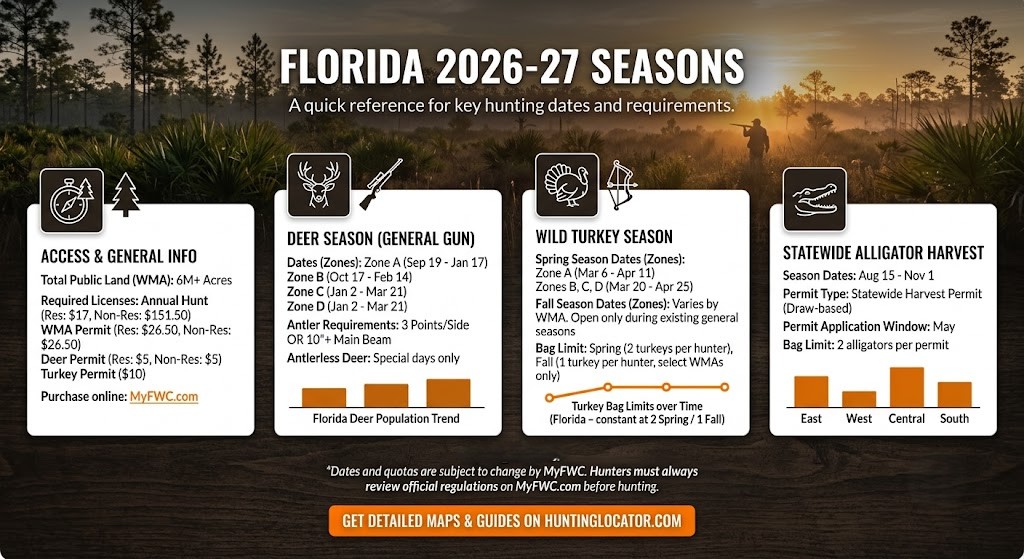
Quick Overview: Florida Alligator Season 2026 at a Glance
The table below summarizes the key facts for the 2026 Florida alligator season per FWC regulations.
| Detail | 2026 Information |
|---|---|
| Season Type | Statewide Harvest (Lottery) |
| Season Dates | August 15 – November 1, 2026 |
| Permit Required | Statewide Alligator Harvest Permit (lottery draw) |
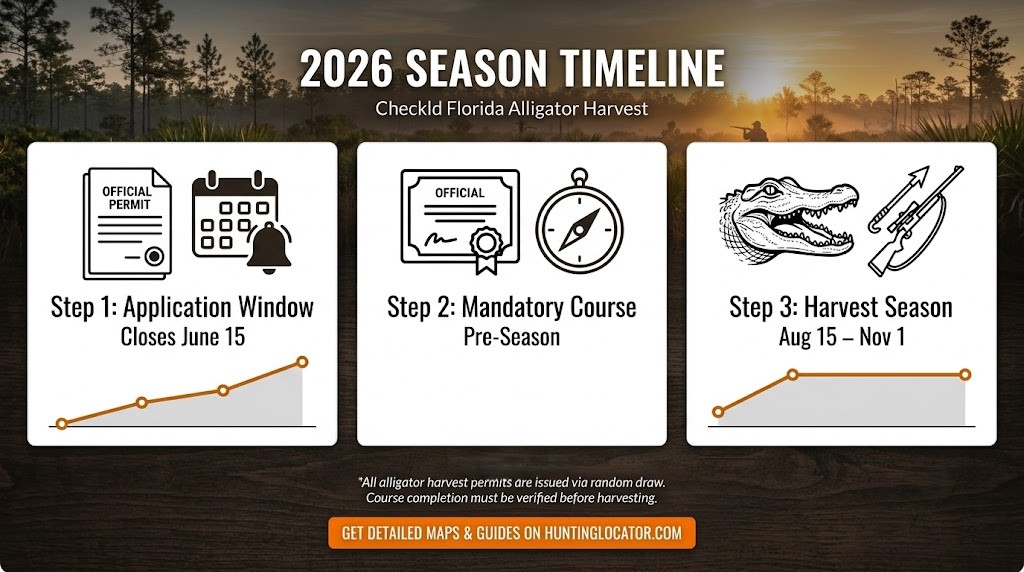
| Application Deadline | Typically ends June 15 |
| Bag Limit | 1–2 alligators per permit (typically 2) |
| Minimum Size | 4 feet total length |
| Hunting Hours | Night only (30 min after sunset to 30 min before sunrise on most areas) |
| Legal Methods | Harpoon, snatch hook, snare, crossbow, bow, bangstick (no firearms on public water) |
To legally participate in the 2026 harvest, FWC requires every hunter to hold a specific bundle of licenses and tags, all issued together through the application process:
- Statewide Alligator Harvest Permit — obtained via lottery draw through GoOutdoorsFlorida.com
- Alligator Trapping License — bundled with your harvest permit at no separate cost
- Two hide validation CITES tags — included to legally validate each harvested alligator’s hide
- Mandatory online course — required for all permit holders starting in 2025, covering safety and regulations before your hunt
- Age requirement — applicants must be at least 18 years old by August 15 of the hunt year
Florida Alligator Hunting Seasons
Florida’s statewide alligator harvest runs entirely through the lottery permit system. The commission oversees all aspects of the hunt — dividing the season into harvest periods, setting take limits, and managing where and how hunting occurs across the state.
Statewide Recreational Harvest Season
The core season runs August 15 through November 1, 2026, confirmed across multiple FWC-citing sources as the standard statewide harvest window. Each permit allows the harvest of up to two alligators within a designated management unit and period. You hunt your assigned area, during your assigned period, under that unit’s specific rules — not anywhere in Florida across the full three months.
Harvest Periods and Management Units
The public water season is divided into four separate harvest periods, each lasting approximately 10 days. This structure manages hunting pressure across Florida’s many regions. Each management unit carries its own harvest quota and specific rules, so once your permit arrives, review your assigned unit’s regulations carefully — access points, pressure levels, and local conditions vary considerably from one unit to the next.
Private Lands and Extended Windows
Hunters on private land operate under a more permissive framework. Depending on landowner permits and participation in FWC’s Private Lands Alligator Management program, extended hunting windows may be available — offering more flexibility than the structured public water periods. Private land hunting is covered in detail in the location section below.
Florida Alligator Licenses and Permits
FWC administers the entire permit process through GoOutdoorsFlorida.com, the state’s official licensing portal.
License Costs
To participate in the statewide harvest, FWC requires every hunter to hold three things: an alligator trapping license, a statewide alligator harvest permit, and two alligator hide validation CITES tags. All three are bundled in a single purchase.
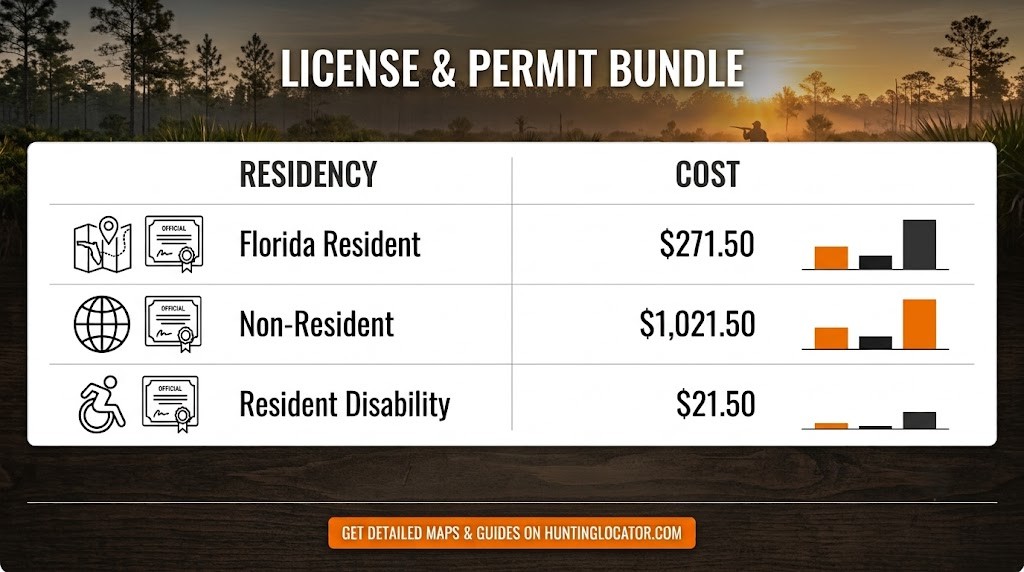
| License Type | 2026 Cost | What’s Included |
|---|---|---|
| Florida Resident | $272 | Alligator Trapping License + Harvest Permit + two hide validation CITES tags |
| Non-Resident | $1,022 | Same inclusions (trapping license + permit + two CITES tags) |
| Resident Disability | $22 | Same inclusions at the discounted disability rate |
Non-resident hunters should account for the $1,021.50 permit cost early in their trip budget. A separate Florida hunting or fishing license is not required — the trapping license bundled with your purchase is the only state authorization you need.
The two CITES hide validation tags are legally required for each harvested alligator’s hide. Per FWC’s official guidance, when your permit and tags arrive by mail, verify immediately that your name, harvest area, harvest period, and CITES tag numbers all match. Correct any discrepancy before your hunt begins.
The Lottery Application
The Statewide Alligator Harvest Permit is issued through a random lottery administered by FWC, with applications submitted through GoOutdoorsFlorida.com or in person at a tax collector’s office or licensed agent.
Approximately 7,000 permits are issued annually from roughly 15,000 applicants, putting overall odds at approximately 47% in any given year. Each permit allows harvest of up to two alligators in your assigned unit. The drawing runs across multiple phases — Phases I, II, and III are random drawings, with Phase IV offering leftover permits on a first-come, first-served basis.
To apply:
- Confirm eligibility — You must be at least 18 years old by August 15 and have a valid credit or debit card
- Apply online at GoOutdoorsFlorida.com — or visit a tax collector’s office or licensed retail agent
- Submit before the June 15 deadline — late applications are not accepted
- Check your results through GoOutdoorsFlorida.com after the drawing
- Complete the mandatory online course — required for all permit holders since 2025, covering safety protocols and regulations
- Pay for and receive your license, permit, and two CITES tags by mail — this completes your legal authorization
- Verify all details upon receipt — confirm your name, assigned area, period, and tag numbers match before heading into the field
Hunting alligators without a valid permit carries fines of $5,000 to $10,000 and possible jail time.
Florida Alligator Hunting: Where to Hunt
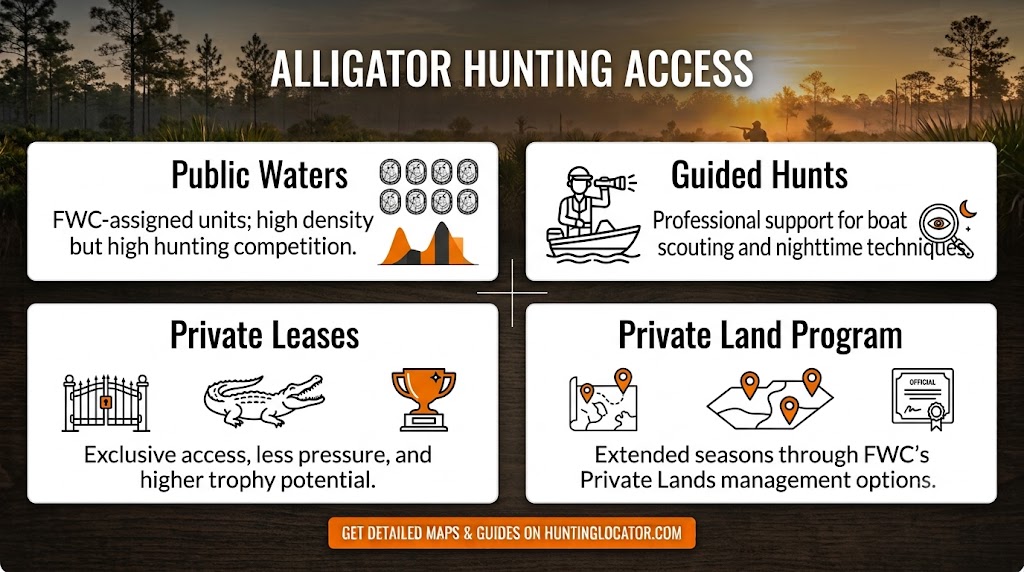
Florida offers three primary access pathways — public lands, guided hunts, and private leases — each with different tradeoffs depending on your experience level, budget, and goals.
Best Public Lands for Florida Alligator Hunting
Florida is the most popular alligator hunting destination in the country, and its public waters give permit holders accessible options. FWC-assigned management units span the state, but seasons and regulations vary significantly by Wildlife Management Area — always review the specific WMA brochure for your assigned unit before hunting.
Some of the most productive public hunting regions include:
- Kissimmee River Corridor — Success rates in the Kissimmee area are described as nearly 100%, making this one of Florida’s most reliable public water regions for alligator density
- Lake Okeechobee — A well-known alligator destination, though popular areas like Okeechobee tend to see more competition — nearby secondary water bodies often carry less pressure
- Lake Jesup and Lake Monroe — Commonly cited by experienced hunters as productive areas within Central Florida’s waterway system
- Lake Hancock and County-Managed Water Systems — Smaller county-managed systems often hold harvestable populations with less competition than marquee lakes
- Central Florida Waterways — Central Florida’s ecosystems provide good habitat across a broad region, and hunters who look beyond the obvious spots generally find it
One practical note: competing against thousands of other hunters makes harvesting a large alligator significantly harder on public land than on private. If trophy size is a priority, the next two sections are worth reading carefully.
Guided Alligator Hunts in Florida
For non-residents and first-time hunters, a guided hunt is often the most straightforward path to a successful harvest. Guided hunts are structured as complete, professionally run experiences — particularly useful if you’re unfamiliar with Florida’s waterways or with alligator behavior at night.
A guided Florida alligator hunt typically includes:
- Pre-hunt briefing covering safety protocols, FWC regulations, and what to expect on the water
- Evening and nighttime hunting during peak alligator activity hours
- Boat-based scouting using spotlights and proven techniques to locate target animals
- Guide-handled recovery after the harvest
- Post-harvest processing guidance for hide and meat handling
Total costs for a non-resident guided hunt typically range from $4,500 to $10,000+, including the $1,021.50 permit bundle plus guide fees. Resident hunters should budget $4,000 to $9,000 total for a guided experience. Outfitters often price by alligator length — private ranch hunts range from around $1,400 for a 6-footer up to $12,000 for a 13-foot trophy animal.
When evaluating outfitters, ask about their permit structure, which management units they operate in, what’s included in their pricing, and how they handle the mandatory online course requirement.
Private Land Hunting with Hunting Locator
Private land hunting offers less pressure, larger animals, and more flexibility than public water. Alligators on private land have the opportunity to grow larger than those on public land due to significantly reduced hunting pressure, which makes private access the preferred route for hunters targeting trophy-class animals.
FWC’s Private Lands Alligator Management Program allows alligator harvest on qualifying private landholdings with documented harvestable populations — often with extended hunting windows and additional method flexibility compared to public waters.
Hunting Locator’s Florida lease listings connect hunters directly with landowners ready to lease access. Whether you need a short-season lease tied to your permit or a longer arrangement with multi-species access across the full fall calendar, Hunting Locator’s listings cover both. Florida private land listings are live and searchable now, so you can identify and secure your lease before lottery results arrive.
Hunting Locator is a searchable marketplace linking hunters to landowners and outfitters across the United States. Search by state, game type, or acreage. For hunters interested in purchasing land outright, the platform also connects you with landowners open to sales. Browse available Florida properties at huntinglocator.com/leases/state/florida/.
Alligator Hunting Tips for Success
Night-water hunting with specialized gear requires a different skillset than most other Florida seasons. These are the most important things to get right.
- Scout productive habitat before the season opens — Productive habitat includes warm shallows, marsh back-lakes, spring-fed creeks, and low-pressure zones. Time on the water before opening day pays off during the season.
- Plan around moon phases — Experienced guides recommend timing hunts around moon phase cycles. New moon periods with calm, humid conditions typically produce the best opportunities — less ambient light makes eye shine more visible and quiet approaches easier.
- Master your spotlighting technique — Most alligator hunts occur after dark, when alligators are more visible and active on the water’s surface. A quality waterproof spotlight and stable boat platform matter — practice scanning technique before opening night.
- Understand the restrain-then-dispatch sequence — Alligators must be restrained using a harpoon, crossbow with line, snatch hook, or snare before a bangstick is used for the kill. Shooting an unrestrained alligator in open water is both illegal and unsafe. Practice your restraint technique with your specific gear before the season opens.
- Practice short, precise shots — A 60 lb draw weight is sufficient for archery setups, and practicing precise short-range shots prior to your hunt is strongly recommended. Most engagements happen at close range from a moving boat.
- Consider a day hunt for your first experience — First-time hunters may benefit from a day hunt to build confidence before tackling nighttime conditions.
- Verify your permit details immediately upon receipt — Check that your name, harvest area, harvest period, and CITES tag numbers all match what’s listed on your license before leaving for the hunt.
- Prioritize safety on the water — Night hunting on Florida waterways demands extra vigilance. Wear your life jacket, share your float plan with someone onshore, and never reach across a harvested alligator before confirming it is fully subdued.
More Resources from Hunting Locator
- Florida Hunting Season Overview — All Florida hunting seasons, dates, and species in one place
- Florida Year-Round Hunting — Species and opportunities available across every month of the Florida hunting calendar
- Florida Deer Hunting Season — Whitetail dates, zones, licenses, and private land access
- Florida Alligator Hunting Season — Additional alligator-specific planning content
- Florida Turkey Hunting Season — Season dates, public land options, and private lease access for spring and fall turkey
- Florida Waterfowl Hunting Season — Dates, zones, and access resources for duck and goose hunters
- Florida Migratory Bird Hunting Season — Federal and state regulations, season dates, and top locations
- Florida Furbearer Hunting Season — Regulations and opportunities for coyote, beaver, and other furbearers
- Florida Hunting Leases — Browse private land listings by region, acreage, and game type
- Hunting Locator Gear Store — Spotlights, harpoons, bangstick setups, and safety equipment for Florida alligator hunting
Frequently Asked Questions
When does the 2026 Florida alligator season open and close?
The 2026 statewide harvest runs from August 15 through November 1. Within that window, permit holders are assigned to specific harvest periods of approximately 10 days each — your actual hunting window depends on the period assigned with your permit.
How do I apply for a Florida alligator hunting permit?
Applications are submitted online through GoOutdoorsFlorida.com or in person at a tax collector’s office or licensed agent. The application period typically closes around June 15. Permits are issued via random lottery across multiple phases, with approximately 7,000 permits issued annually.
What are the odds of drawing a Florida alligator permit?
Approximately 7,000 permits are issued from roughly 15,000 applicants each year, putting overall odds at approximately 47%. The lottery runs across three random drawing phases plus a final Phase IV leftover round.
How much does a Florida alligator license cost?
The complete bundle — alligator trapping license, harvest permit, and two CITES hide validation tags — costs $271.50 for Florida residents, $1,021.50 for non-residents, and $21.50 for residents with a qualifying disability. No separate Florida hunting or fishing license is required.
Can I hunt alligators on private land in Florida?
Yes. FWC’s Private Lands Alligator Management Program allows alligator harvest on qualifying private landholdings with documented harvestable populations, often with extended windows and greater flexibility than public water hunting. Browse current listings at Hunting Locator’s Florida lease page.
What hunting methods are legal for Florida alligator hunting?
Legal methods include harpoon, snatch hook, snare, crossbow, bow, and bangstick. Firearms are not permitted on public waters. An alligator must be restrained first — using a harpoon, crossbow with line, snatch hook, or snare — before a bangstick is used for the kill. Shooting an unrestrained alligator in open water is illegal.
Planning Your 2026 Hunt
The 2026 season opens August 15 and runs through November 1, but the permitting process starts well before that. Applications typically close around June 15, and the permit lottery, mandatory course, and gear preparation all take time to work through in sequence.
Browse Florida private land listings on Hunting Locator before lottery results arrive, so your access is secured when your permit comes through. Gear up at the Hunting Locator store and get your application in before the June deadline.


