The Shiras moose, the subspecies that lives in Wyoming’s mountains, river bottoms, and willow flats, is available in strictly limited numbers, and the draw odds reflect that. If you are planning to apply for 2026, the deadlines and costs below are what you need to know.
This guide is written for residents and non-residents who want a clear picture of what it takes to hunt moose in Wyoming: confirmed season dates, how the draw works, what everything costs, and where to find land access. Before you head into the field, make sure you have the right gear for a Wyoming backcountry hunt. This guide covers everything else.
Here is what you will find inside:
- When you can hunt — confirmed 2026 archery and general season dates
- What it costs and how the draw works — licenses, permits, preference points, and the 90/10 resident/non-resident split
- Where to hunt — public land options, private leases through Hunting Locator, and guided hunt considerations
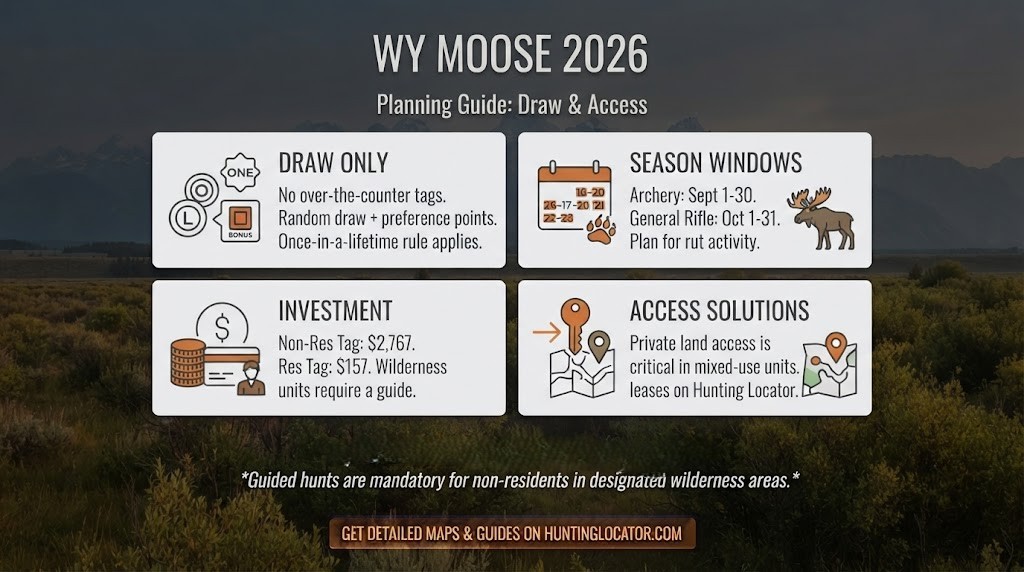
Quick Overview: Wyoming Moose Season 2026 at a Glance
All dates below reflect confirmed 2026 seasons. Bookmark this table and check the WGFD official moose hunting page for unit-specific updates as the season approaches.
| Season Type | Start Date | End Date | Bag Limit | Notes |
|---|---|---|---|---|
| Archery | Sept 1, 2026 | Sept 30, 2026 | One moose per calendar year | Draw-only; once-in-a-lifetime |
| General | Oct 1, 2026 | Oct 31, 2026 | One moose per calendar year | Draw-only; once-in-a-lifetime |
For more context on how these seasons fit Wyoming’s broader hunting calendar, see our complete Wyoming moose hunting season breakdown.
Every Wyoming moose hunt begins with the draw, and a few credentials are required before you can apply:
- A valid Wyoming moose license/tag obtained through the WGFD draw — Wyoming does not sell over-the-counter moose tags. The license is issued for a specific hunt area, season, and sex of animal, available only through the annual limited-quota draw.
- A Conservation Stamp — All hunters, resident and non-resident, must purchase a Conservation Stamp ($21.50) before buying any species-specific tags. It is valid for the calendar year.
- Hunter education certification — First-time license applicants must meet Wyoming’s hunter education requirements. Verify current requirements directly with the WGFD before applying.
- The once-in-a-lifetime rule — A Type 1 moose license is a once-in-a-lifetime license. A hunter who draws and harvests a Wyoming moose cannot draw again.
- The 90/10 resident/non-resident tag split — Wyoming law allocates 90% of moose licenses to residents, with the remaining 10% issued to non-residents. This significantly affects non-resident draw odds and long-term planning timelines.
Wyoming Moose Hunting Seasons
Wyoming structures moose hunting into two method-specific seasons—archery and general—both draw-only. The method you hunt determines which season window applies to your license, so the distinction matters when you apply. All 2026 dates below are confirmed.
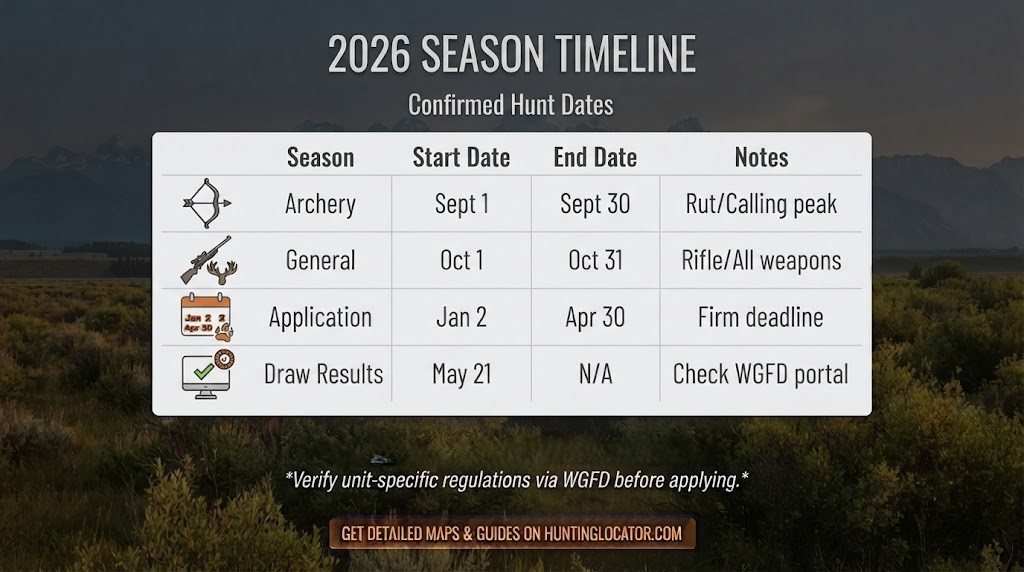
Archery Season (Sept 1 – Sept 30, 2026)
The archery moose season runs September 1 through September 30, 2026. This window aligns with the early rut, when bulls become more active and less cautious as they search for cows. Calling is one of the most efficient hunting methods during the rut, with shots commonly taken from under 30 yards. If you draw an archery tag, moose calling should be a central part of your strategy. An archery license is required in addition to your moose tag for this season.
General Season (Oct 1 – Oct 31, 2026)
The general moose season runs October 1 through October 31, 2026, and opens up the full range of legal weapon options, including rifles. This window covers peak and post-rut activity as bulls continue moving. October in Wyoming also brings early snowfall, which can help with tracking and locating animals. Because regulations vary by unit, verify your hunt area dates and any unit-level restrictions directly with the WGFD before the season opens.
Understanding the Draw & Once-in-a-Lifetime Rule
What “draw-only” means in practice: Wyoming does not issue over-the-counter moose tags. Every moose license—archery or general—is issued through the WGFD’s annual limited-quota draw. You apply, you either draw or you do not, and your preference points carry forward if unsuccessful.
The once-in-a-lifetime rule: A Type 1 moose license is a once-in-a-lifetime license. Once you draw and harvest a Wyoming moose, you cannot draw a Type 1 moose license again. That shapes how you approach your application strategy and how you weigh this hunt against other species.
What to expect from draw odds: Non-residents may wait 5–15+ years to draw a moose tag, and resident odds are also competitive given limited tag numbers. The maximum number of preference points currently held by non-residents is 31—a figure that shows how long some hunters have been in line. Start building points early and apply consistently.
A note on random pool tags: A small number of random moose tags exist each year in specific units—units 25, 26, and 38 all had random licenses available in 2025. If you are in the early stages of building points, tracking which units offer random pool tags is worth adding to your application research.
Wyoming Moose Licenses and Permits
Wyoming’s moose licensing structure is straightforward once you work through it piece by piece. Here is what you need and what it will cost.
Wyoming Hunting Licenses
Wyoming does not issue a traditional base hunting license. Instead, all hunters purchase a Conservation Stamp ($21.50), which serves as the entry credential before buying any species-specific tags. Your moose license is then the species-specific tag itself, issued through the draw for a specific hunt area, season, and sex of animal.
Tag costs for 2026:
| License Type | Resident Cost | Non-Resident Cost | Notes |
|---|---|---|---|
| Moose License (tag) | $157 | $2,767 | Draw-only; once-in-a-lifetime per harvested moose |
Non-residents should account for the full cost picture. The $2,767 tag is your baseline. Add the $21.50 Conservation Stamp, a non-refundable $15 application fee, and a 2.5% processing fee. Non-residents hunting a wilderness area are required by Wyoming law to hire a licensed guide, which adds substantially to total trip cost. Verify all current fee schedules directly with the WGFD before applying, as fees can change between seasons.
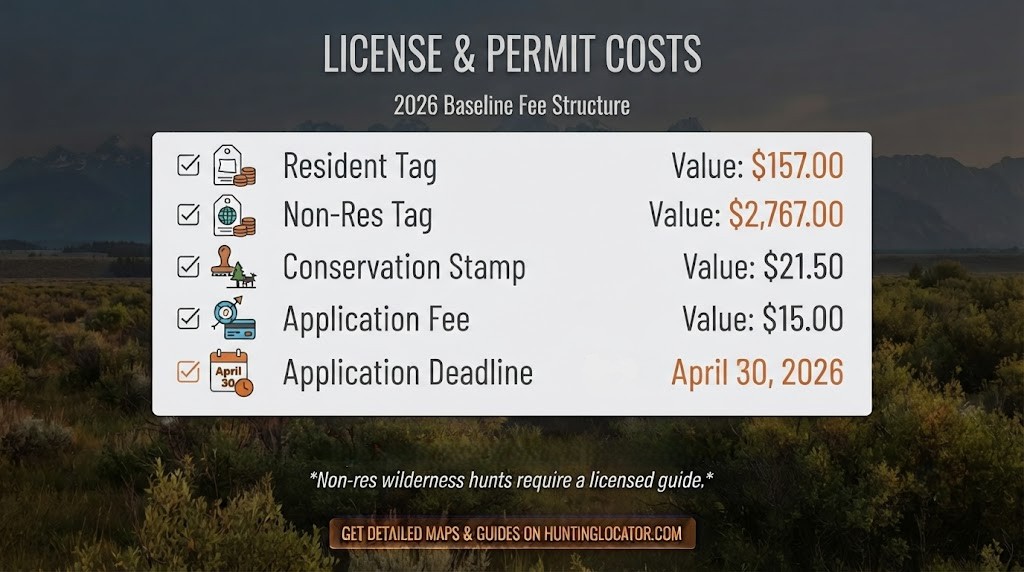
Wyoming Hunting Permits & the Draw Application
The draw application process is where your Wyoming moose hunt either begins or waits another year. Here is how it works:
- Purchase your Conservation Stamp — The $21.50 Conservation Stamp is required before you can apply for any Wyoming big game species.
- Create or log into your WGFD online account — Applications are submitted through the WGFD’s online portal. First-time applicants should set up their account well before the deadline.
- Submit your draw application — Applications for the 2026 draw opened January 2, 2026. Select your hunt area, season type, and sex preference when applying.
- Meet the application deadline — The application deadline for sheep, moose, and mountain goat is 11:59 p.m. MST on April 30, 2026. There is no late application option.
- Check draw results — For 2026, the WGFD has scheduled non-resident draw results to be posted on May 21. Resident results follow on a similar timeline.
- Purchase your preference point if unsuccessful — If you do not draw, purchase a preference point to improve your odds in future years.
How preference points work: Wyoming’s preference point system gives repeat applicants incrementally better draw odds over time. The resident fee to purchase a moose preference point is $7; the non-resident fee is $150. One critical rule: for moose and full-price bighorn sheep, an applicant will lose all accumulated preference points if they fail to participate in the draw or purchase a preference point within two consecutive years. Do not let your points lapse.
The 90/10 split reality for non-residents: For the 2026 season, the license split for moose, bighorn sheep, bison, and mountain goat is 90% resident and 10% non-resident—a change that took effect in 2023 and significantly reduced the number of non-resident tags issued. For non-residents, a realistic wait is measured in years, not months. The maximum preference points currently held by non-residents is 31. Start your preference point strategy early and apply every year without exception.
Wyoming Moose: Where to Hunt
Wyoming’s moose habitat ranges from the Greater Yellowstone ecosystem to the Bighorn Mountains to the willow-lined river bottoms of the Wyoming Range. Finding the right area matters as much as drawing the tag.
Best Public Lands
Wyoming’s public land network is extensive and provides real access for moose hunters willing to put in the legwork. Moose are found in many mountain ranges and river bottom areas throughout Wyoming, with the greatest numbers in the Bridger-Teton National Forest south of Jackson. They are also found in the Bighorn National Forest in northcentral Wyoming and the Medicine Bow-Routt National Forest in southeast Wyoming.
Key public land options include:
- Bridger-Teton National Forest — The primary public land destination for Shiras moose in Wyoming, with large populations in the willow flats and river drainages south of Jackson.
- Shoshone National Forest — Adjacent to Yellowstone and the Absaroka Range, with quality moose habitat and rugged backcountry access. Much of this terrain falls within designated wilderness areas, which triggers the guide requirement for non-residents.
- Bighorn National Forest — Productive moose habitat in northcentral Wyoming with a mix of accessible terrain and more remote backcountry options.
- Medicine Bow-Routt National Forest — Southeastern Wyoming’s primary moose hunting ground, with lower-elevation habitat that may be more accessible for hunters without extensive backcountry experience.
- BLM lands — Scattered throughout the state, often adjacent to National Forest, filling in access gaps particularly in transition zones between mountain and sagebrush terrain.
One important caveat: some licenses with difficult public access have better drawing odds, and the WGFD will not refund a license because you cannot obtain access. Research your unit’s access situation thoroughly before applying.
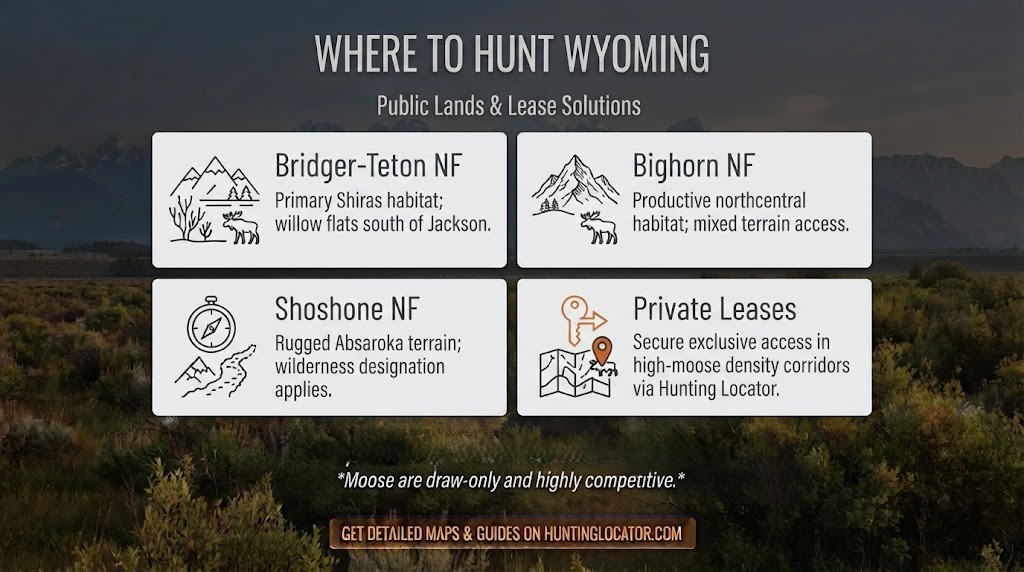
Private Land Hunting with Hunting Locator
In many of Wyoming’s best moose units, private land sits between public parcels or surrounds the most productive habitat. In those cases, access to private ground can determine whether the hunt is productive. You do not need to go through an outfitter to get on private land.
Hunting Locator connects hunters directly with Wyoming landowners willing to lease or sell their hunting properties. Whether you are a resident targeting a specific drainage or a non-resident planning your first trip, securing private land access gives you more control over where and how you hunt.
Browse available Wyoming hunting leases on Hunting Locator to find properties across the state. The platform gives you direct access to landowners offering everything from day-use permissions to long-term exclusive leases. For a hunt this rare, reliable land access secured before the season opens is part of a sound plan, not an optional upgrade.
If you are thinking longer term, Hunting Locator also connects hunters with landowners interested in selling. Owning your own piece of Wyoming moose country provides the most reliable form of access security, and it starts with the same search.
Guided Hunts
For many hunters—particularly non-residents drawing their first Wyoming moose tag—a guided hunt deserves serious consideration. The terrain is demanding, the logistics of a successful moose harvest are substantial, and local knowledge can be the most important factor in your outcome.
Key points about guided moose hunts in Wyoming:
- Non-residents hunting wilderness areas are legally required to hire a licensed guide. This is Wyoming law. If your drawn unit falls within designated wilderness, budget for guided services before you apply.
- Guided hunt costs are substantial. Guided Wyoming moose hunts typically range from $8,000 to $15,000+, and the $2,767 non-resident tag cost is typically separate from outfitter fees. Build both into your planning budget.
- Local expertise adds real value. Experienced outfitters provide knowledge of prime hunting areas and access to private lands where moose are more abundant. For a once-in-a-lifetime tag, that knowledge is worth the cost.
- Verify outfitter credentials. Wyoming requires outfitters operating in wilderness areas to be licensed by the state. Confirm any outfitter’s licensing status through the Wyoming State Board of Outfitters and Professional Guides before committing financially.
- Ask the right questions before booking. Success rates, typical terrain, pack-out logistics, meat care procedures, and exactly what is included in the quoted price—a reputable outfitter will answer these directly.
For hunters considering a DIY approach on non-wilderness public land, be realistic about the physical and logistical demands. Every day in the field hunting Wyoming moose is physically demanding, often requiring navigation of rugged backcountry terrain and sometimes the use of horses, ATVs, or boats to reach remote locations. Plan your fitness preparation accordingly.
Moose Hunting Tips
Drawing a Wyoming moose tag is the hard part. Making the most of it comes down to preparation, strategy, and the right gear.
- Hunt the rut hard. The most successful hunting dates consistently align with the rut, when bulls are traveling and moose are less wary than usual. The archery season in September puts you directly in this window.
- Master moose calling. Calling is one of the most efficient ways to hunt moose during the rut, bringing bulls in to under 30 yards. Practice cow calls and bull grunts well before the season opens.
- Scout willow bottoms and riparian areas. Focus pre-season scouting on willow flats, river drainages, and the transition zones between forest and meadow where Shiras moose concentrate.
- Prepare for a serious pack-out. Moose are the largest big game animal in Wyoming. Plan your meat care logistics before you go—quality game bags, sharp knives, and a clear plan for moving hundreds of pounds of meat out of the field are non-negotiable.
- Gear up for backcountry conditions. Essential gear includes a quality day pack, headlamp, scent eliminator, knives and sharpeners, rangefinder, reliable optics, and layered clothing built for wet, cold conditions—synthetic or wool outerwear, waterproof boots, and gaiters. Visit the Hunting Locator store for backcountry-ready gear suited to this kind of hunt.
- Build your fitness before the season. DIY Wyoming moose hunts are physically demanding by every measure. Start a structured cardio and strength program months before your hunt.
- Verify your unit before you apply. Some units with difficult public access have better drawing odds, but a tag you cannot use is worse than waiting another year. Research access conditions, terrain, and private land boundaries for every unit you are considering.
- Use quality optics for glassing. Shiras moose in dense cover can be difficult to locate. A solid pair of binoculars and a spotting scope will help you work willow flats and riparian corridors before committing to a stalk.
More Resources from Hunting Locator
- Hunting Locator Home — Find hunting leases, land for sale, outfitters, and guides across Wyoming and the rest of the country.
- Wyoming Hunting Leases — Browse available private land hunting leases in Wyoming. Search by location, species, and acreage.
- Wyoming Hunting Seasons Overview — A broad look at all Wyoming hunting seasons, regulations, and big-game opportunities.
- Wyoming Moose Hunting Season — Companion guide with additional context on habitat, strategy, and planning.
- Wyoming Elk Hunting Season — Season dates, licensing, and land access for one of Wyoming’s most pursued big-game species.
- Wyoming Deer Hunting Season — Planning information for Wyoming mule deer and whitetail hunts, including private land access options.
- Wyoming Antelope Hunting Season — Wyoming holds one of the world’s largest pronghorn populations. This guide covers the draw and where to hunt.
- Wyoming Bighorn Sheep Hunting Season — How the draw works and what to expect for another once-in-a-lifetime Wyoming trophy species.
- Wyoming Mountain Goat Hunting Season — Rocky Mountain goat hunting in Wyoming, covering draw basics and what to expect in the field.
- Wyoming Black Bear Hunting Season — Spring and fall bear hunting opportunities, with details on methods, seasons, and land access.
- Wyoming Turkey Hunting Season — Merriam’s turkey hunting in Wyoming’s ponderosa pine country.
- Wyoming Waterfowl Hunting Season — Duck and goose hunting in Wyoming’s river valleys and reservoirs, with season dates and access information.
- Wyoming Small Game Hunting Season — Grouse, rabbit, and other small game opportunities across the state.
- Wyoming Grizzly Bear Hunting Season — Current information on grizzly bear hunting regulations and status in Wyoming.
- Wyoming Gray Wolf Hunting Season — Wolf hunting season information for Wyoming’s designated wolf management zones.
FAQ
How rare is a Wyoming moose tag, and is it really once-in-a-lifetime?
Yes. Wyoming offers limited-quota moose hunting that is a once-in-a-lifetime opportunity. Specifically, a Type 1 moose license is a once-in-a-lifetime license: a hunter who draws and harvests a Wyoming moose cannot draw that license type again. Tags are issued only through the WGFD random draw and are highly competitive for both residents and non-residents.
What are the 2026 Wyoming moose season dates?
The confirmed 2026 Wyoming moose season dates are:
- Archery Season: September 1 – September 30, 2026
- General Season: October 1 – October 31, 2026
Both seasons are draw-only. Verify any unit-specific date variations with the WGFD.
What does a Wyoming moose tag cost in 2026?
The 2026 Wyoming moose tag costs $157 for residents and $2,767 for non-residents. Additional costs include the $21.50 Conservation Stamp (required for all hunters), a non-refundable $15 application fee for non-residents, and a 2.5% processing fee. Non-residents hunting wilderness areas must also budget for a licensed guide, which can add $8,000–$15,000 or more to total trip costs.
When is the application deadline for the 2026 Wyoming moose draw?
The application deadline for sheep, moose, and mountain goat is 11:59 p.m. MST on April 30, 2026. Applications opened January 2, 2026. There is no late application option.
How do preference points work for Wyoming moose, and how long will I wait to draw?
Wyoming’s preference point system gives applicants incrementally better draw odds with each consecutive year of applying. The resident fee to purchase a moose preference point is $7; the non-resident fee is $150. The wait can be substantial: non-residents may realistically wait 5–15+ years to draw a moose tag, and the maximum preference points currently held by non-residents is 31. Failing to apply or purchase a preference point within two consecutive years will result in losing all accumulated points. Apply every year.
Do non-residents need a guide to hunt Wyoming moose?
Not in every unit—but often, yes. Wyoming law requires non-residents hunting in designated wilderness areas to hire a licensed guide. If your drawn moose unit falls within a wilderness designation, a licensed guide is a legal requirement. Check your specific unit’s land classifications with the WGFD before assuming a DIY approach is permitted.
What is the bag limit for Wyoming moose?
The Wyoming moose bag limit is one moose per calendar year. Combined with the once-in-a-lifetime rule for Type 1 licenses, most successful hunters will take one Wyoming moose in their lifetime.
Closing Notes
A Wyoming moose tag represents years of preference point accumulation and, for many hunters, a significant financial commitment. The draw window for 2026 is open, the April 30 deadline is set, and the habitat is there. The practical steps now are to get your application in before the deadline, research your unit’s access situation carefully, and line up your land access strategy—whether that means public units, a private lease through Hunting Locator, or a licensed Wyoming outfitter. The hunters who do that groundwork before the draw are the ones who are ready when their name comes up.
When it does, visit the Hunting Locator store and make sure your gear is dialed in before the season opens.


