This guide covers what you need to plan a 2026 California wild pig hunt: current season rules, license and validation requirements, where to find huntable land, and gear considerations for California terrain.
Here’s what you’ll find inside:
- Year-round season structure, legal shooting hours, and unlimited bag limits — the rules that make California pig hunting unlike any other big game opportunity in the state
- Resident and non-resident license costs plus the Wild Pig Validation — every fee and step you need to hunt legally
- Where to hunt — public land options, private lease access through Hunting Locator, and guided hunt pathways for hunters of every experience level
If you want to see California’s full hunting season lineup before going further, that resource covers everything from deer to waterfowl.
Quick Overview: California Wild Pig Hunting at a Glance
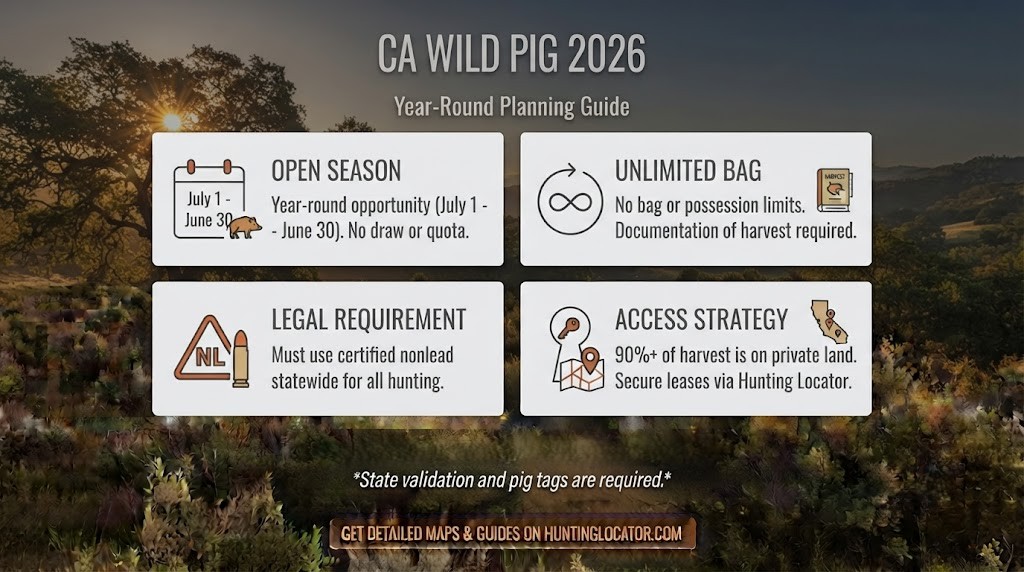
California wild pig hunting differs from every other big game pursuit in the state. As a 2026 planning guide confirms, wild pigs are huntable year-round with no daily bag or possession limit — a direct result of their non-native status and high reproductive rate. Because wild pigs are invasive and cause substantial agricultural and environmental damage, the state actively encourages unlimited harvest. The regulatory logic is straightforward: more harvest means less crop destruction, less habitat degradation, and fewer pressures on native wildlife.
The table below summarizes the key details.
| Detail | Specification |
|---|---|
| Season | Open year-round (July 1 – June 30) |
| Shooting Hours | One-half hour before sunrise to one-half hour after sunset* |
| Daily Bag Limit | None |
| Possession Limit | None |
| Required License | Annual or Two-Day Hunting License |
| Required Validation | Wild Pig Validation |
| Ammunition | Certified nonlead ammunition required statewide |
Shooting hours may differ on private property with specific permits.
Before you head out, have these three requirements in order:
- Valid Hunting License — either an annual license or a two-day license (non-residents); required for all hunters aged 16 and older pursuing birds or mammals
- Wild Pig Validation — a mandatory add-on to your hunting license, purchased before you hunt and carried in the field
- Hunter Education Certification — first-time hunters must complete a CDFW-approved hunter education course before purchasing a license
One important point: even with no bag or possession limit, California regulations require that every harvest be recorded as required by law. No limit does not mean no documentation.
California’s Department of Fish and Wildlife (CDFW) manages wild pig hunting statewide. Always verify current rules directly with CDFW before your hunt, as regulations can change between print cycles. For hunters who want consistent access without the uncertainty of public land availability, browse California hunting leases on Hunting Locator to see what private land options are available near your target area.
California Wild Pig Hunting Seasons
Unlike California’s deer season or elk season — both of which operate within defined windows and draw systems — wild pig hunting has no closed season. There’s no opener to wait for, no application to submit, and no draw. Because wild pigs are non-native and reproduce faster than most native game, California authorizes unlimited year-round harvest to help manage their impact on agriculture and native ecosystems.
For non-resident hunters, this makes California worth considering precisely when home-state seasons have closed. No other big game species in California allows a non-resident to simply purchase a license and validation and hunt any month of the year without a draw result.
The Year-Round Season Structure
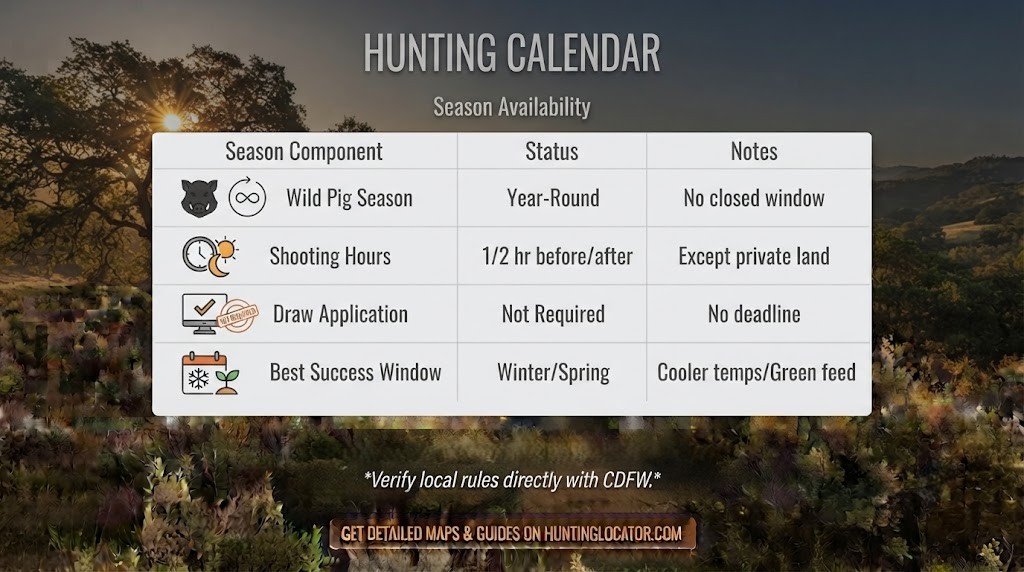
California’s hunting license year runs July 1 through June 30, and wild pig hunting is open for that entire window. There are no split seasons, no zone-specific calendar closures, and no daily or possession limits. A hunter can harvest an unlimited number of pigs provided they hold a valid license and Wild Pig Validation and record each harvest as required by California law. This structure is unique among California’s big game species and reflects the state’s approach to managing an invasive population rather than a native one.
Best Times to Hunt Within the Season
An open year-round season doesn’t mean every month is equally productive. California hunters generally find that late winter and early spring offer the best conditions — the rainy season improves visibility, softens ground for tracking, and pulls pigs out to feed during daylight hours. Cooler temperatures also make meat handling much easier after a harvest.
Summer heat pushes pig activity toward nocturnal patterns, making midday hunts far less productive. Wild pigs are crepuscular animals, most active at dawn and dusk regardless of season — plan your setups around those windows throughout the year. During hot months, focus early and late efforts near water sources, oak groves, and agricultural field edges where pigs concentrate to feed and cool down.
Autumn brings increased movement as pigs forage heavily ahead of winter, making it another productive window for hunters who can access private land where pressure is lower.
Shooting Hours
Legal shooting hours for California wild pig hunting are one-half hour before sunrise to one-half hour after sunset. Plan your setups accordingly, particularly for dawn and dusk hunts when pig activity peaks. Shooting hours may differ on private property with specific permits — confirm the applicable rules for any private land you access before hunting near the legal shooting hour boundaries.
California Wild Pig Licenses and Permits
To legally hunt wild pigs in California, you need two things: a valid Hunting License and a Wild Pig Validation. You must also use certified nonlead ammunition for all hunting statewide — this isn’t species-specific, it applies to every hunt you take in California.
Important terminology note for returning hunters: California no longer issues a wild pig tag. If you hunted pigs here under the old tag system, the requirement has changed. You now need a Wild Pig Validation. Some older third-party sources still reference the tag system, but the Validation is the current legal requirement.
California Hunting Licenses
The table below breaks down current license and validation costs for residents and non-residents.
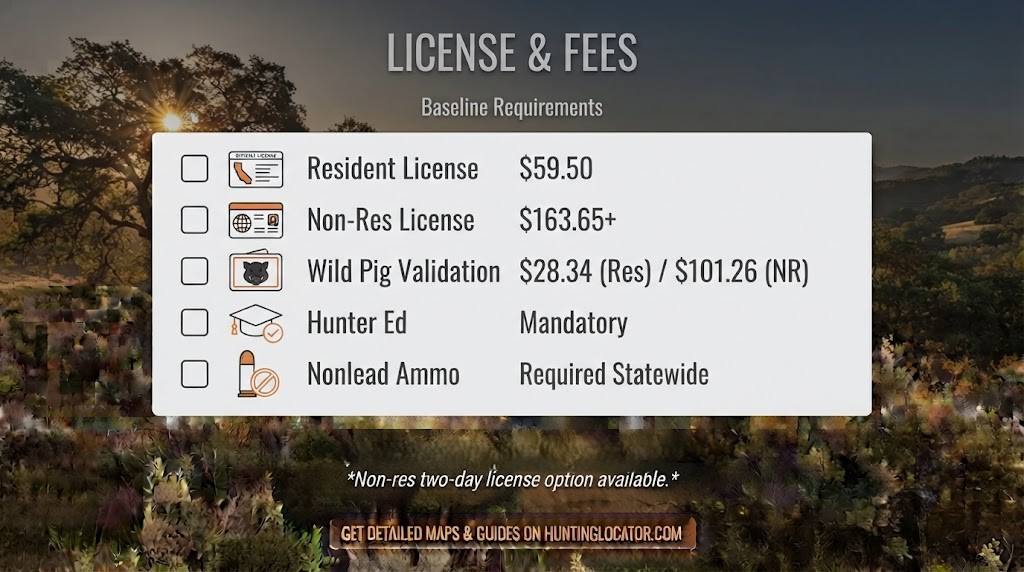
| License / Validation | Resident | Non-Resident |
|---|---|---|
| Annual Hunting License | $60 | $163.65 – $225.46 |
| Wild Pig Validation | $28 | $101.26 |
Non-residents planning a short trip should know that a two-day non-resident license is valid for wild pig hunting when paired with the Wild Pig Validation. This makes a destination hunt accessible without committing to a full annual license, though the annual license is better value for anyone planning multiple California trips. Licenses are available through CDFW’s online licensing system, authorized agents such as sporting goods retailers, and CDFW regional offices. Confirm current fees at the time of purchase, as they are subject to annual adjustment.
California Hunting Permits and Validations
The licensing process works as follows:
- Complete hunter education — First-time hunters must finish a CDFW-approved course before purchasing any license. Hunters must be at least 12 years of age to purchase a Wild Pig Validation.
- Purchase your Hunting License — Buy an annual or two-day license through CDFW online, an authorized retailer, or a regional CDFW office.
- Add the Wild Pig Validation — The Validation is purchased as an add-on to your license before you hunt. Carry it in the field at all times.
- Use certified nonlead ammunition — California is the only state requiring 100% nonlead ammunition for all hunting. Common legal options include copper and other non-lead alternatives. Out-of-state hunters should purchase compliant ammunition before arriving — hunting with lead ammunition is a violation regardless of your home state’s rules.
- Record every harvest — Even with no bag or possession limit, California law requires that each harvest be documented.
Nonlead ammunition is required statewide to protect California’s native wildlife, including raptors and scavengers that feed on gut piles and carcasses. The requirement applies to pig hunters the same as it does to every other species.
Where to Hunt Wild Pigs in California
California wild pig hunting access falls into three broad categories: public land, private leases, and guided hunts. Each has its own trade-offs in cost, access certainty, and likely harvest success.
Best Public Lands for Wild Pig Hunting
California’s public lands offer pig hunting opportunities across several regions, managed by agencies including the Bureau of Land Management (BLM), National Forests, and state wildlife areas. These areas provide accessible entry points for hunters who want to explore the species without committing to a lease.
Consistently productive public land hunting areas include:
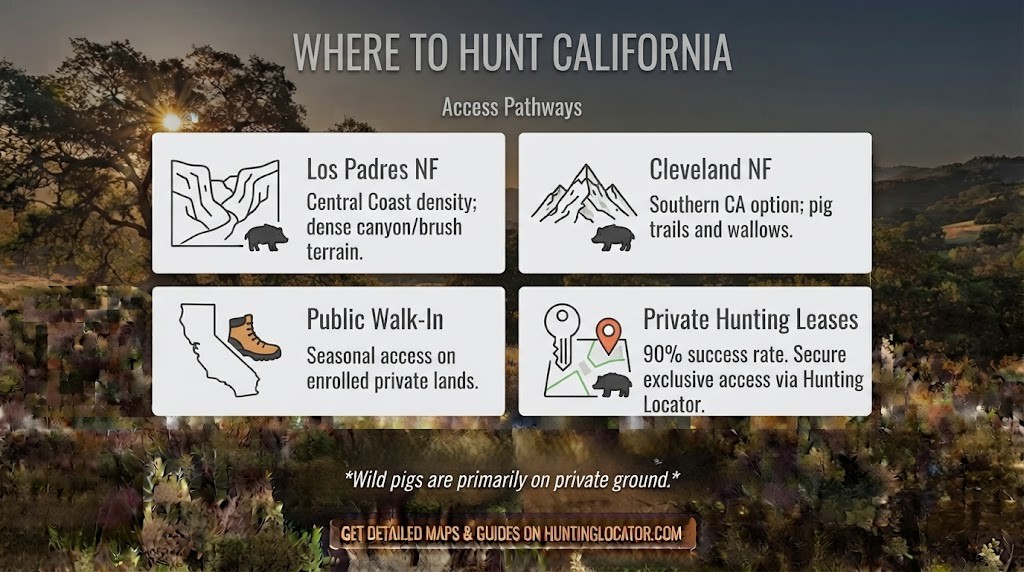
- Los Padres National Forest — Known for dense terrain and established pig populations along the Central Coast, with varied canyon and brushland habitat that holds pigs year-round
- Cleveland National Forest — Pig trails and wallows throughout this Southern California forest make it a well-known public option for hunters in San Diego and surrounding counties
- San Bernardino National Forest — River valleys within the forest provide water sources and feeding areas that concentrate pigs, particularly during drier months
- Tehama and Mendocino Counties (Northern California) — Productive regions with established pig populations across mixed terrain
- San Diego, Imperial, and Ventura Counties (Southern California) — Among the most consistently productive areas in the south, with a mix of public and private land access
- Monterey and Mariposa Counties (Central California) — Well-regarded for wild boar populations across Central California’s varied terrain
Before hunting any public land, check with the specific managing agency — BLM field office, National Forest ranger district, or CDFW wildlife area manager — for current access rules, any required permits, and seasonal restrictions that may apply to specific zones.
Private Land Hunting with Hunting Locator
Public land is a starting point, but the harvest data is worth examining. According to the 2020–21 California Department of Fish and Wildlife Wild Pig Take Report, 90.4% of successful pig hunters used private land — a 7% increase since 2016. Wild boar are intelligent animals that tend to move toward private ranch land, where pressure is lower and habitat is less disturbed. Hunters working public ground and finding slow action may simply be hunting areas where the pigs have already shifted off.
Private land hunting in California offers several advantages over public ground:
- Less competition — No other hunters working the same drainages and ridge lines
- Managed habitat — Landowners and hunting clubs actively manage properties for game production
- Consistent access — Year-round availability without the uncertainty of public land closures
- Better harvest odds — The 90.4% private land success rate reflects what the harvest data shows consistently
Finding private hunting land in California can be difficult — the state is densely populated, access fees are high in many regions, and word-of-mouth connections are hard to build from scratch. Hunting Locator is a marketplace that connects hunters directly with California landowners offering lease or sale access. Rather than cold-calling ranchers or chasing secondhand leads, you get a searchable database of verified California properties, browsable by region, acreage, and game type. California holds 20 million acres of hunting land spanning Shasta County ranches to Kern County mountain properties. Browse current California hunting leases on Hunting Locator to find properties by region and access type.
Guided Hunts
Guided hunts are worth considering for non-resident hunters who lack local knowledge and land connections. A quality California guided pig hunt removes most logistical uncertainty — access, glassing areas, and often meat handling are managed for you — letting you focus on the hunt itself.
The cost math is worth running. A single-day pig hunt on private land typically runs $700–$1,800 depending on the property, while a full annual club membership runs just over $2,000 for unlimited access. A guided two-day hunt in the $1,150 range is often competitive with day-lease pricing once you factor in local expertise, scouted terrain, and logistical support.
Hunting Locator’s outfitter and guide directory is a practical starting point for hunters considering a guided approach. You can find vetted California guides alongside lease listings in one place, making it easier to compare options and connect with professionals who know the state’s pig country.
Wild Pig Hunting Tips
California pig hunting rewards preparation. Whether you’re transitioning from deer hunting or planning your first big game pursuit, these fundamentals will put you in a stronger position from the start.
- Hunt the crepuscular windows — Wild pigs are most active at dawn and dusk, so position yourself near feeding and watering areas before first light and again in the last hour before sunset. Midday sits during summer months are rarely productive.
- Work the wind — Pigs have an exceptional sense of smell and will detect you long before you see them if you’re hunting downwind. Always approach from upwind and reposition whenever the wind shifts. A quality wind indicator or powder helps on every hunt.
- Choose the right caliber — Centerfire rifles in .243, .270, .308, or .30-06 are proven choices for California pig hunting, offering the range and stopping power needed for pigs that can exceed 300 pounds. Shot placement behind the shoulder is critical for clean kills — pigs are tough animals with thick shoulder shields.
- Use certified nonlead ammunition — California is the only state mandating 100% nonlead ammunition statewide, and violations carry real consequences. Stock up on copper or other certified alternatives before your hunt. Check the Hunting Locator store for compatible ammunition and gear options suited to California hunting conditions.
- Dress the harvest immediately — Field dress hogs right after harvest, especially in warmer weather, and cool the meat as quickly as possible. Pig meat degrades fast in California’s heat. A cooler packed with plenty of ice before you leave the truck is essential.
- Invest in terrain-appropriate gear — California’s terrain is rugged and often dry, demanding sturdy boots, lightweight camo, and a reliable hydration system. A rangefinder and mapping app improve spot-and-stalk success across open hillsides and canyon country. Browse the Hunting Locator store for boots, optics, and field gear suited to Western hunting.
- Time your season tactically — Late fall through early spring generally offers the best daytime movement and most manageable meat-handling conditions. If your schedule is flexible, plan primary pig hunts outside the summer heat window for the most productive experience.
More Resources from Hunting Locator
- Hunting in California — Full Season Overview — California’s complete hunting calendar, covering all major species and season structures in one place
- California Wild Pig Hunting Season — A dedicated wild pig resource from Hunting Locator with additional context on seasons, access, and regulations
- California Hunting Leases — Verified private land lease listings across California, searchable by region and game type
- California Deer Hunting Season — Current deer season dates, zone information, and tag requirements for combination trip planning
- California Elk Hunting Season — California’s elk draw, zones, and access information
- California Turkey Hunting Season — California’s spring and fall turkey seasons covered alongside year-round pig hunting options
- California Bear Hunting Season — Season dates, tag requirements, and access information for California black bear hunters
- California Pronghorn Hunting Season — Draw information, zone breakdowns, and planning resources for California pronghorn hunters
- California Bighorn Sheep Hunting Season — One of California’s most sought-after tags, covered in full detail
- California Upland Game Hunting Season — Pheasant, quail, chukar, and more — California’s upland bird seasons for hunters looking to diversify
- California Waterfowl Hunting Season — Duck and goose season dates, zone information, and access resources
- Hunting Locator Store — Boots, optics, ammunition, and field essentials matched to Western hunting conditions
FAQ
Do I need a special license to hunt wild pigs in California?
You need two things: a valid California Hunting License (annual or two-day) and a Wild Pig Validation. The Validation is a required add-on purchased separately from your license. Both must be in your possession while hunting. First-time hunters must also complete a CDFW-approved hunter education course before purchasing a license, and hunters must be at least 12 years of age to purchase the Wild Pig Validation.
Is there a bag limit on California wild pigs?
No. California wild pig hunting has no daily bag limit and no possession limit. You can legally harvest an unlimited number of pigs, provided you hold a valid license and Wild Pig Validation. Every harvest must still be recorded as required by California law.
When is wild pig hunting season in California?
California wild pig hunting is open year-round, running from July 1 through June 30 of the license year with no closed season. Legal shooting hours are one-half hour before sunrise to one-half hour after sunset, with possible exceptions on private property under specific permits.
What type of ammunition is required for pig hunting in California?
California requires certified nonlead ammunition for all hunting statewide — this applies to wild pigs just as it applies to every other hunted species. Common legal options include copper and other non-lead alternatives. California is the only state with a 100% nonlead ammunition requirement, so out-of-state hunters should purchase compliant ammunition before arriving.
How much does it cost for a non-resident to hunt wild pigs in California?
A non-resident’s baseline cost is the Non-Resident Hunting License ($163.65–$225.46 for an annual license, or a two-day option at lower cost) plus the Wild Pig Validation ($101.26). The two-day non-resident license is valid for wild pig hunting when paired with the Validation, making short-trip hunts accessible without purchasing an annual license.
Where can I find private land for pig hunting in California?
Hunting Locator’s California lease listings connect hunters directly with landowners offering private hunting access across the state. Given that 90.4% of successful California pig hunters harvested on private land, securing private access is one of the more consequential decisions you can make for your 2026 hunt. Browse current listings to find properties by region and access type.
Closing Notes
California wild pig hunting offers a genuinely open calendar — no draw, no closed season, no bag limit — and the regulations are straightforward. The main compliance detail that catches unprepared hunters, particularly non-residents, is the statewide nonlead ammunition requirement. Get your license and Wild Pig Validation before you arrive, load compliant ammunition, and record every harvest.
Land access is usually what separates a productive hunt from a frustrating one. The 90.4% private land success rate in the CDFW harvest data is a consistent signal about where pigs are actually being taken. Find your 2026 California hunting lease on Hunting Locator and connect directly with landowners ready to work with qualified hunters.


