This Michigan Elk Season Guide for 2026 puts every confirmed date, fee, and regulation in one place. For residents, that means the drawing timeline, license costs, and land-access strategy you need to fill a tag. For non-residents, it means a clear answer about where you stand, plus alternatives worth pursuing. Whether you’re deep into your search for land or just starting to look, Hunting Locator connects hunters with the land and resources that make a season successful.
This guide covers:
- Confirmed 2026 hunt periods, fees, and the elk drawing timeline — exact dates, application windows, and what it costs at every step
- Licenses, permits, and residency rules — including who can and can’t apply
- Where to hunt — public land, private leases through Hunting Locator, and guided hunt options
Here’s the overview before the details.
Michigan Elk Hunting at a Glance: 2026 Quick Overview
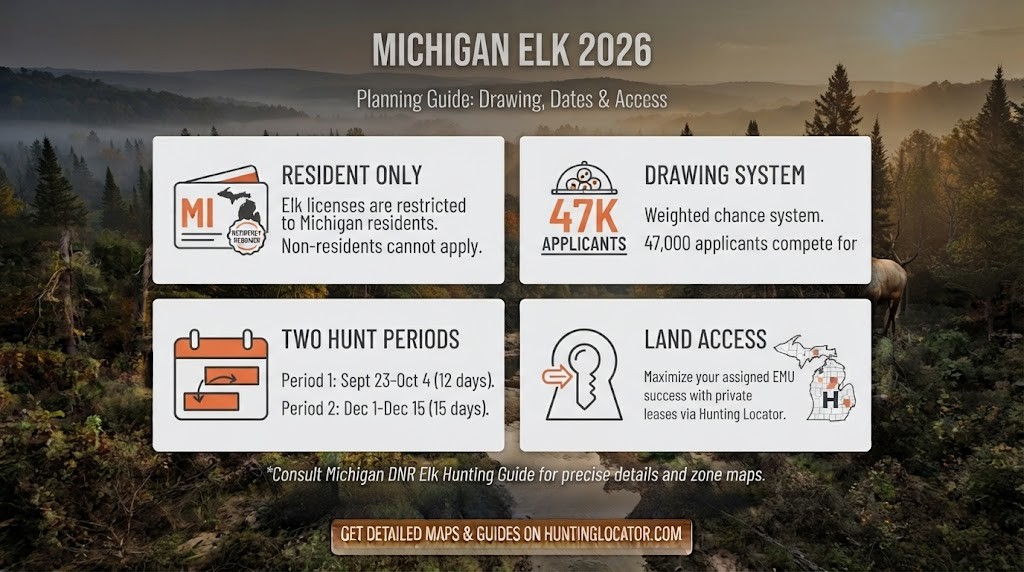
Michigan elk hunting is drawing-only, restricted to specific management units in the northern Lower Peninsula, and split into two hunt periods each year. According to the Michigan DNR, this structure manages a herd estimated at 733 animals while giving a limited number of hunters a shot at a once-in-a-lifetime tag.
| Season Type | Dates | Bag Limit | Key Regulations | Notes |
|---|---|---|---|---|
| Hunt Period 1 | Sept. 23 – Oct. 4, 2026 (12 days) | 1 elk per license | Drawing-only; permit valid in assigned EMU | Contiguous period; replaces former late-August split sessions |
| Hunt Period 2 | Dec. 1 – Dec. 15, 2026 (15 days) | 1 elk per license | Drawing-only; permit valid in assigned EMU | Valid in designated northern Lower Peninsula units |
Before you can hunt either period, you’ll need to clear a few licensing and education requirements:
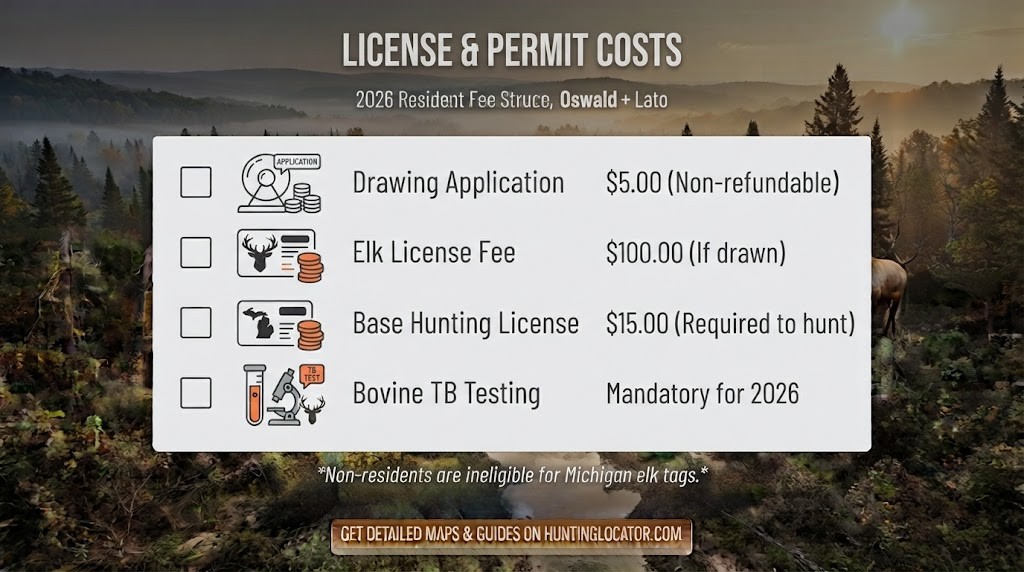
- $5 application fee — non-refundable, required to enter the elk drawing
- $100 elk license — paid only if you’re successfully drawn
- Michigan Base Hunting License — required to hunt if drawn (not required simply to apply)
- Hunter safety certification — required for every applicant
- Mandatory elk hunt orientation — required for all successful applicants before hunting
- 72-hour DNR check-in — plus new-for-2026 bovine TB testing on every harvested elk
For a deeper dive into the full application cycle, see our Michigan elk hunting breakdown.
Michigan Elk Hunting Seasons
Michigan’s 2026 elk season keeps its two-period structure, but Hunt Period 1 looks different this year. According to the Michigan DNR, the state restructured what used to be three separate four-day sessions into one contiguous 12-day window, aimed at hunter convenience and better hunting conditions.
Brent Rudolph, the DNR’s Deer, Elk, and Moose Management Specialist, explained it this way: “For the first hunt period in particular, having a contiguous session that starts later in the season should make it easier for hunters to plan their hunt… The move also provides more favorable conditions and avoids the warm temperatures we’ve experienced during the earlier hunt in recent years.”
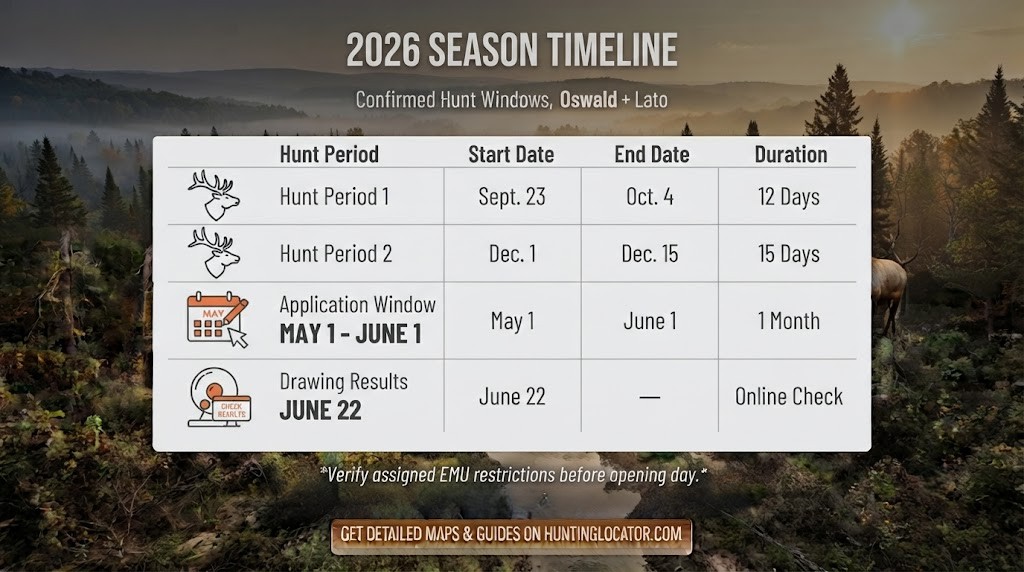
Hunt Period 1: Sept. 23 – Oct. 4, 2026
This 12-day contiguous window replaces the prior structure of three separate four-day sessions that used to begin in late August, according to the Michigan DNR. The later start pushes the hunt past the warmest stretch of early fall, meaning more comfortable conditions for scouting, sitting, and tracking elk in your assigned management unit.
This cooler, later timing may line up better with elk movement patterns before the rut fully winds down. For context, the 2025 Hunt Period 1 produced 50 legally harvested elk out of the drawn hunters, a 50% success rate — useful for setting expectations rather than guaranteeing an outcome.
Hunt Period 2: Dec. 1 – Dec. 15, 2026
Hunt Period 2 runs 15 days and is valid in designated units — specifically EMU H, X and EMU I, X, per the Michigan DNR. This late-season window brings snow, colder temperatures, and shifting herd behavior, which changes how you approach tracking and calling.
Snow cover can work in your favor for spotting fresh sign and following herd movement, but it also means packing for genuinely cold-weather conditions. For context, 2025’s Hunt Period 2 saw 103 legally harvested elk with a 64% success rate, notably higher than Period 1, though every season varies with weather and herd behavior.
How the Michigan Elk Drawing Works
Michigan has used a weighted drawing system since 2003, and understanding it is the difference between guessing and planning. Per the Michigan DNR, “an applicant’s total number of entries is equal to the number of chances earned in past drawings plus one chance for his or her current application.”
In plain terms: your chances stack the more years you apply, but every applicant still has a shot, including first-timers. Nobody is locked out, and persistence pays off over time.
Here’s the application timeline to keep on your calendar:
- Apply May 1 – June 1 — submit your $5, non-refundable application
- Drawing results posted June 22 — check your status online
- If drawn, purchase your license — Base License plus the $100 elk receipt
- Complete mandatory elk hunt orientation — required before you can hunt
With roughly 47,000 applicants competing for 200 licenses in 2026, per the Michigan DNR, it’s worth setting realistic expectations even as you keep applying. The weighted system rewards patience, but this remains one of the most competitive tags in the country.
Michigan Elk Licenses and Permits
If you’re drawn, hunting Michigan elk requires two separate pieces of paper — a base hunting license and an elk license. Eligibility to apply comes down to residency and basic hunter education requirements. Here’s how it all fits together.
Michigan Hunting Licenses for Elk
You don’t need a base license to apply for the drawing, but according to the Michigan DNR, if you’re chosen, you must purchase a base license and elk receipt before you can hunt. Here’s how the costs break down:
| License Type | Resident Cost | Non-Resident Cost | Notes |
|---|---|---|---|
| Elk Drawing Application | $5 | Not eligible to apply | Non-refundable; one per applicant per year |
| Elk License | $100 | Not eligible | Paid only if drawn |
| Base Hunting License | $15 | $200 | Required to hunt if drawn; base license alone does not permit elk |
Your elk license includes a kill tag valid only within your assigned elk management unit, per the Michigan DNR — you can’t use it outside that zone. Beyond the base license, the $100 elk license and $5 application fee are the only elk-specific costs.
Michigan Elk Permits and the Residency Rule
Michigan elk licenses are issued to Michigan residents only. Non-residents cannot apply for or draw a Michigan elk tag, according to the Michigan DNR. This is a hard eligibility line, not a technicality.
If you’re a non-resident, Michigan hunting isn’t off the table — the state offers strong deer, bear, turkey, and waterfowl opportunities, and quality land access is still available to you (more on that below).
For residents, here’s what eligibility and the permit process look like:
- What you’re applying for: The elk license itself functions as your kill tag
- How many: One per successful applicant, valid for one elk
- Where to apply: Any licensed agent or online at Michigan.gov/DNRLicenses
- Eligibility requirements: You must be a Michigan resident, at least 10 years old by the start of Hunt Period 1, and hunter-safety certified (with apprentice and mentored-youth pathways available for younger hunters)
Michigan Elk: Where to Hunt
Once you’re drawn, you’re assigned a specific elk management unit somewhere in the northern Lower Peninsula, so where you hunt within that zone matters just as much as drawing the tag itself. Broadly, you’ve got three pathways: public land, private leases, and guided hunts.
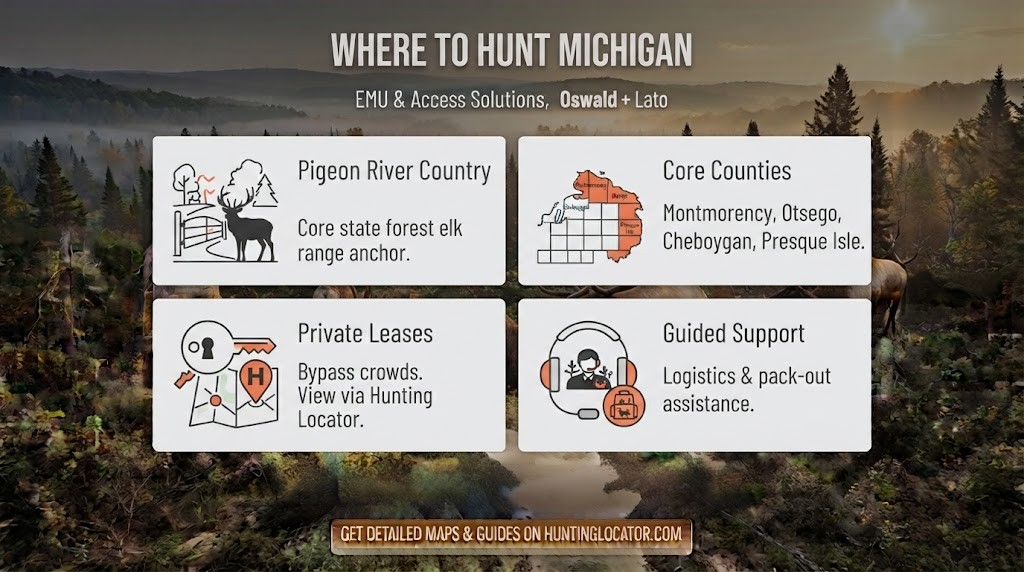
Michigan’s elk range is concentrated in the northeastern Lower Peninsula, centered on Pigeon River Country State Forest across Montmorency, Otsego, Cheboygan, and Presque Isle counties. Whichever path you choose, understanding this core range shapes how you scout and plan.
Best Public Lands for Michigan Elk
Public land access starts with the state forest system surrounding the elk range. Here’s where to focus:
- Pigeon River Country State Forest — the heart of Michigan’s elk range and the anchor for most public-land hunting strategy
- Surrounding state forest lands — additional public acreage spread across the four core elk counties
- DNR maps and harvest data — the wildlife division maintains EMU maps, and reviewing past harvest data by unit can help you scout your assigned zone before the season opens
Private Land Hunting with Hunting Locator
Because your tag is restricted to a specific management unit, you can’t simply hunt wherever elk happen to be that week; your access strategy has to work within your assigned boundaries. That’s why private land matters so much for elk hunters — it often means less pressure, better food sources, and a real edge over public acreage alone.
When it comes to securing that access, you’ve got two real paths: leasing or buying. Leasing gives you flexible, lower-commitment access to quality ground for a season or a set term, useful if you’re not ready to invest in land ownership but want reliable access year after year. Buying is the long-term play, building equity in land you control completely, season after season.
This is where Hunting Locator does its best work. As a platform built specifically to connect hunters with landowners ready to lease or sell, we make it simple to browse Michigan hunting leases and find real listings near your assigned unit — actual Michigan properties from landowners looking to work with hunters.
Given that your permit is EMU-restricted and land access can make or break your season, it’s worth exploring what’s available before opening day. Secure your access early, and you’ll spend the season hunting instead of scrambling.
Guided Elk Hunts in Michigan
For hunters — especially those drawn for the first time — a guided hunt is worth weighing. Guides typically know the lay of the land, including property boundaries and where elk are likely to be, which can shortcut a steep learning curve if you’ve never hunted this specific terrain before.
There’s also a practical side to consider: an elk weighs as much as five whitetail deer combined, and getting an animal that size out of the woods is no small task. A guide’s experience with logistics, from packing out meat to navigating unfamiliar ground, can be genuinely valuable, particularly if you’re balancing a limited window and unfamiliar territory. Guided hunts aren’t a requirement, but they’re worth considering if you want extra support turning a hard-won tag into a successful hunt.
Michigan Elk Hunting Tips
Drawing a tag is half the battle. The other half is showing up prepared. These tips will help you turn a rare opportunity into a filled tag.
- Scout your assigned EMU early — pre-season scouting helps you identify feeding areas, bedding zones, and travel corridors before the pressure of opening day sets in.
- Match your setup to the period — cooler September conditions call for different layering than December’s snow and cold, so plan your clothing and gear around your specific hunt period.
- Practice your shot placement — elk are large-bodied animals, and confident, ethical shot placement matters more than ever when the opportunity may only come once.
- Plan your pack-out in advance — an elk weighs roughly as much as five whitetails combined, so figure out your hauling logistics and manpower before you’re standing over a downed animal.
- Gear up before you go — reliable optics, proper layering, calls, and a pack built for the terrain all make a difference. Gear up at the Hunting Locator store to make sure you’re equipped for whichever period you draw.
More Resources from Hunting Locator
Whether you’re locked in on elk or planning around Michigan’s other seasons, these resources can help you go deeper.
Platform & Land Access
- Hunting Locator homepage — the platform connecting hunters to land and gear nationwide
- Michigan hunting leases — browse current lease and land listings across the state
- Hunting Locator store — gear up for your next hunt, whatever species you’re chasing
- Michigan hunting season guide — the master overview covering every Michigan season in one place
Big Game
- Michigan elk hunting season — our deeper companion piece on elk-specific strategy
- Michigan deer hunting season — plan your whitetail season dates and tactics
- Michigan black bear hunting season — bear draw odds and season details
Other Seasons
If elk isn’t in the cards this year — especially for non-resident hunters who can’t draw a tag — these seasons offer real Michigan hunting opportunities:
- Michigan turkey hunting season — spring and fall turkey planning
- Michigan waterfowl hunting season — ducks and geese across the state’s flyways
- Michigan game bird hunting season — upland and game bird opportunities
- Michigan small game hunting season — rabbit, squirrel, and other small game seasons
Frequently Asked Questions
Can non-residents hunt elk in Michigan?
No. According to the Michigan DNR elk regulations, elk licenses are issued to Michigan residents only, and non-residents cannot apply for or draw a tag. Non-resident hunters can still pursue Michigan deer, bear, turkey, and waterfowl seasons with strong success.
How much does it cost to hunt elk in Michigan in 2026?
Plan on a $5 non-refundable application fee to enter the drawing, and a $100 elk license if you’re successfully drawn. You’ll also need a Michigan Base Hunting License, which costs $15 for residents, according to the Michigan DNR.
What are the odds of drawing a Michigan elk tag?
Roughly 47,000 hunters apply each year for just 200 licenses, per the Michigan DNR’s 2026 elk application announcement. The state’s weighted drawing system, in place since 2003, gives repeat applicants a growing edge over time, though every applicant retains a chance each year.
What is an elk management unit (EMU)?
An elk management unit, or EMU, is a designated geographic zone within Michigan’s northern Lower Peninsula elk range. If you’re drawn, your license and kill tag are only valid within your assigned unit and hunt period, not anywhere else in the state.
Do I need a hunter safety certificate to apply?
Yes. Eligibility requires hunter-safety certification, along with Michigan residency and being at least 10 years old by the start of Hunt Period 1, according to the Michigan DNR elk regulations. Apprentice and mentored-youth pathways are available for younger or newer hunters.
What happens after I harvest an elk?
You have 72 hours to present the elk head or entire animal at a DNR check station for registration and biological data collection. New for 2026, all harvested elk must also undergo bovine tuberculosis testing, per the Michigan DNR.
The Final Shot
Michigan elk hunting comes down to a few fixed facts: it’s drawing-only, split across two hunt periods (Sept. 23–Oct. 4 and Dec. 1–15), open exclusively to residents, and shaped heavily by where you can access land within your assigned unit. None of that changes year to year, which is why planning ahead matters so much.
Apply between May 1 and June 1, prepare for your base license and mandatory orientation if you’re drawn, and start lining up land access well before the season opens. Every date, fee, and regulation in this Michigan Elk Season Guide for 2026 traces back to the Michigan DNR, so you can plan with confidence instead of guesswork.
Hunting Locator’s role is straightforward: we bring the facts together in one place and connect you to the land that turns a hard-won tag into a filled one. When you’re ready to start scouting real opportunities, browse Michigan leases and start planning.


