This Idaho bighorn sheep guide covers what you need to know before applying: season dates, licenses, fees, and application mechanics, plus where to hunt once you draw. All bighorn tags in Idaho come through controlled hunts administered by Idaho Fish and Game (IDFG), covering two legal subspecies under a once-in-a-lifetime framework.
What’s covered below:
- 2026 season dates and the draw-only process — what the Aug 30–Oct 13 window means and why the tag can’t be purchased directly
- Licenses, permits, fees, and application steps — costs and deadlines for residents and nonresidents
- Where to hunt — public land, private leases through Hunting Locator, and guided hunt options once your tag is in hand
Whether you’re applying for the first time or you’ve been putting in for years, here’s the current information you need.
Quick Overview: Idaho Bighorn Sheep Season at a Glance
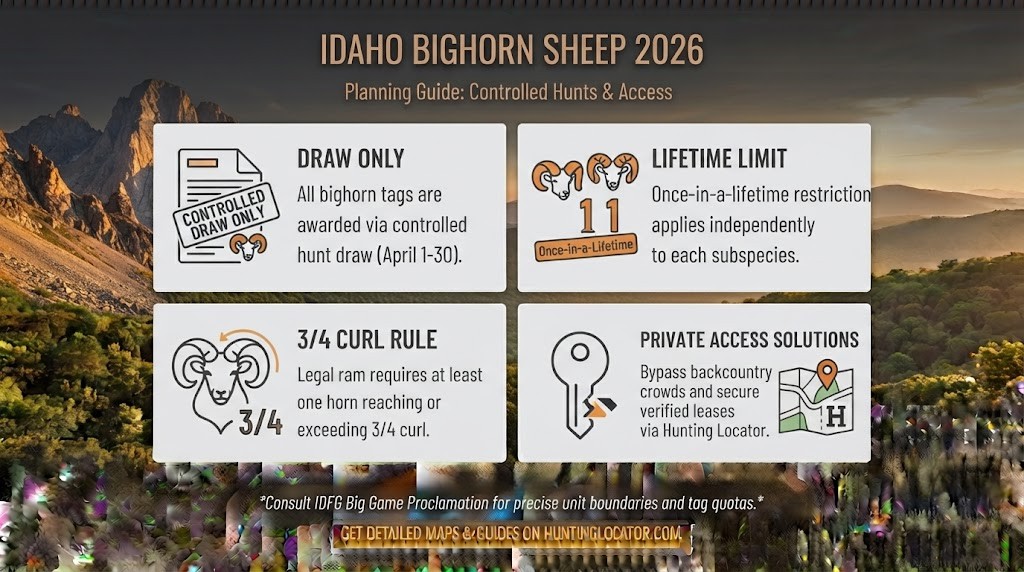
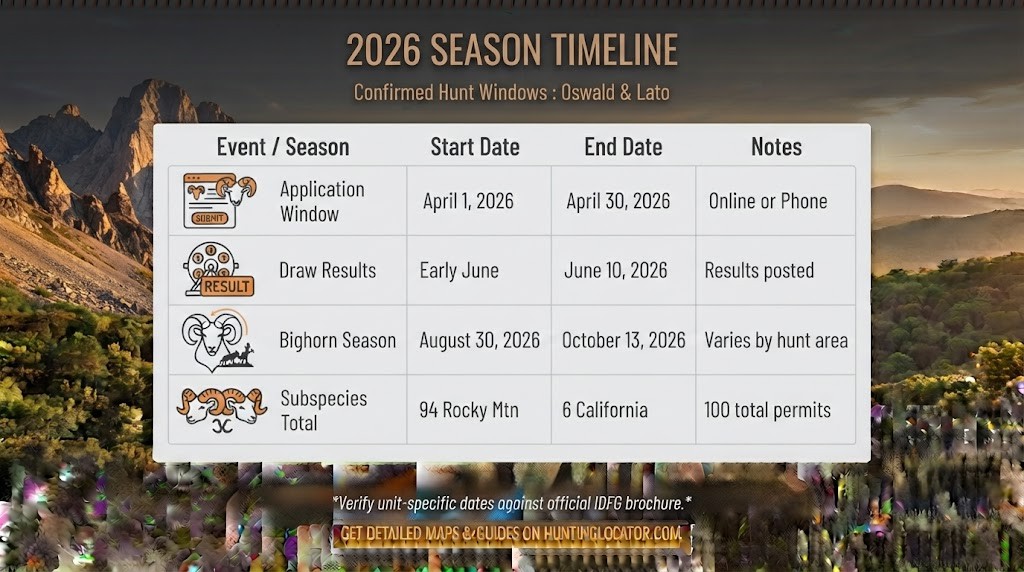
Idaho bighorn tags are awarded only through a controlled hunt draw. The season runs from August 30 through October 13, 2026, though exact dates vary by controlled hunt area. The table below summarizes the season.
| Element | Detail |
|---|---|
| Season Type | Controlled hunt (draw-only) |
| Season Window | Aug 30 – Oct 13, 2026 (varies by hunt area) |
| Subspecies | Rocky Mountain bighorn & California bighorn |
| Bag Limit | 1 bighorn of either subspecies per lifetime |
| Legal Ram | Any ram with at least one horn at/over 3/4 curl (most units) |
| Total 2026 Permits | 100 statewide (94 Rocky Mountain, 6 California) |
| Nonresident Cap | Up to 10% of total tags |
| Application Window | April 1 – April 30 |
| Results Posted | Early June |
Because dates shift by unit, confirm your specific hunt area’s dates with IDFG’s official seasons and rules brochure before applying. For a unit-by-unit breakdown, see our Idaho bighorn sheep hunting guide.
Before choosing a hunt area, clear these licensing requirements:
- A valid 2026 Idaho hunting or combination license is required before you can apply.
- Your controlled hunt application must be submitted between April 1 and April 30.
- Idaho requires hunter education if you’ve never held an Idaho license before.
- The once-in-a-lifetime restriction applies separately to each subspecies. Draw a Rocky Mountain ram, and you’re still eligible to apply for California bighorn later, and vice versa.
Idaho Bighorn Sheep Hunting Seasons
Idaho’s bighorn season runs Aug 30 through Oct 13, with the exact window depending on hunt area. The state sets dates and permit numbers on a two-year regulation cycle, and 2026 is the second year of that cycle, so the numbers here should hold steady from last year. Idaho’s bighorn herds concentrate in a handful of rugged strongholds: the Salmon River corridor, Hells Canyon, and the upper Selway drainage.
Two subspecies are legal to hunt, Rocky Mountain bighorn and California bighorn, and the once-in-a-lifetime rule applies to each independently. In practice, the lifetime limit isn’t one sheep ever — it’s one of each subspecies, giving dedicated hunters a shot at two tags over a lifetime of applying.
Rocky Mountain Bighorn Season
The Rocky Mountain subspecies carries most of Idaho’s tags: 94 of the 100 available statewide in 2026. Tag numbers reflect ongoing population surveys, and recent counts in areas like the Middle Fork and Lost River Range have trended upward, supporting increases in both early-hunt and late-hunt tag allocations. This is where most of the state’s legal-ram opportunity lives.
California Bighorn Season
California bighorn is the rarer draw by a wide margin, with just 6 of Idaho’s 100 total 2026 tags. Declining population counts across most California bighorn herds — the Jim Sage population is an exception — have pushed tag numbers down in recent years. Unit 40, historically known for producing some of the state’s best rams, has been dealing with a pneumonia outbreak, and as of this guide’s writing, IDFG had not finalized whether the unit would remain open for 2026. Anyone considering a California bighorn application should verify current unit status directly with IDFG before committing to a choice.
Legal Ram & the 3/4 Curl Rule
A legal ram in Idaho is any ram with at least one horn reaching or exceeding a 3/4 curl, in most units statewide. There’s also a harvest requirement: hunters must leave the portion of the skull plate containing the upper half of the eye socket naturally attached to the horns until IDFG has officially pinned them. Skipping this step can turn a legal harvest into a regulatory problem, so plan field care accordingly.
Idaho Bighorn Sheep Licenses and Permits
Getting to the hunt means clearing two steps: buying your license, then submitting your controlled hunt application. The full tag fee is due only if you’re drawn, but the license and application fee are due upfront every year you apply.
Idaho Hunting Licenses
Here’s what residents and nonresidents can expect to pay in 2026:
| Item | Resident | Nonresident |
|---|---|---|
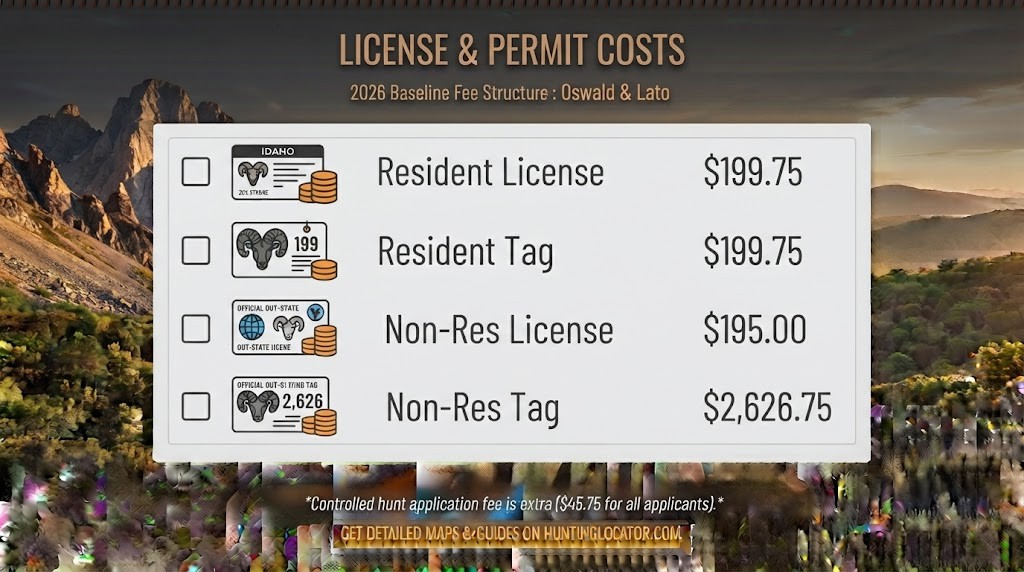
| General Hunting License (required before applying) | $200 | $195 |
| Controlled Hunt Application Fee | $46 | $46 |
| Bighorn Tag Fee (if drawn) | $200 | $2,627 |
The general hunting license isn’t optional paperwork — without it, you can’t submit a bighorn application, regardless of residency status. And since the once-in-a-lifetime rule means every application is a bet on a tag you can only use once per subspecies, it’s worth going in with a clear strategy rather than applying on a whim.
Idaho Bighorn Sheep Permits & Application Process
Once your license is in hand, the process is straightforward, but the timing matters:
- Buy your 2026 Idaho hunting or combination license. Required before you can apply for any controlled hunt, bighorn included.
- Apply during April 1–30. You can apply online, at any Fish and Game office, through a license vendor, or by phone at 1 (800) 554-8685.
- Pay the application fee of $45.75. Nonresidents are capped at up to 10% of the total tags available for the species.
- Check your results in early June. Refunds or tags are mailed by June 10, but verifying your draw status is your responsibility rather than the mail’s.
According to Idaho Fish and Game’s controlled hunt application details, applicants can list two hunt choices, but all first choices are awarded before any second choices are considered. For bighorn sheep, that means your first choice is effectively the only one that counts.
A couple of eligibility notes: submitting a bighorn application makes you ineligible for most deer, elk, and pronghorn controlled hunt drawings that same year, and you’re limited to applying for only one once-in-a-lifetime species — sheep, moose, or mountain goat — per year. The draw is a random lottery with no preference or bonus points, so tenure alone doesn’t improve your odds.
Where to Hunt Idaho Bighorn Sheep
Drawing the tag is only the first hurdle. Where you hunt determines whether it turns into a filled tag or a long, frustrating season. There are three main paths: public land, private leases, and guided hunts.
Best Public Lands
Most of Idaho’s bighorn habitat sits on remote, rugged public land, and a handful of areas consistently produce the bulk of the state’s rams:
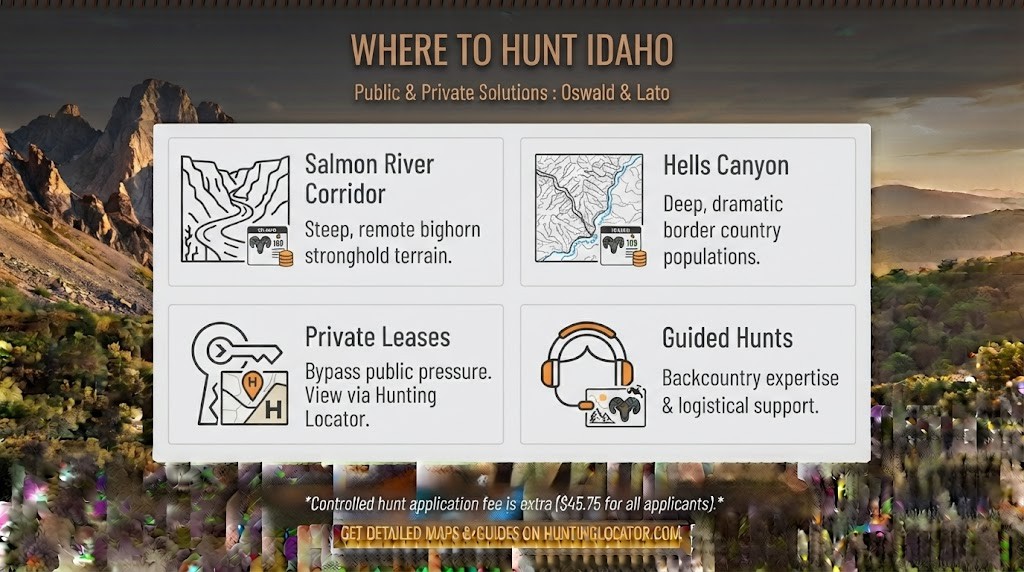
- Salmon River corridor — one of the most productive bighorn strongholds in the state, known for steep, remote terrain
- Hells Canyon — deep, dramatic country along the Idaho-Oregon border with solid bighorn populations
- Upper Selway drainage — wilderness-grade access that rewards hunters willing to go deep on foot
- IDFG’s Access Yes! program, which improves access to and through private land to reach public hunting ground, plus the Hunt Planner mapping tool for scouting unit boundaries before your season starts
Private Land Hunting with Hunting Locator
Public land access is real, but it comes with competition, long approach hikes, and unpredictable pressure from other hunters. For a tag you may only hold once in your lifetime, many hunters choose private land instead, through a lease or an outright purchase, to hunt with less crowding and better-managed ground.
Hunting Locator connects hunters directly with landowners across Idaho who are ready to lease or sell hunting access, cutting out the cold-calling that used to define the search for private ground. You can search listings by location, acreage, and game type, and reach out directly to landowners who already want hunters on their land.
Browse Idaho hunting leases to see what’s currently available across the state. Listings are added regularly, so it’s worth checking back as your season approaches even if you don’t see a bighorn-specific property today. Whether you’re looking to lease for a single season or buy land outright for years of access, it’s a solid starting point for securing ground before the season arrives.
Guided Hunts
For nonresidents unfamiliar with Idaho’s remote, high-altitude sheep units, or for anyone on their first sheep hunt, a guided or outfitted hunt is worth serious consideration. Bighorn country is steep, physically demanding, and often far from any road, and outfitters bring experienced guides along with the backcountry equipment needed to operate safely in that terrain. A guide’s local knowledge can matter a great deal if you haven’t navigated Idaho’s wilderness-grade hunt areas before.
Idaho Bighorn Sheep Hunting Tips
Sheep hunting in Idaho depends as much on fitness and optics as on shooting. Steep, high-altitude country rewards preparation, so focus your efforts here:
- Train for the Terrain: Bighorn country is steep and remote, often requiring miles of off-trail hiking at altitude. Build your cardio and pack-weight conditioning months before opening day, not weeks.
- Glass More, Walk Less: Quality optics do the real finding — spend patient hours behind glass locating legal rams before committing to a stalk.
- Know Your Legal Ram: Study the 3/4 curl rule until you can judge it instantly in the field. Misjudging a ram under pressure isn’t a mistake to make on a once-in-a-lifetime tag.
- Scout Early: Start e-scouting your unit and mapping public and private boundaries well before the season opens, not the week before.
- Bring the Right Weapon Setup: Any legal weapon is allowed for bighorn sheep. Muzzleloaders must be at least .50 caliber, and bows need a minimum 40-lb draw weight with 24-inch arrows, 300-grain minimum weight, and a fixed or mechanical broadhead at least 7/8 inches wide.
- Gear Up for High Country: Reliable boots, proper layering, and a pack built for long backcountry days matter as much as your rifle. Browse sheep hunting gear at our store before heading into the mountains.
More Resources from Hunting Locator
Planning an Idaho bighorn hunt often means planning around Idaho’s broader hunting calendar too. Here are more resources:
- Hunting Locator — our home base for finding hunting land access across the country, from leases to guided connections.
- Idaho hunting leases — browse current private land opportunities across the state.
- Gear store — find the right equipment for your species and terrain.
- Idaho hunting season guide — the full master guide to every Idaho hunting season.
- Idaho bighorn sheep hunting season — a companion deep dive into bighorn-specific details.
For the other big game seasons overlapping or bordering bighorn season in Idaho:
- Idaho elk hunting season
- Idaho deer hunting season
- Idaho antelope hunting season
- Idaho moose hunting season
- Idaho mountain goat hunting season
If predators or small game round out your season plans:
- Idaho black bear hunting season
- Idaho mountain lion hunting season
- Idaho coyote hunting season
- Idaho upland game hunting season
And for birds and waterfowl:
Frequently Asked Questions
What are the 2026 Idaho bighorn sheep season dates?
Idaho’s bighorn sheep season runs from August 30 through October 13, 2026, though exact dates vary depending on your specific controlled hunt area. Confirm your area’s exact dates with IDFG’s official seasons and rules brochure before finalizing your plans.
How much does an Idaho bighorn sheep tag cost in 2026?
Resident tags run $199.75, while nonresident tags cost $2,626.75. Both residents and nonresidents also pay a $45.75 controlled hunt application fee, plus a required general hunting license — $199.75 for residents or $195.00 for nonresidents — before applying.
Do you have to draw a tag to hunt bighorn sheep in Idaho?
Yes. Every Idaho bighorn sheep hunt is a controlled hunt, meaning tags are awarded only through the annual draw. You apply between April 1 and April 30, with results posted online in early June. It’s a random lottery with no preference points, and draw odds run roughly 1 in 228.
What is the 3/4 curl rule for Idaho rams?
Only legal rams — defined as any ram with at least one horn reaching or exceeding a 3/4 curl — may be taken in most Idaho units. After harvest, hunters must leave the portion of the skull plate containing the upper half of the eye socket naturally attached to the horns until IDFG has officially pinned them.
What’s the difference between Rocky Mountain and California bighorn sheep in Idaho?
Both subspecies are legal to hunt through controlled hunts, but Rocky Mountain bighorn carries far more tags — 94 of the 100 available in 2026 — compared to just 6 for California bighorn. The once-in-a-lifetime rule applies separately to each subspecies, so drawing one doesn’t disqualify you from ever applying for the other.
Can nonresidents hunt bighorn sheep in Idaho?
Yes, nonresidents can apply for and hunt Idaho bighorn sheep, though they’re capped at up to 10% of the total tags available statewide. Nonresident tag fees run significantly higher than resident fees at $2,626.75, and nonresidents must also hold a valid Idaho hunting license before applying.
The Final Shot
Idaho’s bighorn sheep hunt is about as strict a controlled-hunt system as western big game gets: draw-only, once-in-a-lifetime per subspecies, and running from August 30 through October 13 across the state’s most rugged country. Getting there means buying your license, applying between April 1 and April 30, checking your results in early June, and, if you want to make the most of a tag you may only carry once, lining up your access well before the season arrives.
Before you finalize anything, confirm your specific hunt area’s dates and any unit closures with IDFG’s official seasons and rules brochure, since details like the Unit 40 situation can shift year to year. We’ve compiled the official numbers here to give you a clear starting point, and we can help with the access side too.
When you’re ready to line up ground for your hunt, browse Idaho hunting leases or explore everything else at Hunting Locator.


