This Idaho Deer Season Guide for 2026 puts the season dates, license costs, permit requirements, and access options in one place, then connects the dots to real hunting ground through Hunting Locator. Whether you’re a lifelong Idaho resident or a nonresident mapping out your first trip west, here’s what you need to know.
Here’s what’s below:
- Season dates by weapon type — archery, muzzleloader, general any-weapon, and whitetail-specific seasons, in one quick-reference table
- License, tag, and permit costs — for residents, nonresidents, and mentored juniors, including the validations nonresident archery and muzzleloader hunters need
- Where to hunt — public land units, private-land leases, and guided-hunt options to fit your budget and timeline
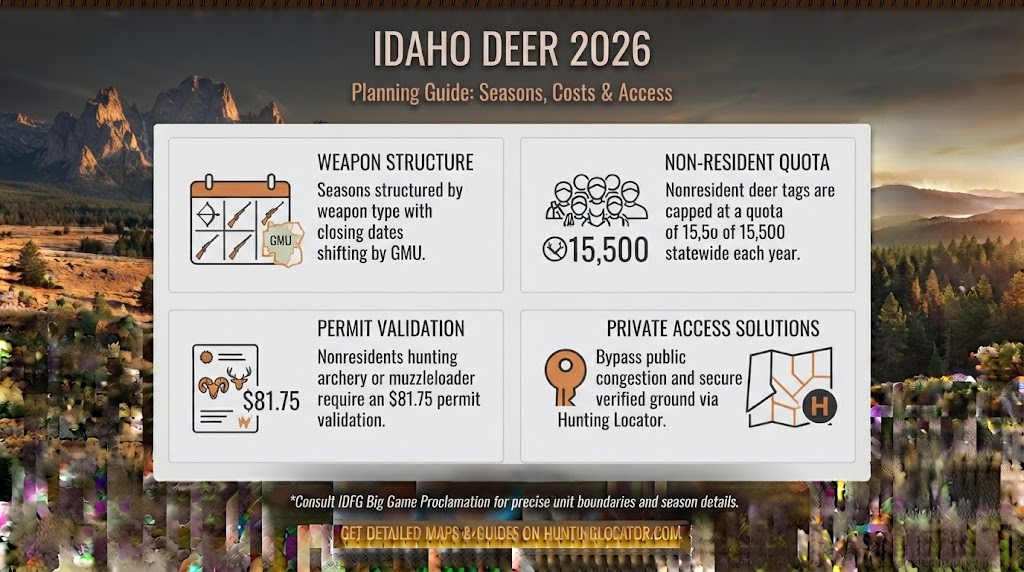
Idaho Deer Season 2026 at a Glance
Idaho structures its deer seasons around weapon type rather than one blanket opening day, and closing dates shift depending on your game management unit (GMU). The table below is a starting point — confirm your specific unit’s closing date before you lock in vacation days or lease agreements.
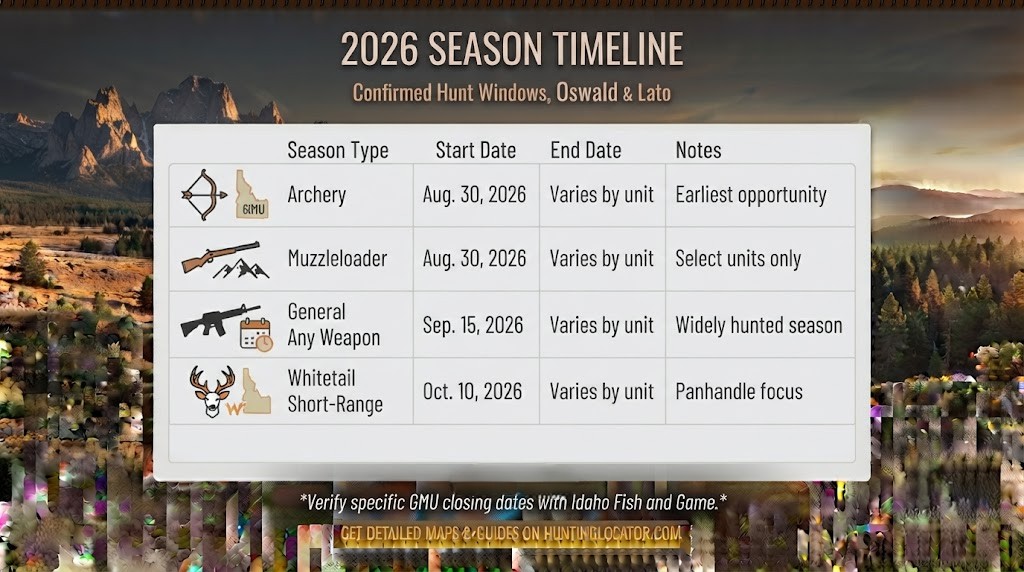
| Season Type | Start Date | End Date | Bag Limit | Notes |
|---|---|---|---|---|
| Archery | August 30 | Varies | One deer per tag | Earliest opportunity of the year |
| Muzzleloader | August 30 | Varies | One deer per tag | Available in select units |
| General Any Weapon | September 15 | Varies | One deer per tag | Most widely hunted season |
| White-tailed Deer General Any Weapon | September 15 | Varies | One deer per tag | Whitetail-specific |
| White-tailed Deer General Archery Only | August 30 | Varies | One deer per tag | Whitetail-specific |
| White-tailed Deer Short-Range Weapon | October 10 | Varies | One deer per tag | Whitetail-specific |
| Controlled Hunts | See IDFG season guide | Varies | One deer per tag | Draw/lottery required |
Dates and bag limits vary by unit and often distinguish antlered from antlerless harvest — confirm your specific GMU with the Idaho Fish and Game big game rules before finalizing your plans. For a deeper breakdown of what these seasons mean for your hunt, see our full Idaho deer hunting breakdown.
Before you hit the field, every Idaho deer hunter needs a few things in order:
- A valid Idaho hunting license — the base requirement before you can buy any tag
- A deer tag matching your residency status and chosen weapon season
- Hunter education certification, if you were born after December 31, 1974, and have never held a hunting license
- Weapon-class permit validation, required for nonresidents hunting archery or muzzleloader seasons
- A mandatory harvest report, filed after the season whether or not you filled your tag
- CWD testing, required within 10 days of harvest in certain units
A license grants the general right to hunt in Idaho; a tag authorizes you to harvest a specific animal. You need both before you head afield.
Idaho Deer Hunting Seasons by Weapon Type
Idaho organizes its deer seasons primarily by weapon type, and your choice determines both your start date and, for nonresidents, whether you’ll need an additional permit validation. Archery and muzzleloader both open August 30, general any-weapon opens September 15, and the whitetail short-range weapon season opens October 10. Treat every date below as a starting point — Idaho’s detailed season system shifts by unit, antlered/antlerless status, and weapon class, so confirm specifics with Idaho Fish and Game for your unit.
Archery Season
Archery season opens August 30, the earliest deer hunting opportunity of the year in Idaho. It overlaps with early archery elk season, so many hunters plan a combination hunt — if that’s on your radar, our Idaho elk hunting season guide can help you plan both at once.
Recent regulation updates mean crossbows are allowed in archery seasons for deer and other game, expanding options for hunters who prefer that setup. Nonresidents will need an $81.75 archery permit validation in addition to their license and tag — more on that in the Licenses section below.
Muzzleloader Season
Muzzleloader season also begins August 30, though it’s available only in select units rather than statewide. Nonresidents hunting this weapon class face the same $81.75 permit validation requirement as archery hunters, so budget for it accordingly. As with every season here, the specific units open to muzzleloader hunting and their closing dates are set by Idaho Fish and Game — verify before you plan your trip.
General Any-Weapon Season
The general any-weapon season is Idaho’s most widely hunted, opening September 15 for both general deer and whitetail-specific general seasons. This is the season most residents plan their fall around, and it draws the heaviest hunting pressure statewide.
Many northern Panhandle units run well into the fall, with Panhandle rut timing often putting hunters in the field during peak rut activity as several units close around December 1 — a real advantage if you’re chasing a mature buck.
White-tailed Deer Short-Range Weapon Season
The whitetail short-range weapon season opens October 10, giving hunters a later-season option specifically for whitetail deer. This reflects Idaho’s broader whitetail-versus-mule-deer framing: whitetails concentrate heavily in the Panhandle, while mule deer are more widespread and often managed through controlled hunts.
If you’re targeting whitetail specifically, the state’s prime whitetail units are generally recognized as Units 1, 2, 3, 4A, 5, and 6 in the Panhandle.
Controlled Hunts
General season tags are available to anyone who buys one, but controlled hunts are awarded through a random drawing, and you have to apply ahead of time to be considered.
For 2026, the Idaho deer controlled hunt application deadline was June 5, 2026, with successful applicants required to purchase their tags by August 1, 2026. Mail-in applications are no longer accepted — everything runs through Idaho Fish and Game’s online system now. If controlled hunts are part of your strategy for next season, mark your calendar early and check the IDFG season guide for the most current application windows.
Idaho Deer Hunting Licenses and Permits
Hunting deer legally in Idaho requires a hunting license plus a deer tag at minimum, and costs — along with any additional permits — differ depending on whether you’re a resident, a nonresident, or a mentored junior hunter. Here’s the full cost breakdown.
Idaho Hunting Licenses and Tag Fees
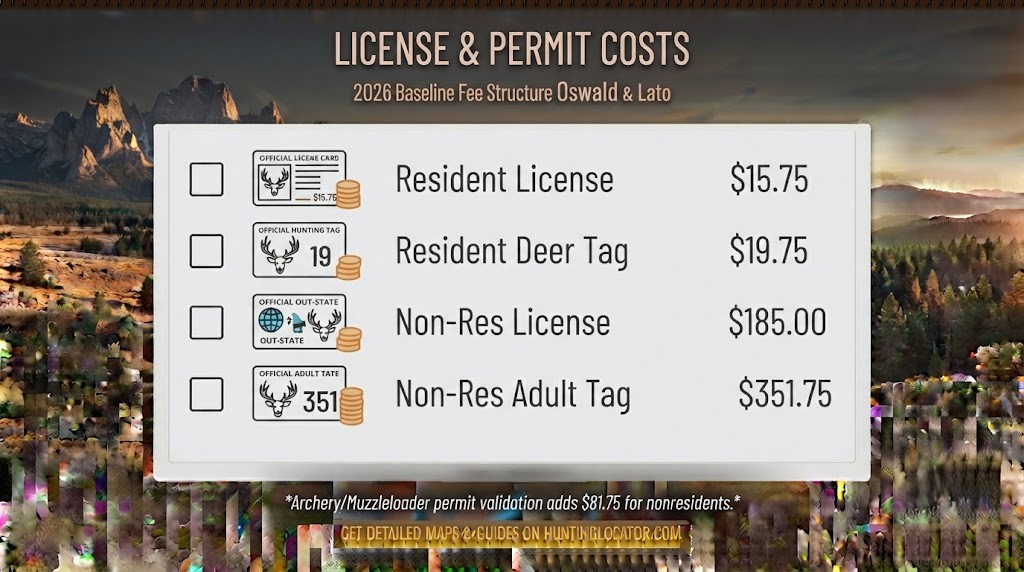
| License / Tag | Cost | Who It’s For |
|---|---|---|
| Resident Hunting License | $15.75 | Idaho residents |
| Resident Deer Tag | $19.75 (approx. standard resident fee) | Idaho residents |
| Nonresident Hunting License | $185.00 | Out-of-state hunters |
| Nonresident Adult Deer Tag | $351.75 | Out-of-state adults |
| Nonresident Junior Mentored Deer Tag | $176.75 | Mentored youth |
| Archery / Muzzleloader Permit Validation | $81.75 (nonresidents) | Required for those weapon classes |
These figures line up with the official nonresident deer tag fees published by Idaho Fish and Game, which also confirms nonresident deer tags are capped at a quota of 15,500 statewide each year.
A few notes worth flagging: nonresident license fees are generally nonrefundable if you don’t draw a tag, so factor that into your budget before applying. The $81.75 permit validation applies only to nonresidents hunting archery or muzzleloader seasons — general any-weapon hunters won’t need it. And if you’re bringing a young hunter along, the junior mentored deer tag offers a lower price point for getting them started.
Idaho Hunting Permits and How to Buy Your Tag
Buying your Idaho deer tag is straightforward once you know the order of operations:
- Complete hunter education, if required — first-time hunters born after December 31, 1974, must finish an Idaho hunter education requirement approved by IDFG and IHEA-USA before they can buy a license.
- Buy your Idaho hunting license — resident, nonresident, or junior, depending on your situation.
- Select the correct deer tag matching your residency status and hunting plans.
- Add a weapon-class permit validation if you’re hunting archery or muzzleloader as a nonresident.
- Apply through the draw if you’re pursuing a controlled hunt rather than a general-season tag.
- Purchase online through the Idaho Fish and Game website or an approved license vendor.
Nonresidents must hold a valid nonresident hunting license before they can draw any tags — many hunts run through a draw system rather than first-come, first-served. The archery/muzzleloader permit validation is an add-on, not a separate license — it stacks on top of your existing license and tag.
Where to Hunt Idaho Deer
Idaho stands out among Western states for the scale of its public hunting land, but it also offers real private-land opportunities for hunters who want less pressure and more control over their hunt. This section walks through your three main paths: public land, private leases, and guided hunts — including current Idaho hunting leases worth a look before the season opens. Access can disappear fast once the season gets closer, so browse early.
Best Public Lands
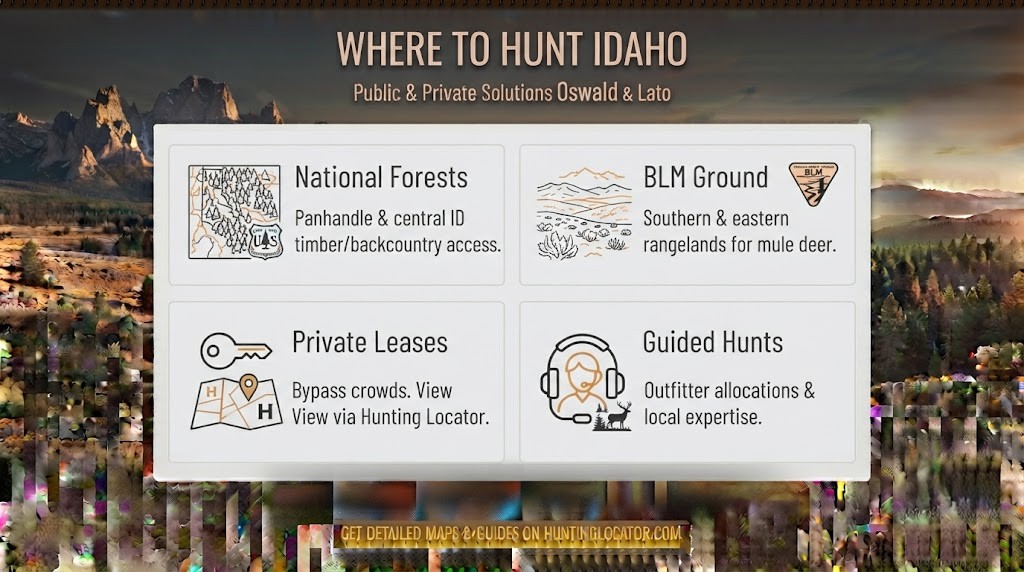
Idaho’s public-land base — spanning national forest and BLM ground — gives hunters enormous room to roam, especially in the backcountry units favored for mule deer. If you’re chasing whitetail specifically, the Panhandle units (1, 2, 3, 4A, 5, and 6) consistently produce some of the state’s highest deer densities.
- National forest land across the Panhandle and central Idaho offers extensive access for both archery and rifle hunters
- BLM ground in the southern and eastern parts of the state supports strong mule deer populations
- Prime whitetail units in the Panhandle region reward hunters willing to scout timbered draws and river bottoms
- Backcountry units for mule deer often require more physical effort but reward hunters with less competition
CWD testing is mandatory within 10 days of harvest in certain units, including 14, 18, 23, 24, 32A, and parts of Unit 1. Unit boundaries and access rules are set by Idaho Fish and Game, so confirm the specifics for wherever you plan to hunt.
Private Land Hunting with Hunting Locator
Public land gets crowded, especially during peak rut when everyone’s chasing the same bucks. Private land changes the equation: less pressure, often better whitetail concentrations, and the flexibility to lease seasonal access or even explore buying land outright if you’re ready to put down roots in Idaho hunting country.
This is where Hunting Locator comes in. We’re a marketplace connecting hunters directly with landowners who lease or sell hunting land — no middleman, no guesswork about whether a listing is legitimate. You search by state, game type, or acreage, connect directly with the landowner, and secure your spot. It addresses the two biggest headaches hunters face every year: not knowing where to look, and running out of time to look before the season starts.
Right now, Idaho’s lease listings include opportunities like:
- Panhandle whitetail ground — wooded acreage in the northern units known for dense whitetail populations
- Southern Idaho mule deer country — open rangeland and foothill terrain suited to spot-and-stalk hunting
- Mixed-game properties — leases that combine deer access with elk or upland bird opportunities on the same ground
- Smaller acreage tracts — ideal for hunters who want quality access without a large-group lease commitment
Listings change regularly, so browse current Idaho leases now and lock down your access before opening day.
Guided Hunts
If you’re short on time to scout, new to Idaho, or want the local knowledge a guide brings, a guided hunt can be a good way to fill your tag with less legwork on your end. Idaho publishes nonresident tag allocations to outfitters each year, reflecting how significant guided hunting is to the state’s nonresident hunting economy.
Guided hunts are one path among several — they’re not a requirement, and plenty of hunters do just as well going the self-directed route through a private lease or public land. They suit hunters who value convenience and local expertise over handling all the scouting themselves.
Idaho Deer Hunting Tips
A little preparation goes a long way toward a successful Idaho deer season. Here are the tips that matter most, whether this is your first hunt or your fifteenth.
- Scout before the opener — Getting eyes on your unit before season opens, even a few weeks ahead, tells you far more than any forum post or map study.
- Layer for Idaho’s extremes — Early archery season can bring warm, dry conditions, while late rifle hunts in the mountains regularly deliver snow and bitter cold. Layering keeps you comfortable and safe across that range.
- Match your rifle to the terrain — Versatile calibers like .270, .308, 6.5 Creedmoor, or .30-06 handle everything from tight timber shots to long crossings over open basins, making them solid all-around choices for Idaho’s varied terrain.
- Time the rut — Many northern Panhandle general seasons run into early December, putting you in the field during peak rut activity when mature bucks move more freely.
- Confirm your unit’s rules — Bag limits and species restrictions shift from unit to unit, so double-check the current regulations for wherever you’re hunting.
- Report your harvest — Idaho requires a mandatory harvest report after the season, whether or not you filled your tag.
Once your season’s dialed in, make sure your gear is too. From optics to layering systems to packs built for long days in the backcountry, gear up at our store so you’re equipped for whatever Idaho’s terrain and weather throw at you.
More Resources from Hunting Locator
Planning more than deer this season? Here’s the rest of our Idaho hunting library, along with everything else Hunting Locator has to offer.
For the full picture on Idaho’s hunting calendar across every major species, start with our Idaho hunting season guide. And when you’re ready to stock up on gear for any hunt, the Hunting Locator store has you covered.
Hunting other species in Idaho? Here’s where to find season details for each:
Big game:
- Elk — Idaho’s iconic backcountry big-game pursuit
- Black bear — spring and fall opportunities across multiple units
- Antelope — open-country hunting in southern Idaho
- Moose — controlled-hunt-only, highly sought-after tags
- Bighorn sheep — a once-in-a-lifetime draw hunt
- Mountain goat — rugged, high-elevation pursuit
Predators:
- Coyote — year-round opportunity with liberal limits
- Mountain lion — houndsmen and spot-and-stalk options alike
Birds/upland:
- Turkey — spring gobbler action statewide
- Upland game — chukar, quail, and grouse across varied terrain
- Migratory bird — dove and other migratory opportunities
- Waterfowl — duck and goose hunting along Idaho’s waterways
Frequently Asked Questions
How much does a nonresident Idaho deer tag cost in 2026?
A nonresident adult deer tag runs $351.75, on top of the $185.00 nonresident hunting license. If you’re hunting archery or muzzleloader, add the $81.75 permit validation. Budget for all three pieces before you commit to a trip — none of them are optional for a legal hunt.
What is the resident Idaho hunting license fee?
Idaho residents pay $15.75 for a hunting license, plus approximately $19.75 for a resident deer tag — a modest total compared to nonresident costs.
When does deer season start in Idaho in 2026?
Archery and muzzleloader seasons both open August 30, general any-weapon opens September 15, and the whitetail short-range weapon season opens October 10. Exact closing dates vary by unit, so confirm your specific GMU’s schedule with Idaho Fish and Game before finalizing plans.
Do I need hunter education to hunt deer in Idaho?
Yes — first-time hunters born after December 31, 1974, must complete an IDFG- and IHEA-USA-approved hunter education course before they can buy a hunting license. Hunters who’ve held a license in Idaho or another state previously are typically exempt from retaking the course.
What’s the difference between a controlled hunt and a general season?
General season tags are first-come, first-served — buy one and you’re set. Controlled hunts are awarded through a random drawing and require an application ahead of time; the 2026 deer controlled hunt deadline was June 5. Both require the underlying hunting license and tag.
Do nonresident archery hunters need a special permit in Idaho?
Yes — nonresidents hunting archery or muzzleloader weapon classes must add an $81.75 permit validation on top of their standard license and tag. This requirement doesn’t apply to nonresidents hunting the general any-weapon season.
How can I find private land to hunt deer in Idaho?
Hunting Locator connects hunters directly with landowners offering deer hunting leases across the state. Browse current Idaho hunting leases to see what’s available near your preferred unit, then connect directly with the landowner to work out the details.
The Final Shot
Idaho’s 2026 deer season comes down to three things: knowing your dates, budgeting for the right license and tags, and locking down where you’re going to hunt. Archery and muzzleloader open August 30, general any-weapon follows on September 15, and whitetail short-range weapon season starts October 10 — with every closing date depending on your specific unit.
Confirm your unit’s dates with Idaho Fish and Game, buy your license and tag, and secure your hunting ground. That last piece is where a lot of hunters run out of runway, scrambling for access right as the season approaches instead of locking it down months in advance.
Treat Idaho Fish and Game as the final word on unit-specific dates and regulations — this guide gets you close, but they confirm the details that matter for your exact hunt. What we can help with is everything that comes after: matching you with real hunting ground before the crowds show up. When you’re ready to turn this Idaho Deer Season Guide for 2026 into an actual hunt, browse our leases and gear at Hunting Locator.


