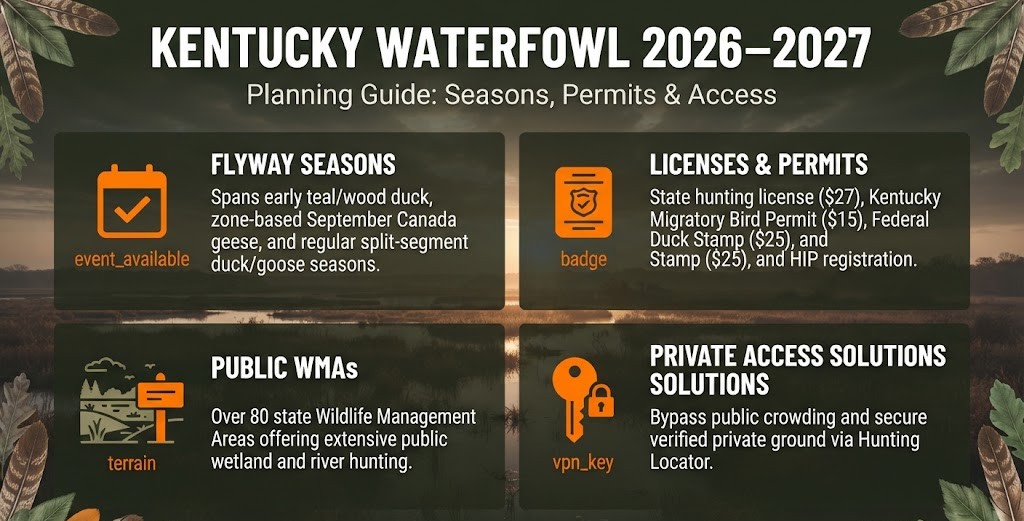
This Kentucky waterfowl guide pulls together every confirmed 2026–2027 date, bag limit, license requirement, and access option in one place.
As the platform connecting hunters to land access nationwide, Hunting Locator exists to make finding your next hunt simpler, whether that means confirming a date on the calendar or securing a private lease before the birds show up.
This article covers what you need to plan a legal Kentucky waterfowl season, whether you’re a longtime resident, a non-resident planning a trip, or hunting waterfowl here for the first time:
- Confirmed 2026–2027 season dates and bag limits by species — ducks, geese, coots, mergansers, and special seasons, all in one place
- License, permit, and hunter-education requirements for residents and non-residents, spelled out step by step
- Where to hunt — public Wildlife Management Areas, private leases, and guided hunts
Kentucky manages its waterfowl harvest as part of the Mississippi Flyway Council framework, a cooperative agreement between 14 states, 3 Canadian provinces, and federal oversight from the U.S. Fish and Wildlife Service. That’s why these dates and limits carry real regulatory weight. Here are the fast answers first.
Kentucky Waterfowl Season at a Glance: Quick Overview
The table below reflects the confirmed 2026–2027 regulations for Kentucky waterfowl, as finalized for this season.
| Species / Season | Season Type | Dates (2026–2027) | Daily Bag Limit | Notes |
|---|---|---|---|---|
| Teal & Wood Duck | Early | Sept. 19–23, 2026 | 6 daily (max 2 wood ducks) | Early opportunity |
| September Canada Goose (Western Zone) | Early | Sept. 1–15, 2026 | 5 daily | Western Zone counties |
| September Canada Goose (Eastern Zone) | Early | Sept. 16–30, 2026 | 5 daily | All other counties |
| Duck, Coot & Merganser | Regular (split) | Nov. 26–29, 2026, then Dec. 7, 2026–Jan. 31, 2027 | Duck 6; Coot 15; Merganser 5 (max 2 hooded) | See sub-species duck limits below |
| Canada/Cackling Goose, White-fronted Goose & Brant | Regular | Nov. 26, 2026–Feb. 15, 2027 | 5 combined (max 3 Canada, 2 white-fronted, 1 brant) | Combined dark-goose limit |
| Light Goose Conservation Order | Special | Feb. 16–March 31, 2027 | 20 daily (no possession limit) | Snow/Ross’s geese |
| Youth-Only Waterfowl | Special | Nov. 21, 2026, and Feb. 13, 2027 | Per regular limits | Youth 15 & under |
| Military/Veteran-Only Waterfowl | Special | Nov. 22, 2026, and Feb. 14, 2027 | Per regular limits | Active duty & honorably discharged |
| Sandhill Crane | Quota | Dec. 7, 2026–Jan. 31, 2027 | Per permit | Permit application: Sept. 1–30 |
These dates reflect the official 2026–2027 season as confirmed, but check final details with KDFWR (fw.ky.gov) before you head afield. For more on Kentucky waterfowl, see our full Kentucky waterfowl hub.
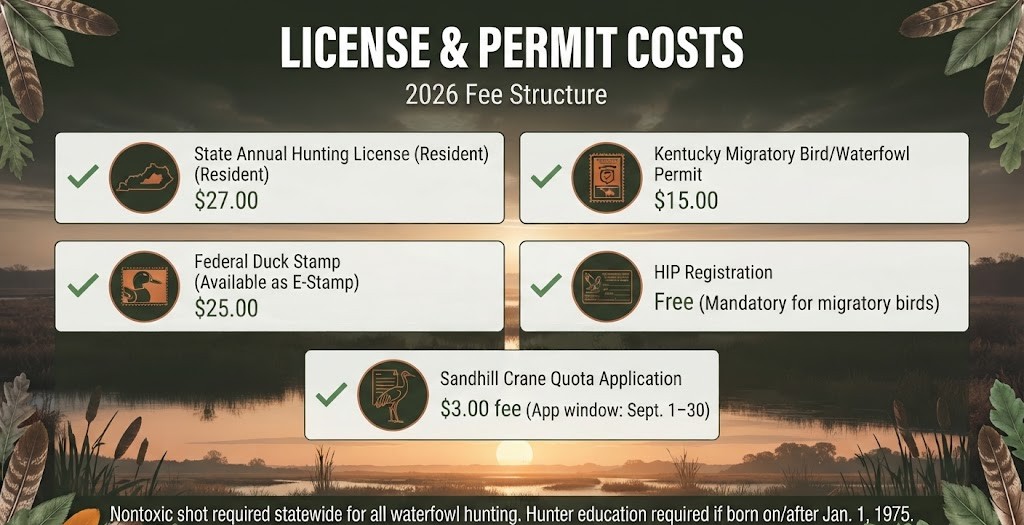
Before you hunt, you’ll also need this stack of credentials:
- State Annual Hunting License — $27.00 for residents (non-resident fees vary — more on this below)
- Kentucky Migratory Bird/Waterfowl Permit — $15.00 for both residents and non-residents
- Federal Duck Stamp — $25.00, now available digitally as a Federal Duck E-Stamp
- HIP (Harvest Information Program) — mandatory registration for all migratory bird hunters
- Hunter Education — required if you were born on or after Jan. 1, 1975, unless exempt
- Nontoxic shot — required for all waterfowl hunting, statewide
Kentucky Waterfowl Hunting Seasons by Species
Kentucky’s waterfowl calendar isn’t one long season. It’s several distinct seasons stacked across the fall and winter, each with its own dates, zones, and rules. The simplest way to stay organized is to match your target species, zone, permit, and method window before planning a trip. These seasons are set within the Mississippi Flyway framework and finalized by KDFWR, so cross-check specifics against the official guide before you go.

Early Teal & Wood Duck Season
The earliest waterfowl opportunity of the year runs Sept. 19–23, 2026, with a daily limit of 6 birds (max 2 wood ducks). It’s a short window, but a low-pressure way to start the season before goose and regular duck seasons ramp up. Nontoxic shot is required, as it is for every waterfowl season in the state.
September Canada Goose Season (Zone-Based)
This is where Kentucky’s zone system first comes into play, and it directly affects your dates. The Western Zone runs Sept. 1–15, 2026, while the Eastern Zone runs Sept. 16–30, 2026 — both with a 5-bird daily limit. County-by-county zone boundaries are spelled out in the official KDFWR waterfowl guide, so confirm which zone your hunting county falls into before finalizing plans. This matters most for out-of-state hunters — booking the wrong week because you assumed statewide dates is an easy mistake to make.
Regular Duck, Coot & Merganser Season
The regular duck season is split into two segments: Nov. 26–29, 2026, then reopening Dec. 7, 2026–Jan. 31, 2027. The gap is a standard rest period built into the split-season structure to give birds a breather during the transition.
Within the overall 6-duck daily limit, several species carry their own sub-limits:
| Species | Limit Within Daily 6-Duck Bag |
|---|---|
| Mallards | Max 4 (no more than 2 hens) |
| Wood ducks | Max 3 |
| Redheads | Max 2 |
| Pintails | Max 3 |
| Black ducks | Max 2 |
| Canvasbacks | Max 2 |
| Scaup | Varies by dates |
Coot carries a separate 15 daily limit, and merganser is 5 daily (max 2 hooded). If you’re planning weekends around the split, build your calendar around this structure.
Regular Goose Season (Canada/Cackling, White-fronted & Brant)
The regular goose season runs Nov. 26, 2026–Feb. 15, 2027, with a 5 combined daily limit — capped at 3 Canada, 2 white-fronted, and 1 brant. This is a combined limit rather than separate limits per species, so keep track of your count in the field when mixing species.
Special Seasons: Youth, Military/Veteran, Sandhill Crane & Light Goose
Kentucky also carves out several special seasons for specific groups and situations:
- Youth-Only Waterfowl — Nov. 21, 2026, and Feb. 13, 2027. A low-pressure entry point for hunters 15 and under.
- Military/Veteran-Only Waterfowl — Nov. 22, 2026, and Feb. 14, 2027, open to active duty service members and honorably discharged veterans.
- Sandhill Crane — Dec. 7, 2026–Jan. 31, 2027, requires a quota permit. The application period runs Sept. 1–30, with a $3.00 application fee.
- Light Goose Conservation Order — Feb. 16–March 31, 2027, allowing 20 daily with no possession limit for snow and Ross’s geese.
Kentucky Waterfowl Licenses and Permits
Every waterfowl hunter in Kentucky needs a specific stack of credentials before heading out, and the requirements are easy to mix up if you’re new to the sport. This section breaks down what you need and where to get each piece.
There are four distinct pieces: your state hunting license is your base permission to hunt in Kentucky; the Kentucky Migratory Bird/Waterfowl Permit is a state add-on specifically for migratory birds; the Federal Duck Stamp is a separate federal requirement; and HIP registration is a mandatory harvest-survey sign-up rather than a purchase in the usual sense.
Kentucky Hunting Licenses (Resident & Non-Resident)
Here’s how the core costs break down:
| License / Permit | Resident | Non-Resident |
|---|---|---|
| State Annual Hunting License | $27 | Fees vary — confirm with KDFWR |
| Kentucky Migratory Bird/Waterfowl Permit | $15 | $15.00 |
| Federal Duck Stamp | $25.00 | $25 |
The Federal Duck Stamp is now available digitally as a Federal Duck E-Stamp through KDFWR’s licensing portal, so you don’t need to track down a physical stamp at a post office before your hunt. Non-resident license costs vary and aren’t fixed in this guide — confirm current pricing directly with KDFWR before you finalize travel plans, since arriving under-licensed can derail an otherwise well-planned trip.
Kentucky Hunting Permits: What You Need & How to Get Them
Here’s the practical sequence for getting everything in order:
- Buy your state hunting license (unless you qualify for an exemption).
- Add the Kentucky Migratory Bird/Waterfowl Permit ($15.00).
- Purchase your Federal Duck Stamp ($25.00) — the digital E-Stamp option through KDFWR’s portal makes this quick.
- Complete HIP registration, mandatory for all migratory bird hunters.
- If you’re pursuing sandhill crane, submit your quota permit application during the Sept. 1–30 window for $3.00.
The distinction between a “license” and a “permit” trips people up: your license is general permission to hunt in Kentucky, while permits like the Migratory Bird/Waterfowl Permit are additional, species-specific add-ons layered on top. All of these are administered through KDFWR, so verify current requirements there before your season starts.
Where to Hunt Waterfowl in Kentucky
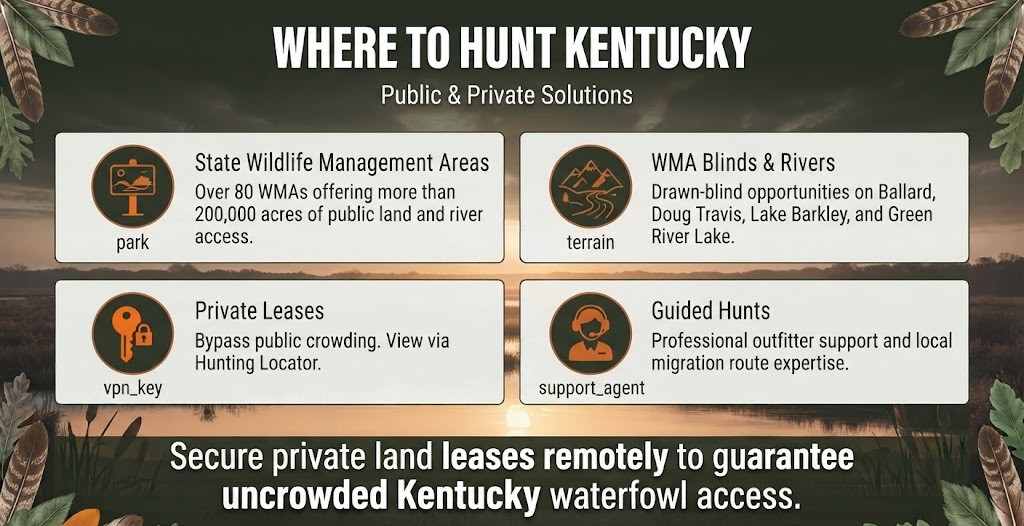
Once your license and permits are squared away, the question becomes where you’ll actually hunt. Kentucky hunters generally choose between three paths: public Wildlife Management Areas, private leases, and guided hunts. The right choice depends on your time, budget, and how far you’re traveling.
Best Public Lands & WMAs for Waterfowl
Kentucky offers over 80 Wildlife Management Areas covering more than 200,000 acres. A few worth putting on your radar:
- Ballard WMA — a well-known western Kentucky destination for waterfowl hunters
- Peabody WMA — frequently cited for waterfowl-related planning
- Big Rivers WMA — broad opportunity across a large tract
- Green River Lake WMA — one of the areas with drawn-blind hunts
If you’re drawn for a blind on Doug Travis, Lake Barkley, Green River Lake, or Barren River Lake WMAs, you’re responsible for locating, preparing, and maintaining that blind site for the entire 2026–2027 season, though you can name a co-owner to use it in your absence. Public land can deliver good hunts, but it also means more competition and more advance research. Check KDFWR’s maps for exact boundaries and drawn-hunt details before committing a weekend to a specific WMA.
Private Land Hunting with Hunting Locator
Losing access to a reliable spot — or never finding one in the first place — is one of the more frustrating parts of waterfowl hunting. Public land gets crowded fast, and birds get wise to pressure quickly. Private land access means fewer hunters competing for the same water, better-managed habitat, and generally more consistent opportunity season after season.
There are two real paths here: leasing private land for hunting, which gives you seasonal or weekend access without the long-term commitment of ownership, and buying hunting land outright, for hunters ready to control their own spot for good. Which one makes sense depends on how often you hunt and how much you’re ready to invest.
This is the gap Hunting Locator exists to close. As a platform, we connect hunters directly with landowners who are ready to lease or sell, with verified listings, direct landowner contact, and detailed property information covering acreage, game species, and pricing, so you know what you’re getting before you make a call. Instead of cold-calling landowners or hoping a random online post is legitimate, you get a searchable, vetted marketplace built specifically for this.
If you’re ready to lock in where you’ll hunt this winter, browse Kentucky waterfowl leases and see what’s currently available near you.
Guided Waterfowl Hunts
For hunters unfamiliar with Kentucky’s terrain, especially non-residents, a guided hunt can offer a turnkey experience without the guesswork of scouting new water from scratch. When evaluating any guided option, keep a few things in mind:
- Verified access — confirm the outfitter or guide has legitimate, established permission to hunt the property or water they’re offering
- Clear pricing — get exact costs and what’s included (gear, lodging, birds cleaned, etc.) in writing before you commit
- Species targeted — make sure the hunt matches what you’re actually after, whether that’s ducks, geese, or a mixed bag
- Local knowledge — a guide’s value comes largely from their familiarity with local bird movement and water conditions
If you’d rather have direct control over your access instead of relying on a guide, Hunting Locator’s platform gives you a verified path to that same land without the middleman.
Kentucky Waterfowl Hunting Tips
A few gear and tactical fundamentals go a long way toward a productive Kentucky waterfowl season, regardless of experience level.
- Match Your Shot to the Rules — Nontoxic shot is required statewide, so carry loads sized appropriately for the birds you’re after — smaller shot for ducks, heavier loads for geese.
- Build a Realistic Decoy Spread — A well-set spread draws birds within range instead of letting them flare off at a distance; adjust your spread’s size to match the species and water you’re hunting.
- Prioritize Concealment — A well-brushed blind that blends naturally with surrounding cover is often the biggest difference-maker between a slow morning and a limit.
- Learn Duck Identification — Correct identification in the field keeps you legal on sub-species limits like mallards, pintails, and canvasbacks, where mistakes are easy to make under pressure.
- Plan Around the Split — Use the rest-period gap between Nov. 30 and Dec. 6 to scout new water so you’re dialed in for the stronger December–January stretch.
Before opening morning arrives, it’s worth taking stock of your gear. You can get equipped for the season through the Hunting Locator store, where you’ll find gear that supports the tips above.
More Resources from Hunting Locator
Whether you’re locking down land access or planning your next Kentucky hunt beyond waterfowl, these resources can help:
- Kentucky Waterfowl Leases — Browse verified private-land waterfowl opportunities across the state.
- Hunting Locator Homepage — Search leases and land nationwide by state, game type, or acreage.
- Hunting Locator Store — Gear up for your waterfowl season with the right equipment.
- Kentucky Waterfowl Hunting Season Hub — Our broader Kentucky waterfowl resource for deeper planning.
- Kentucky Hunting Season Overview — The full-state season rundown across all game.
- Kentucky Deer Hunting Season — For hunters chasing whitetail alongside waterfowl.
- Kentucky Turkey Hunting Season — Spring and fall turkey planning.
- Kentucky Elk Hunting Season — Kentucky’s elk opportunity explained.
- Kentucky Black Bear Hunting Season — Kentucky’s bear season details.
Frequently Asked Questions
What are the Kentucky duck season dates for 2026–2027?
The regular duck season is split: Nov. 26–29, 2026, then reopening Dec. 7, 2026–Jan. 31, 2027. The early Teal & Wood Duck season runs Sept. 19–23, 2026. Daily limit is 6 ducks. Confirm final dates with KDFWR before hunting.
Do I need a federal duck stamp to hunt waterfowl in Kentucky?
Yes — hunters 16 and older need a Federal Duck Stamp ($25.00), plus the Kentucky Migratory Bird/Waterfowl Permit and HIP registration. The stamp is now available digitally as a Federal Duck E-Stamp through KDFWR’s licensing portal.
What is the Kentucky non-resident waterfowl license requirement?
Non-residents need a Kentucky non-resident hunting license plus the same $15.00 Migratory Bird/Waterfowl Permit, $25.00 Federal Duck Stamp, and HIP registration as residents. Non-resident license fees vary — confirm current pricing with KDFWR before you travel.
When is Kentucky youth waterfowl hunting in 2026?
Youth-only waterfowl days are Nov. 21, 2026, and Feb. 13, 2027. Youth hunters 15 and under generally hunt under a youth license, and the Federal Duck Stamp and state waterfowl permit aren’t required for hunters under 16. A qualifying adult must accompany young hunters.
Do Kentucky hunters need hunter education?
Anyone born on or after Jan. 1, 1975, must complete hunter education, unless covered by an allowed exemption such as the temporary hunter-education exemption permit. Verify current requirements and exemptions with KDFWR before purchasing your license.
How do I apply for the Kentucky sandhill crane permit?
The sandhill crane season runs Dec. 7, 2026–Jan. 31, 2027, with a quota-hunt application period of Sept. 1–30 and a $3.00 application fee. Apply through KDFWR during that window for a chance at the drawing.
What are the Kentucky goose bag limits for 2026–2027?
September Canada goose is 5 daily (Western Zone Sept. 1–15; Eastern Zone Sept. 16–30). Regular dark geese allow 5 combined daily (max 3 Canada, 2 white-fronted, 1 brant). Light goose allows 20 daily with no possession limit during the conservation order.
The Final Shot
Kentucky’s 2026–2027 waterfowl season involves a lot to track — 20 season segments, multiple zones, sub-species limits, and a stack of licenses and permits. It comes down to a simple framework: match your species, your zone, your permit, and your method window, and the rest falls into place. This guide gave you every confirmed date and requirement in one spot so you can spend less time researching and more time planning your hunt.
From here, the next steps are straightforward: confirm your target season and zone, lock in your license, permit, stamp, and HIP registration, then secure your access, whether that’s a public WMA or a private spot of your own. Verify final regulatory details with KDFWR (fw.ky.gov) before you head afield, since state guides can be updated as the season approaches.
Teal season opens Sept. 19. Browse Kentucky waterfowl leases to line up your access before the season gets underway.


