This Arkansas alligator guide recaps the 2026 rules and covers how to prepare for next season. It lays out what the hunt costs, when to apply, and where you can legally hunt, whether you’re an Arkansas resident entering the public draw or a non-resident who must hunt private land. Hunting Locator is the planning and access resource here, matching the regulations to actual places to hunt.
What the guide covers:
- 2026 season dates, night hours, bag and size limits, and how the private-land quota works
- License and permit costs for residents and non-residents, plus the July application steps
- Where to hunt: public draw areas, private land leases through Hunting Locator, and questions to ask about guided hunts
If you only need the numbers, start with the quick overview.
Arkansas Alligator Season 2026: Quick Overview
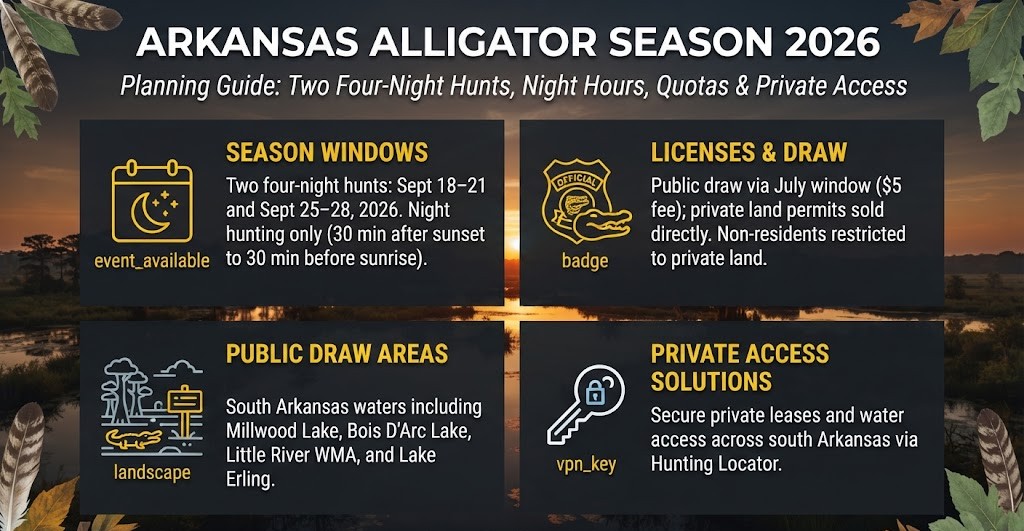
Arkansas’s 2026 alligator season ran as two four-night hunts, Sept 18–21 and Sept 25–28, with hunting allowed only at night. The same dates applied to public and private land, though private land can close early once a zone’s quota is met.
| Category | Public Land (Draw) | Private Land (Quota) | Notes |
|---|---|---|---|
| Season dates | Sept 18–21 and Sept 25–28, 2026 | Sept 18–21 and Sept 25–28, 2026 | Private land may close early if the zone quota is met |
| Hunting hours | 30 min after sunset to 30 min before sunrise | Same | Night only |
| Bag limit | 1 per permit holder per year | Same | — |
| Size limit | 4 ft minimum | Same | — |
| Access | Drawn permit only; residents | Permit sold directly; residents and non-residents | Non-residents: private land only |
| Legal method | Snare or harpoon by hand, restraining line attached, then dispatch with firearm or bang stick | Same | Only the permit holder snares, harpoons, and dispatches |
Paperwork requirements:
- A valid Arkansas hunting license, in addition to the alligator permit:
- Resident Sportsman’s/Combination: $25.00–$35.50
- Nonresident All-Game: $410.00
- Alligator permit/tag: about $300, varying by tag category
- Public land draw: $5 nonrefundable application fee; the 2026 window ran July 1–31 via the AGFC Permit Application Schedule
- Mandatory hunt orientation for successful applicants
- Hunter education: Arkansas hunter education rules apply to licensing, so confirm your status with AGFC
Non-Residents, Read This First. Non-residents are restricted to private land and cannot enter the public draw. Private land is your only route, so browse Arkansas hunting leases early.
Regulations can change annually; confirm with AGFC before you hunt.
Alligator Hunting Seasons in Arkansas
Arkansas runs two four-night alligator hunts on the last two weekends of September. Three open Alligator Management Zones (AMZs) cover the south of the state:
- AMZ 1: southwest Arkansas
- AMZ 2: south-central Arkansas
- AMZ 3: southeast Arkansas
On private land, the season works like a shared bag for the whole zone. Once the quota fills, the season in that zone is over, so check nightly. The official AGFC alligator season page lists the dates, and private-land hunters call 833-345-0398 after 2 p.m. on hunt day to learn whether their zone’s quota has been met. According to AGFC, hunters took 181 alligators in a recent season.
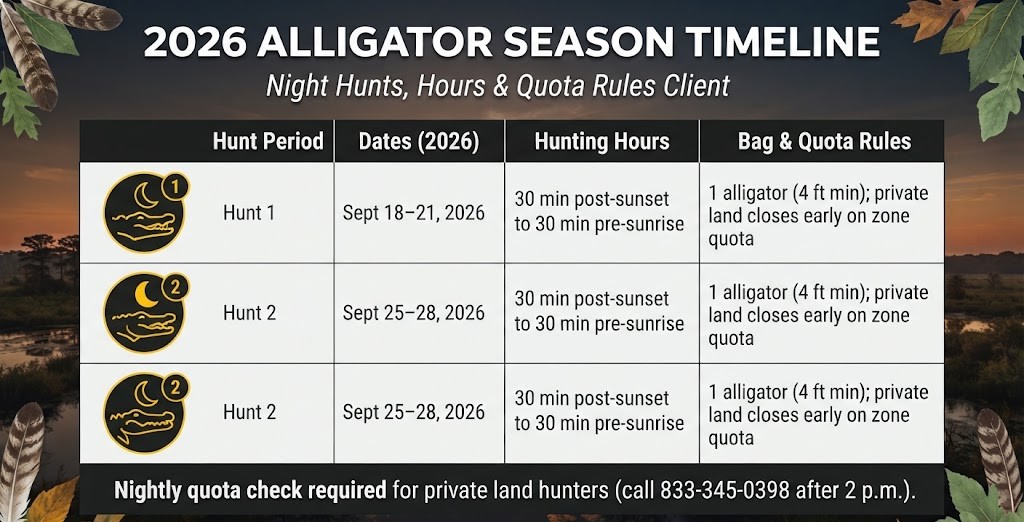
Season 1: September 18–21, 2026
The opening hunt ran four nights, Sept 18–21, 2026. Hunting hours ran from 30 minutes after sunset to 30 minutes before sunrise, so planning centers on darkness: boat lights, navigation, and knowing your water before the sun goes down.
Public draw permit holders hunted their assigned area. Private-land hunters called 833-345-0398 after 2 p.m. each hunt day, or checked agfc.com, to see whether the zone quota had been met.
Season 2: September 25–28, 2026
The second hunt ran Sept 25–28, 2026. The season ended 30 minutes before sunrise on Sept 28, or earlier in any zone where the quota was met.
The quota system favors taking a legal alligator over holding out for a bigger one. If a zone filled during Hunt 1, Hunt 2 may never have opened there, which is a good reason to line up access early.
Arkansas Alligator Licenses and Permits
Hunting alligators in Arkansas takes two things: a valid hunting license and an alligator permit. The cost differs for residents and non-residents.
Arkansas Hunting Licenses
Every alligator hunter needs a base Arkansas hunting license in addition to the alligator permit.
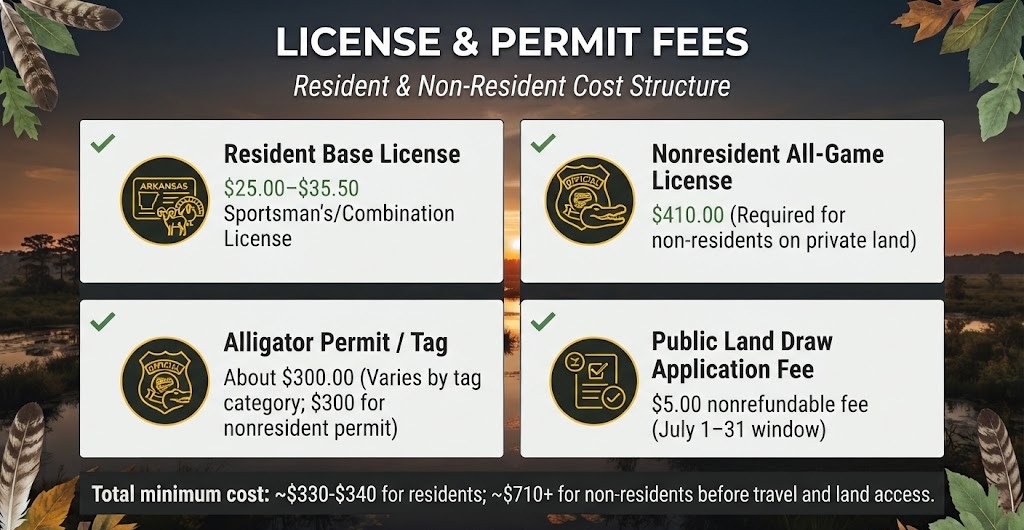
| License/Permit | Who Needs It | Cost | Notes |
|---|---|---|---|
| Resident Sportsman’s/Combination | Arkansas residents | $25.00–$35.50 | Base license required |
| Nonresident All-Game | Non-residents | $410.00 | Private land only |
| Alligator Permit/Tag | All alligator hunters | About $300 | Varies by tag category; the Nonresident Alligator Permit is $300 |
| Public Land Application Fee | Residents applying for the draw | $5 | Nonrefundable; July 1–31 window in 2026 |
Added up, the costs look like this:
- Resident: about $330–$340 or more, including the $5 application fee if you apply for the draw
- Non-resident: about $710 or more before travel, lodging, and land access
These are 2026 figures, so confirm current fees with AGFC. For the state’s other seasons, see our statewide Arkansas hunting season overview.
Arkansas Alligator Hunting Permits
Public land permits come only through the AGFC draw. Private land permits are sold directly and are subject to the zone quota. The public draw works like this:
- Watch for the application window. In 2026 it ran 8 a.m. July 1 to 11:59 p.m. July 31 via the AGFC Permit Application Schedule. It has historically opened each July, so watch AGFC for next year’s schedule.
- Choose your zone or public hunt area.
- Pay the $5 nonrefundable application fee.
- If drawn, complete the mandatory hunt orientation.
- Buy your hunting license and alligator permit/tag.
Private land is simpler on the permit side. Anyone, resident or non-resident, may buy a private land permit. Hunting ends early in a zone once its quota fills, and you need legal access to private land, which the next section covers.
Resident tip: If you miss the draw, buy a private land quota system permit and lease land. Anyone may purchase one, but the season ends early if the zone quota is met.
Other details to know:
- Permit counts are limited. Public permits have historically been scarce. One recent year saw 50, and sources note fewer than 100 annually.
- Helpers: Up to three helpers have historically been allowed; confirm in the current guidebook.
- Permit-holder rule: Only the permit holder may snare, harpoon, and dispatch the alligator.
- Tagging and check-in: Follow the instructions issued with your permit or at orientation.
Where to Hunt Alligators in Arkansas
Alligator hunting is limited to south Arkansas. Public waters are for draw winners only, and everyone else hunts private land, so the first decision is whether to apply for the draw or lease land.
Best Public Lands
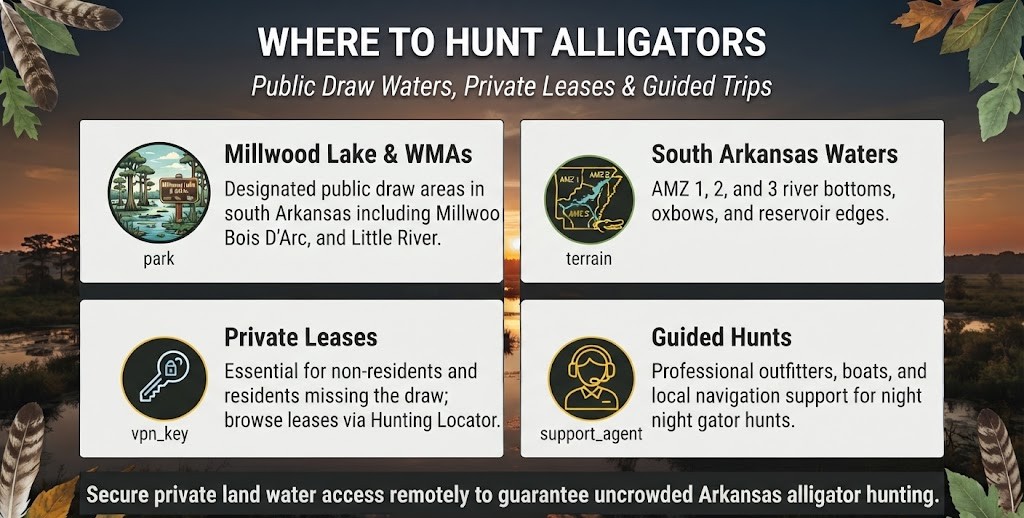
In 2026, public hunting was by drawn permit on designated areas of WMAs, lakes, and rivers in south Arkansas. These were the named areas in AMZ 1:
- Millwood Lake: 13 permits, harvest quota of 9. Millwood hunter success rates have ranged from 25 to 75 percent in recent years.
- Dr. Lester Sitzes III Bois D’Arc Lake
- Little River WMA
- Lake Erling
AMZ 2 and AMZ 3 also have designated areas. Check the AGFC zone map, because areas and permit numbers can change each year.
Private Land Hunting with Hunting Locator
Private land is the only option for non-residents and the best backup for residents who miss the draw. A lease gives you legal permission to hunt the property, but you still need your license and private land permit.
When you evaluate a property, look for:
- Water access: oxbows, river bottoms, or reservoir edges in south Arkansas
- Zone location: which Alligator Management Zone the property sits in
- Night boat access: whether the landowner allows it
Arkansas leases on Hunting Locator range from under $1,000 to $15,000+ annually, and current listings are pulled live from the site. If you’d rather own, recreational land with water access in south Arkansas can give you long-term access, and Hunting Locator is built for that search.
Hunting Locator connects hunters directly with landowners who lease or sell land, which cuts down the time spent chasing access. You can search by state, game type, or acreage, and browse Arkansas hunting leases on Hunting Locator to see what’s available now.
Landowners in south Arkansas with gator water can list their property to reach responsible, licensed hunters during a season when private access is in demand. Hunters should lock in a lease well before next September.
Guided Hunts
A guided hunt suits first-timers and non-residents who want help with the water, the boat, and the process. Pricing varies, so ask each outfitter directly.
Before you book, ask:
- Do they hunt private land with valid permits?
- Do they understand the zone quota and the nightly check?
- Who provides the boat and gear?
- Is processing included?
- Is the license or tag included, or extra?
Only the permit holder can harpoon or snare and dispatch the gator. A guide can assist but cannot take the animal for you. To find landowners and outfitters, start with Arkansas hunting leases on Hunting Locator.
Alligator Hunting Tips
Build your gear and plan around the method: line attached first, then subdue, then dispatch. These tips put ethics and safety first:
- Know the method order: Snare or harpoon by hand, attach a restraining line, subdue the gator, then dispatch it with a firearm or bang stick.
- Respect the permit-holder rule: Only the tag holder snares, harpoons, and dispatches.
- Measure before you commit: The 4-ft minimum is strict. Carry a tape measure and practice judging length.
- Scan for eyeshine: Use a strong spotlight to find red eyes at the surface.
- Treat night boating safety as a requirement: Wear PFDs, carry navigation lights, and scout the water in daylight first.
- Check the quota every night: On private land, call 833-345-0398 after 2 p.m. or check agfc.com.
- Take the first legal gator: With one tag and a possible early close, holding out can cost you the season.
- Plan processing ahead: Line up meat processing and hide care before the hunt.
Snare poles, spotlights, tape measures, and boat safety gear are in our alligator hunting gear section at the Hunting Locator store.
More Resources from Hunting Locator
Resources for planning next season:
- Find land: Arkansas hunting leases. Browse private land and contact landowners directly.
- Gear up: Hunting Locator store. Lights, snare poles, and safety gear.
- Plan your season: Arkansas hunting season guide. A statewide, all-species overview for the year ahead.
FAQ
When is Arkansas alligator season?
Sept 18–21 and Sept 25–28, 2026, night only. Private land can close early once a zone quota is met. Both 2026 hunts are over, so watch AGFC for next year’s dates and application window.
Can non-residents hunt alligators in Arkansas?
Yes, on private land only. Non-residents need the $410 Nonresident All-Game license plus the $300 alligator permit. They can’t enter the public draw, so start by browsing Arkansas hunting leases.
How much does an Arkansas alligator tag cost?
About $300, varying by tag category. With a license added, residents pay about $330 or more in total, and non-residents about $710 or more, before travel and land access.
When do I apply for the public land draw?
The 2026 window ran July 1–31, and it has historically opened every July. Applicants pay a $5 nonrefundable fee. Watch AGFC for next year’s schedule.
What are the hunting hours?
Alligators may be hunted only at night: from 30 minutes after sunset until 30 minutes before sunrise.
What’s the size limit?
4 feet minimum. Each permit holder may take 1 alligator per year, so measure carefully before you commit to the shot.
What happens if the quota is met?
The private-land season closes in that zone. Call 833-345-0398 after 2 p.m., or check agfc.com, before each night’s hunt so you don’t launch the boat for nothing.
What methods are legal?
Snare or harpoon by hand, attach a restraining line, subdue the alligator, then dispatch it with a firearm or bang stick. Only the permit holder may snare, harpoon, and dispatch.
Can I lease land for gator hunting?
Yes. Leases on Hunting Locator run from under $1,000 to $15,000+ annually. Landowners with south Arkansas water can also list their property to connect with licensed hunters.
Do I need hunter orientation or education?
Successful draw applicants must complete a mandatory hunt orientation. Hunter education rules apply to licensing, so confirm your status with AGFC. Regulations can change annually; confirm with AGFC before you hunt.
The Final Shot
Arkansas alligator hunting has a few fixed points: two four-night hunts, night only, one gator of 4 feet or longer, the public draw for residents, private land for everyone, and a nightly quota check. Use this guide as a checklist for next year.
Three steps will put you ahead:
- Budget the cost stack. Know your license, permit, and application fees before you commit.
- Mark July on your calendar. The application window has historically opened each July.
- Secure private land now. Access is the piece most hunters leave too late.
Watch the AGFC site for next year’s official schedule. To start on access now, find your Arkansas hunting lease well before September.


