This Minnesota elk guide covers season dates, licenses, the lottery, party rules, and where to hunt in the northwest corner of the state. Hunting Locator connects hunters with landowners, so use this guide as a planning reference and access hub for the next cycle.
- 2026 dates and tags: the seasons, zones, and how the 12 licenses were split
- How the draw works: the fee, deadline, reserved tags, and party rules for your 2027 Minnesota elk application
- Where and how to hunt: public land, private leases, guided options, and gear
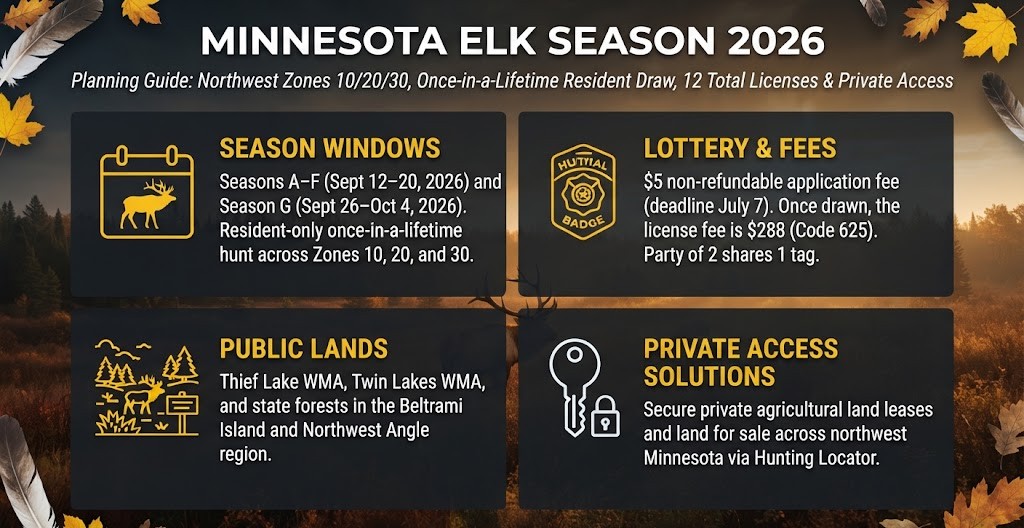
Minnesota Elk Season Quick Overview
Minnesota offered 12 licenses across three zones and seven seasons in 2026. “Either-sex” means you may take a bull or a cow, while “antlerless” means cows or calves only.
| Season | Dates | Hunt type | Bag limit | Notes |
|---|---|---|---|---|
| Seasons A–F | Sat, Sept 12 – Sun, Sept 20, 2026 | Either-sex (A, C, E) and antlerless (B, D, F) | 1 elk per lifetime | Zones 10, 20, 30; mandatory Friday orientation |
| Season G | Sat, Sept 26 – Sun, Oct 4, 2026 | Antlerless | 1 elk per lifetime | Zone 30; 4 licenses |
| Application | Closed July 7, 2026 | Lottery, $5 fee | — | Residents only; parties of 2 share 1 tag |
The Minnesota DNR elk hunting page confirms this is a resident-only, once-in-a-lifetime hunt. Applicants should know the following:
- Resident-only, once-in-a-lifetime: each hunter gets one elk license for life.
- Fees: a $5 non-refundable application fee, plus $288 for the license if you’re drawn.
- Orientation: every selected hunter must attend a pre-hunt orientation.
- Firearms safety: Minnesota generally requires a firearms safety certificate for hunters born after Dec 31, 1979. Confirm with the DNR.
- Legal firearm: centerfire, at least .220 caliber, loaded with single-projectile ammunition.
For general licensing beyond elk, see our Minnesota hunting season guide. If you’re not a Minnesota resident or weren’t drawn, you can explore Minnesota hunting leases.
Minnesota Elk Hunting Seasons
Minnesota’s elk range is in the northwest, where three herds live: Grygla, Kittson Central, and Kittson Northeast (Caribou-Vita). The DNR increased harvest opportunity in 2026 after aerial surveys counted more elk than the year before. Herd goals still weigh public interest in elk against landowner and farmer tolerance, which is part of balancing elk and farmer tolerance and why tag numbers stay small.
| Zone | Season | License type | Dates |
|---|---|---|---|
| 10 | A | Either-sex | Sept 12–20 |
| 10 | B | Antlerless | Sept 12–20 |
| 20 | C | Either-sex | Sept 12–20 |
| 20 | D | Antlerless | Sept 12–20 |
| 30 | E | Either-sex | Sept 12–20 |
| 30 | F | Antlerless | Sept 12–20 |
| 30 | G | Antlerless | Sept 26–Oct 4 |
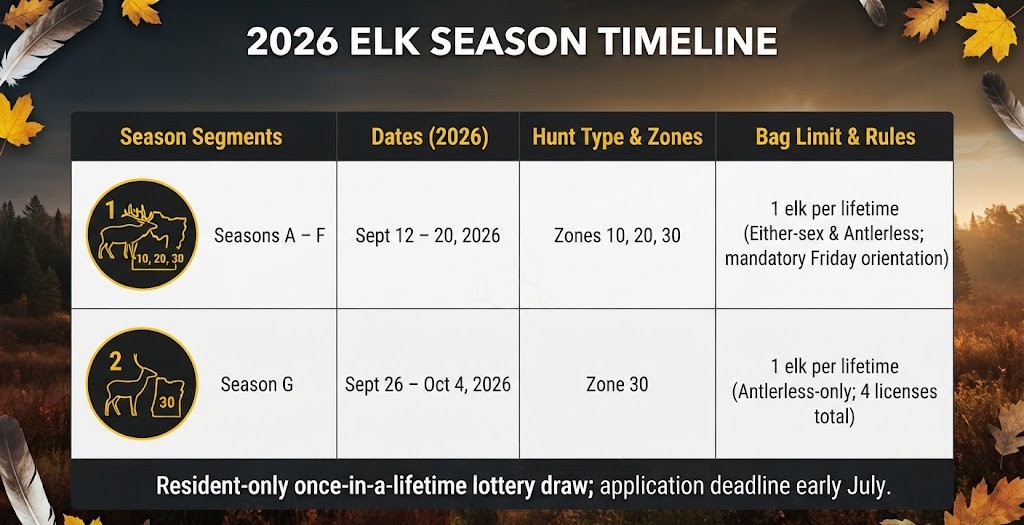
Seasons A–F (September 12–20, 2026)
These six seasons shared one nine-day window across all three zones. The three either-sex licenses came from Seasons A, C, and E, which is where the bull opportunity sits.
Past results are encouraging but no guarantee. In 2024, hunter success reached 60% in Zone 20 and 100% in Zone 30, according to the DNR’s 2024 elk harvest report.
Mandatory orientation: All selected hunters must attend a pre-hunt orientation on the Friday immediately before their scheduled hunt. Party partners should plan to attend too. Verify the location and details with the DNR once you’re drawn.
Season G (September 26 – October 4, 2026)
Season G was a later, antlerless-only hunt with 4 licenses in Zone 30. The later start can bring cooler weather, which helps with meat care.
The 2027 dates haven’t been announced yet. Check the DNR elk page in spring or summer.
Minnesota Elk Licenses and Permits
Costs come in two layers: the lottery application and the license you buy if you’re drawn.
Minnesota Hunting Licenses
| Item | 2026 detail |
|---|---|
| Application fee | $5, non-refundable, per hunter |
| License cost (if drawn) | $288, once-in-a-lifetime |
| Application deadline | July 7, 2026 |
| Total licenses | 12 (3 either-sex / 9 antlerless) |
| Reserved licenses | 2 for applicants with 10+ years of application history |
| Landowner tag | 1 for eligible agricultural landowners residing in Zone 30 (Caribou-Vita) |
The license code is 625. Applicants pick a season, zone, and license type when they apply. The DNR sets refund and transfer policies, so confirm those with them directly.
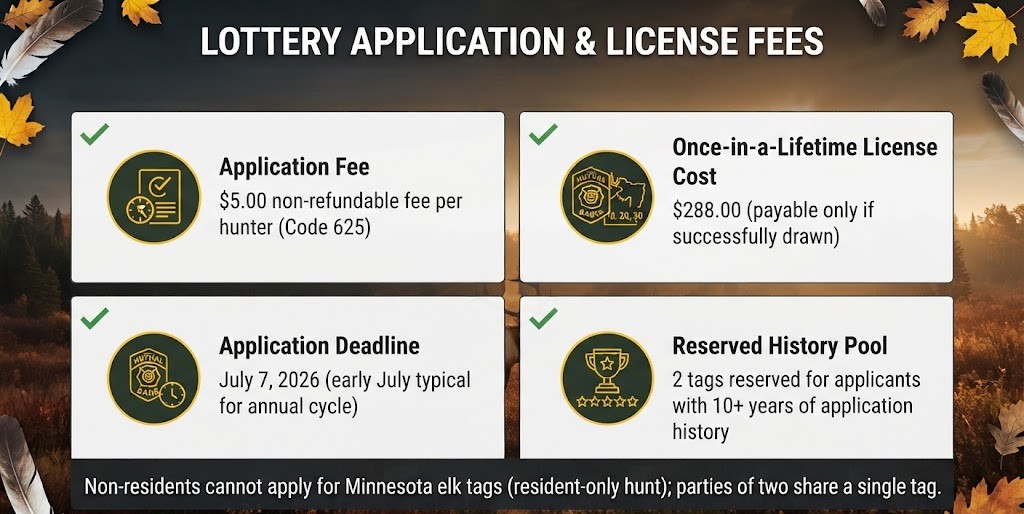
Minnesota Hunting Permits (Application and Lottery)
To apply for the 2027 draw:
- Confirm residency. The hunt is for Minnesota residents only.
- Choose solo or party. You can apply alone or in a party of two.
- Select your hunt. Pick a season, zone, and license type using code 625.
- Pay the $5 fee. Apply through the DNR electronic licensing system before the deadline (July 7 in 2026; early July is typical).
- Check the results. Watch for your DNR notification.
- Buy and prepare. If you’re drawn, purchase the $288 license and attend orientation.
Two tags sit in a “10-year application history pool,” reserved for applicants with 10 or more years of application history. If you’re drawn and decline to buy the license, you stay eligible for future hunts and earn an application point toward that 10-year history.
Party caution: two names, one tag, two lifetimes used. A party of two shares one tag, and the hunt counts as the once-in-a-lifetime hunt for both people. Decide deliberately before you apply together.
Your 2027 checklist:
- Watch the DNR elk page in spring or summer for dates and deadlines.
- Apply every year to build application history.
- Decide on a party partner early.
Minnesota Elk: Where to Hunt
Elk forage in open brushland and grassland, then retreat to forest for cover, as described in this overview of where elk live in Minnesota. Most northwest elk range is private agricultural land, so landowner permission matters as much as your tag.
Best Public Lands
Public land is limited in elk country, so confirm that any parcel falls within your zone before you go. These public lands sit in or near northwest elk range:
- Thief Lake WMA: a wildlife management area in the northwest; confirm it falls within your zone.
- Twin Lakes WMA: another northwest option to check against your zone.
- State forests in the Beltrami Island and Northwest Angle area: public ground in the region worth reviewing with the DNR.
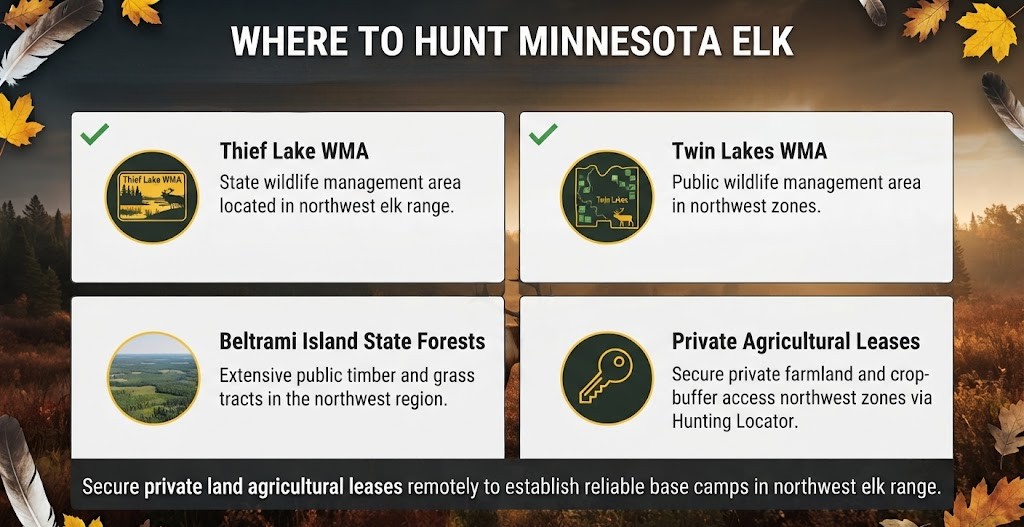
Private Land Hunting with Hunting Locator
Leasing private land gives you access, scouting time, and a relationship with the landowner. Elk can damage crops, so landowners value hunters who respect their property. Ask permission early, ideally before draw results come out.
Buying is another route. Minnesota hunting land for sale can give you a permanent base, whether you hunt elk, deer, or birds.
Hunting Locator connects hunters directly with landowners who lease or sell land. Browse Minnesota hunting leases and connect with landowners, or start at Hunting Locator to see what’s available. Non-residents can lease for deer, bear, and birds even though they can’t hunt Minnesota elk.
Guided Hunts
Hunting Locator has no Minnesota elk outfitter listings, so we can’t point you to specific outfitters. A drawn hunter still holds their own tag and must attend orientation, so any guide works alongside those requirements.
When evaluating a guide, check the following:
- Licensing and insurance: ask for proof of both.
- Landowner access: confirm they have access in your zone.
- References: talk to past clients.
- What’s included: get lodging, transport, and field support in writing.
- Meat handling: ask how they handle cooling and processing.
You can connect with outfitters and landowners through Hunting Locator. Non-residents seeking elk should look to western states’ elk programs.
Minnesota Elk Hunting Tips
A once-in-a-lifetime tag deserves careful preparation. Gear up at the Hunting Locator store so you’re ready when your number comes up.
- Get landowner permission early. Most elk range is private, so start those conversations before the draw results arrive.
- Glass open fields at first and last light. Elk feed in open ground and retreat to cover, so good optics from the store pay off.
- Choose a legal, adequate cartridge. Minnesota requires centerfire, at least .220 caliber, with single-projectile ammunition. Browse rifles and ammo with that rule in mind.
- Practice at realistic distances. Open farmland can mean longer shots, so shoot from field positions before your hunt.
- Plan for meat cooling in September warmth. Have meat-care gear and a plan ready before you pull the trigger.
- Scout while bird hunting. Sharp-tailed grouse and upland habitat overlap with elk country, and the Minnesota game bird season gives you a reason to walk the ground.
- Verify registration rules. Confirm harvest registration and reporting requirements with the DNR before your hunt.
More Resources from Hunting Locator
These Hunting Locator pages are grouped by what you need.
Plan your Minnesota hunt
- Minnesota hunting season guide: licensing and seasons across all Minnesota species.
- Minnesota elk hunting season: bookmark this page for 2027 updates.
Other Minnesota seasons
- Minnesota deer hunting season: dates and rules for whitetail hunters.
- Minnesota bear hunting season: a lottery-based hunt worth knowing about.
- Minnesota turkey hunting season: spring and fall turkey details.
- Minnesota small game hunting season: rabbits, squirrels, and more.
- Minnesota game bird hunting season: grouse, pheasant, and other upland birds.
- Minnesota waterfowl hunting season: ducks and geese.
- Minnesota furbearer hunting season: trapping and furbearer rules.
Access and gear
- Minnesota hunting leases: search private land by state.
- Hunting Locator home: leases, outfitters, and guides in one place.
- Hunting Locator store: gear for your next hunt.
FAQ
Can non-residents hunt elk in Minnesota?
No. The Minnesota elk hunt is open to residents only, and the DNR is the authority on eligibility. Non-residents can hunt deer and bear in Minnesota, so see our guides to deer and bear. For elk, look to western states’ elk programs.
How much does a Minnesota elk license cost?
Applying costs $5, and that fee is non-refundable. If you’re drawn, the once-in-a-lifetime license costs $288. Each hunter pays the application fee separately, even in a party of two.
When is the deadline to apply for the Minnesota elk lottery?
The 2026 deadline was July 7, and early July is typical. The 2027 deadline hasn’t been announced. Watch the DNR elk page in spring and summer, since the DNR sets the dates each year.
How does party hunting work?
Two applicants can apply together and share one tag. That means two names, one tag, and two lifetimes used: the hunt counts as the once-in-a-lifetime hunt for both partners, so decide carefully before applying as a party.
What are the reserved elk tags?
In 2026, two tags went to applicants with 10 or more years of application history. One landowner tag was available to eligible agricultural landowners residing in Zone 30 (Caribou-Vita). The DNR administers both.
What happens if I’m drawn and don’t buy the license?
You stay eligible for future elk hunts. You also earn an application point toward your 10-year application history. The DNR sets the specifics, so confirm any questions with them.
Do I have to attend the orientation?
Yes. Selected hunters must attend a mandatory pre-hunt orientation on the Friday before their hunt. Verify the location and details with the DNR after you’re drawn.
What caliber is legal for Minnesota elk?
Legal big game cartridges must be at least .220 caliber with centerfire ignition, loaded with single-projectile ammunition. Confirm current rules on the DNR elk page before you buy ammunition.
When will 2027 Minnesota elk dates be announced?
They haven’t been announced yet. The DNR posts elk dates on its elk hunting page, typically in spring or summer. Bookmark the page and check back.
The Final Shot
The 2026 Minnesota elk hunt came down to 12 tags, one lifetime per hunter, a party rule that uses both hunters’ chances, and a reserved pool for applicants with 10 or more years of history. If you didn’t draw this year, you added to your application history, which counts toward your next application.
Apply in 2027 through the DNR, and look into land access now by searching Minnesota hunting leases. Minnesota turkey season is one way to spend time in the field while you wait for the draw.


