This Rhode Island waterfowl guide collects the state-published dates, limits, and prices in one place so residents and non-residents can plan quickly. It also points to Hunting Locator, a marketplace that connects hunters with landowners who lease or sell hunting land, for anyone looking for a quieter place to hunt.
The guide covers:
- Every 2026–27 duck, goose, snow goose, and brant date and bag limit in one table
- The license, stamp, and HIP stack you need, with online and vendor prices
- Where to hunt: public marshes and WMAs, private leases, and guided options
The quick-reference table below is worth saving to your phone for the blind.
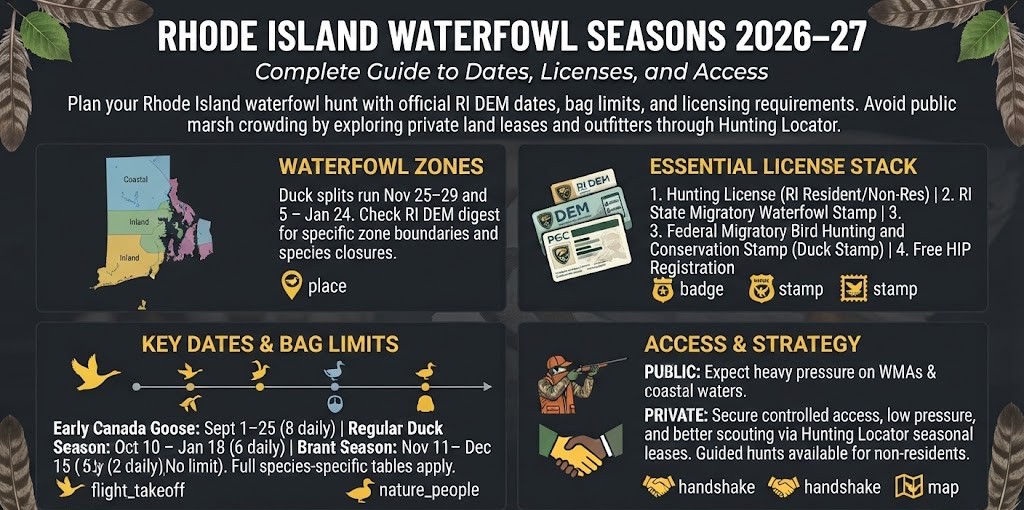
Quick Overview: Rhode Island Waterfowl Seasons at a Glance
For every species Rhode Island offers, see our full Rhode Island hunting season guide. As of November 2026, the early goose season and the first duck split have closed, and snow goose is open now. Confirm dates and limits with RI DEM Division of Fish and Wildlife before each hunt.
| Species | Season / Method | Dates | Daily Bag Limit | Notes |
|---|---|---|---|---|
| Ducks | Split 1 | Oct 9–12, 2026 | 6 (aggregate) | Closed |
| Ducks | Split 2 | Nov 25–29, 2026 | $6.00 | Species sub-limits apply |
| Ducks | Split 3 | Dec 5, 2026 – Jan 24, 2027 | $6.00 | Longest split |
| Canada goose | Early | Sept 1–30, 2026 | $15 | Closed |
| Canada goose | Regular | Nov 21–29, 2026 & Dec 5, 2026 – Jan 24, 2027 | 2 | Includes white-fronted geese |
| Canada goose | Late | Jan 30 – Feb 13, 2027 | 2 | Providence, Bristol, Kent, and portions of Washington County only |
| Snow goose (incl. blue) | Regular | Oct 14, 2026 – Jan 24, 2027 | 25 | No possession limit; open now |
| Brant | Regular | Dec 26, 2026 – Jan 24, 2027 | 1 | Coastal |
| Coots | With duck season | Duck season dates | 15 | Possession limit 30; separate from the duck limit |
| Mergansers | With duck season | Duck season dates | 5 (max 2 hooded) | In addition to the duck limit |
| All legal waterfowl | Active Military & Veterans | Nov 10–11, 2026 | Regular-season limits | Proof of eligibility required |
| All legal waterfowl | Youth days | Last full weekend in October (by rule) | Regular-season limits | Passed for 2026; check the RI DEM portal for next year |
| Harlequin duck, swans | — | Closed | 0 | Watch for misidentification |
Every waterfowl hunter needs the same paperwork: a current Rhode Island hunting license, the RI State Waterfowl Stamp, a Federal Duck Stamp (age 16 and older), and a free HIP permit. First-time hunters must complete hunter education before buying a license, and RI DEM can point you to current courses.
Non-resident checklist:
- Non-resident hunting license ($65 online / $68 at a vendor)
- RI State Waterfowl Stamp ($9.00 online / $9.50 at a vendor)
- Federal Duck Stamp
- Free HIP permit
Rhode Island Waterfowl Hunting Seasons
Rhode Island waterfowl seasons are set in “splits,” separate open windows timed to overlap peak migration instead of running as one continuous block. The dates sit inside the Atlantic Flyway framework that governs federal season structure. Woodcock, rails, and other migratory game birds follow related rules, covered in the Rhode Island migratory bird hunting season breakdown.
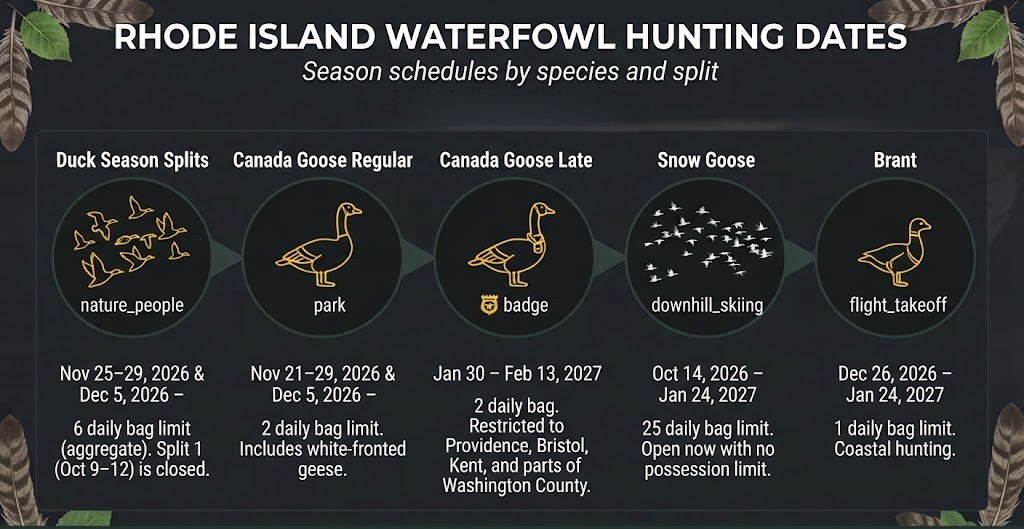
Duck Seasons
Rhode Island’s 2026–27 duck season runs in three splits:
- Split 1: October 9–12, 2026 (closed)
- Split 2: November 25–29, 2026
- Split 3: December 5, 2026 – January 24, 2027
The next opening is November 25, and the long December split is where most of the season’s hunting happens. The daily limit is 6 ducks in the aggregate, with species sub-limits inside that number:
| Species | Daily Limit (within the 6) |
|---|---|
| Mallard | 4 (no more than 2 hens) |
| Black duck | 2 |
| Pintail | 3 |
| Wood duck | 3 |
| Redhead | 2 |
| Canvasback | 2 |
| Scaup | 2 |
Sub-limits, scaup especially, can vary by split, so confirm them in the current DEM guide before each one.
Two groups of species catch hunters off guard. Mergansers are 5 daily, with only 2 hooded mergansers, and they are taken in addition to your duck limit. Coots are 15 daily with a possession limit of 30, also separate from the duck limit.
The lower black duck limit reflects Atlantic Flyway conservation management. Sea ducks, including eiders, scoters, and long-tailed ducks, offer coastal hunting around Narragansett Bay, but check the DEM guide for sea duck limits before you go.
Closed species: Harlequin ducks and swans are closed. Harlequins can be mistaken for female bufflehead, goldeneye, or scoters, so identify the bird before you shoot.
Canada Goose Seasons
Rhode Island splits Canada goose hunting into three seasons:
- Early season: September 1–30, 2026, 15 daily. This season has closed.
- Regular season: November 21–29, 2026 and December 5, 2026 – January 24, 2027. The limit is 2 daily, and white-fronted geese count toward it.
- Late season: January 30 – February 13, 2027, 2 daily. It is limited to Providence, Bristol, and Kent counties and portions of Washington County. Check the DEM map for the Washington County boundaries.
The late season suits traveling hunters who want a post-holiday trip with fewer hunters in the field.
Snow Goose & Brant
Snow goose (including blue geese): October 14, 2026 – January 24, 2027, with a 25-bird daily limit and no possession limit. This season is open now.
Brant: December 26, 2026 – January 24, 2027, 1 daily. Brant is a coastal bird and a common target for non-residents.
Special Seasons: Military, Veterans & Youth
Active Military & Veterans Waterfowl Season (new): November 10–11, 2026. Regular-season bag and possession limits apply. You need a current RI hunting license, HIP, the state stamp, and the Federal Duck Stamp, and you must carry proof of eligibility on your person. The full text is in the Rhode Island waterfowl hunting regulations.
Youth Waterfowl Days: By rule, these fall on the last full weekend in October. They have passed for 2026, so watch the RI DEM portal for next year’s dates. The rules to know:
- Youth hunters are ages 12–17.
- Ages 12–14 must be in the immediate company of a licensed adult aged 21 or older.
- One adult may accompany no more than 2 youths.
- Adults may not hunt on youth days.
Rhode Island Waterfowl Licenses and Permits
Waterfowl hunting in Rhode Island requires four things: a hunting license, the state waterfowl stamp, the Federal Duck Stamp, and a free HIP permit. Buying online saves a little on most items.
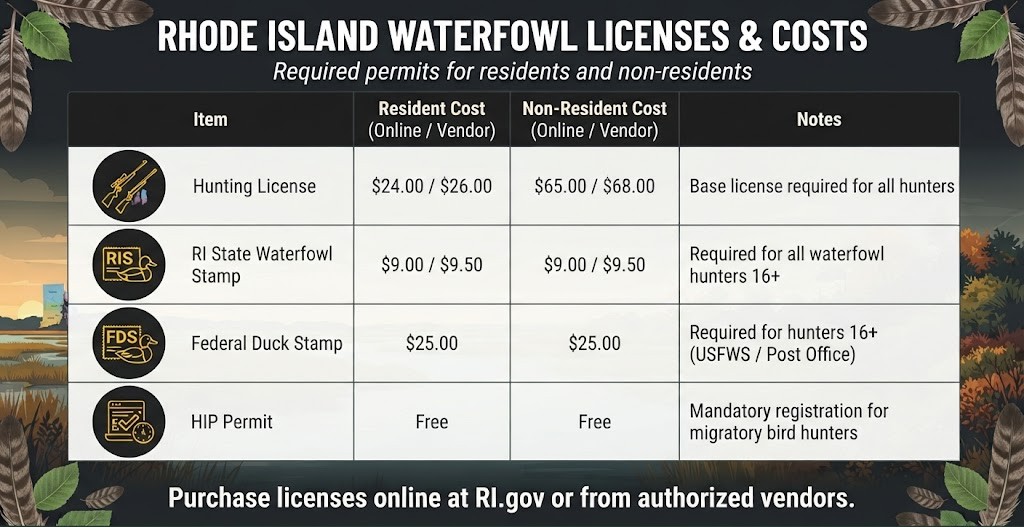
Rhode Island Hunting Licenses
| License | Online | Vendor | Who needs it |
|---|---|---|---|
| Resident hunting license | $24 | $26 | RI residents |
| Non-resident hunting license | $65 | $68 | Out-of-state hunters |
| Resident junior (12–14) | $14 | $16 | Resident youths aged 12–14 |
| Non-resident junior (12–14) | $40 | $43 | Non-resident youths aged 12–14 |
| Active military personnel | $24 | $26 | Active-duty service members |
| RI State Waterfowl Stamp | $9 | $10 | All waterfowl hunters 16+ |
| HIP permit | Free | Free | All migratory bird hunters |
| Federal Duck Stamp | $25 (via USFWS or post office) | — | All hunters 16+ |
Buying online saves $2–3 per item. The military license costs the same as the resident license. Youths aged 15–17 need a standard license, and first-time buyers need hunter education. As a sample budget, a non-resident adult pays $65 + $9 + $25 = $99 before travel, based on online prices.
Rhode Island Hunting Permits
The permits and requirements to know about:
- HIP: Free and required for migratory bird hunters.
- State stamp: Sign it in ink across the face, or carry the online certification from rio.ri.gov. The 2026–2027 migratory bird regulations cover the full stamp and HIP requirements.
- Federal Duck Stamp: Required for hunters 16 and older, and you must carry it on your person.
- South Shore Management Area goose fields: These require a permit or reservation. Check with DEM for current-season requirements.
- John H. Chafee NWR: Follows state seasons and requires a signed hunt brochure.
To get legal:
- Complete hunter education if this is your first license.
- Go to rio.ri.gov or a licensed vendor.
- Buy a resident, non-resident, junior, or military license.
- Add the RI State Waterfowl Stamp and register for HIP (free).
- Buy the Federal Duck Stamp through USFWS or a post office.
- Sign your stamps in ink or carry the certification. Add proof of eligibility for military days.
- Secure any area-specific permits (South Shore, refuge brochure).
Rhode Island Waterfowl: Where to Hunt
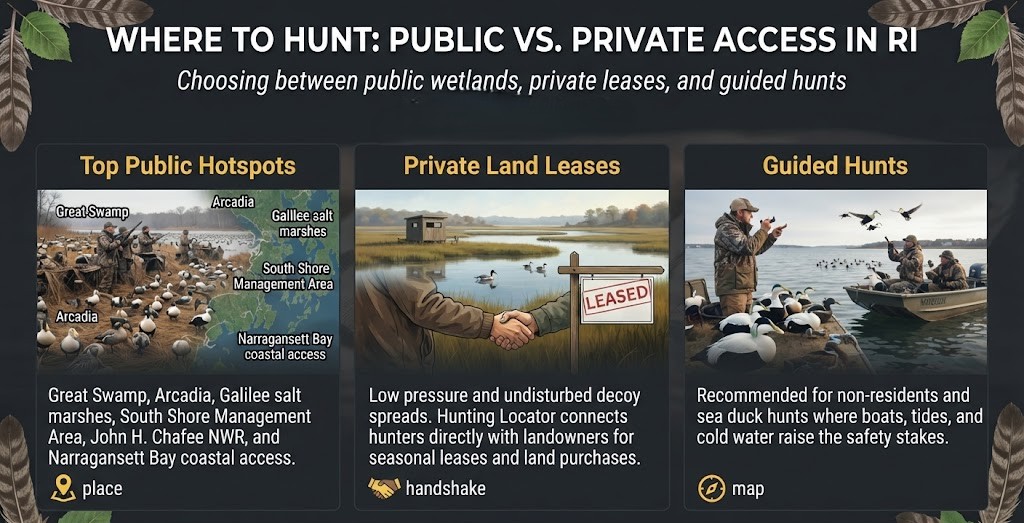
Rhode Island is small, dense, and coastal, so public hunting pressure is real. The options fall into three groups: public land, private land, and guided hunts.
Best Public Lands
These are the public areas Rhode Island waterfowl hunters look at first:
- Great Swamp: Inland wetland habitat in the Rhode Island WMA system.
- Arcadia: Management area with ponds and wooded wetlands.
- Galilee-area salt marshes: Coastal marsh habitat on the southern shore.
- South Shore Management Area goose fields: Requires a DEM permit or reservation.
- John H. Chafee NWR: Requires a signed hunt brochure and follows state seasons.
- Narragansett Bay coastal access: Primary water for sea duck hunters.
If crowded marshes are a problem, browse Rhode Island hunting leases.
Private Land Hunting with Hunting Locator
Leases offer less pressure, predictable access, and decoy spreads that stay undisturbed from one morning to the next. In a state this compact, that kind of quiet is hard to find on public ground.
A good lease starts with respect for the property. Get a clear written agreement, understand exactly where you have permission to hunt, and leave the land better than you found it. Landowners want hunters who treat their property like their own, and that trust keeps access open for years.
For the longest-term access, you can also buy hunting land. Searches for hunting land for sale in Rhode Island are the place to start, and landowners list parcels alongside leases.
Hunting Locator is a SaaS platform that connects hunters with landowners who lease or sell land. You can browse Rhode Island leases, contact landowners directly, and arrange access without cold-calling across the state. Search Rhode Island hunting leases to see what’s available for duck hunting leases in Rhode Island, or join Hunting Locator to start your search.
Guided Hunts
A guide makes the most sense for non-residents and for sea duck hunts, where boats, tides, and cold water raise the stakes. The table compares DIY and guided hunts:
To connect with waterfowl guides and outfitters, start at Hunting Locator.
Waterfowl Hunting Tips
A few habits help on Rhode Island’s crowded coastal water:
- Hunt the tide. Salt marsh and coastal pond birds move with the water, so time your setup around tide changes.
- Set up with the wind at your back. Birds land into the wind, so position your spread to bring them into your shooting lane.
- Prioritize concealment. Brush your blind thoroughly and stay still. Pressured birds flare at small mistakes.
- Match decoy spreads to salt marshes. Smaller, realistic spreads often outperform big ones on tight coastal water, and the right gear for coastal New England waterfowl makes setup faster.
- Use non-toxic shot. Federal law requires steel, bismuth, or tungsten for waterfowl, so stock up on non-toxic ammo from the Hunting Locator store before opener.
- Identify before you shoot. Hen mallards, scaup, and harlequins are the classic trouble spots, and sub-limits make misidentification costly.
- Layer for the late season. Cold, wet January mornings call for waterproof outerwear and insulating layers, and the Hunting Locator store is a good place to build your kit.
- Respect boat safety on sea duck hunts. Wear flotation, check the forecast, and never hunt alone in open water.
More Resources from Hunting Locator
These Hunting Locator pages are grouped by what you may need next.
Plan your waterfowl season:
- Rhode Island hunting season guide: Dates and limits for every species in the state.
- Rhode Island migratory bird hunting season: Migratory bird context, including HIP and related species.
- our ongoing Rhode Island waterfowl hunting season coverage: More on Rhode Island waterfowl seasons.
Find access:
- Hunting Locator homepage: Search leases, outfitters, and guides nationwide.
- Rhode Island hunting leases: Browse private land available in the state.
Gear up:
- Hunting Locator store: Gear for your next hunt.
Other Rhode Island seasons:
- Rhode Island deer hunting season: Dates, limits, and rules for deer.
- Rhode Island small game hunting season: Seasons for rabbit, squirrel, and other small game.
- Rhode Island predator hunting season: Coyote, fox, and other predator regulations.
- Rhode Island turkey hunting season: Turkey season dates and requirements.
FAQ
When does duck season open in Rhode Island in 2026?
Rhode Island’s 2026 duck season runs in three splits: October 9–12 (closed), November 25–29, and December 5, 2026 through January 24, 2027. The next opening is November 25. Verify with RI DEM before you hunt.
What do non-residents need to hunt waterfowl in Rhode Island?
Non-residents need a non-resident hunting license ($65 online / $68 vendor), the RI State Waterfowl Stamp ($9 online / $9.50 vendor), a Federal Duck Stamp (age 16+), and a free HIP permit. Online prices total about $99 with the Federal stamp. Verify with RI DEM.
Who qualifies for the Active Military & Veterans days?
The new season, November 10–11, 2026, is open to active military and veterans. You must carry proof of eligibility on your person, plus a current license, HIP permit, state waterfowl stamp, and Federal Duck Stamp. Regular-season bag limits apply. Verify with RI DEM.
Do youth hunters need stamps?
The Federal Duck Stamp is required at age 16 and older. State rules exempt youths aged 12–15 from the stamps, but accompanying adults need them. All youths and accompanying adults need a license and HIP permit. Confirm with RI DEM.
What is the daily duck bag limit?
The daily limit is 6 ducks in the aggregate, with sub-limits including 4 mallards (no more than 2 hens), 2 black ducks, 3 pintails, and 2 canvasbacks. Mergansers and coots are taken in addition to the duck limit. Verify with RI DEM.
Which counties are open for the late Canada goose season?
The late season, January 30 – February 13, 2027, is limited to Providence, Bristol, and Kent counties and portions of Washington County. Check the DEM map for the Washington County boundaries before you plan a trip. Verify with RI DEM.
Is the HIP permit free?
Yes. The Migratory Bird (HIP) permit has no fee, and every migratory bird hunter must have one. You can register through the online licensing system or a licensed vendor.
Do I need non-toxic shot?
Yes. Federal law requires non-toxic shot, such as steel, bismuth, or tungsten, for waterfowl hunting. Lead shot is not legal for ducks and geese, so check your shells before you head out.
Where can I hunt waterfowl on private land in Rhode Island?
Hunting Locator lists private land that landowners will lease for hunting. Search the less-crowded Rhode Island leases to compare properties and connect with owners directly.
The Final Shot
The dates ahead: military and veterans days on November 10–11, Canada geese on November 21, ducks on November 25, and brant on December 26. This guide has the dates, limits, and paperwork to hunt each window legally. Confirm every detail with RI DEM before you head out.
If you want private water for the December 5 split, browse Rhode Island hunting leases before then.


