Updated November 2026
This Arkansas migratory bird guide collects the 2026–27 dates, limits, and license requirements for every migratory bird season in Arkansas: ducks, coots, mergansers, geese, dove, woodcock, snipe, rail, and gallinule. It applies to residents and nonresidents. We put it together at Hunting Locator from the official 2026–27 regulations, and we also list private land for hunters who want an alternative to crowded public areas.
Inside, you’ll find:
- Season dates, bag limits, and possession limits for every migratory species, including what’s open right now, plus our full Arkansas hunting season calendar for other game.
- Licenses, stamps, HIP, and permit costs for residents and nonresidents, with a nonresident cost snapshot.
- Where to hunt (public WMAs, private leases, land for sale, and guided hunts) and how to hunt them well.
Start with the at-a-glance table, then go to the section for your species.
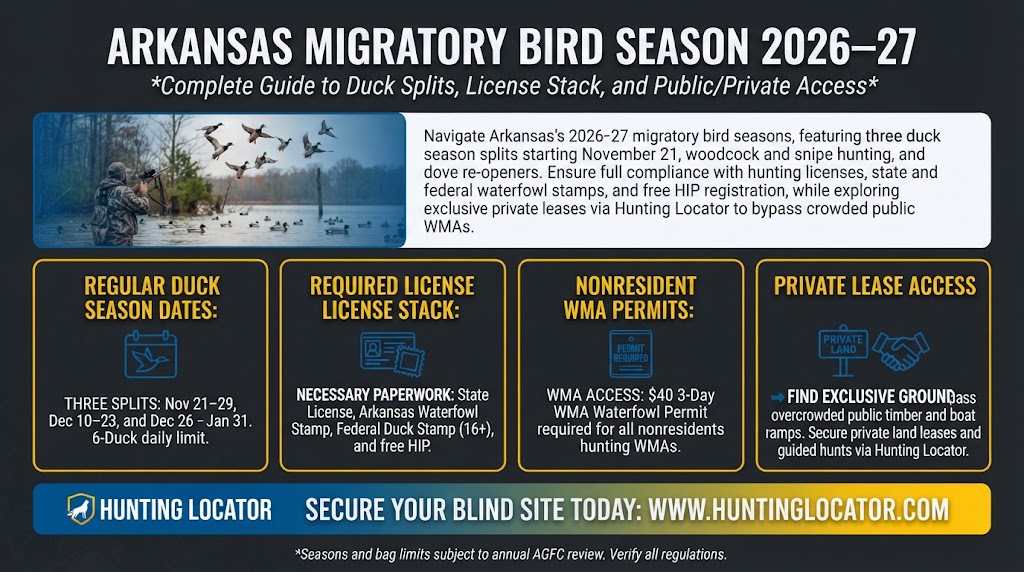
Arkansas Migratory Bird Season Quick Overview
Migratory birds are regulated by both the federal government and the state, so Harvest Information Program (HIP) registration applies to all of them. Two limits matter. The daily limit is what you can take in one day, and the possession limit is the total you can have on hand, usually three times the daily limit. The possession limit comes into play on multi-day trips.
The early migratory dates and limits below match the official listing on the AGFC early migratory bird seasons page.
| Species | Season Dates | Daily Limit | Possession | Notes |
|---|---|---|---|---|
| Ducks | Nov. 21–29, 2026; Dec. 10–23, 2026; Dec. 26, 2026–Jan. 31, 2027 | 6 (species sub-limits apply) | 18 (3× daily) | Opens Nov. 21; max 4 mallards (2 hens) |
| Coots | Same as ducks | $15.00 | 45 | Possession 3× daily |
| Mergansers | Same as ducks | 5 (max 2 hooded) | 15 (3× daily) | — |
| Special Early Teal | Sept. 19–27, 2026 | 6 (blue-winged, green-winged, cinnamon combined) | 18 | Closed; shooting began at sunrise |
| Youth Waterfowl Hunt | Feb. 6–7, 2027 | Same as regular duck limits | Same as regular | See youth section |
| Geese (regular) | See AGFC Early Migratory Birds Guide | Varies (light, dark, white-fronted) | Varies | Confirm splits with AGFC |
| Early Canada Goose | Sept. 1–Oct. 15, 2026 | $5 | 15 | Closed |
| Mourning & White-winged Dove | Sept. 5–Oct. 25, 2026; Dec. 8, 2026–Jan. 15, 2027 | 15 | 45 | Reopens Dec. 8 |
| Eurasian Collared-Dove | Same as dove | No limit | No limit | Must remain fully feathered |
| Virginia Rail & Sora | Sept. 12–Nov. 20, 2026 | 25 (combined) | 75 (combined) | Currently open (Nov. 13), closes Nov. 20 |
| Common & Purple Gallinule | Sept. 1–Nov. 9, 2026 | 15 | 45 | Closed |
| Wilson’s Snipe | Nov. 1, 2026–Feb. 15, 2027 | 8 | 24 | Currently open (Nov. 13) |
| Woodcock | Nov. 7–Dec. 21, 2026 | 3 | 9 | Currently open (Nov. 13) |
What’s open and what’s not (as of Nov. 13):
- Open now: woodcock, snipe, and rail (rail through Nov. 20).
- Up next: Duck Segment 1 (Nov. 21) and the dove reopener (Dec. 8).
- Already closed for 2026: early teal, early Canada goose, gallinule, and dove Segment 1.
Regulations can change mid-season, including emergency closures and WMA-specific rules. Verify with AGFC before every hunt.
Before you head out, make sure you have:
- Valid Arkansas hunting license (resident or nonresident)
- Arkansas Waterfowl Stamp (for ducks, geese, and coots; hunters under 16 are exempt)
- Federal Duck Stamp (for waterfowl hunters 16 and older)
- Free HIP registration (for all migratory bird hunters 16 and older, including dove, woodcock, snipe, and rail)
- 3-Day WMA Waterfowl Permit ($40), only for nonresidents hunting waterfowl on WMAs
- Hunter education, if it applies to you. Check AGFC for your specific requirement.
If WMA parking lots fill up before you arrive, Arkansas hunting leases are one way around the crowds.
Arkansas Migratory Bird Hunting Seasons
The duck splits anchor the Arkansas calendar, so the seasons below are grouped by hunting style: waterfowl first, then the special hunts, then the early and upland migratory birds. Arkansas is known for green timber hunting in flooded hardwood bottoms across the Delta, and Stuttgart carries the title “Duck Capital of the World.”
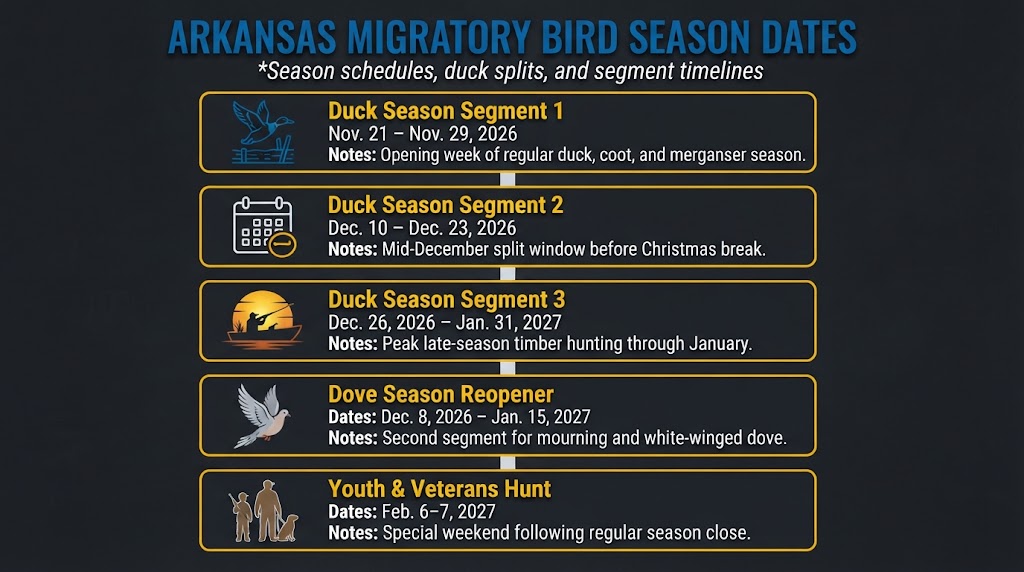
Season 1: Duck, Coot & Merganser Season (Three Splits)
Arkansas runs its regular duck, coot, and merganser season in three segments:
| Segment | Dates |
|---|---|
| Segment 1 | Nov. 21–29, 2026 |
| Segment 2 | Dec. 10–23, 2026 |
| Segment 3 | Dec. 26, 2026–Jan. 31, 2027 |
The gaps between segments (Nov. 30–Dec. 9 and Dec. 24–25) give birds a chance to rest and redistribute.
The daily limit is 6 ducks, which may include no more than:
- 4 mallards (no more than 2 hens)
- 3 wood ducks
- 3 pintails
- 2 redheads
- 2 canvasbacks
- 2 black ducks
- 1 mottled duck
- 1 scaup
- Any species not listed (such as teal or gadwall) may make up the full 6.
The sub-limits cap each species within the 6-bird total. For example, 4 mallards (2 drakes, 2 hens) plus 2 gadwall is a legal limit. A third hen mallard puts you over, even though you’re still under 6 ducks.
Coots have a daily limit of 15, and mergansers are 5 daily, including no more than 2 hooded mergansers. Possession limits for ducks, coots, and mergansers are three times the daily limit, which matters if you’re driving home after a multi-day trip.
Standard waterfowl shooting hours begin 30 minutes before sunrise, but many WMAs set earlier closing times, so check area-specific rules. Federal rules require nontoxic shot for waterfowl.
For more on ducks and geese, see our Arkansas waterfowl hunting season guide.
Regular light, dark, and white-fronted goose splits and limits vary, so we haven’t listed them here. Check the AGFC Early Migratory Birds Guide and the waterfowl guide above for specifics.
Season 2: Special Early Teal & Youth Waterfowl Hunt
Early teal: Sept. 19–27, 2026. This season has closed for 2026, but it’s worth planning around next September. Shooting hours began at sunrise rather than 30 minutes before. The daily limit was 6 (blue-winged, green-winged, and cinnamon teal combined), with a possession limit of 18.
Youth Waterfowl Hunt: Feb. 6–7, 2027. This weekend is commonly shared with a veterans hunt, so confirm eligibility details with AGFC. Youth under 16 are exempt from the Arkansas Waterfowl Stamp, while the Federal Duck Stamp and HIP apply at 16 and older. Check with AGFC on hunter education before you go.
Season 3: Dove, Goose, Woodcock, Snipe, Rail & Gallinule
The early and upland migratory seasons fill the calendar from September through February:
- Mourning & White-winged Dove: Sept. 5–Oct. 25, 2026 (closed) and Dec. 8, 2026–Jan. 15, 2027. Limit 15, possession 45. Mark the Dec. 8 reopener.
- Eurasian Collared-Dove: Same dates as dove, with no daily or possession limit. Birds must remain fully feathered in the field and during transport, which lets officers tell them apart from mourning doves.
- Early Canada Goose: Sept. 1–Oct. 15, 2026 (closed). Limit 5, possession 15.
- Woodcock (open now): Nov. 7–Dec. 21, 2026. Limit 3, possession 9. Look for lowlands near major waterways.
- Wilson’s Snipe (open now): Nov. 1, 2026–Feb. 15, 2027. Limit 8, possession 24. The season is long and hunting pressure is low.
- Virginia Rail & Sora (open through Nov. 20): Sept. 12–Nov. 20, 2026. Limit 25 combined, possession 75 combined.
- Common & Purple Gallinule: Sept. 1–Nov. 9, 2026 (closed). Limit 15, possession 45.
HIP is free, quick, and required for every migratory bird hunter 16 and older, even if you only hunt doves or woodcock.
If you plan to pair a woodcock walk with squirrels or rabbits, see our Arkansas small game hunting season guide.
Arkansas Migratory Bird Licenses and Permits
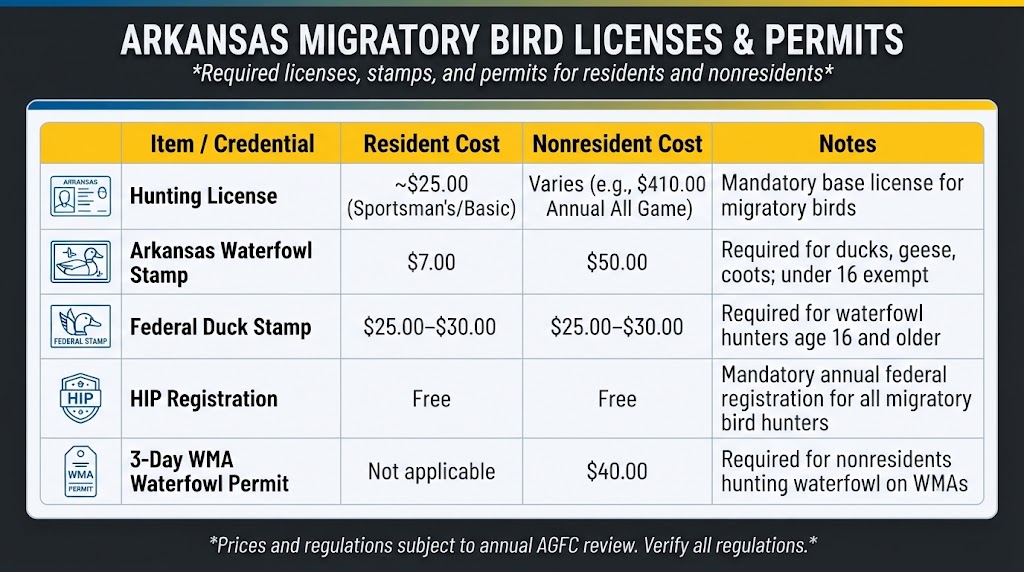
Your requirements stack up in this order: hunting license, Arkansas Waterfowl Stamp, Federal Duck Stamp, and HIP, plus the WMA permit if you’re a nonresident hunting a WMA. The next two sections cover what each piece costs and how to get it.
Arkansas Hunting Licenses
| Item | Resident | Nonresident | Notes |
|---|---|---|---|
| Hunting License | ~$25 (Sportsman’s/Basic) | Varies (e.g., $410 Annual All Game) | Required for all migratory birds |
| Arkansas Waterfowl Stamp | $7 | $50.00 | Ducks, geese, coots; under 16 exempt |
| Federal Duck Stamp | $25–$30 | $25–$30 | Waterfowl hunters 16+ |
| HIP Registration | Free | Free | All migratory bird hunters 16+ |
| 3-Day WMA Waterfowl Permit | Not applicable | $40.00 | Only for WMA waterfowl hunting; not needed on private land |
A resident duck hunter’s core cost runs roughly $57–$62 (license, Arkansas stamp, and federal stamp, with HIP free). That figure is an estimate.
For nonresidents, a typical duck trip adds up like this: $410 all-game license + $50 Arkansas Waterfowl Stamp + $25–$30 Federal Duck Stamp + $40 3-Day WMA permit (if hunting a WMA) = an estimated $525–$530, with HIP free. Hunting private land or with a guide removes the $40 permit. Prices can change, so confirm current pricing with AGFC before you buy. Hunter education may be required depending on your situation, so check AGFC. Dove, woodcock, snipe, and rail hunters need a license and HIP but not the waterfowl stamps.
Arkansas Hunting Permits
The main permit for nonresidents is the 3-Day WMA Waterfowl Permit. It costs $40 and is required for nonresidents hunting waterfowl on WMAs during regular duck season, in addition to a hunting license. It is not needed on private land. AGFC has offered longer-duration nonresident WMA permits in recent seasons, so check current availability.
HIP is free and required every season, and the easiest time to complete it is when you buy your license. The Arkansas Waterfowl Stamp is exempt for hunters under 16.
You can buy through AGFC online licensing, AGFC offices, or licensed vendors, and you should have everything in hand before opening day. No draw is required for these items, though individual WMAs may have their own permit or check-in rules, so check AGFC area regulations.
Step by step:
- Buy your hunting license (resident or nonresident).
- Add the Arkansas Waterfowl Stamp if you’re 16 or older and hunting waterfowl.
- Buy the Federal Duck Stamp for waterfowl.
- Register for HIP (free).
- Add the 3-Day WMA permit if you’re a nonresident hunting a WMA.
Where to Hunt Migratory Birds in Arkansas
Arkansas has good public land, but pressure at peak season is heavy. Your options are public WMAs, private leases or land you buy, and guided hunts.
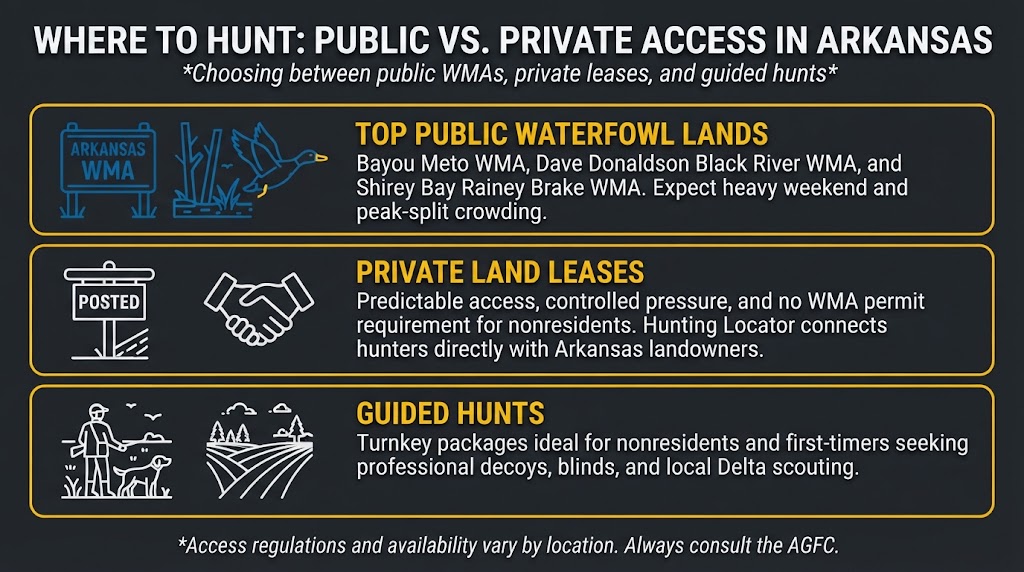
Best Public Lands
Public land is a cornerstone of Arkansas hunting tradition, and it’s worth hunting. WMA rules vary by area, so check with AGFC before you go.
Well-known public options include:
- Bayou Meto WMA: a well-known flooded timber destination for waterfowl hunters.
- Dave Donaldson Black River WMA: a widely known option for green timber duck hunting in northeast Arkansas.
- Shirey Bay Rainey Brake WMA: an eastern Arkansas area known among dove hunters for early-season birds.
- Before you go: check each WMA’s specific regulations, shooting hours, and permit rules with AGFC.
On a cold Saturday in Segment 3, public ground can be crowded. If WMA pressure is a problem, browse Arkansas hunting leases.
Private Land Hunting with Hunting Locator
A private lease gives you predictable access, less pressure, and room to scout, which helps when you only have a few weekends to hunt. Nonresidents also skip the $40 WMA permit on private ground. When you evaluate a lease, look at:
- Water management or flooding ability
- Proximity to the Delta or the Stuttgart area
- Access terms and rules
- The landowner relationship, which is built on respect for the property
For longer-term access, owning hunting ground is the most secure option, and Hunting Locator also lists hunting land for sale.
Hunting Locator connects hunters directly with Arkansas landowners who lease or sell hunting land. You can search by state and game type to find a waterfowl or upland spot. Duck season opens Nov. 21. Browse Arkansas hunting leases and lock in your spot before the next segment.
Guided Hunts
A guided hunt is the turnkey option, especially for nonresidents who can’t scout ahead.
Before you book, ask the outfitter:
- What’s included (blinds, decoys, dogs, lodging, bird cleaning)?
- Is the hunting on private land, which avoids the WMA permit?
- Which season segments are available, and is late December through January open?
- What are the group size and cancellation or weather policy?
- What license and stamps do I need to bring?
Mallard numbers typically peak from late December to mid-January, so Segment 3 is a good target. Search outfitters and hunting opportunities on Hunting Locator.
Arkansas Migratory Bird Hunting Tips
Good habits and the right gear for flooded timber, dove fields, and woodcock cover go a long way. Gear up at the Hunting Locator store.
- Hunt mid-week: Weekday hunts help you avoid public-land crowds.
- Follow the cold fronts: Hunts right after a front often see more birds.
- Target the late-season peak: Mallards typically peak from late December to mid-January.
- Know your sub-limits before shooting: Identify hen mallards carefully before you pull the trigger.
- Shoot nontoxic for waterfowl: It’s a federal requirement, so stock up on nontoxic shells before opening day.
- Stay dry in green timber: Quality waders and layers matter in flooded hardwoods, so shop waders and cold-weather gear.
- Dial in decoys and calls: Small spreads and soft calling suit timber holes. Browse decoys and calls.
- Scout woodcock in the lowlands: Check lowlands near major waterways while the season runs through Dec. 21.
- Keep collared-doves feathered: Leave them fully feathered in the field and during transport.
- Register HIP and carry proof: Keep proof with you on every migratory bird hunt.
More Resources from Hunting Locator
These guides cover the rest of the Arkansas hunting year, from the blind to the deer stand.
Bird & Small Game
- Arkansas waterfowl hunting season: duck and goose details, including goose splits.
- Arkansas migratory bird hunting season guide: bookmark this one; we update it when AGFC changes regulations.
- Arkansas small game hunting season: squirrel, rabbit, and more.
Big Game
- Arkansas deer hunting season: dates and rules for whitetail season.
- Arkansas elk hunting season: what to know about elk hunting in the state.
- Arkansas black bear hunting season: bear season dates and requirements.
- Arkansas turkey hunting season: spring and fall turkey details.
Other Opportunities
- Arkansas feral hog hunting season: a year-round option on many leases.
- Arkansas alligator hunting season: an Arkansas-specific hunt.
- Arkansas hunting season calendar: the statewide master calendar.
- Hunting Locator store: gear for every season.
FAQ
When does Arkansas duck season open in 2026?
Arkansas duck season opens Nov. 21, 2026. The three segments are Nov. 21–29, 2026; Dec. 10–23, 2026; and Dec. 26, 2026–Jan. 31, 2027. The daily limit is 6 ducks, with species sub-limits that apply. Verify with AGFC before you hunt.
What is the mallard limit in Arkansas?
You may take up to 4 mallards per day, no more than 2 of them hens, within the 6-duck daily limit. The possession limit is three times the daily limit, which matters on multi-day trips.
What licenses do I need to duck hunt in Arkansas as a nonresident?
You need a nonresident hunting license (for example, the $410 annual all-game license), the $50 Arkansas Waterfowl Stamp, a Federal Duck Stamp, and free HIP registration. If you’re hunting a WMA, add the $40 3-Day WMA Waterfowl Permit. Confirm current details with AGFC.
How much does an Arkansas duck hunting trip cost in licenses?
As an estimate, a resident’s core license costs run about $57–$62. A nonresident hunting a WMA should plan for roughly $525–$530 with the WMA permit. These are estimates, so verify with AGFC at purchase.
Do I need the 3-Day WMA permit on private land?
No. The 3-Day WMA Waterfowl Permit applies only to nonresidents hunting waterfowl on WMAs. If you hunt private ground, such as Arkansas hunting leases, you skip it.
When is the Arkansas youth waterfowl hunt?
The youth waterfowl hunt is Feb. 6–7, 2027. Hunters under 16 are exempt from the Arkansas Waterfowl Stamp. Confirm eligibility details with AGFC before the weekend.
When does Arkansas dove season reopen?
Dove season reopens Dec. 8, 2026, and runs through Jan. 15, 2027. The daily limit is 15, and the possession limit is 45.
Is woodcock or snipe season open now?
Yes, both are open as of Nov. 13. Woodcock runs Nov. 7–Dec. 21, 2026 with a 3-bird daily limit. Snipe runs Nov. 1, 2026–Feb. 15, 2027 with an 8-bird daily limit.
Is there a limit on Eurasian collared-doves?
There is no daily or possession limit on Eurasian collared-doves. Birds must remain fully feathered in the field and during transport.


