Here’s what you’ll find in this detailed Connecticut hunting guide:
- Complete license costs for residents and non-residents, plus all required stamps and permits
- Every season date for deer, turkey, small game, and furbearers
- Where to hunt including public lands, guided services, and private land access
Let’s jump straight into the most important stuff—license costs and season dates—then get into the species-specific details and best hunting spots across Connecticut.
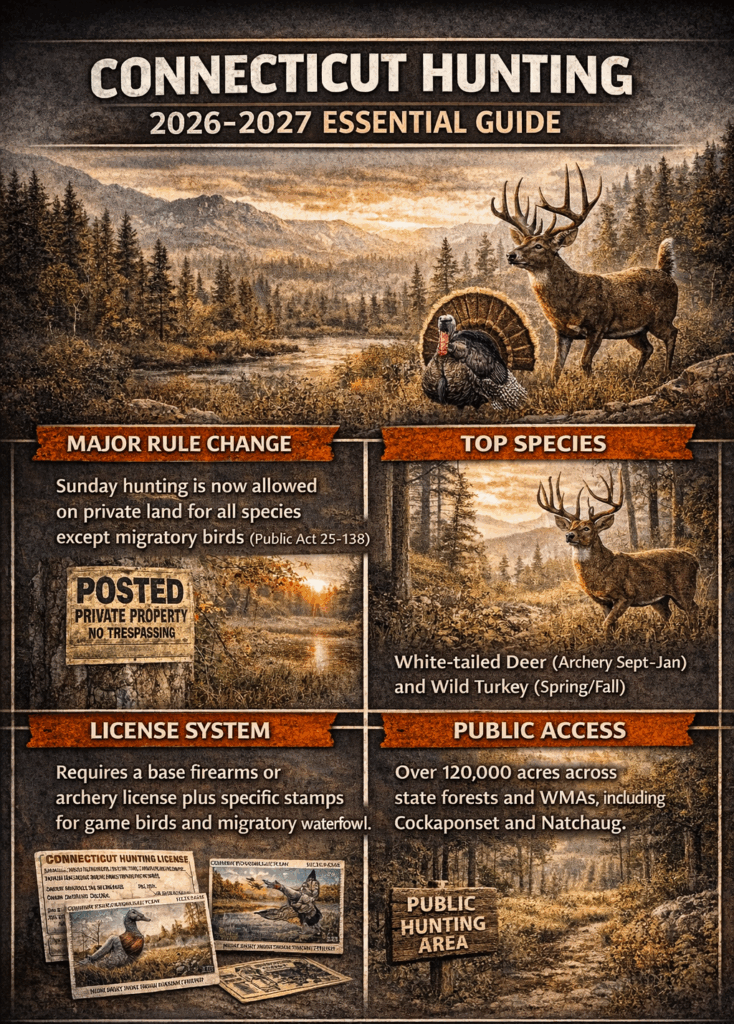
Quick Overview: Season Dates, Connecticut Hunting Licenses, and Regulations
Connecticut DEEP requires a base hunting license plus species-specific permits and conservation stamps depending on what you’re hunting. The licensing system includes base hunting licenses, archery permits, muzzleloader permits, and conservation stamps.
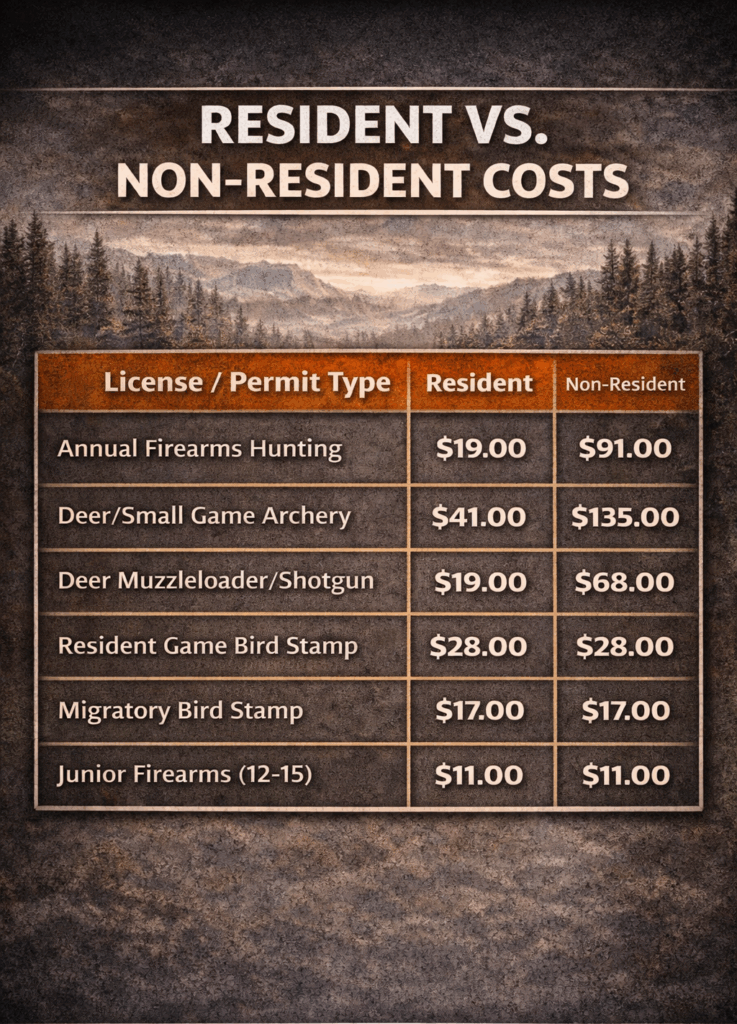
Non-resident hunters will find Connecticut’s pricing competitive with other New England states. We’ve listed resident and non-resident costs side by side for easy comparison.
Connecticut Hunting License Costs
| License/Permit Type | Resident Cost | Non-Resident Cost |
|---|---|---|
| Annual Firearms Hunting | $19.00 | $91.00 |
| Junior Firearms (Ages 12–15) | $11.00 | $11.00 |
| Senior (65+ Resident) | Free | N/A |
| 3-Day Non-Resident Bird | N/A | $35.00 |
| Deer/Small Game Archery | $41.00 | $135.00 |
| Junior Archery (12–15) | $10.00 | $19.00 |
| Deer Muzzleloader/Shotgun | $19.00 | $68.00 |
| Migratory Bird Conservation Stamp | $17.00 | $17.00 |
| Junior Migratory (12–17) | $9.00 | $9.00 |
| Resident Game Bird Stamp | $28.00 | $28.00 |
| Federal Duck Stamp | ~$25.00 | ~$25.00 |
You can buy licenses and permits 24/7 through DEEP’s Online Outdoor Licensing System.
Connecticut manages deer through Deer Management Zones. Zones 11 and 12 get extended seasons and extra bag limits on private land. This zone system lets the state adjust regulations based on local deer populations and hunting pressure.
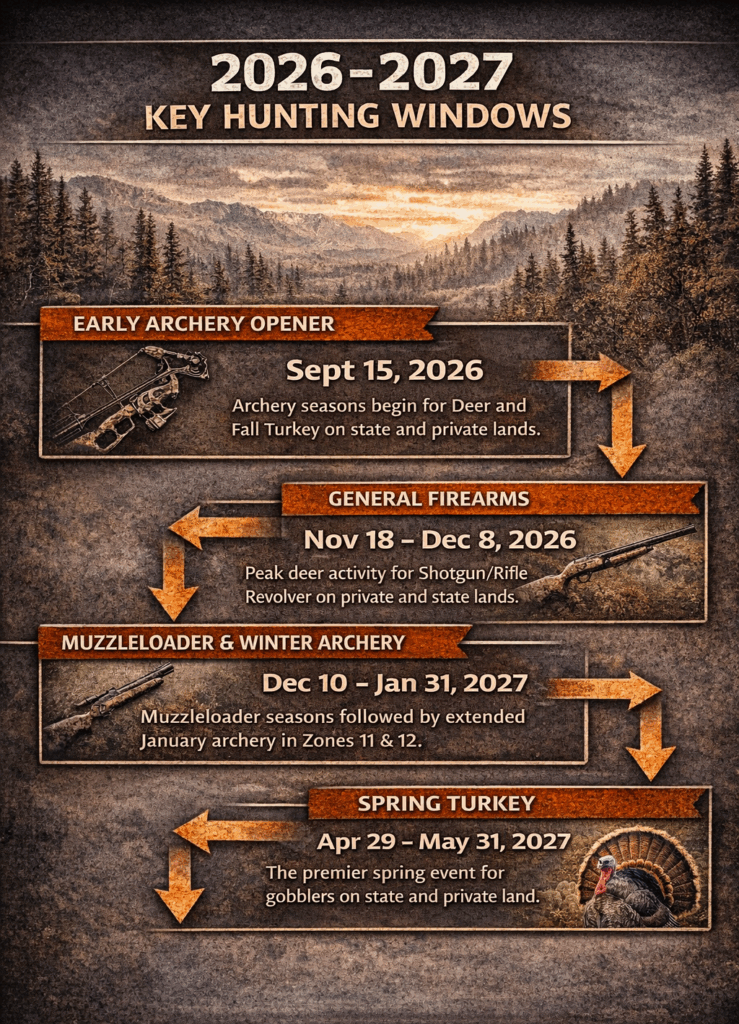
Connecticut Hunting Seasons Overview
| Species | Season Type | Start Date | End Date |
|---|---|---|---|
| White-tailed Deer | Archery – Private Land (All Zones) | Sept 15, 2026 | Dec 31, 2026 |
| White-tailed Deer | Archery – Private Land (Zones 11 & 12) | Jan 1, 2027 | Jan 31, 2027 |
| White-tailed Deer | Archery – State Land Bowhunting Only Areas | Sept 15, 2026 | Dec 31, 2026 |
| White-tailed Deer | Archery – State Land | Sept 15, 2026 | Nov 17, 2026 |
| White-tailed Deer | Archery – State Land (Late) | Dec 24, 2026 | Dec 31, 2026 |
| White-tailed Deer | Shotgun – State Controlled No Lottery | Nov 18, 2026 | Dec 8, 2026 |
| White-tailed Deer | Archery-Only Lottery | Sept 15, 2026 | Dec 31, 2026 |
| White-tailed Deer | State Land Lottery “A” Season | Nov 18, 2026 | Nov 27, 2026 |
| White-tailed Deer | State Land Lottery Regular Season | Nov 18, 2026 | Dec 8, 2026 |
| White-tailed Deer | Shotgun/Rifle/Revolver – Private Lands | Nov 18, 2026 | Dec 8, 2026 |
| White-tailed Deer | Shotgun/Rifle/Revolver – Landowner | Nov 1, 2026 | Dec 31, 2026 |
| White-tailed Deer | Muzzleloader – Private Land | Dec 10, 2026 | Dec 31, 2026 |
| White-tailed Deer | Muzzleloader – State Land | Dec 10, 2026 | Dec 23, 2026 |
| Wild Turkey | Spring – State and Private Lands | Apr 29, 2027 | May 31, 2027 |
| Wild Turkey | Fall Archery – Private Land (Zones 11 & 12) | Jan 1, 2027 | Jan 31, 2027 |
| Wild Turkey | Fall Archery – Private Land (All Zones) | Sept 15, 2026 | Dec 31, 2026 |
| Wild Turkey | Fall Archery – State Land Bowhunting Only Areas | Sept 15, 2026 | Dec 31 |
| Wild Turkey | Fall Archery – State Land | Sept 15, 2026 | Nov 17, 2026 |
| Wild Turkey | Fall Archery – State Land (Late) | Dec 24, 2026 | Dec 31, 2026 |
| Wild Turkey | Fall Firearms – State and Private Lands | Oct 3, 2026 | Oct 31 |
| Pheasant | Fall Season | October 17 | December 31, 2026 |
| Pheasant | General Season | Jan 1, 2027 | Feb 28, 2027 |
| Ruffed Grouse | General Season | Oct 17, 2026 | Nov 28, 2026 |
| Quail | General Season | Oct 17, 2026 | Oct 31, 2026 |
| Gray Squirrel | Fall Season | Sept 1, 2026 | Dec 31, 2026 |
| Gray Squirrel | Winter Season | Jan 1, 2027 | Feb 28, 2027 |
| Cottontail Rabbit & European Hare | Fall Season | Oct 17, 2026 | Dec 31, 2026 |
| Cottontail Rabbit & European Hare | Winter Season | Jan 1, 2027 | Feb 28, 2027 |
| Coyote | Year-Round | Jan 1, 2027 | Dec 31, 2027 |
Connecticut Deer Hunting
Deer hunting is Connecticut’s biggest draw, and for good reason. You get multiple season types running from September clear through January. But here’s the thing—deer kills dropped 7% in the 2024 season, so understanding the state’s complex season structure and zone rules is more important than ever for success.
Connecticut runs archery, firearms, and muzzleloader seasons, each with specific dates and bag limits designed to manage deer populations effectively. For detailed strategies and zone-specific intel, check out our complete Connecticut deer hunting season guide that covers advanced tactics and prime locations.
Connecticut Deer Hunting Seasons
Connecticut structures deer seasons around four main hunting methods: archery, firearms (shotgun/rifle/revolver), muzzleloader, and special landowner seasons, plus lottery permits for state lands.
Archery Seasons give you the longest opportunities. Private land archery runs September 15 – December 31 in all zones, plus an extended January 1-31 season only in Zones 11 & 12. State land archery goes September 15 – November 17, with a late season December 24-31. That January extension in Zones 11 & 12? That’s gold for bowhunters who want to keep hunting after firearms pressure dies down.
Firearms Seasons include shotgun/rifle/revolver on private lands November 18 – December 8, state controlled no-lottery areas November 18 – December 8, and the landowner season November 1 – December 31. Landowners get that early November 1 start, giving property owners extra time before general firearms seasons kick off.
Muzzleloader Seasons offer private land hunting December 10-31 and state land hunting December 10-23. Notice the gap between state land muzzleloader ending December 23 and late archery starting December 24—that’s intentional.
Lottery Permits include Archery-Only Lottery (September 15 – December 31), State Land Lottery “A” Season (November 18-27), and State Land Lottery Regular Season (November 18 – December 8). Applications open January 2, 2026, at 9:30 AM. You can’t buy both a State Land Lottery Permit and a State Land No-Lottery Permit.
Junior Deer Weekend runs November 7-14, 2026, giving young hunters dedicated time during peak season.
Connecticut Deer Hunting Regulations
Connecticut DEEP regulations change based on zone and land type, so double-check requirements for your specific hunting area.
- Bag Limits: Archery—2 either-sex & 2 antlerless (4 total); Zones 11 & 12 private land January 1-31 adds +1 either-sex & +1 antlerless. Firearms—varies by zone, typically 1 either-sex & 1 antlerless. Landowner—2 deer (1 either-sex, 1 antlerless).
- Hunting Hours: ½ hour before sunrise until sunset for archery seasons.
- Written Permission: Required for private land hunting—must be dated for current season, show authorized weapon types, and have landowner’s original signature. Minimum 10 acres required for rifle/revolver use.
- Harvest Reporting: Report deer harvests within 24 hours through DEEP’s system.
- CWD Status: No chronic wasting disease detected in Connecticut’s deer herd so far, keeping the state’s deer population healthy.
Connecticut Wild Turkey Hunting
Turkey hunting in Connecticut gives you three distinct seasons: Spring, Fall Archery, and Fall Firearms. Each one offers completely different hunting experiences and challenges. You can hunt turkeys during three separate seasons, with spring turkey archery and firearms bag limits combined rather than separate.
Connecticut’s turkey population is strong across both state and private lands. Spring season is when you’ll have the most fun—gobblers are fired up and responsive. For complete strategies and location details, our Connecticut turkey hunting season guide covers calling techniques, setup strategies, and prime hunting areas statewide.
Connecticut Wild Turkey Hunting Seasons
Spring Season runs April 29 – May 31, 2027 on both state and private lands. This is Connecticut’s premier turkey hunting opportunity when gobblers are most active and responding to calls during breeding season.
Fall Archery Seasons give you plenty of opportunities. Private land hunting in all zones goes September 15 – December 31, plus extended January 1-31 hunting only in Zones 11 & 12. State land archery runs September 15 – November 17 with a late season December 24-31. Bowhunting-only areas offer September 15 – December 31 access, so you get consistent opportunities all fall.
Fall Firearms Season runs October 3-31, 2026 on both state and private lands. This coincides with peak fall colors when turkeys are in winter flocks and feeding patterns are predictable.
Junior Spring Turkey Hunt gives young hunters dedicated opportunities April 18-25, 2027—a full week of exclusive access before general spring season opens.
Connecticut Wild Turkey Hunting Regulations
DEEP regulations specify that the Resident Game Bird Conservation Stamp is required to hunt pheasant, ruffed grouse, quail, partridge, AND wild turkey.
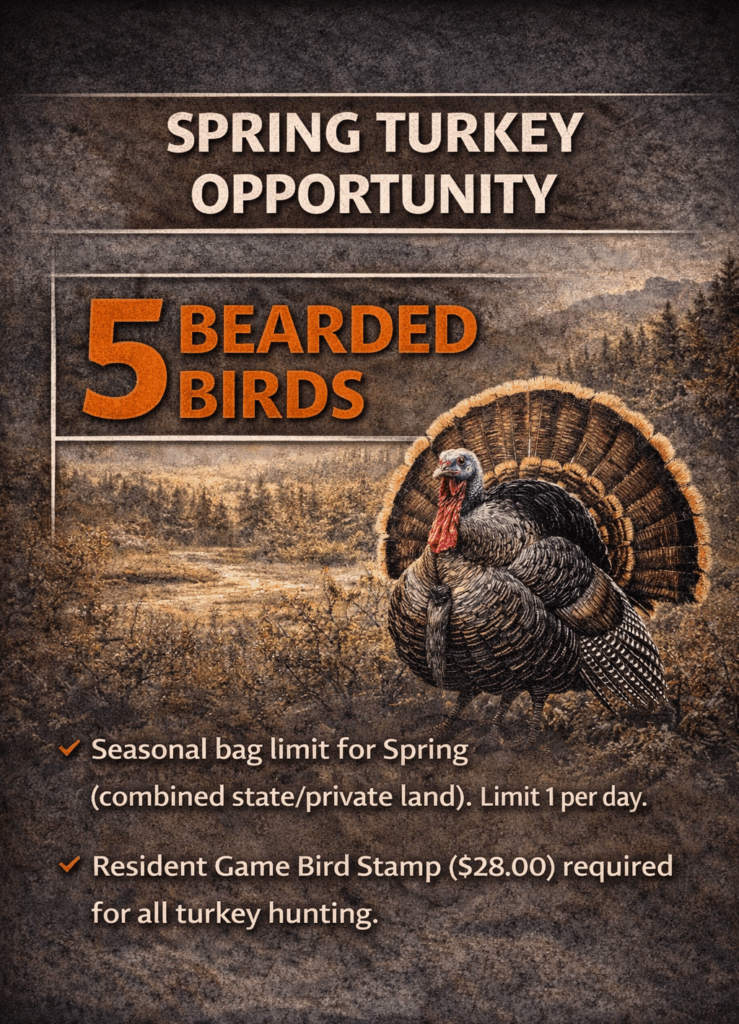
- Bag Limits: Spring—5 bearded birds total (combined state/private), limit 1 per day. Fall Archery—2 birds (either-sex). Fall Firearms—3 birds (either-sex).
- Required Stamp: Resident Game Bird Conservation Stamp ($28.00) required for all turkey hunting.
- Legal Weapons: Shotguns at least 20 gauge, can’t hold more than 3 shells. Bows minimum 40-pound draw weight. Crossbows permitted.
- Harvest Reporting: Report turkey harvests within 24 hours through DEEP’s online system.
- Sunday Hunting: Now allowed on private land under Public Act 25-138, significantly expanding your hunting time.
Connecticut Game Bird Hunting
Connecticut’s upland game bird hunting includes both stocked and wild species, giving you diverse opportunities from early fall through late winter. The state stocks pheasants on select public lands while maintaining wild populations of ruffed grouse, plus additional opportunities for quail, chukar, Hungarian partridge, and crow hunting.
The Resident Game Bird Conservation Stamp is required for hunting pheasant, ruffed grouse, quail, and partridge—it consolidates what used to be separate permit requirements.
Connecticut Game Bird Hunting Seasons
Pheasant seasons include Fall Season October 17 – December 31 and General/Winter Season January 1 – February 28. The Junior Pheasant Hunter Training Day on October 10, 2026 gives young hunters supervised learning opportunities on stocked birds.
Ruffed Grouse season runs October 17 – November 28, targeting wild birds during peak fall activity when leaves are down and birds are easier to spot.
Quail season is short—October 17-31—focusing on the limited wild quail population and any released birds.
Chukar & Hungarian Partridge offer Fall Season October 17 – December 31 and Winter Season January 1 – February 28, giving you extended opportunities for these released game birds.
Crow hunting includes three separate seasons: Early Fall August 12 – October 10, Late Fall October 21 – November 28, and Winter December 22 – March 23. Crow hunting is only allowed Wednesday, Friday, and Saturday during open seasons.
Connecticut Game Bird Hunting Regulations
- Bag Limits: Pheasant/Quail—2 daily, 10 season. Ruffed Grouse—1 daily, 8 season. Chukar/Partridge—2 daily, 10 season. Crow—no limit.
- Required Stamp: Game Bird Conservation Stamp ($28.00) required for pheasant, grouse, quail, and partridge.
- Crow Hunting Days: Wednesday, Friday, and Saturday only during open seasons.
- Migratory Bird Stamp: Required for crow hunting ($17.00, includes HIP registration).
Connecticut Small Game Hunting
Connecticut’s small game hunting is perfect for hunters of all experience levels. You get extended seasons and generous bag limits on gray squirrel, cottontail rabbit, European hare, snowshoe hare, and woodchuck. These species offer some of Connecticut’s longest hunting seasons and they’re ideal for skill development, youth hunting, and filling the freezer.
Connecticut Small Game Hunting Seasons
Gray Squirrel offers the longest small game season with Fall Season September 1 – December 31 and Winter Season January 1 – February 28. That’s nearly six months of hunting opportunities.
Cottontail Rabbit & European Hare seasons include Fall Season October 17 – December 31 and Winter Season January 1 – February 28, when rabbits are most active during shorter daylight hours.
Snowshoe Hare provides Fall Season November 14 – December 31 and Winter Season January 1-31, targeting these northern species during peak winter conditions.
Woodchuck offers a unique season March 15 – November 15, 2027, giving you year-round opportunities outside winter months when woodchucks are hibernating.
Connecticut Small Game Hunting Regulations
- Bag Limits: Gray Squirrel—8 daily, 40 season. Cottontail Rabbit—3 daily, 25 season. Woodchuck—no limit.
- Season Length: Small game offers some of Connecticut’s longest hunting seasons, perfect for skill development and introducing new hunters.
- Public Land Access: Available on most state forests and Wildlife Management Areas without special permits.
Connecticut Minor Game Species Hunting
Connecticut Furbearer Hunting Information
Connecticut’s furbearer hunting includes year-round coyote hunting plus seasonal opportunities for raccoon, opossum, and fox. Coyote hunting stands out as Connecticut’s only year-round hunting opportunity, giving predator hunters consistent action through all seasons.
Coyote hunting is allowed year-round (January 1 – December 31, 2027) with no bag limit. It’s Connecticut’s most liberal hunting opportunity.
Raccoon & Opossum seasons include Fall Season October 17 – December 31 and Winter Season January 1-17, targeting these species when pelts are prime and activity is predictable.
Red & Gray Fox offer Fall Season October 17 – December 31 and Winter Season January 1 – February 28, giving you extended opportunities for these traditional fur species.
Connecticut Waterfowl Hunting Information
Connecticut’s waterfowl hunting follows federal frameworks with specific state regulations for ducks, geese, woodcock, and snipe. The state’s coastal location and inland wetlands provide diverse waterfowl hunting opportunities from early teal seasons through late winter.
Waterfowl hunting requires both state and federal permits, including the Migratory Bird Conservation Stamp and federal duck stamp for hunters 16 and older. HIP registration comes with the state stamp purchase.
Duck Aggregate Bag Limit: 6 per day (18 possession) with specific sub-limits: Max 4 Mallards (2 hens), 3 Wood Ducks, 2 Black Ducks, 2 Redheads, 3 Pintails, 2 Canvasbacks.
Canada Goose: Changes by zone and date, with early season typically 15 daily bag limit.
Snow Geese: 25 per day with no season limit during Conservation Order periods.
Woodcock/Snipe: 3 Woodcock (9 possession) / 8 Snipe (24 possession).
Where to Hunt in Connecticut
Connecticut’s hunting landscape covers over 120,000 acres of state-owned land open to public hunting, plus extensive private land opportunities and guided hunting services. The state’s compact size means diverse hunting opportunities are always close by—from coastal waterfowl hunting to northern forest grouse and deer hunting.
Best Public Lands
Connecticut offers diverse public hunting opportunities across state forests, Wildlife Management Areas, and special permit areas. Each provides unique hunting experiences and species opportunities.
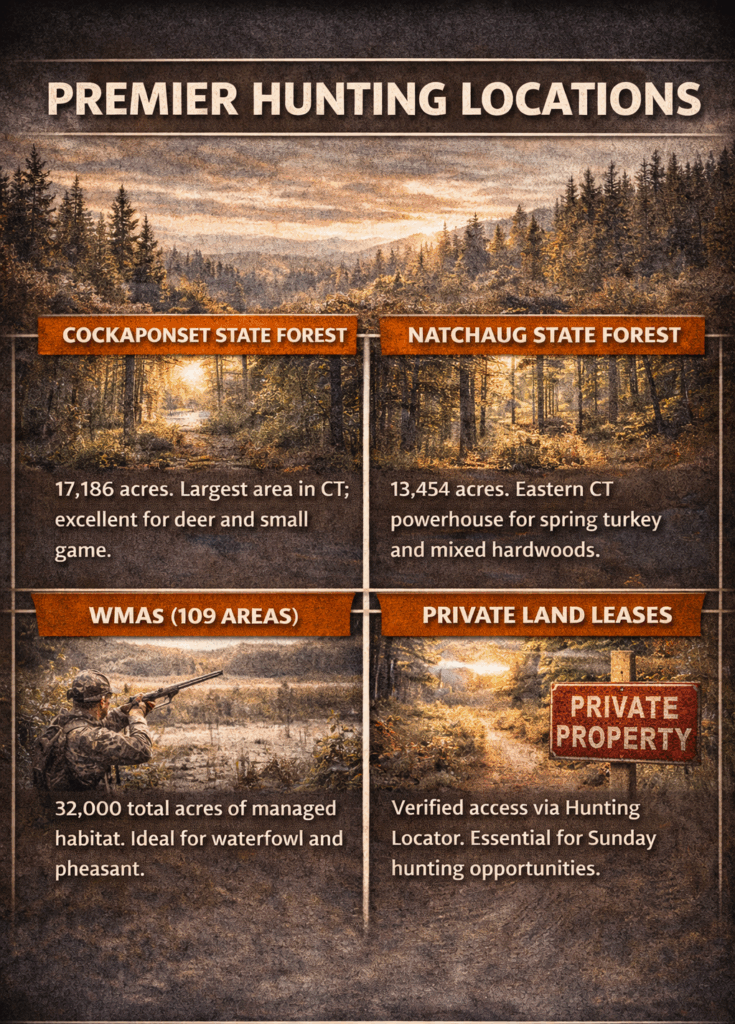
- Cockaponset State Forest – 17,186 hunting acres making it Connecticut’s largest hunting area. Excellent deer, turkey, and small game opportunities across diverse habitats from hardwood ridges to wetland areas.
- Natchaug State Forest – 13,454 acres of prime hunting land in eastern Connecticut. Known for excellent spring turkey hunting and consistent deer populations across mixed forest types.
- Naugatuck State Forest – 4,295 acres providing quality hunting opportunities in western Connecticut with good access and diverse terrain suitable for multiple species.
- Wildlife Management Areas – 109 Wildlife Management Areas totaling 32,000 acres of specialized habitat management. Many target specific species like waterfowl, with some areas requiring special permits or lottery drawings.
Guided Hunts
Connecticut’s guided hunting services must register annually with DEEP with a $100 registration fee, ensuring professional standards and regulatory compliance. Guided hunts are excellent for visiting hunters unfamiliar with local areas and hunting pressure patterns.
Professional guides offer specialized knowledge of seasonal patterns, prime hunting locations, and local regulations that can significantly improve hunting success. Guided turkey hunts during spring season are especially popular, with experienced guides providing calling expertise and knowledge of roosting areas.
Private Land Hunting
Private land hunting in Connecticut requires written landowner permission that must be dated for the current season, show authorized hunting weapon types, and have the landowner’s original signature. Minimum 10 acres is required for rifle or revolver use, with no minimum acreage for shotgun, muzzleloader, or archery equipment.
Building relationships with landowners often provides the most consistent and productive hunting opportunities. Private land leasing has become increasingly popular as hunting access gets more competitive. Lease agreements provide guaranteed access and often include exclusive hunting rights, making them valuable for serious hunters seeking consistent opportunities.
Hunting Locator connects hunters with landowners throughout Connecticut who are willing to lease or sell their hunting properties. Our platform provides verified listings, direct landowner contact, and detailed property information including acreage, game species, and access details. Whether you’re seeking a small archery lease or a large multi-species property, Hunting Locator’s Connecticut hunting leases help you find the perfect hunting opportunity.
FAQ
What hunting licenses do I need as a Connecticut resident?
Connecticut residents need a base hunting license plus species-specific permits and stamps. The Annual Firearms Hunting License ($19.00) covers most hunting, but you’ll also need the Deer/Small Game Archery Permit ($41.00) for bowhunting, Game Bird Conservation Stamp ($28.00) for turkey and upland birds, and Migratory Bird Conservation Stamp ($17.00) for waterfowl. Seniors 65+ get free annual firearms hunting licenses, though permits and stamps cost extra.
When do Connecticut deer lottery permit applications open?
Deer Lottery Permits can be applied for starting January 2, 2026, at 9:30 AM. Applications go through DEEP’s online system, and you can’t buy both a State Land Lottery Permit and a State Land No-Lottery Permit.
Can I hunt on Sundays in Connecticut?
Yes, Sunday hunting is now allowed on private land for all species using any approved hunting weapon under Public Act 25-138. However, hunting migratory birds remains prohibited on Sundays on all land types.
What are Connecticut’s bag limits for deer?
Bag limits change based on season type and location. Archery hunters can take 2 either-sex & 2 antlerless deer (4 total), with Zones 11 & 12 private land offering additional bag limits during January. Firearms hunters typically get 1 either-sex & 1 antlerless per zone, while landowner permit holders can take 2 deer (1 either-sex, 1 antlerless).
Do I need hunter education to hunt in Connecticut?
Yes, you must either show proof of Connecticut hunter education (or recognized equivalent) or have held a Connecticut resident license within the past 5 years in the specific discipline. “Apprentice” or “Mentored” hunting licenses issued in other states don’t qualify for Connecticut licensing requirements.
What is the minimum age to hunt in Connecticut?
Connecticut requires hunters to be at least 12 to hunt. Ages 12–15 must buy a Junior Hunting License and be accompanied by a licensed hunter age 18 or older. At 16, hunters can hunt alone with proper licensing but still qualify for junior license pricing until age 18.
The Final Shot
Connecticut’s 2026-2027 hunting seasons offer unprecedented opportunities with the new Sunday hunting provisions significantly expanding your time afield. From extended archery seasons running September through January to diverse small game and furbearer opportunities, the Constitution State provides year-round hunting action for dedicated hunters.
Whether you’re planning to hunt Connecticut’s productive deer zones, chase spring gobblers in the state forests, or explore waterfowl opportunities along the coast, proper preparation with licenses, permits, and hunting locations sets you up for success. The state’s compact size means you’re never far from quality hunting, while zone-specific regulations ensure sustainable wildlife management for future generations.
Ready to secure your hunting access for the 2026-2027 season? Visit Hunting Locator to find verified hunting leases, connect with licensed guides, and discover the hunting opportunities that will make your Connecticut hunting season unforgettable.


