Here’s what you’ll find in this detailed Nevada spring turkey guide:
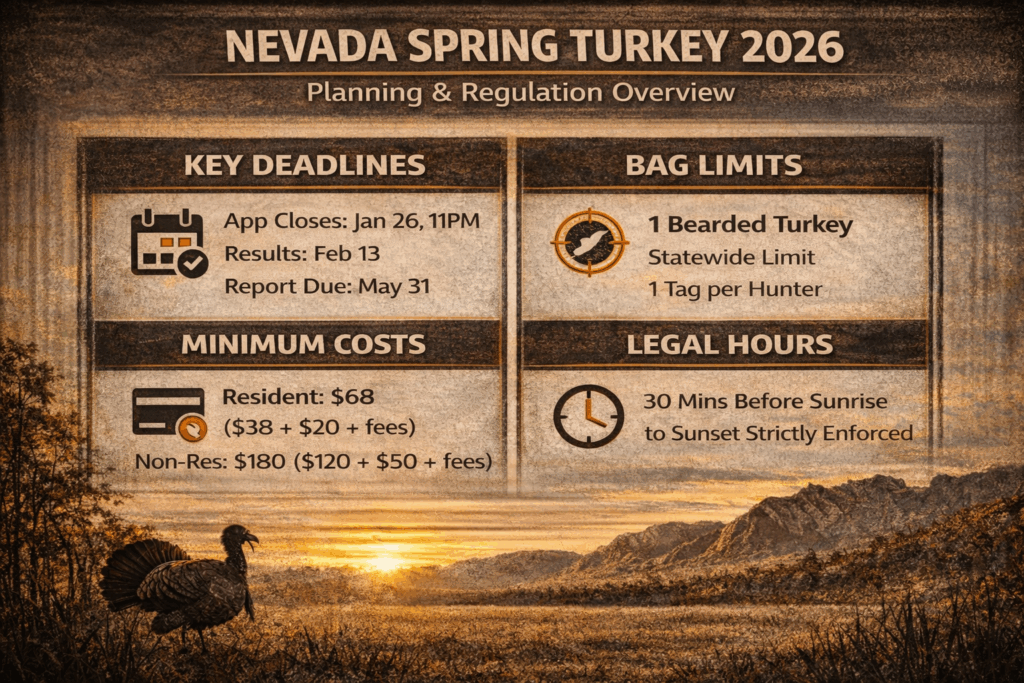
- Key dates and deadlines – Application window closes January 26, 2026 at 11:00 p.m., draw results posted by February 13
- License and permit costs – Residents pay $38-$75 for license plus $20 tag, non-residents shell out $120-$190 plus $50 tag
- Where to hunt – Public land options, guided hunts, private access through Hunting Locator
Let’s get into the dates and requirements first.
Quick Overview of Nevada Spring Turkey Hunting 2026
Nevada runs a limited-entry draw system. Seasons vary by where you live, where you hunt, and how old you are. For other Nevada hunting opportunities, check our complete Nevada hunting season guide.
| Season Type | Residency | Dates | Location/Units |
|---|---|---|---|
| Spring Resident Junior | Resident | Mar 21 – May 23, 2026 | Mason Valley WMA |
| Spring Resident Junior | Resident | Mar 21 – Apr 12, 2026 | Moapa Valley, Clark County |
| Spring Resident Junior | Resident | Mar 21 – May 3, 2026 | All Other Open Counties |
| Spring Resident Limited Entry | Resident | Mar 21 – May 3, 2026 | Varies by Unit |
| Spring Resident/Non-Resident | Both | Mar 28 – May 3, 2026 | Paradise Valley, Humboldt |
| Spring Non-Resident Limited Entry | Non-Resident | Mar 28 – May 3, 2026 | Multiple Units |
| Spring Non-Resident Limited Entry | Non-Resident | Mar 21 – Mar 27, 2026 | Moapa Valley, Clark |
Important Notes:
- Bag Limit: 1 bearded turkey statewide
- Legal Hunting Hours: One-half hour before sunrise to sunset
- New for 2026: Silver State Turkey Tag available for the first time
License, Permit, and Education Requirements:
- Hunting License: Required age 12+. Residents: $38 (basic) or $75 (combo). Non-residents: $120-$144 (basic) or $155-$190 (combo)
- Turkey Tag Application Fee: ~$10 (non-refundable)
- Turkey Tag Fee (if drawn): Residents $20, Non-residents $50
- Hunter Education: Required before license purchase
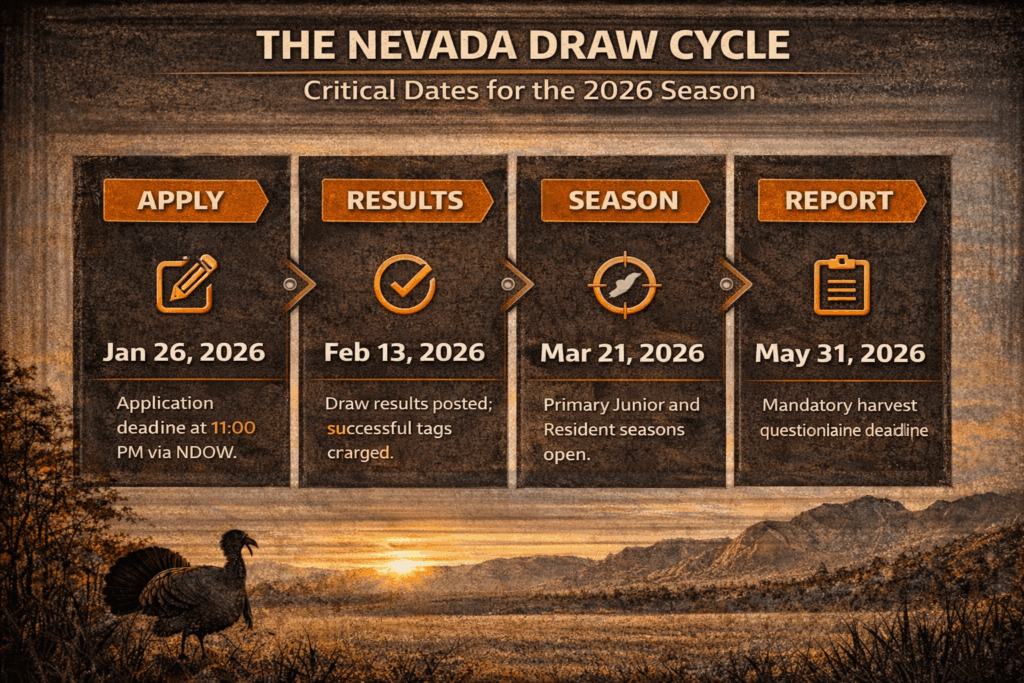
- Application Deadline: January 26, 2026 at 11:00 p.m. via ndowlicensing.com
- Bonus Point Deadline: February 2, 2026 at 11:00 p.m.
- Draw Results: On or before February 13, 2026
- Harvest Questionnaire: Due May 31, 2026 ($50 penalty if you skip it)
Nevada Spring Turkey Hunting Seasons
Nevada splits seasons by residency, location, and age. The state manages populations carefully because turkeys need specific habitat—riparian areas with tree cover for roosting. They can’t just survive anywhere.
Spring Resident Junior Turkey Season
Junior seasons give young hunters more time in the field. Applicants under 12 can apply if they’ll turn 12 before opening day.
Three location options with different season lengths:
- Mason Valley WMA: March 21 – May 23, 2026 (longest junior season at over two months, follows productive Walker River habitat)
- Moapa Valley/Clark County: March 21 – April 12, 2026 (gets you into southern Nevada’s desert turkey populations)
- All Other Open Counties: March 21 – May 3, 2026 (flexibility across multiple units)
Spring Resident Limited Entry Season
This runs March 21 – May 3, 2026. It’s the main adult resident season, competitive draw. You can apply once per draw period for one hunt type, but you get to pick up to five unit choices within that type.
With fewer than 150 total tags statewide, your odds depend on which unit you pick and how many bonus points you’ve stacked up. Bonus points increase draw probability. Don’t draw? You automatically get points for next time.
Spring Non-Resident Seasons
Non-residents get three options:
Paradise Valley (Humboldt County) – March 28 – May 3, 2026: This unit combines residents and non-residents, Rio Grande populations. Same bag limit for both residency categories. Best shot at an extended season window.
Limited Entry Multiple Units – March 28 – May 3, 2026: Non-resident-specific tags spread across different units statewide. Access to diverse habitat types.
Moapa Valley/Clark County – March 21 – March 27, 2026: Just seven days for non-residents. Most restrictive window but potentially less competition.
According to NWTF data, “Nonresident adult combination hunting license cost is $155; Nonresident turkey tag cost is $50 plus $10 application fee.”
Nevada Turkey Licenses and Permits
Nevada requires both a hunting license AND a turkey tag through the draw system. Two separate steps. First-time applicants mess this up constantly.
Nevada Hunting Licenses
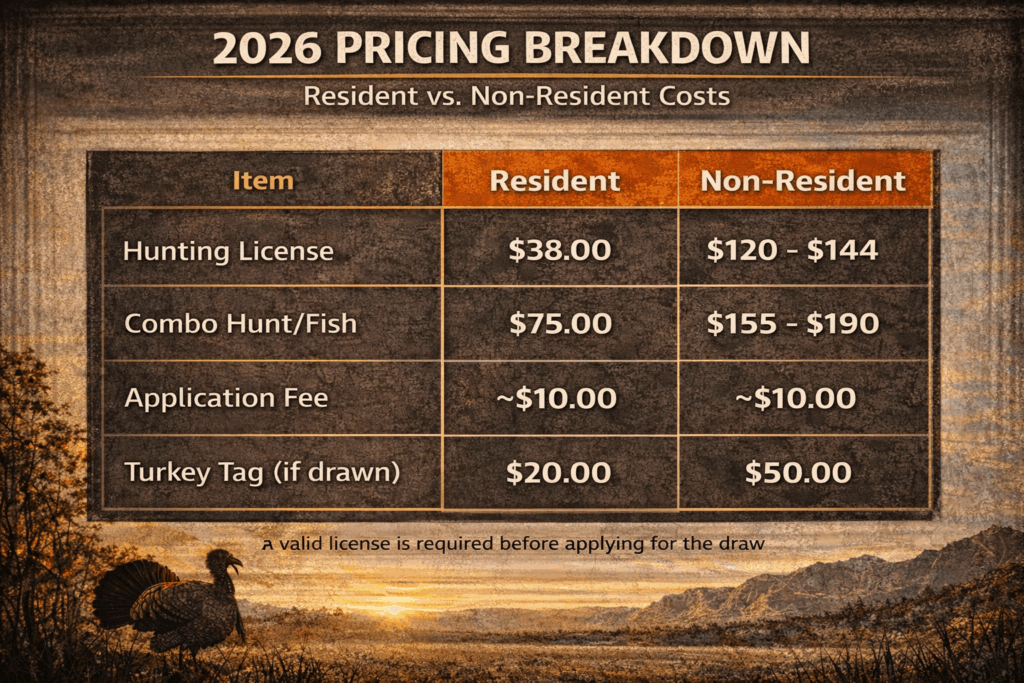
Everyone age 12+ needs a valid license before applying for turkey tags.
| License Type | Resident Cost | Non-Resident Cost | Notes |
|---|---|---|---|
| Basic Hunting License | $38.00 | $120 – $144 | Required for all hunters age 12+ |
| Combination Hunt/Fish | $75.00 | $155 – $190 | Optional but often preferred |
| Turkey Tag Application Fee | ~$10 | ~$10 | Non-refundable draw entry fee |
| Turkey Tag (if drawn) | $20.00 | $50.00 | Paid only after successful draw |
Important Notes:
- Purchase licenses through ndowlicensing.com
- Hunter education certification required before purchase
- You must have valid license and tag on you at all times while hunting
- Combination license saves money if you’re fishing during your trip
Nevada Turkey Permits and the Draw System
Nevada allocates turkey tags through limited-entry draw. Here’s how it works:
- Complete Hunter Education (if you’re not certified already) – Required before license purchase
- Purchase Hunting License through ndowlicensing.com
- Submit Turkey Tag Application by January 26, 2026 at 11:00 p.m.
- Select Hunt Choices – Up to 5 units within one hunt type (you can’t apply for multiple types)
- Pay Application Fee (~$10, non-refundable)
- Check Draw Results on or before February 13, 2026
- Pay Tag Fee (if drawn) – $20 residents, $50 non-residents
- Submit Harvest Questionnaire by May 31, 2026 – Mandatory whether you kill a bird or not
Critical Deadlines:
- ⚠️ Application: January 26, 2026 at 11:00 p.m.
- ⚠️ Bonus Points: February 2, 2026 at 11:00 p.m.
- 📅 Draw Results: On or before February 13, 2026
- 📋 Harvest Report: May 31, 2026 ($50 penalty if you don’t submit)
Bonus Points:
Bonus points increase your draw probability in future years. Don’t draw? You automatically get points. Or buy points without applying. Rewards persistence. Keep applying and your odds gradually improve.
Leftover Tags:
Remaining tags go first-come, first-served through ndowlicensing.com after the draw. Watch NDOW announcements after February 13. But leftovers are rare given how few tags they issue.
Where to Hunt Turkey in Nevada
Nevada’s turkey populations are smaller and more localized than other states. Birds concentrate in specific habitat corridors. The state has Rio Grande turkeys (western river corridors, Ruby Mountains, Paradise Valley) and Merriam’s turkeys (higher elevations, especially Moapa Valley).
Best Public Lands for Turkey Hunting
You can hunt turkeys on BLM lands, National Forest, and Wildlife Management Areas. Success means targeting riparian corridors with tree cover. Turkeys don’t survive in open desert.
- Mason Valley WMA (Western Nevada): Productive Walker River habitat; extended junior season through May 23
- Ruby Mountains (Elko County): Forested slopes and riparian zones, prime Merriam’s habitat, less hunting pressure
- Paradise Valley (Humboldt County): Combined resident/non-resident unit, Rio Grande populations, accessible March 28 – May 3
- Schell Creek Range (Eastern Nevada): Forested slopes and meadows, less pressured because it’s remote
- Pahranagat National Wildlife Refuge (Lincoln County): Southern Nevada desert oasis, unique riparian/desert combination
- Moapa Valley/Overton Area (Clark County): Rio Grande and Merriam’s populations; very short non-resident window (March 21-27)
For more Nevada hunting opportunities, check our guides to Nevada elk hunting, Nevada mule deer hunting, and Nevada game bird hunting.
Guided Turkey Hunts
Guided hunts make sense as an alternative to DIY public land hunting, especially if you’re coming from out of state. According to Grand Slam Network, outfitters “can typically offer outstanding turkey hunting opportunities and better chances to harvest a turkey than public land hunting.”
Most hunts are 3-day fully guided hunts for one bird including landowner voucher, meals and lodging. Some outfitters report impressive numbers. One claimed 100% success on over 100,000 acres during 2022.
Advantages:
- No scouting time or access headaches
- Professional guides who understand local turkey behavior
- Private land access with less pressure
- Higher success rates than public land
- All-inclusive packages simplify planning
Considerations:
- Significant cost vs. DIY
- Less flexibility in timing and approach
- May not appeal if you value self-guided challenges
Selection Tips:
- Verify legal land access and proper permissions
- Ask for historical success rates and client references
- Confirm what’s included (tags, licenses, meals, lodging, transportation)
- Understand cancellation and refund policies
- Check if landowner vouchers are provided or if you still enter the draw
Private Land Turkey Hunting
A significant portion of turkey populations occurs on private lands and permission should be obtained from landowners before applying. According to DiveBomb Industries, hunters “may need to secure access through leases, guided hunts, or landowner permission.”
Leasing vs. Buying:
- Leasing: Lower financial commitment, seasonal arrangements, ideal for quality access without ownership responsibilities
- Buying: Permanent access and control, investment potential, ability to manage habitat specifically for turkeys
Hunting Locator: Direct Connection to Private Landowners
Hunting Locator connects you directly with landowners offering lease opportunities or selling hunting properties. Browse Nevada hunting leases by county, acreage, and species. Filter for turkey habitat, review property details, contact landowners directly. Whether you want seasonal leases or you’re evaluating purchases, Hunting Locator eliminates guesswork and provides access to opportunities you won’t find through traditional channels.
Turkey Hunting Tips for Nevada Success
Nevada’s desert and mountain environments require adapted strategies:
Focus on Riparian Corridors: Turkeys concentrate along water sources with tree cover. Target river valleys, creek bottoms, spring-fed areas. Scout these corridors before season to locate roost trees and feeding areas.
Hunt Early and Late: Spring temperatures climb fast. Turkeys are most active first two hours after sunrise and last hour before sunset. Use midday for scouting or relocating.
Adapt Calling to Sparse Cover: In open terrain, turkeys spot decoys and movement from way farther out. Use natural terrain for concealment. Call conservatively. Soft yelps and clucks often work better than aggressive cutting.
Scout for Sign in Limited Habitat: With concentrated populations, fresh sign (tracks, droppings, feathers, scratching) confirms active use. Focus your efforts where you find recent evidence.
Prepare for Variable Weather: Spring weather swings from freezing mornings to hot afternoons. Layer your clothing and pack for temperature extremes.
Use Decoys Strategically: In open country, decoys work really well for pulling birds into range. Position hen decoys where approaching toms have to enter shooting range. Jake decoys trigger territorial responses.
Pattern Your Shotgun: With a one-bird bag limit, make your shot count. Pattern your shotgun at 20, 30, and 40 yards to understand effective range. Legal weapons include shotgun no larger than 10 gauge nor smaller than 20 gauge, shot size no larger than number 2.
Respect Private Land Boundaries: Many productive areas border private land. Always verify boundaries using GPS or maps. Never pursue birds onto private property without explicit permission.
For turkey hunting gear, check the Hunting Locator store for equipment suited to Nevada’s spring season.
More Resources from Hunting Locator
Expand your Nevada hunting knowledge:
- Nevada Hunting Season Guide – Complete overview of all seasons and regulations
- Nevada Turkey Hunting Season – Year-round turkey information including fall seasons
- Nevada Mule Deer Season – Complete guide with unit recommendations
- Nevada Elk Hunting Season – Everything about Nevada’s limited elk tags
- Nevada Pronghorn Season – Antelope hunting dates and unit analysis
- Nevada Bighorn Sheep Season – Once-in-a-lifetime tag information
- Nevada Waterfowl Season – Duck and goose opportunities
- Nevada Small Game Season – Rabbit, squirrel, and other small game
- Nevada Hunting Leases – Browse available private land leases
FAQ
When is the application deadline for Nevada’s 2026 spring turkey season?
Applications accepted until 11:00 p.m. on Monday, Jan. 26, 2026. Hard deadline. Late applications aren’t accepted. The bonus point purchase deadline extends to February 2, 2026 at 11:00 p.m.
How much does it cost for non-residents to hunt turkeys in Nevada?
According to NWTF data, “Nonresident adult combination hunting license cost is $155; Nonresident turkey tag cost is $50 plus $10 application fee.” Total investment is roughly $215 for combination license, application fee, and tag (if drawn), plus travel, lodging, and gear.
What is Nevada’s turkey bag limit for 2026?
One bearded turkey statewide. Only one Wild Turkey tag can be awarded per individual within a calendar year.
Do I have to submit a harvest report even if I don’t harvest a turkey?
Yes. Wild turkey harvest questionnaires are mandatory regardless of hunt success. Deadline is May 31, 2026. Don’t submit and you’ll pay a $50 penalty. Submit through ndowlicensing.com.
What are the best units for non-resident turkey hunters in Nevada?
Paradise Valley in Humboldt County offers the longest non-resident season (March 28 – May 3, 2026). It’s a combined resident/non-resident unit with Rio Grande populations along productive river corridors. Limited Entry Multiple Units also run through May 3, offering diverse habitat options.
Can I apply for both resident and non-resident turkey hunts?
No. Hunters may apply once per draw period for one hunt type, and cannot apply for more than one type. But you can select up to five unit choices within your chosen hunt type.
The Final Shot
Nevada’s 2026 spring turkey season offers a unique western hunting experience if you’re willing to navigate the limited-entry system. Application deadlines hit in late January. Finalize your unit selections, purchase your license, submit your draw application now.
Whether you’re planning a junior hunt at Mason Valley WMA, competing for limited-entry tags in Paradise Valley, or exploring private land through Hunting Locator, success starts with preparation. Mark January 26, 2026 at 11:00 p.m. on your calendar. Submit your application before the deadline.
Nevada will never be a high-volume turkey state. But that’s what makes drawing a tag special. When you connect with a Nevada gobbler in sagebrush and juniper country, you’ll have earned a memorable hunt in one of the West’s most distinctive turkey hunting environments.


