If a Nevada bighorn sheep is on your list, whether as a standalone hunt or part of a Grand Slam pursuit, this guide covers what you need to plan a 2026 hunt.
This guide is written for both residents and nonresidents who want a single consolidated resource. It covers current season dates, cost breakdowns, draw mechanics, and land access options.
Here’s what’s inside:
- When and where Nevada’s Desert Bighorn Sheep and California Bighorn Sheep seasons run in 2026, by unit
- What it costs up front and what’s required before you can apply — license, application fee, tag fees, and the mandatory bighorn seminar
- How to secure access — public land, private leases through Hunting Locator, and guided hunts
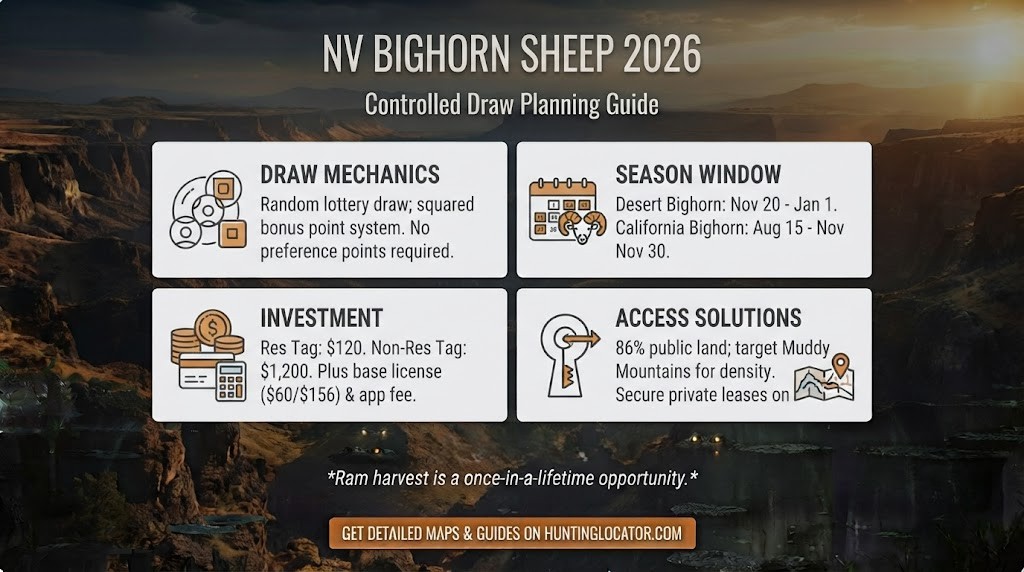
Quick Overview: Nevada Bighorn Season at a Glance
Nevada has two huntable bighorn subspecies in 2026 — Desert Bighorn Sheep and California Bighorn Sheep — each with its own season structure and unit framework. Every season carries a 1-ram bag limit. Nevada’s 2026–2027 Big Game Seasons, Applications & Hunting Regulations guide from the Nevada Department of Wildlife (NDOW) is the governing regulatory document — review it alongside this guide as you finalize your application strategy.
| Species | Season Type | Start Date | End Date | Bag Limit |
|---|---|---|---|---|
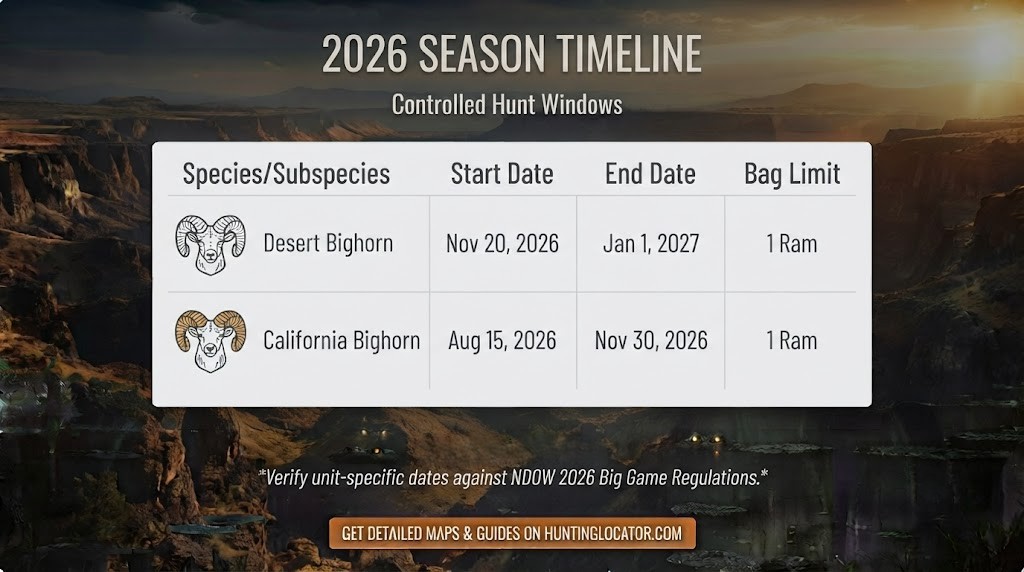
| Desert Bighorn | Any Ram (Most Units) | Nov 20, 2026 | Jan 1 | 1 ram |
| Desert Bighorn | Any Ram (Unit 184) | Oct 15, 2026 | Nov 15, 2026 | 1 ram |
| Desert Bighorn | Unit 268 Early | Nov 16, 2026 | Dec 8, 2026 | 1 ram |
| Desert Bighorn | Unit 268 Late | 12/10/2026 | 01/01/2027 | 1 ram |
| California Bighorn | Various Units | 08/15/2026 | 11/30/2026 | 1 ram |
Bighorn sheep is widely treated as a once-in-a-lifetime tag — a designation that shapes application strategy and hunt preparation alike. Before you can enter the draw, you’ll need to satisfy the following requirements:
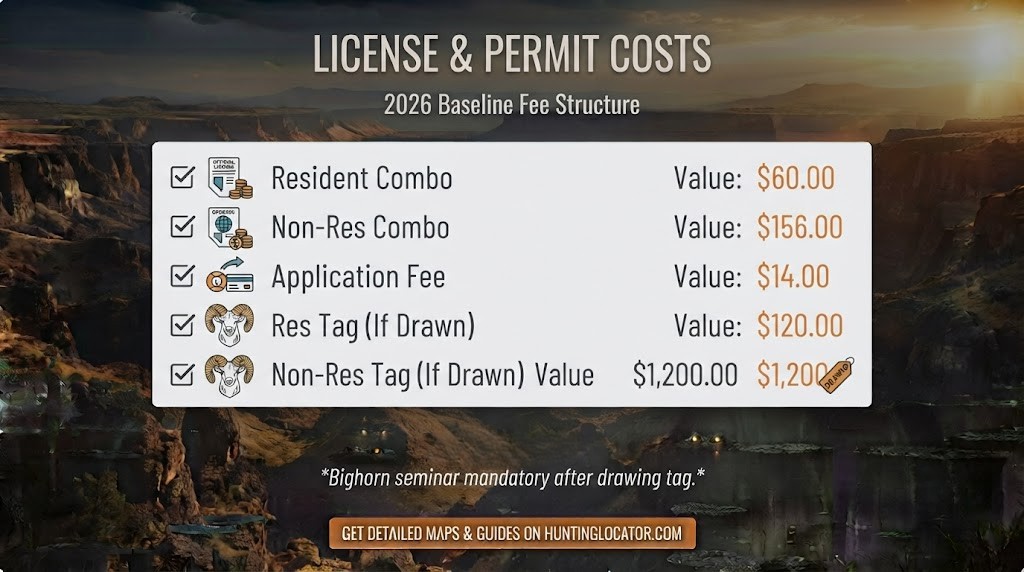
- Hunting/Fishing Combo License — Required before you apply; $60 for residents (or applicable combo fee) / $156 for nonresidents
- Application Fee — $14 per species for both residents and nonresidents; nonrefundable regardless of draw outcome
- Mandatory Bighorn Seminar — Every hunter who draws a bighorn sheep tag must complete a bighorn sheep seminar available online through NDOW
- Tag Fee (if drawn) — $120 for residents / $1,200 for nonresidents, due only if your application is selected
Nevada Bighorn Sheep Hunting Seasons
Nevada structures its bighorn seasons by subspecies and unit, with Desert Bighorn seasons concentrated in late fall and early winter, and California Bighorn seasons running from late summer through fall. Season dates can shift year to year across subspecies and units, so always confirm your specific unit’s dates against current NDOW regulations before finalizing your application or hunt plan.
Desert Bighorn — General Any-Ram Season (Most Units)
The primary desert bighorn season opens November 20, 2026, and runs through January 1, 2027. The timing is deliberate: the desert bighorn rut occurs in fall, when rams compete to mate with females, so the weeks surrounding the opener can produce active, visible rams during daylight hours — a real advantage for hunters willing to commit to consistent glassing from elevation.
Habitat knowledge matters just as much. Desert bighorn prefer rough, rocky mountain terrain in southern Nevada, where steep terrain provides escape cover from predators. Despite their desert adaptation, they require freestanding water, making water sources a high-value scouting target when identifying approach routes and glassing positions before the season opens.
Desert Bighorn — Unit 184 & Unit 268
Nevada’s unit-specific seasons add meaningful complexity for applicants doing their homework.
Unit 184 runs an earlier any-ram season from October 15 – November 15, 2026 — a full month ahead of the general opener. This window puts hunters in the field before the rut peaks in most areas, which favors deliberate, pattern-based glassing to locate rams on their daily routines.
Unit 268 (Muddy Mountains) features a split-season structure:
- Early season: November 16 – December 8, 2026
- Late season: December 10, 2026 – January 1, 2027
Unit 268 draws attention for good reason: the Muddy Mountains herd is by far the largest desert bighorn herd in Nevada, with an estimated 600 animals. That population density translates to real hunt opportunity for drawn tags. For a closer look at unit strategy, see our Nevada bighorn sheep hunting breakdown.
For nonresident applicants: certain units are restricted, including Unit 213, which is closed to nonresident desert bighorn applications. Confirm your target unit’s eligibility against current NDOW regulations before submitting.
California Bighorn — Various Units
The California Bighorn season spans August 15 – November 30, 2026 across various Nevada units, covering the late summer through fall transition. The core hunting months typically fall in September and October, though the 2026 window extends earlier and later in select units.
California bighorn tags are among the hardest to draw in North America, with draw odds considerably worse than Desert Bighorn for both residents and nonresidents. Treat this as a long-term pursuit built on accumulated bonus points.
Nevada Bighorn Licenses and Permits
Getting into the Nevada bighorn draw requires a specific sequence of purchases and applications. The licensing foundation must be in place before you can submit a draw application, and the fees are largely nonrefundable.
Nevada Hunting Licenses
Nevada requires both a valid hunting license and an application fee before you can enter the bighorn draw. These costs apply regardless of whether you’re drawn — they’re the price of participation.
| Fee Type | Resident | Non-Resident |
|---|---|---|
| Hunting/Fishing Combo License | $60 (or applicable combo fee) | $156 |
| Application Fee (per species) | $14 | $14 |
| Tag Fee (if drawn) | $120 | $1,200 |
The license and application fee are nonrefundable and must be purchased before submitting your draw application. Nonresidents should budget for the full $1,370 combined cost (license + application fee + tag) before applying.
Nevada Hunting Permits & How to Apply
Nevada’s bighorn sheep tags are allocated through a limited-entry draw managed by NDOW. You may draw only one Desert Bighorn tag per year, and the tag is broadly treated as a once-in-a-lifetime opportunity given draw odds and population management objectives.
The 2026 application window ran March 23 through May 13, with applications required by 11 p.m. PDT on the deadline date and results released by May 29. Note those dates for future planning cycles — the window is firm.
Understanding the Squared Bonus Point System
Nevada squares your accumulated bonus points and adds the current year’s entry, so accumulating points multiplies your chances rather than simply adding to them:
- 0 points = 1 entry (0² + 1)
- 3 points = 10 entries (3² + 1)
- 9 points = 82 entries (9² + 1)
- 20 points = 401 entries (20² + 1)
That said, all qualified applicants have a chance of drawing regardless of bonus point totals — first-time applicants can and do draw Nevada sheep tags. Bonus points improve your odds meaningfully over time but don’t guarantee a tag.
Application Process — Step by Step
- Purchase your combo license — Complete this before anything else; it’s required to enter the draw
- Pay the $14 application fee — Nonrefundable; applies per species
- Create your NDOW account — Nevada’s application system requires account creation before submitting; log in at the state’s licensing portal
- Select your hunt unit and alternate tag preference — When you apply, you choose whether to accept an alternate tag; alternates can be selected up to fourteen business days prior to the season opener
- Submit before the deadline — Applications can be withdrawn or changed electronically by logging into your account on or before the application deadline
- Check results by May 29 — A second draw for returned or unclaimed tags typically follows in mid-June; remaining tags may go to a first-come, first-served sale opening in early-to-mid July
Nevada Dream Tags — The Raffle Alternative
There’s a second pathway worth knowing. Nevada’s Dream Tags program is a raffle that allocates resident and nonresident Desert Bighorn tags, with tickets at $5 each plus a $1 online convenience fee — and winners can hunt anywhere in the state. It’s a long shot, but a legitimate alternative route to a tag.
Nevada Bighorn Sheep: Where to Hunt
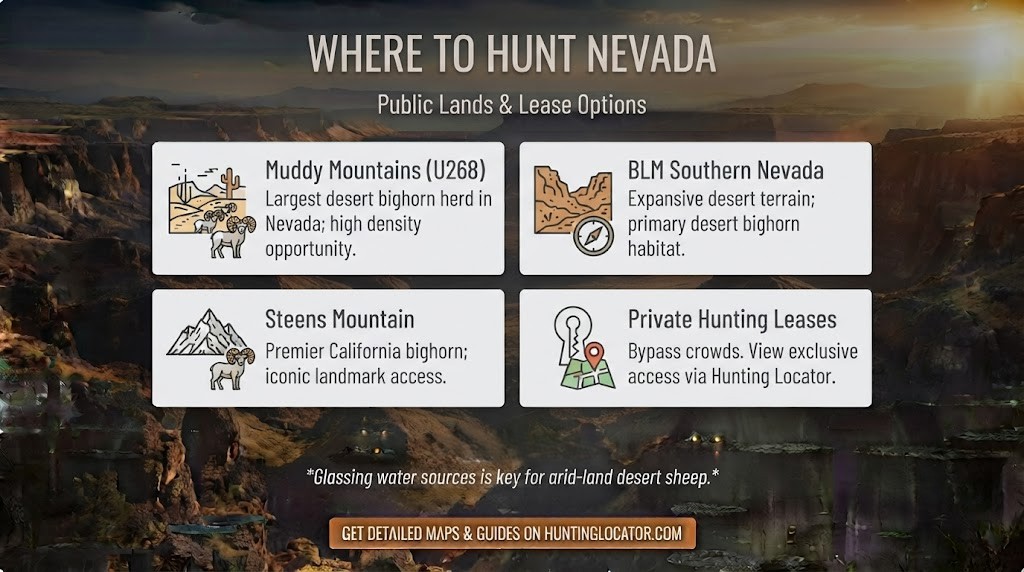
Nevada’s land profile works in hunters’ favor. Over 86% of the state is public land, giving bighorn hunters an enormous base of accessible terrain. Layering public land knowledge with private land access adds flexibility and reduces competition.
Best Public Lands
Nevada’s public lands span six ecoregions — from Great Basin sagebrush to high desert canyon systems — and the state’s bighorn herds are distributed across BLM-managed terrain throughout southern Nevada and the Great Basin. Key areas and access considerations for bighorn hunters include:
- BLM Southern Nevada — The core of desert bighorn range; wide open terrain that rewards hunters who invest in quality optics and disciplined glassing
- Muddy Mountains (Unit 268) — Home to Nevada’s largest desert bighorn herd at an estimated 600 animals; a high-priority unit for applicants focused on population density
- Units 034 and 035 — Both units have produced five rams over 160″ in a recent season; strong options for trophy-focused applicants
- Nevada Test and Training Range (Units 280, 281, 282) — Co-managed by the USAF and USFWS and relatively undisturbed since 1940; hunters must pass a criminal background check, submit a full equipment inventory, and attend a mandatory safety briefing before access is granted
- Unit 091 (Rocky Mountain Bighorn — Residents Only) — Reopened for 2026 after a herd die-off, with older rams in the population making it a notable resident-only opportunity
When selecting a unit, match your choice to both your trophy size expectations and your physical capabilities — terrain difficulty and realistic trophy potential should both factor into your decision.
Private Land Hunting with Hunting Locator
Public land covers most of Nevada’s map, but animals on private land tend to be less pressured and less skittish, which translates to better opportunities in the field. Private parcels adjacent to BLM ground work well as a base: camp on private land, hunt the surrounding public terrain, and return each evening. Private parcels adjacent to BLM acreage expand your effective hunting territory — particularly near known bighorn range, where private inholdings can put you closer to water sources, travel corridors, and terrain features that concentrate animals.
Hunting Locator connects hunters with landowners ready to lease or sell hunting ground. Browse available Nevada hunting leases to find private land options that fit your unit, budget, and season timeline. Whether you need a seasonal lease to supplement your public land hunt or a longer-term arrangement, Hunting Locator puts you in direct contact with landowners. Hunters on the platform regularly secure leases within two weeks of joining.
Guided Hunts
For hunters who want experienced guidance on one of North America’s more demanding pursuits, a guided Nevada bighorn hunt is worth considering. Guided Nevada bighorn hunts are built around spot-and-stalk methods with a heavy emphasis on premium glassing setups. Reputable outfitters customize hunts around the client’s physical ability and experience level — relevant given the terrain these hunts cover. One licensed Nevada outfitter reports a 100% success rate on Desert Bighorn hunts, with statewide harvest success rates for ram hunters reaching 90%.
When evaluating a guided bighorn hunt, consider these factors:
- Experience and licensure — Confirm the outfitter holds a valid Nevada guide/outfitter license
- Subspecies specialization — Some outfitters focus on Desert Bighorn, others on California Bighorn; match the guide to your tag
- Physical fitness expectations — These hunts can be physically demanding in very rugged terrain; ask the outfitter directly what conditioning level they recommend
- Optics capability — Quality glassing setups are a hallmark of high-success sheep operations; ask about their equipment
- Hunt customization — The best outfitters build the hunt around your needs and physical ability
Browse Nevada hunting resources on Hunting Locator to find guided options that match your target species and unit.
Bighorn Sheep Hunting Tips
The preparation you put in before the opener determines whether you fill a Nevada bighorn tag. Whether you’re hunting desert bighorn in late November or California bighorn in late summer, these tips will improve your odds. Find the right gear to execute them at the Hunting Locator store.
- Glass first, move second — Successful bighorn hunts are built on optics-intensive spot-and-stalk methods. Set up on high vantage points at first and last light and cover terrain with your glass before you move. A quality spotting scope and binoculars are not optional — find premium optics at the Hunting Locator store
- Scout water sources — Desert bighorn require freestanding water to survive. In Nevada’s arid southern units, natural tanks, springs, and seeps concentrate animals predictably. Identify them during pre-season scouting and build your glassing strategy around them
- Hunt the rut timing — The desert bighorn rut occurs in fall when rams compete to mate, overlapping directly with the November 20 general opener. Active rutting rams are more visible and more predictable — commit fully to the early days of your tag
- Train for the terrain — A successful sheep harvest requires an intimate understanding of the terrain and specialized gear. Nevada’s bighorn country is steep and rocky, and the physical demands are real. Start a fitness program months out — leg strength, cardiovascular endurance, and loaded pack training all matter
- Match your unit to your capabilities — Select units that align with both your trophy size expectations and physical abilities. If you’re targeting a 160″+ ram, Units 034 and 035 have produced five rams over 160″ in a recent season — but they demand hunters who can cover serious vertical
- Invest in your pack system — A multi-day sheep hunt in Nevada’s backcountry requires a pack capable of carrying optics, water, shelter, and meat comfortably. Explore load-bearing packs and sheep-specific gear at the Hunting Locator store
- Plan your approach around escape terrain — Desert bighorn rely on steep rocky terrain for protection from predators. Understanding how sheep use vertical escape routes shapes your stalk — approach from above when possible and minimize your silhouette against skylines
- Prepare for shots at distance — Nevada’s open canyon and desert terrain means shots can stretch well beyond what most hunters practice. Work from field positions, confirm your zero at extended range, and select a capable rifle caliber before your season. The Hunting Locator store carries shooting and range gear to help you prepare
More Resources from Hunting Locator
- Nevada Hunting Season Guide — An overview of all Nevada hunting seasons, dates, and species; a useful starting point for any Nevada hunting plan
- Nevada Bighorn Sheep Hunting — A closer look at Nevada bighorn strategy, unit selection, and what makes this one of North America’s premier sheep destinations
- Nevada Elk Hunting — Season dates, tag info, and access strategies for Nevada’s trophy elk herds
- Nevada Mule Deer Hunting — Planning resources for Nevada mule deer, from top units to draw strategy
- Nevada Pronghorn Hunting — Season dates and planning resources for Nevada’s antelope country
- Nevada Mountain Goat Hunting — Information on one of Nevada’s rarest and most coveted tags
- Nevada Mountain Lion Hunting — Season structure and access guidance for Nevada mountain lion hunting
- Nevada Black Bear Hunting — Season dates, regulations, and planning resources for Nevada black bear
- Nevada Moose Hunting — What you need to know about pursuing one of Nevada’s rarest big game animals
- Nevada Waterfowl Hunting — Season dates and access options for Nevada’s waterfowl hunting
- Nevada Game Bird Hunting — Chukar, quail, grouse, and more — Nevada’s upland game bird seasons covered
- Nevada Turkey Hunting — Spring and fall turkey season information for Nevada hunters
- Nevada Small Game Hunting — Rabbit, squirrel, and other small game season dates and regulations
- Nevada Hunting Leases — Browse current private land lease listings in Nevada — search by location, acreage, and species
FAQ
How many bighorn sheep can I harvest in Nevada?
The bag limit is 1 ram across all Nevada bighorn sheep seasons — Desert Bighorn and California Bighorn alike. Bighorn sheep is treated as a once-in-a-lifetime tag in Nevada, and you may draw only one Desert Bighorn ram tag per year.
Can non-residents apply for Nevada bighorn sheep tags?
Yes. Non-residents can apply for both Desert Bighorn and California Bighorn in Nevada. However, certain unit restrictions apply — non-residents cannot apply for Desert Bighorn in Unit 213, and all Rocky Mountain Bighorn tags are reserved for residents in 2026. Non-residents should verify unit eligibility against current NDOW regulations before applying.
What does it cost a non-resident to hunt bighorn sheep in Nevada in 2026?
The total mandatory state fees for a non-resident are: $156 for the hunting/fishing combo license, $14 for the application fee (non-refundable), and $1,200 for the tag if drawn — a combined total of $1,370. Guided hunt costs, gear, and travel are additional.
When is the Nevada bighorn draw application deadline?
The 2026 Nevada big game application period ran March 23 through May 13, with results released by May 29. Applications must be submitted by 11 p.m. PDT on the deadline date. No late submissions are accepted.
How does Nevada’s bonus point system work for sheep?
Nevada squares your accumulated bonus points and adds the current year’s entry. For example, 9 points gives you 82 entries (9² + 1 = 82), while 20 points gives you 401 entries (20² + 1 = 401). Each additional year of accumulation multiplies your draw chances significantly — but it doesn’t guarantee a tag, and first-time applicants can and do draw Nevada sheep tags.
Is a bighorn seminar required after drawing a tag?
Yes — it’s mandatory. Any hunter who draws a bighorn sheep tag in Nevada is required to complete a bighorn sheep seminar, available online through NDOW. Complete it well before your season opener.
The Final Shot
Nevada’s combination of huntable subspecies, strong public land herds, and a draw system that gives every applicant a real chance makes it a reasonable place to direct your bonus points and planning energy. Tags are available to first-timers and long-time applicants alike, and the 2026 seasons offer legitimate opportunity across both subspecies.
If you haven’t secured land access yet — or if you’re planning around a future draw — browse Nevada hunting leases on Hunting Locator and connect directly with landowners. Private access near proven bighorn range improves your options, and the better leases tend to fill before the season. Start your search early and have access confirmed before you need it.


