This West Virginia bear guide covers the dates, license costs, and land-access details you need before opening day, whether you’ve hunted West Virginia for years or you’re planning your first trip across state lines. Get your gear sorted early with West Virginia hunting gear so it’s one less thing to think about later, and for the full calendar covering every species, see our complete season guide at that same link.
Here’s what this guide covers:
- Every 2026 bear season date — archery/crossbow, all gun splits, and youth season
- What licenses and stamps you need, and what they cost for residents and non-residents
- Your options for hunting ground — public WMAs, private leases, and guided hunts
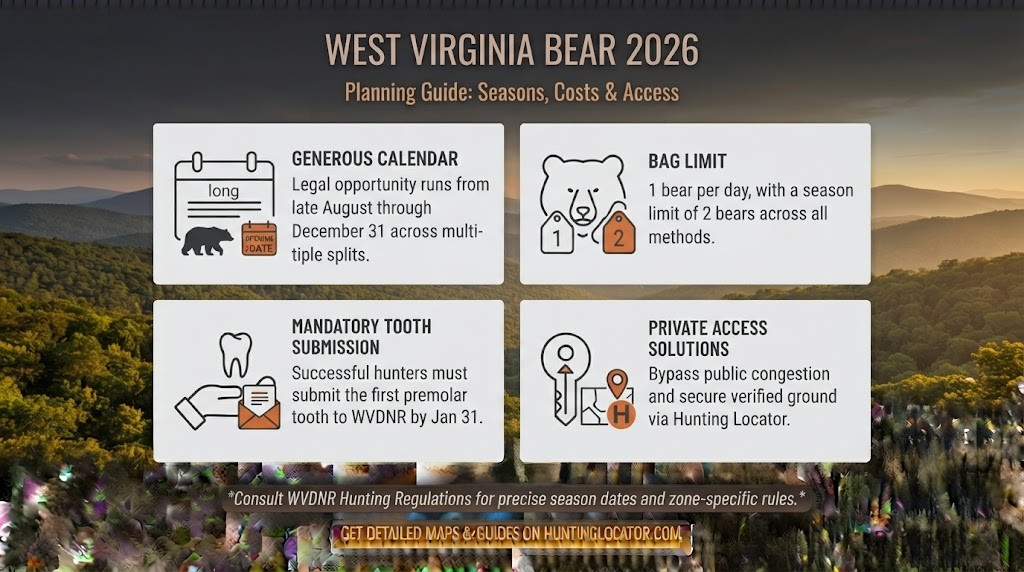
Quick Overview: 2026 West Virginia Bear Season at a Glance
West Virginia’s bear hunting calendar is one of the more generous in the country, with legal opportunity running from late August through December 31. Here’s the full 2026 season in one table.
| Species | Season Type | Dates | Bag Limit | Notes |
|---|---|---|---|---|
| Bear | Archery & Crossbow | Sept 27 – Dec 31, 2026 | 1/day; 2/season | Runs alongside deer archery season |
| Bear | Gun (Split, Selected) | Aug 30 – Sept 7, 2026 | 1/day; 2/season | Early split; selected areas |
| Bear | Gun | Sept 20 – Sept 26, 2026 | 1/day; 2/season | — |
| Bear | Gun | Oct 4 – Oct 10, 2026 | 1/day; 2/season | — |
| Bear | Gun | Oct 23 – Oct 26, 2026 | 1/day; 2/season | Concurrent antlerless/bear window |
| Bear | Gun | Nov 24 – Dec 7, 2026 | 1/day; 2/season | Concurrent with deer firearms |
| Bear | Gun | Dec 8 – Dec 31, 2026 | 1/day; 2/season | Late-season opportunity |
| Bear | Youth Season | Sept 13 – 14, 2026 | 1/day; 2/season | Second youth split Oct 18–19 |
Across every method and split, the bag limit is one bear per day, with a season limit of two. Every hunter who tags a West Virginia bear must submit the first premolar tooth to WVDNR by January 31 of the following year — easy to forget after a successful hunt, so keep it in mind now.
Before you head out, make sure your paperwork is squared away:
- All hunters: A valid West Virginia hunting license is required.
- Residents: Hunting license + Bear Damage Stamp (Class DS).
- Non-residents: Class EE Bear Hunting License ($162) + Bear Damage Stamp (Class DS, $10) + Conservation/Law Enforcement Stamp (CS/LE, $13).
- Hunter education: If you were born on or after January 1, 1975, you’ll need to complete a certified hunter education course before you can get licensed.
Bear Hunting Seasons in West Virginia
West Virginia bear season runs across several overlapping pieces: one long archery/crossbow window that stays open for months, a series of short gun splits scattered across fall, and dedicated youth days. It breaks down cleanly once you separate it by method. Exact open counties and dog-hunting rules vary, so check your specific county against the official regulations before heading out. For more detail, see our West Virginia bear hunting guide.
Recent hunting outlook data suggests harvests could run slightly higher than last year, since a strong oak mast crop tends to extend bear activity later into December before bears den — worth factoring into late-season plans.
Archery & Crossbow Season (Sept 27 – Dec 31, 2026)
This is the longest of WV’s bear seasons — a three-month window running September 27 through December 31, 2026, with the standard one-bear-per-day, two-per-season limit. Crossbows are legal throughout the entire window, which makes this the most accessible option for hunters who’d rather not juggle separate equipment rules mid-season.
It also overlaps with West Virginia deer season, so a single trip can put you in position for both species. For DIY residents and traveling non-residents alike, this is the longest and most flexible window on the calendar.

Gun Season Splits (Aug 30 – Dec 31, 2026)
The gun seasons come in distinct chunks:
- Aug 30 – Sept 7: An early, selected-area split that gets gun hunters into the woods before Labor Day.
- Sept 20 – Sept 26: A second September window.
- Oct 4 – Oct 10: An early-October split.
- Oct 23 – Oct 26: Runs concurrent with an antlerless deer window in many counties.
- Nov 24 – Dec 7: Concurrent with deer firearms season — expect more hunters in the woods.
- Dec 8 – Dec 31: A late-season closer, often the quietest of the splits.
Open counties vary by split, so check the official regulations summary before you plan your trip. The September splits often line up with peak acorn drop, when bears are feeding heavily in oak stands — timing a hunt to that food source can make the difference between a quiet week and a full tag.
The special permit season for bear-dog hunters was discontinued in 2016, so the concurrent gun seasons described here are hunted without dogs.
Youth Bear Season (Sept 13–14 & Oct 18–19, 2026)
West Virginia gives young and new hunters two dedicated windows: the first youth bear split runs Sept 13–14, 2026, and a second runs Oct 18–19, 2026, concurrent with the youth white-tailed deer season. Full detail is available through the state’s West Virginia youth seasons announcement.
Youth hunters must be at least 8 and under 18. Hunters ages 15–17 must meet all standard licensing requirements just like an adult. Hunters ages 8–14 must be accompanied by a licensed adult over 21 who carries no weapon and stays close enough to advise and assist throughout the hunt.
For anyone introducing someone to bear hunting for the first time, this is a low-pressure entry point — no prior bear-hunting experience required, just the right supervision and a valid license where applicable.
West Virginia Bear Licenses and Permits
Every bear hunter in West Virginia needs a base hunting license plus bear-specific stamps, and exactly what’s required depends on residency. It’s simpler laid out side by side.
West Virginia Bear Hunting Licenses
| License/Stamp | Resident/Non-resident | Cost |
|---|---|---|
| WV Hunting License | Resident | Required |
| Bear Damage Stamp (Class DS) | Resident | Required (exemptions apply) |
| Class EE Bear Hunting License | Non-resident | $162 |
| Bear Damage Stamp (Class DS) | Non-resident | $10 |
| Conservation/Law Enforcement Stamp (CS/LE) | Non-resident | $13 |
For non-residents, the full non-resident bear license requirements add up to a minimum bear-specific outlay of $185 — the Class EE Bear Hunting License ($162), the Bear Damage Stamp ($10), and the Conservation/Law Enforcement Stamp ($13). The Class EE authorizes bear hunting statewide except where otherwise restricted.
Residents have a lighter lift: a standard hunting license plus the Bear Damage Stamp (Class DS). Resident landowners hunting their own property, along with certain underage residents, may be exempt from the DS Stamp requirement.
Buy your license and stamps early through the official WVhunt.com portal. WVDNR has given the same advice for the coming season: get licensed early, review the regulations summary, and head into fall prepared.
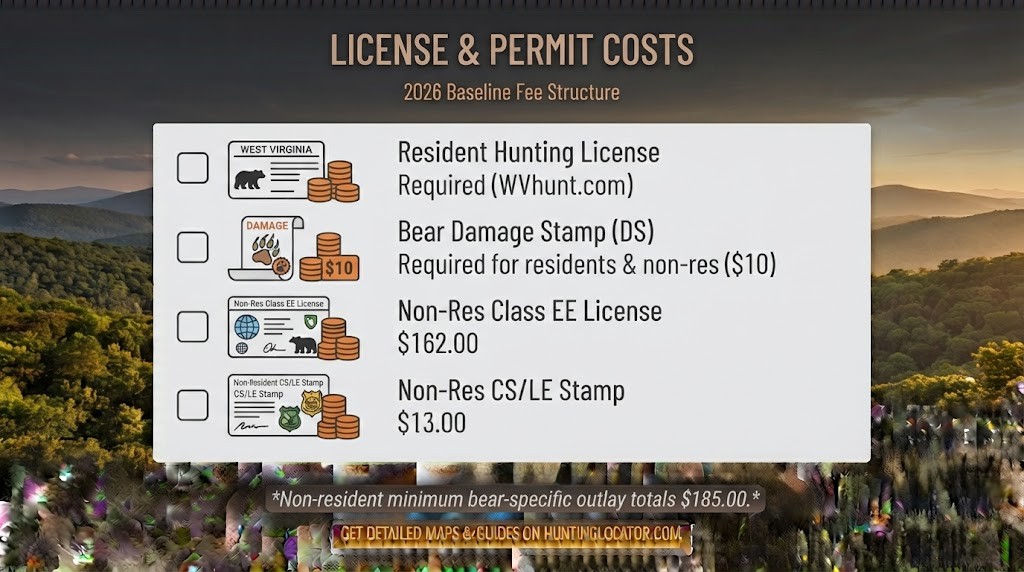
West Virginia Bear Permits & Requirements
Getting legally squared away for bear season comes down to a few steps:
- Confirm your hunter education status — required if you were born on or after January 1, 1975.
- Buy your hunting license and required stamps at WVhunt.com before the season opens.
- Confirm your county’s open dates and method rules, since splits and open areas vary by county.
- After harvest, check your bear through your WVDNR account and submit the first premolar tooth to WVDNR by Jan. 31.
That last step is the one hunters most often forget after a successful hunt — the premolar tooth submission is mandatory and has a hard deadline. Game checks can be completed entirely online through WVhunt.com, and youth hunters check their own harvests under their individual WVDNR account.
Where to Hunt Bear in West Virginia
Once your license and dates are sorted, the next question is where you’ll be standing on opening morning. There are three main paths to bear ground in West Virginia: public land, private leases, and guided hunts. Each comes with tradeoffs in cost, access, and how much local knowledge you need going in.
Best Public Lands
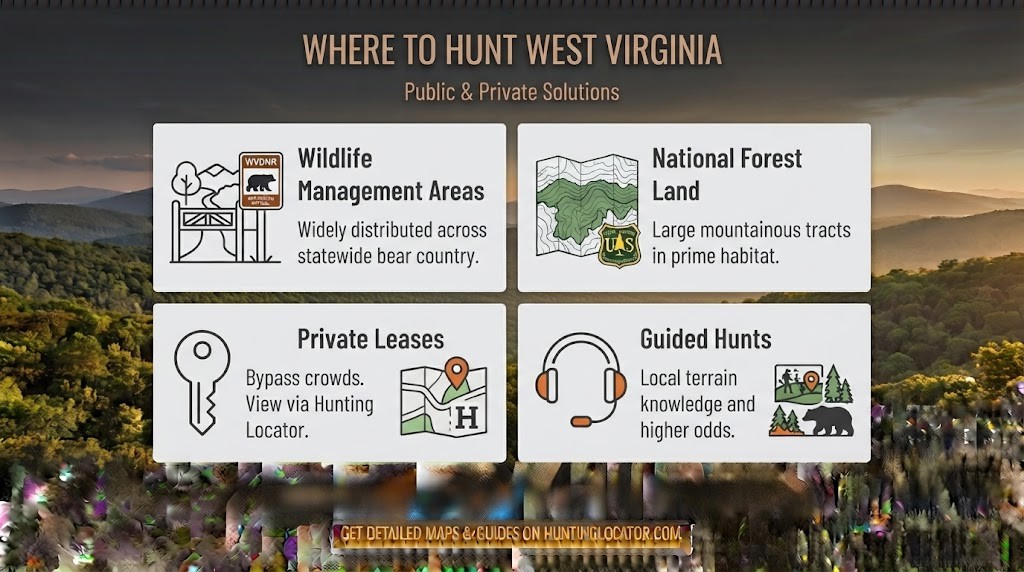
West Virginia’s Wildlife Management Areas and national forest lands offer free public bear access — a solid starting point for residents and out-of-state hunters alike.
- Wildlife Management Areas (WMAs): Widely distributed across bear country statewide; check the official regulations summary to confirm which counties and WMAs are open for your chosen method and split.
- National forest land: Large tracts of mountainous public ground sit within prime bear habitat.
- Know before you go: Confirm your split and county are open before you scout, and expect heavier pressure on public ground during the most popular windows.
Private Land Hunting with Hunting Locator
Public land works, but it comes with more hunters, more pressure, and less consistency season to season. Private land means less competition, more predictable bear activity, and the ability to hunt the same ground across multiple splits without competing for a spot. Losing access to a good spot, or never finding one in the first place, is a real concern — and most hunters don’t have time to cold-call landowners or scout blind.
That’s where leasing, or buying, private hunting land comes in. Leasing gives you dedicated access for a season (or multiple) without the long-term commitment of ownership. Buying is the path for hunters who want a place that’s theirs, season after season.
The Hunting Locator platform connects hunters directly with landowners who are ready to lease or sell hunting ground, so you’re not starting from zero.
Browse current West Virginia bear hunting leases and start reaching out to landowners while prime spots are still available before the September 27 opener.
Guided Hunts
Whether guided or DIY makes more sense depends on your familiarity with the terrain, your budget, and how much time you have to scout.
- Guided hunts: Local knowledge and terrain familiarity translate directly into higher odds, especially for non-residents hunting West Virginia for the first time.
- DIY hunts: Lower cost and full flexibility to hunt any split that fits your schedule — a natural fit for experienced residents who already know the ground.
If you’re going the guided route, book early — quality operations for the 2026 season will fill their calendars well before the September opener. If you’d rather keep full control of your hunt, securing your own private lease is a strong alternative that puts you in charge of your schedule from day one.
Bear Hunting Tips for a Successful 2026 Season
A little preparation now pays off once you’re in the stand. Here’s what separates a productive season from a frustrating one:
- Hunt the mast: Target oak stands during the September splits when acorn drop peaks and bears feed heavily. Timing your hunt to the food source is one of the biggest levers for success.
- Play the long archery window: With the season open Sept 27 – Dec 31, pattern bears early in the fall and be ready to adjust as food sources and weather shift heading into December.
- Layer for the mountains: West Virginia’s terrain and late-season cold call for quality layers, solid boots, and reliable optics — gear that keeps you comfortable and in the stand longer.
- Dial in your setup: Whether you’re running a crossbow, bow, or rifle, practice at realistic ranges before opening day. Confidence in your equipment matters more than any single caliber debate.
- Stay legal and ethical: Know your county’s open split, respect the one-bear-per-day, two-per-season limit, and plan ahead for the mandatory premolar tooth submission after harvest.
When it’s time to fill gaps in your gear, the Hunting Locator store carries layering pieces and optics suited to West Virginia’s bear country.
More Resources from Hunting Locator
Bear season is one piece of West Virginia’s fall lineup. Here’s a hub for planning the rest of your season:
- Hunting Locator home — find hunting land nationwide, whether you’re staying in West Virginia or planning a hunt elsewhere.
- West Virginia hunting leases — browse current lease listings across the state and connect directly with landowners.
- Complete WV hunting overview — a guide covering every major West Virginia season in one place.
- WV bear hunting deep dive — additional bear-specific strategy and detail beyond what’s covered here.
- West Virginia deer season guide — plan around the overlapping deer archery season for a two-species trip.
- WV turkey season guide — worth a look if you’re hunting in Logan, McDowell, Mingo, or Wyoming counties, where the Mountaineer Heritage Season now allows bear and turkey to be taken with any legal weapon.
- WV small game season — a good option for filling off-days between bear splits.
- West Virginia wild boar season — another big-game opportunity worth exploring in the region.
- Predator and furbearer season — extend your time in the field once bear season wraps.
Frequently Asked Questions
What are the West Virginia bear season 2026 dates?
Archery and crossbow season runs Sept 27 – Dec 31, 2026. Gun season is split into several windows running Aug 30 – Dec 31, and youth season falls on Sept 13–14 and Oct 18–19. The bag limit is one bear per day, two per season, across all methods, aligned with WVDNR’s regulatory framework.
How much is a non-resident bear hunting license in West Virginia?
Non-residents need the Class EE Bear Hunting License at $162, plus the Bear Damage Stamp (DS) at $10 and the Conservation/Law Enforcement Stamp at $13 — a minimum bear-specific total of $185. All licenses and stamps can be purchased through WVhunt.com.
When is the WV youth bear season in 2026?
The first youth black bear split runs Sept 13–14, 2026, with a second split on Oct 18–19, 2026, running concurrent with youth deer season. Youth hunters ages 8–14 must be accompanied by an unarmed, licensed adult over 21 at all times during the hunt.
What is the bag limit for bear hunting in West Virginia?
The bag limit is one bear per day, with a season limit of two bears, across archery, gun, and youth seasons alike. Most hunters also need the Bear Damage Stamp (Class DS), with limited exemptions for resident landowners hunting their own property.
Do I need a Bear Damage Stamp to hunt bear in WV?
Yes, nearly every bear hunter in West Virginia needs the Bear Damage Stamp (Class DS). Exceptions include resident landowners hunting their own land and certain underage residents. Residents add the stamp to their base license, while non-residents pay $10 for it on top of the Class EE license.
What do I do after I harvest a bear in West Virginia?
Check your bear through your WVDNR account, which can be completed online at WVhunt.com, and submit the first premolar tooth to WVDNR by January 31 of the year following your harvest. This tooth submission is mandatory and shouldn’t be overlooked after a successful hunt.
The Final Shot
Three things stand between you and a successful 2026 season: knowing your dates, getting licensed, and locking down your ground. The archery opener lands September 27, gun splits start as early as August 30, residents need a license plus the Bear Damage Stamp, and non-residents will want the Class EE license alongside the DS and CS/LE stamps. Buy your license at WVhunt.com, confirm your county’s open splits, and start lining up your hunting access now rather than in September.
WVDNR’s advice is worth repeating: get licensed early and review the regulations summary so you head into fall prepared. Treat this guide as your starting point, and consider Hunting Locator a way to connect with landowners who can put you on real bear ground this season.
If you haven’t already, now is the time to secure access and get your gear squared away so you’re ready when the September 27 opener arrives.


