What makes West Virginia special? It’s the terrain. From the rugged Allegheny peaks to the rolling Ohio River Valley, you’ve got hunting diversity that’s hard to match anywhere in the East. We’re talking 92 Wildlife Management Areas covering 8% of the entire state—that’s serious hunting ground.
Whether you’re planning your first West Virginia hunt or you’re tired of fighting crowds on the same old public spots, this guide breaks down everything you need to know. No fluff, just the details that matter.
Here’s what we’re covering:
- Licensing requirements, costs, and season dates for every game species that matters
- Regulations and bag limits for deer, bear, turkey, and small game
- Where to actually find good hunting—public lands, private leases, and guided options
Time to dig into what makes West Virginia hunting work.
Quick Overview: Season Dates, West Virginia Hunting Licenses, and Regulations
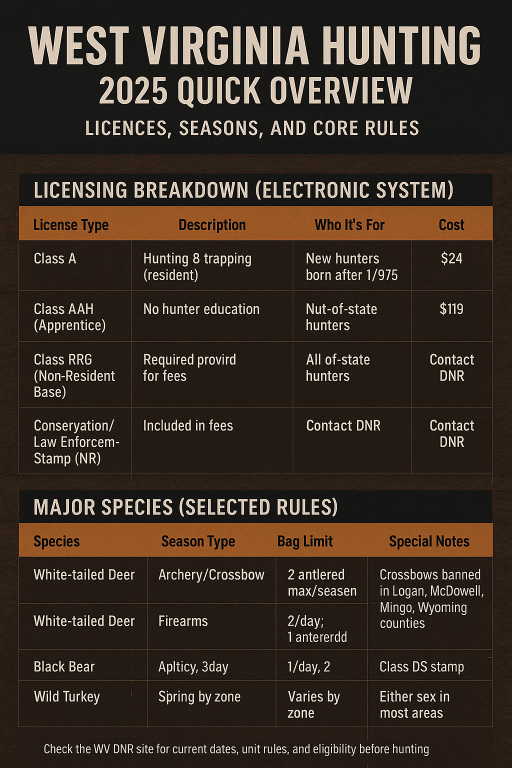
West Virginia’s Electronic Licensing & Game Check System handles thousands of hunting licenses every year. The system’s pretty straightforward once you understand the basics, but resident versus non-resident requirements are night and day different.
Here’s the licensing breakdown that actually matters:
| License Type | Description | Who It’s For | Cost |
|---|---|---|---|
| Class A (Hunting and Trapping) | Basic resident hunting license | WV residents 15+ | $24 |
| Class AAH (Apprentice Hunting/Trapping) | No hunter education required | New hunters born after 1/1/75 | $119 |
| Class RRG (Non-Resident Base) | Basic non-resident hunting license | Out-of-state hunters | Contact DNR |
| Conservation Stamp | Required for residents | All resident hunters | Included in fees |
| Conservation/Law Enforcement Stamp | Required for non-residents | All non-resident hunters | Contact DNR |
| Lifetime License | One-time purchase for lifetime hunting | Adults seeking permanent license | $805 |
Everything goes through the Electronic Licensing system—online enrollment, payment, printing. Done. One catch: if you were born on or after January 1, 1975, you need hunter education before you can buy a base license. Unless you go with the Apprentice option.
Season dates and bag limits change, so verify everything with WV DNR. But here’s what you’re looking at for major species:
| Species | Season Type | Bag Limit | Special Notes |
|---|---|---|---|
| White-tailed Deer | Archery/Crossbow | 2 antlered max per season | Crossbows banned in Logan, McDowell, Mingo, Wyoming counties |
| White-tailed Deer | Firearms | 2 per day, 1 antlered per day | 3 antlered allowed in CWD areas |
| White-tailed Deer | Muzzleloader | Same as firearms | Single-shot muzzleloader .38 cal+ |
| Black Bear | Archery | 1 per day, 2 per season | One bear daily maximum |
| Black Bear | Firearms | 1 per day, 2 per season | Class DS stamp required |
| Wild Turkey | Spring Season | Varies by zone | Gobbler and bearded hens only |
| Wild Turkey | Fall Season | Varies by zone | Either sex in most areas |
West Virginia Deer Hunting
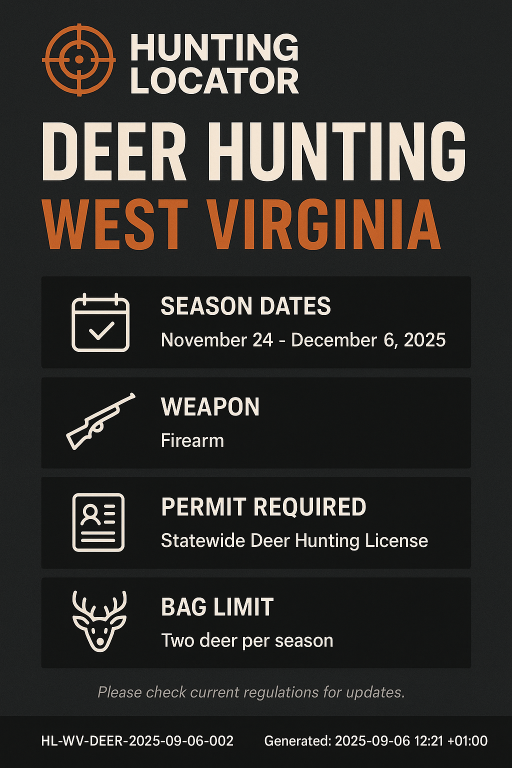
Deer hunting drives everything else in West Virginia. The state tracks rifle and archery harvests separately, and for good reason—the numbers are impressive. From oak-covered ridges to farm country valleys, all 55 counties support deer populations that keep both meat hunters and trophy chasers coming back.
West Virginia Deer Hunting Seasons
West Virginia gives you options. Archery season opens first and runs longest, usually with the best weather. You can hunt deer of either sex statewide with bow or crossbow during archery seasons—just remember those four counties where crossbows are off-limits.
Muzzleloader season sits between archery and firearms. It’s primitive weapons with a twist: single-shot muzzleloading rifles, .38 caliber minimum. Timing often hits peak rut activity, which means productive hunting.
Firearms season is when most hunters hit the woods. Liberal bag limits let you take two deer daily, but only one antlered deer per day. That’s serious opportunity.
West Virginia Deer Hunting Regulations
The rules are designed to keep hunting legal and support wildlife management. Here’s what you need to know:
- Two antlered deer maximum during regular seasons—except CWD areas allow three
- Electronic registration and tagging required before hunting again
- Two deer daily limit, one antlered deer daily limit
- Valid photo ID required while hunting
- Online game checking using your DNR ID Number
West Virginia Bear Hunting
Black bear hunting in West Virginia delivers some of the best big game action on the East Coast. You can harvest one bear daily and two bears total per season—that’s multiple chances at success most states don’t offer.
West Virginia Bear Hunting Seasons
West Virginia runs both archery and firearms bear seasons, structured to provide opportunity while keeping harvest sustainable. Bear seasons usually overlap with deer seasons, so you can hunt both species on the same trip.
Season timing takes advantage of bear behavior—especially pre-hibernation feeding that makes bears more active and predictable. Smart management that works for hunters.
West Virginia Bear Hunting Regulations
Bear hunting regulations focus on safety and proper harvest:
- Class DS stamp required beyond base license
- One bear daily, two bears per season maximum
- Proper identification crucial—bears aren’t the only large dark animals in the woods
- Immediate tagging and registration required
- Weapon restrictions vary by season
West Virginia Turkey Hunting
Turkey hunting in West Virginia offers spring and fall seasons that couldn’t be more different. The state’s turkey recovery story is remarkable—from near extinction to populations that support hunting seasons drawing hunters from across the country.
West Virginia Turkey Hunting Seasons
Spring turkey season is the main event. Late April through May, when gobblers are fired up and responding to calls. This is interactive hunting at its finest—calling birds within range creates the kind of chess match that hooks hunters for life.
Fall turkey season changes everything. Different tactics, different birds. You’re often breaking up flocks and calling scattered birds back. Fall seasons may allow either sex harvest, depending on area management goals.
West Virginia Turkey Hunting Regulations
Turkey hunting regulations emphasize safety and proper identification:
- Spring season: gobblers and bearded hens only
- Fall season: varies by area for either sex or gobbler-only
- Legal shooting hours: sunrise to sunset typically
- Hunter orange requirements during overlapping seasons
- Proper identification essential—know your target
West Virginia Minor Game Species Hunting
Small game hunting in West Virginia offers something big game can’t: accessibility. Longer seasons, liberal bag limits, less specialized gear. Perfect for beginners or anyone wanting variety beyond deer and bear.
West Virginia Squirrel Hunting Information
Squirrel hunting might be the most underrated opportunity in West Virginia. Extensive hardwood forests support both gray and fox squirrels, with seasons running several months. These aren’t easy targets—squirrel hunting teaches patience, accuracy, and woods knowledge.
Early morning and late afternoon produce the best action when squirrels are feeding. Learn their patterns, and you’ll have consistent hunting all season long.
West Virginia Rabbit Hunting Information
Cottontail rabbit hunting thrives where agriculture meets cover—and West Virginia has plenty of both. Hunt solo or with groups, often with beagles to move rabbits within range.
Perfect training for beginning hunters. Liberal bag limits, long seasons, and the chance to work with hunting dogs adds another dimension. Plus, rabbits make excellent table fare.
West Virginia Grouse Hunting Information
Ruffed grouse hunting represents West Virginia’s ultimate upland challenge. Mountain birds in mountain country—young forest growth and edge habitat in terrain that’ll test your legs as much as your shooting.
Grouse populations cycle, so some years are better than others. But when these birds flush, it’s explosive. The shooting challenge in beautiful mountain settings makes grouse hunting a favorite among serious upland hunters.
Where to Hunt in West Virginia
West Virginia’s hunting landscape runs from the Allegheny Mountains to the Ohio River Valley. 92 Wildlife Management Areas covering 8% of the state plus state forests open to hunting means public land options everywhere. Competition can be brutal during peak seasons, though.
Best Public Hunting Lands
Public hunting in West Virginia requires more work and knowledge, but the access is there for hunters without private land connections:
- Monongahela National Forest – Massive acreage across multiple counties, diverse opportunities
- George Washington National Forest – Eastern panhandle with solid deer and turkey numbers
- Coopers Rock State Forest – Popular near Morgantown, multiple species
- Greenbrier State Forest – Cabins and camping available for extended trips
- Seneca State Forest – Remote location, less pressure, good bear country
- Kumbrabow State Forest – Mountain terrain, challenging hunting, diverse wildlife
- Cabwaylingo State Forest – Southern location with camping facilities
Guided Hunts in West Virginia
Professional outfitters make sense for non-residents or hunters targeting specific trophies. Mountain Meadow Hunting Preserve in Greenville runs big game hunts for trophy whitetail, fallow deer, red stag, and wild boar. Land Baron Outfitters in Palestine provides whitetail and turkey hunts with exclusive access to 236+ acres.
Guided hunts typically include lodging, meals, and professional guidance. Complete experience without the logistics headache.
Private Land Hunting Options
Private land hunting beats public land in almost every way: less pressure, better management, higher success rates. Hunting leases can run $1,000 yearly memberships with specific payment deadlines.
Lease options range from day-use permits to annual memberships. Hundreds of properties available for daily, seasonal, or annual lease through various platforms. Corporate properties—coal companies, natural resource companies with large holdings—often provide access to quality wildlife including deer, bear, turkey, rabbit, and grouse.
Understanding hunting lease agreements becomes essential for serious hunters. Hunting Locator connects hunters directly with West Virginia landowners offering leases—from small family properties to timber company holdings spanning thousands of acres. Our platform simplifies finding, evaluating, and securing hunting access across the state.
For permanent solutions, West Virginia land for sale provides options for hunters wanting their own property.
FAQ
What hunting license do I need as a non-resident in West Virginia?
Non-residents need a non-resident base or combination hunting license plus the Conservation/Law Enforcement Stamp. License class depends on target species, with additional stamps required for deer and bear. Purchase through the Electronic Licensing & Game Check System online.
Do I need hunter education to hunt in West Virginia?
How much does it cost to lease hunting land in West Virginia?
Some properties require $1,000 yearly memberships due by June 30th, while others offer daily or seasonal rates. Outdoor Access provides hundreds of properties for daily, seasonal, or annual lease—often cheaper than traditional hunt clubs with more available land and higher success rates.
What are the best counties for deer hunting in West Virginia?
Fresh opportunities opened in Calhoun, Doddridge, Jackson, Pleasants, Ritchie, Wirt, and Wood counties where DNR acquired 31,218 acres of new public hunting land. These areas offer new hunting opportunities with potentially less pressure. Available hunting leases in Fayette County, Braxton County, and Hardy County provide additional options.
Can beginners hunt on West Virginia public lands?
Absolutely. 92 Wildlife Management Areas make up 8% of West Virginia’s land, providing plenty of opportunities for new hunters. Complete hunter education requirements first, then consider starting with less pressured areas or small game species before tackling big game on crowded public lands.
How do I check in harvested game in West Virginia?
Check your game online using your DNR ID Number through the Electronic Licensing & Game Check System. All harvested deer must be electronically registered and legally tagged before hunting again. The online system makes game checking convenient and ensures harvest reporting compliance.
The Final Shot
West Virginia hunting delivers for everyone—from first-timers to veterans seeking fresh challenges. Success comes down to understanding regulations, getting the right license, and finding the perfect spot for your goals.
Your action plan: figure out license requirements based on residency and birth date, complete hunter education if needed, pick your target species and mark season dates, then lock down your hunting location—public land, guided hunt, or private lease.
Always check the West Virginia Division of Natural Resources official website for current regulations and license purchases. Whether you’re exploring vast public lands or securing exclusive access through a hunting lease, the Mountain State’s opportunities are as diverse as its terrain.
Ready to find your perfect West Virginia hunting spot? Check out available hunting leases, public land options, and hunting clubs to make this your best season yet.


