This Washington mountain goat guide covers the season dates, license fees, permit rules, and land-access options you need, so you can spend less time digging through regulations and more time preparing for the hunt. If you want a head start on gear, our store carries equipment built for steep alpine terrain, and for everything else in play this year, see our full Washington hunting season guide.
What’s covered below:
- Season & Draw Reality — Exact dates, the seven-tag lottery, and the odds you’re up against.
- Costs & Licensing — Resident versus non-resident fees, including the $2,729 non-resident tag.
- Where & How to Hunt — Public land options, private-lease access, and gear for getting up the mountain and back.
Here’s the season at a glance before the details.

Quick Overview: Washington Mountain Goat Season at a Glance
Mountain goat hunting in Washington isn’t an over-the-counter season. It runs on a special-permit lottery with extremely limited entry, and your hunt depends entirely on being drawn. The table below covers the essentials.
| Element | Detail |
|---|---|
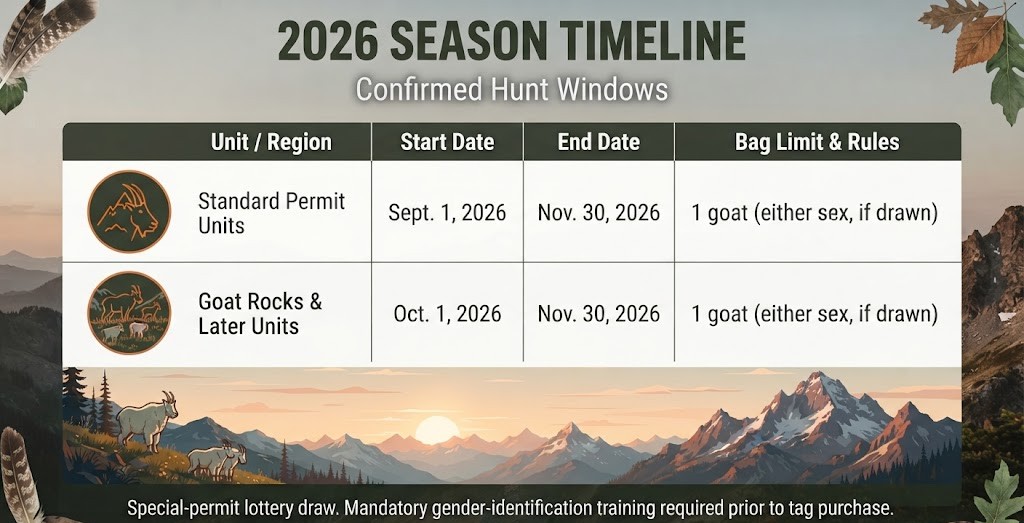
| General Season | September 1 – November 30, 2026 (some GMUs like Goat Rocks open Oct 1) |
| Hunt Type | Special-permit lottery (limited entry) |
| Bag Limit | One (1) mountain goat of either sex per year (if drawn) |
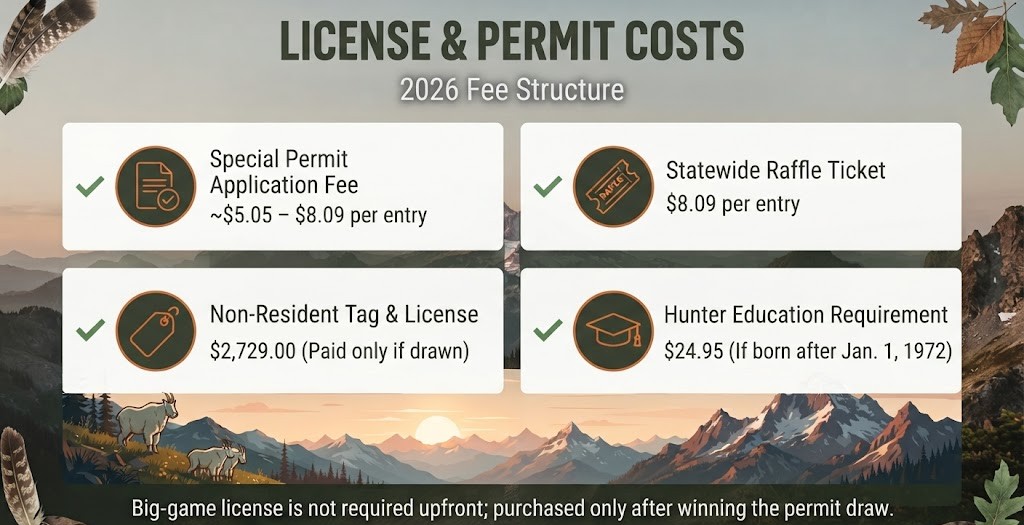
| Application Fee | ~$5.05–$8.09 per species entry (varies by residency/youth) |
| Non-Resident Tag & License | $2,729 (paid only if drawn) |
| Raffle Ticket | $8.09 per statewide raffle entry |
| License Requirement | No big-game license purchase required upfront — only if drawn |
For more detail on planning a successful goat season, see our companion mountain goat deep-dive. Fees and deadlines shift year to year, so confirm exact numbers on WDFW’s official licensing portal before submitting anything.
A few requirements determine whether you’re eligible to apply or hunt:
- Hunter Education — Required for anyone born after January 1, 1972. The Washington hunter education requirement costs $24.95 and must be completed before you apply.
- Special Permit — The one credential that matters. You can’t hunt goats without it, and the only way to get one is through the lottery.
- License/Tag — Purchased only after you’re drawn and after completing mandatory gender-identification training.
Washington Mountain Goat Hunting Seasons
Unlike deer or elk, where general seasons apply broadly across the state, goat seasons tie directly to the specific permit and Game Management Unit (GMU) you’re drawn for. The WDFW mountain goat hunt areas dataset defines the official 2026-2027 hunt boundaries. Some historically popular units are closed entirely this season, according to industry guide sources.
General Season (September 1 – November 30)
The statewide window for drawn goat permits runs September 1 through November 30, 2026. Exact dates depend on which unit you’re assigned. Your bag limit is one mountain goat of either sex per year, and only if your name comes up in the draw.
Goat Rocks & Later-Opening Units (Oct 1)
Some units, Goat Rocks among them, open later, typically around October 1. Sources vary on the exact opener, so verify your specific unit’s dates with WDFW before finalizing travel plans. Many goat areas overlap with popular hiking and recreation zones, so you may need additional hiking or camping permits before heading into the backcountry.
Standout Trophy Units
Industry guides consistently point to Mount Margaret and Mount St. Helens as standout units, both known for strong goat populations and trophy-quality billies. If you’re after size along with the experience, these are the units to watch.
Washington Mountain Goat Licenses and Permits
The part of this process most hunters misunderstand: you don’t buy the expensive license upfront. You only pay the tag and license fee if you’re actually drawn. This structure, confirmed by the Washington mountain goat special permits regulations, protects hunters from paying thousands for a hunt they’ll never take.
Washington Hunting Licenses (Costs)
A hunting license is your general authorization to hunt in Washington. A tag is the specific authorization to harvest a particular species. A special permit is the limited-entry lottery credential required before you can purchase a goat tag at all. For mountain goat, you need all three, in that order.
| Item | Resident | Non-Resident |
|---|---|---|
| Special Permit Application Fee | ~$5.05–$8.09 per entry | ~$5.05–$8.09 per entry |
| Statewide Raffle Ticket | $8.09 | $8.09 |
| Tag & License (paid only if drawn) | Significantly lower | $2,729 |
Resident hunters pay a fraction of the non-resident tag cost, which makes Washington’s goat draw one of the more accessible options for in-state hunters willing to accumulate points. Confirm exact 2026 resident figures and any fee adjustments on WDFW’s licensing portal before you apply.
Washington Hunting Permits & Application Process
Washington’s draw system uses what guides call a “bonus squared” mechanism, a weighted-point structure where your odds improve the longer you apply without being drawn, though hunters with zero or few points still have a real shot. Goat permits average over 15 points for successful applicants, and that number is trending upward, so understanding the point system matters as much as the fee schedule.
The process, step by step:
- Complete Hunter Education — Required if you were born after January 1, 1972. You need this certification before applying.
- Apply during the special-permit window — The window opened in April 2026. Some sources cite a May 20 deadline, others an extended May 27 deadline, so confirm the exact date with WDFW directly.
- Pay the application fee — Roughly $5.05 to $8.09 per species entry, depending on residency and youth status.
- Check results in mid-June — Draw results post around the middle of June, and it’s your responsibility to check the WDFW website. No one calls you.
- Complete WDFW’s mountain goat gender-identification training — Mandatory if you’re drawn, before you can purchase anything further.
- Purchase your license and tag — Resident costs are significantly lower; non-residents pay $2,729 for the adult license and tag combination.
Washington also offers a statewide raffle tag at $8.09 per ticket, a lower-cost alternate path into the draw pool, separate from the standard special-permit lottery.
Washington Mountain Goat: Where to Hunt
With roughly 15-plus average points needed to draw and only seven tags issued across five units in 2026, it’s worth setting expectations early. Being drawn is only half the battle. Where and how you hunt your unit matters just as much, including access options through our Washington lease listings.
Best Public Lands
Most drawn goat units sit within national forests and designated wilderness areas, many of which overlap with popular hiking and recreation zones. Because of that overlap, you may need additional permits just to access the backcountry your goat tag covers.
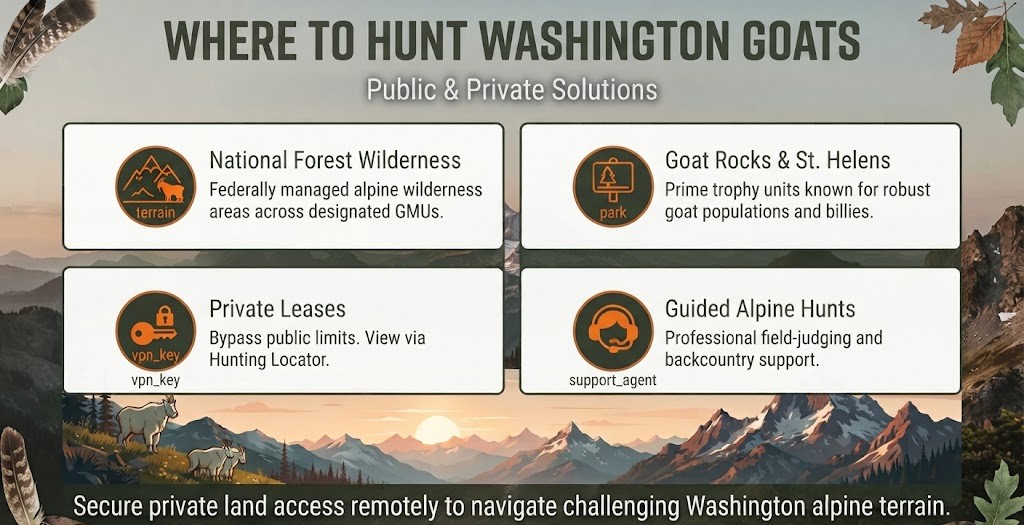
- National forest wilderness areas — The bulk of Washington’s goat habitat sits within federally managed wilderness, requiring careful attention to boundaries and seasonal closures.
- Goat Rocks Wilderness — A well-known unit with a later opener, popular with both hunters and hikers during overlapping seasons.
- Mount St. Helens and Mount Margaret areas — Public land access points known for strong goat populations and trophy potential.
- WDFW’s official GIS mapping tool — Use the mountain goat hunt area dataset referenced earlier in this guide to confirm your unit’s boundaries and any closures before you scout.
Some units, including GMUs 372, 382, and 564, sit close enough to private ground that landowner access can reshape your entire hunt plan.
Private Land Hunting with Hunting Locator
Drawing a tag is hard enough. The last thing you want is to discover that public access in your unit is limited, overcrowded, or bordered by private land you can’t reach. That’s where private-land access becomes a real advantage rather than an afterthought.
Leasing or purchasing private land near your drawn GMU can solve access problems that public land alone can’t. Instead of competing with other hunters for the same trailhead or navigating boundary disputes, you get dedicated, exclusive access to ground closer to where the goats actually are.
This is what Hunting Locator was built for. As a platform connecting hunters directly with landowners ready to lease or sell, we take the guesswork out of finding quality private access. Browse listings by acreage, terrain, and location, connect directly with landowners, and secure ground that fits your hunt, without cold calls or dead-end leads.
Browse Washington leases and secure your access before the season gets away from you. Whether you’re a resident scouting a nearby unit or a non-resident planning a once-in-a-lifetime trip, this is where your access plan starts.
Guided Hunts
Mountain goats are notoriously difficult to judge in the field, which makes a guided hunt worth serious consideration, especially for less-experienced hunters or non-residents unfamiliar with Washington’s terrain. If you draw a tag, you’ll want either a professional guide or someone in your party who can confidently judge goats before you pull the trigger.
- Field-judging expertise — A guide’s trained eye helps you avoid harvesting a nanny, which industry sources warn can lead to entire units being shut down for future seasons.
- Terrain knowledge — Experienced guides know the drainages, cliff bands, and safe travel routes specific to your unit.
- Time efficiency — With a narrow season window and a once-in-a-lifetime tag on the line, a guide’s local knowledge can be the difference between success and a wasted trip.
Mountain Goat Hunting Tips
Alpine terrain punishes unprepared hunters, and a goat tag is too rare to risk on poor conditioning or the wrong gear. Keep these fundamentals in mind as you prepare.
- Train Early for the Alpine — Goat hunts demand serious physical conditioning. Expect steep, remote climbing with a loaded pack, often at elevation, so start training months in advance.
- Invest in Quality Boots & Layers — Bitterly cold, high-altitude terrain punishes bad gear fast. Check out gear built for alpine hunts before your season starts, not the week before.
- Learn to Judge Goats — Practice field judging before your hunt and never shoot a nanny. Protecting breeding females keeps future units open for everyone.
- Hunt Smart & Safe — Carry reliable navigation tools, use the buddy system, and never hunt alone in remote alpine terrain.
- Scout Your Drawn GMU — Use WDFW’s GIS mapping tool to study your unit’s boundaries, closures, and access points before you ever set boot to trail.
More Resources from Hunting Locator
Planning more Washington hunts beyond mountain goat? Explore our full library of state-specific guides.
- Washington Hunting Season Guide — The parent guide covering every Washington season in one place.
- Washington Mountain Goat Hunting Season — A deeper dive specifically into goat hunting strategy and details.
- Washington Bighorn Sheep Hunting Season — Another coveted limited-entry lottery draw with similar mechanics.
- Washington Moose Hunting Season — Limited-entry hunting under the same special-permit draw system.
- Washington Elk Hunting Season — Everything you need to plan your elk hunt.
- Washington Deer Hunting Season — Season dates and unit breakdowns for deer.
- Washington Black Bear Hunting Season — Bear season dates and proven tactics.
- Washington Cougar Hunting Season — Regulations and season details for cougar hunters.
- Washington Turkey Hunting Season — Spring and fall turkey season planning.
- Washington Small Game Hunting Season — Options for small game hunters across the state.
- Washington Waterfowl Hunting Season — Duck and goose season dates and details.
Frequently Asked Questions
Do I need a hunting license to apply for a Washington mountain goat permit?
No. You don’t need to purchase the big-game hunting license upfront to apply for the special permit lottery. You only pay for your license and tag if you’re drawn, and only after completing WDFW’s mandatory gender-identification training, per regulations outlined by eRegulations.
What is the bag limit for mountain goats in Washington?
One mountain goat of either sex per year, but only if you’re drawn for a permit. Industry guides also note a minimum horn standard of roughly 4 inches, so confirm legal harvest criteria before you head into the field.
How much does a non-resident Washington mountain goat tag cost in 2026?
The non-resident adult license and tag combination costs $2,729, paid only if you’re successfully drawn in the lottery. Verify the exact current figure against WDFW’s official licensing portal before budgeting your season.
How many points does it take to draw a Washington goat permit?
Successful applicants average more than 15 points, according to industry draw-odds analysis. Washington’s bonus-squared system, though, means even low-point hunters retain a real, if smaller, chance of being drawn.
When do I find out if I drew a Washington goat permit?
Draw results post in mid-June. It’s your responsibility to check the WDFW website directly. The state does not proactively notify unsuccessful or successful applicants by phone or mail.
Why are Washington mountain goat permits so limited?
A 2023 WDFW study identified extreme winter and drought conditions as major drivers of mountain goat survival in the state. That research supports the strict, conservation-minded permit limits in place today, as detailed on the 2023 WDFW mountain goat study page.
The Final Shot
A Washington mountain goat tag is rare, demanding, and genuinely once-in-a-lifetime, but the planning around it is within your control. It runs on a special-permit lottery, not a season you show up for. You pay the heavy tag fee only once you’re drawn. And your access, public or private, is something you can start securing now, well before results post in June.
Before you apply: verify current dates and fees with WDFW, complete your hunter education if needed, submit your application during the window, and start lining up where you’ll hunt if your name comes up. We’ve done the homework so you can put your energy toward training for the mountain and planning your shot.
When you’re ready to lock down access for whenever that tag comes through, browse our Washington leases and connect with hunters who plan their access ahead of time. Your Washington Mountain Goat Season Guide for 2026 starts here. The rest of the mountain is up to you.


