This Montana moose guide covers the dates, rules, costs, and access options for hunters holding a 2026 permit and for those planning for the May 1, 2027 drawing. Moose are special drawing only, unlike deer and elk, so understanding the draw is the first step. Hunting Locator connects hunters who have drawn a tag with places to use it.
What follows:
- Seasons and rules: 2026 archery and general dates, plus how the one-moose bag limit works.
- Licenses and costs: a full resident and non-resident cost breakdown and how the drawing works.
- Where and how to hunt: public land, guided options, and Montana hunting leases on Hunting Locator, plus field tips.
Quick Overview
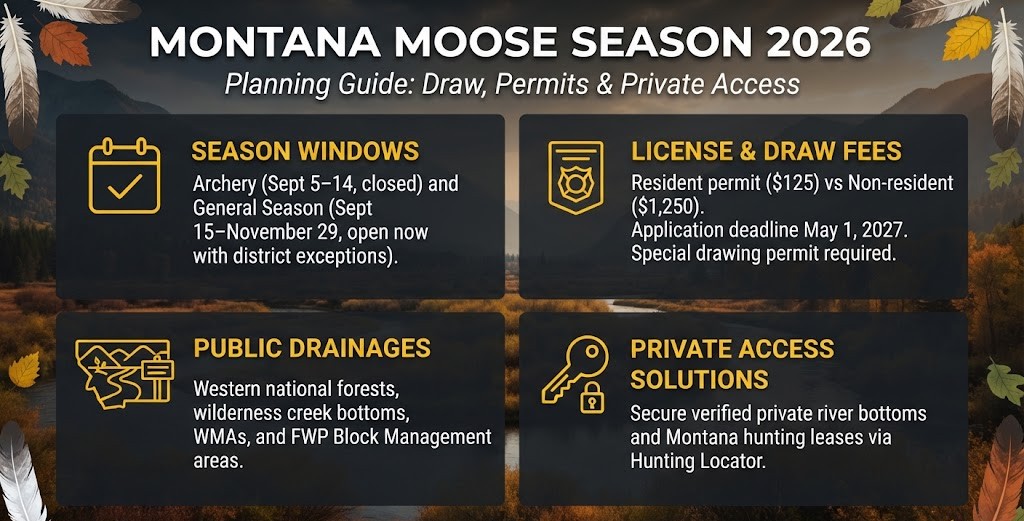
Montana’s 2026 moose seasons run September 5–14 (archery) and September 15–November 29 (general), with one moose per hunter per license year by special drawing permit. Use Montana FWP’s official season dates as your reference, and keep in mind that district exceptions apply.
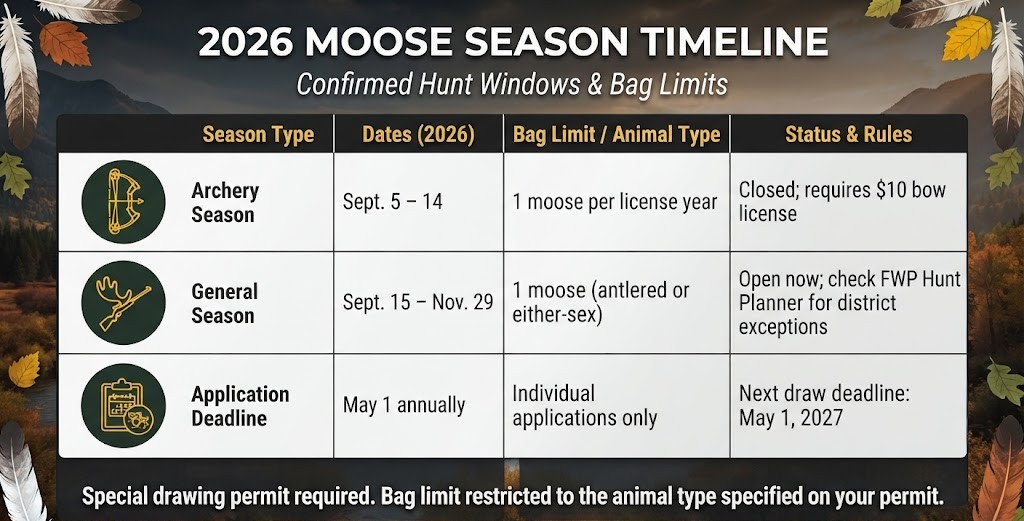
| Season Type | Dates | Bag Limit |
|---|---|---|
| Archery | Sept 5–14, 2026 | 1 moose per license year (permit’s animal type) |
| General | Sept 15–Nov 29, 2026 | 1 moose per license year (permit’s animal type) |
| Application Deadline | May 1 | — |
Before you can hunt a Montana moose, you need the following:
- Hunter education certification: required to buy a Montana hunting license.
- Base hunting license and conservation license: both are prerequisites for the moose application.
- A special drawing permit: a limited-quota lottery. You pay the permit fee only if you’re drawn.
- Individual applications only: no party applications for moose.
- Bow and arrow license ($10): required if you hunt the archery season.
Montana Moose Hunting Seasons
Montana has two moose seasons, plus a planning window for the next drawing. Each Hunting District (an FWP management unit with its own quotas and rules) can carry its own exceptions, so check the FWP Hunt Planner for your district before you head out.
Archery Season: September 5–14, 2026
Archery ran September 5–14 and required a $10 bow and arrow license on top of your drawn permit. The window overlaps the pre-rut, when bulls respond well to calling and close-range setups near willow bottoms work.
It closed September 14. If you’re planning for 2027, archery comes before peak rut calling.
General Season: September 15–November 29, 2026
The general season runs September 15 through November 29, with district exceptions. Confirm yours in the FWP Hunt Planner. The season breaks into three phases:
- Rut (late September to early October): Calling peaks from roughly the last week of September into the first week of October. As of October 11, that window is tapering.
- Post-rut tail (mid-to-late October): Bulls drift back toward thick cover. Glass willow and riparian edges at dawn and dusk.
- Late season (November): Bulls turn reclusive. Snow helps tracking but complicates the pack-out. Moose often feed at lower elevations in colder weather.
Your bag limit is one moose per license year, limited to the animal type printed on your permit (antlered or either-sex). Montana may also apply lifetime or waiting-period restrictions on certain moose licenses, so confirm in the current FWP regulations before you apply.
From October 11, you have seven weeks. Plan your days around access, weather, and pack-out capacity.
Application and Planning Window: Preparing for May 1, 2027
The 2026 deadline has passed, and the next is May 1, 2027. The off-season is the time to build bonus points, set a budget, and scout ground, including leases near the districts you want.
Elk and deer seasons overlap moose season, which matters if you’re planning a combination trip. See the seasons overview under More Resources below.
Montana Moose Licenses and Permits
The process is sequential: base license, conservation license, application, then permit, each before the next.
Montana Hunting Licenses
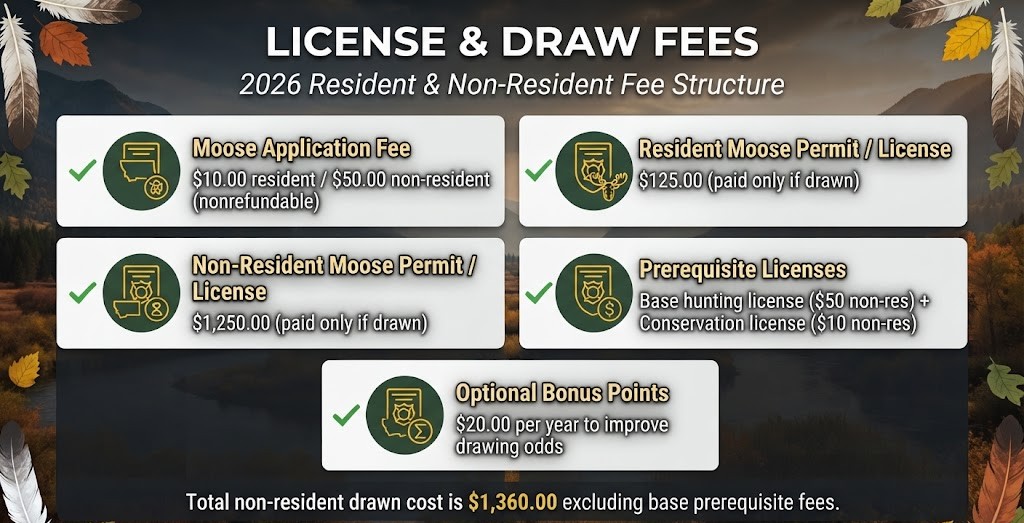
| License / Fee | Resident | Non-Resident | Required / Optional | Notes |
|---|---|---|---|---|
| Base hunting license | Check current FWP fees | $50 | Required | Prerequisite for all licenses |
| Conservation license | Check current FWP fees | $10.00 | Required | Prerequisite |
| Application fee (moose) | $10 | $50.00 | Required | Nonrefundable, per application |
| Moose license / permit | $125 | $1,250 | Required if drawn | Paid only if drawn |
| Bonus points | — | $20 | Optional | Improves future drawing odds |
| Bow and arrow license | Check current FWP fees | $10.00 | Required for archery season | Archery only |
For a non-resident who draws, the total is $50 base + $10 conservation + $50 application + $1,250 permit = $1,360. Add $20 for optional bonus points and $10 for the bow license if you hunt archery.
A resident pays $125 for the moose license and $10 to apply, plus base and conservation license costs.
These figures reflect 2026 fees. The application fee is nonrefundable, and the official FWP application fee notice confirms the $10 resident and $50 non-resident amounts. Confirm current-year fees on FWP before you apply.
Montana Hunting Permits
Moose special drawing permits are district-specific. Depending on the district drawing, a permit is either antlered or either-sex. Quotas vary by district, so check the FWP Hunt Planner. Non-residents typically receive up to about 10% of a district’s quota, though that isn’t guaranteed. Verify with FWP.
You buy and apply through Montana FWP:
- Complete hunter education.
- Buy the base and conservation licenses.
- Research districts in the FWP Hunt Planner.
- Submit an individual application, with the fee, by May 1, 2027.
- Opt into bonus points if you want them.
- Pay the $125 or $1,250 permit fee only if you’re drawn.
Bonus points work like raffle tickets. Your application gets one chance, then your point total is squared and added as extra chances. With 4 points, you’d have 1 + 16 = 17 chances. Points cost $20.
Drawing a moose tag is difficult and can take years, so a tag in hand is a once-in-a-lifetime opportunity for most hunters.
Montana Moose: Where to Hunt
Montana’s moose are Shiras moose, the smallest moose subspecies in North America, found in mountain valleys and willow-lined waterways across western and southwestern Montana. They feed on willows and mountain maple, bed in timber, and may travel 10–20 miles between habitats.
Access is often the hardest part. Montana hunting leases on Hunting Locator can put you on private ground near your district.
Best Public Lands
Public ground gives you options without a lease. The main categories:
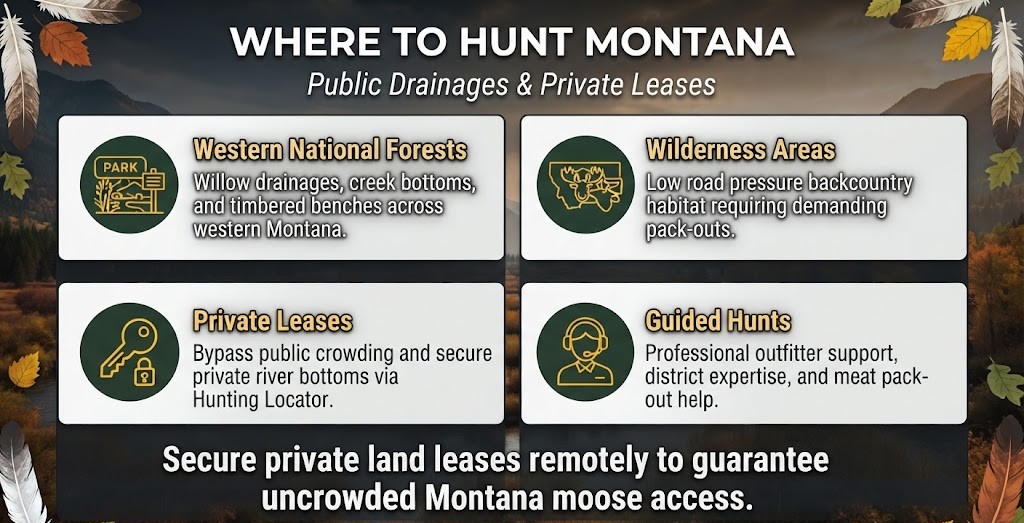
- National forests in western and southwestern Montana: willow drainages, creek bottoms, and timbered benches.
- Wilderness areas: low road pressure but demanding pack-outs. Plan for remote logistics and river crossings.
- Wildlife Management Areas (WMAs): check seasonal access rules before you go.
- Block Management: an FWP program that opens enrolled private land to public hunting. Moose access may exist on some areas; verify with FWP.
Your permit is district-locked, so match public land to your drawn district in the Hunt Planner. Call the area FWP biologist too.
Private Land Hunting with Hunting Locator
Montana’s checkerboard of public and private land can put good riparian habitat behind private boundaries. Private river bottoms often see less pressure, which makes ground near a moose district valuable.
Leasing and buying each have a place:
| Option | Best For | Advantages |
|---|---|---|
| Leasing | Hunters with a tag in hand | Lower entry cost, seasonal or multi-year flexibility, no ownership burden |
| Buying | Long-term planners | Long-term control, access for future seasons, investment value |
Hunting Locator is a platform that connects hunters directly with landowners who lease or sell hunting land. You can search by state, game type, or acreage and contact landowners directly.
Browse Montana hunting leases and find ground near your district before the season closes.
Guided Hunts
You don’t need a guide, but one can help non-residents and first-time moose hunters with district knowledge, private access, and pack-out. When comparing outfitters, check these points:
- Moose-specific experience: how many years they’ve guided moose hunts.
- Private land access: inside your drawn district.
- Guide-to-hunter ratio: ask what to expect.
- Meat care and pack-out: who handles it and how.
- Bear protocols: this is grizzly country.
- What the price includes: lodging, meals, transport, processing.
- Licensing: confirm they’re licensed with the Montana Board of Outfitters.
If you’d rather hunt on your own, a lease near your district gives you private access without a guided package.
Moose Hunting Tips
These tips apply whether you’re glassing public drainages or hunting a lease, with an emphasis on the weeks that remain.
- Scout with the Hunt Planner and call the biologist: Confirm boundaries and permit type, and ask about recent moose movement.
- Glass willow bottoms at dawn and dusk: Bulls bed in timber by day and feed at the edges of cover.
- Call and rake during the rut: Use cow calls and grunts, and use the terrain to project sound. Rake brush with an old shoulder blade to imitate a thrashing bull. These work best in late September and early October.
- Adjust for late season: Slow down, track in snow, and check lower-elevation feeding areas.
- Choose adequate caliber and bullet: Common choices include .30-06, .300 Win Mag, and .338, with bonded or monolithic bullets for deep penetration.
- Plan the pack-out before the shot: An adult moose can weigh 1,000+ lbs. Shoot where you can recover the animal, and line up help and a heavy-load pack.
- Bring game bags and keep meat cool: Quarter quickly and hang meat in shade.
- Practice bear safety: Carry bear spray, work in pairs, and keep meat away from the carcass.
- Layer for weather: Cold mornings and swings in conditions call for layers and durable boots.
- Follow CWD carcass rules: Heads with brain material and spinal columns stay at the kill site or go to an approved landfill after processing.
Gear up for the pack-out at the Hunting Locator store.
More Resources from Hunting Locator
These Hunting Locator pages cover the rest of your planning.
Find Land
- Montana hunting leases: private ground by acreage, location, and game type.
Plan Your Season
- Montana hunting seasons overview: useful for planning elk and deer seasons that overlap moose season.
Gear Up
- Hunting Locator store: optics, packs, and field gear.
FAQ
Is moose season still open in Montana?
Yes, as of mid-October 2026. The general season runs through November 29, and archery closed September 14. District exceptions apply, so check the FWP Hunt Planner for your district.
How much is a non-resident moose tag in Montana?
The permit is $1,250. A non-resident who draws pays $1,360 total ($50 base, $10 conservation, $50 application, $1,250 permit). Add $20 for optional bonus points and $10 for a bow license if you hunt archery.
When is the Montana moose application deadline?
May 1. The 2026 window has closed, and the next deadline is May 1, 2027. Applications must be individual. Confirm the date on FWP before you apply.
Can you hunt moose with a bow in Montana?
Yes. The archery season ran September 5–14, 2026, and requires a $10 bow and arrow license in addition to your drawn permit.
How many moose can you kill in Montana?
One moose per hunter per license year, of the type authorized on your permit (antlered or either-sex). Montana may also apply lifetime or waiting-period restrictions on certain moose licenses. Confirm in the current FWP regulations before you apply.
Do Montana bonus points help for moose?
Yes. Your point total is squared and added as extra chances, so 4 points gives you 17 chances (1 + 16). Points cost $20. Drawing can still take years.
Where can I hunt moose on private land in Montana?
Through leases, land purchases, Block Management, or outfitters with private access. Start with Montana hunting leases on Hunting Locator to find ground near your district.
Do I need a guide to hunt moose in Montana?
No. A guide helps with district knowledge, private access, and pack-out, but it’s optional. Use the outfitter checklist above if you decide to hire one.
The Final Shot
For 2026, the rules come to one moose per license year, tied to the animal type on your permit, and a non-resident total of $1,360 once you draw. The rest is preparation, access, and patience.
If you’re drawn, seven weeks remain. Confirm your district in the Hunt Planner and lock in private access for the rest of the season. If you’re planning ahead, mark May 1, 2027, build your points, and start scouting ground now.
Hunting Locator can help you find ground to hunt. Defer to Montana FWP for final regulations.


