This Utah desert bighorn sheep guide covers dates, fees, permits, as well as locations you can hunt on.
It’s written for residents and non-residents, whether you hold a tag today or are building toward one. Hunting Locator has pulled the regulations, costs, access options, and resources into one place, so you can gear up with optics and packs built for rugged country and focus on the hunt.
Inside you’ll find:
- 2026 season dates and the lifetime bag limit
- Permit and license costs, plus how the draw works
- Where to hunt, plus tips and gear for desert canyon country
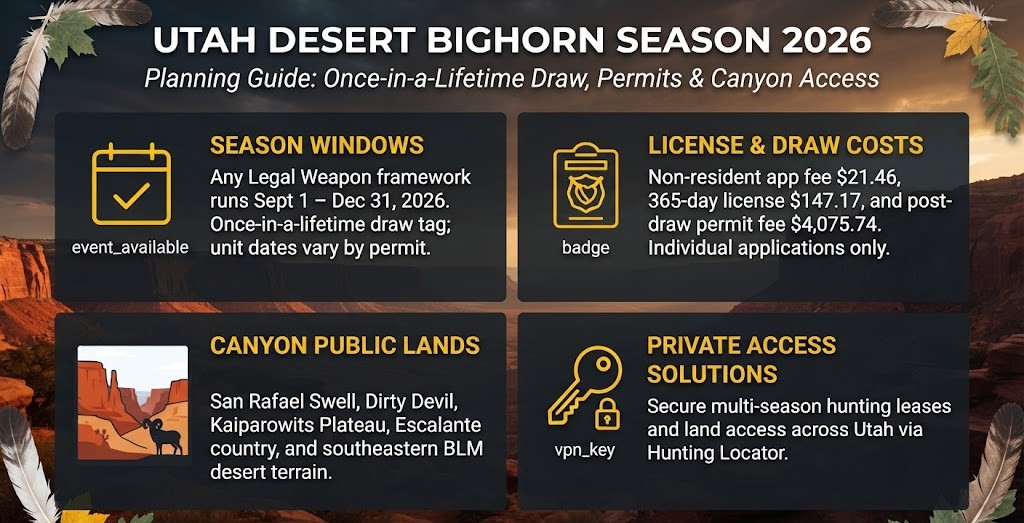
Utah Desert Bighorn Sheep Season Guide for 2026: Quick Overview
The once-in-a-lifetime classification shapes everything about this hunt. Desert bighorn and Rocky Mountain bighorn are separate hunts with separate permits, so make sure you apply for the right one. For a quick reference, see our species season page. Dates vary by unit and weapon, so confirm your exact hunt in the current Utah DWR guidebook.
| Species | Season Type | Dates | Bag Limit | Notes |
|---|---|---|---|---|
| Desert bighorn sheep | Any Legal Weapon | Sept 1 – Dec 31, 2026 | 1 ram per lifetime (or 1 ewe on management tags) | Once-in-a-lifetime species; draw only; no group applications; unit dates vary |
Before you can hunt, you’ll need all of the following:
- A valid Utah hunting license. Non-residents buy the 365-day license.
- Hunter education. Utah requires it for license eligibility for many hunters, and out-of-state certificates are generally accepted. Verify with DWR.
- A successful application in the big game draw. Permits are draw only.
- An individual application. No group applications are allowed for once-in-a-lifetime species.
Desert Bighorn Sheep Hunting Seasons
Utah runs one season type for desert sheep: any legal weapon. Individual hunts run shorter windows within that framework, so check your unit’s dates in the DWR guidebook or Hunt Planner before you plan travel.
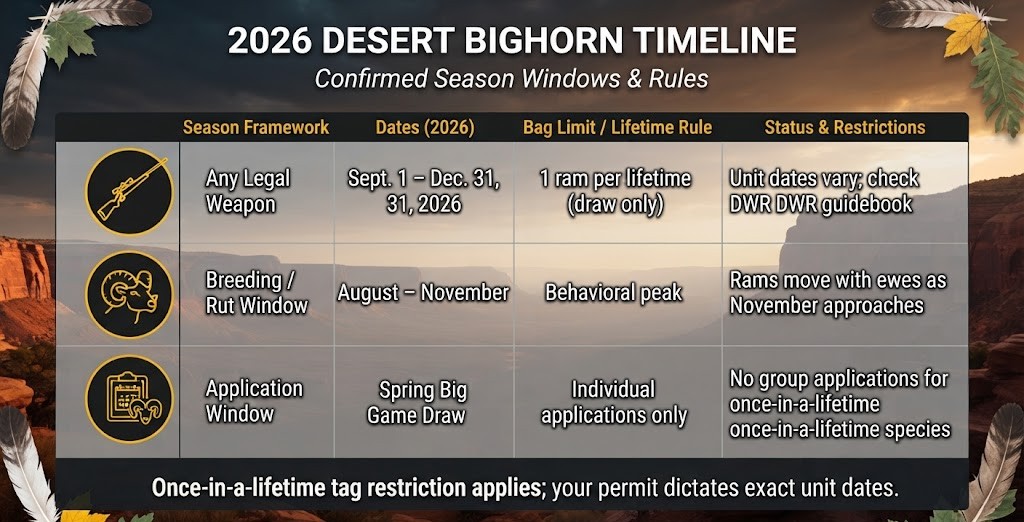
Any Legal Weapon Season (September 1 – December 31)
Every desert bighorn permit falls under this framework. Your permit assigns the specific unit and dates, so the broad window gives the outer limits and not your actual hunt.
The bag limit is one ram per lifetime. As of mid-October, many hunts are active. If you hold a tag, confirm how many days remain in your window and plan your remaining scouting around it. Keep your once-in-a-lifetime permit paperwork with you in the field.
Unit and Weapon Variations
Utah does not run separate archery or muzzleloader seasons for desert sheep. Within the any legal weapon framework, you choose your weapon: rifle, muzzleloader, handgun, or archery. Hunt windows vary by unit, so your permit is the final word on when you can be in the field.
Rut timing matters for planning. According to Utah’s statewide bighorn management plan, the desert bighorn breeding season runs roughly August to November. Rams are often easier to find as November approaches, because they move in with ewes.
Utah Desert Bighorn Sheep Licenses and Permits
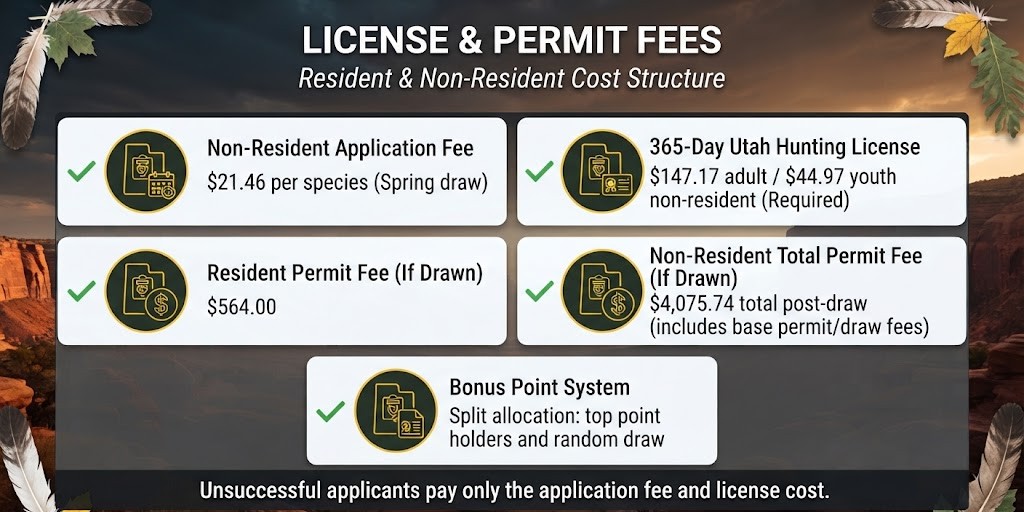
Drawing a permit is expensive, but applying is cheap. A non-resident application costs $21.46 per species, which keeps your name in the pool without a big commitment.
Desert sheep share the once-in-a-lifetime rules with moose and bison. If you’re building points across species, see our guides to Utah moose hunting season and bison hunting in Utah.
Utah Hunting Licenses
The license is separate from the permit, and you need both. Here is the cost breakdown:
| Item | Resident | Non-resident |
|---|---|---|
| Desert bighorn permit (if drawn) | $564 | $3988 total post-draw (includes base permit/draw and related fees) |
| Application fee (per species) | $10 | $21.46 |
| 365-day hunting license | $40 | $147.17 adult / $44.97 youth |
A lease or private land does not substitute for the license. Keep your license current to stay eligible to apply, and confirm fees at purchase, since they can change. If you don’t draw, non-residents pay only the application fee and license.
Utah Hunting Permits
How the draw works matters if you’re planning for the long term:
- Draw only. There are no over-the-counter desert bighorn permits.
- Bonus points. More points means better odds. Roughly half of permits go to the top point holders and half go to a random draw, where points still add chances.
- No group applications. Hunting partners each apply individually.
- Lifetime limit and ewe management tags. Once you draw, you can’t draw a desert bighorn permit again. A ewe management tag, if offered and drawn, counts within this framework.
- Unit variation. You choose the hunt you apply for.
Non-resident permits are very limited, and residents receive most permits. Apply consistently to keep your points, and check the DWR guidebook for current rules.
Applications are submitted online through the Utah Division of Wildlife Resources. The process runs as follows:
- Buy a valid Utah hunting license.
- Apply online during the spring big game draw window.
- Choose your desert bighorn hunt or unit.
- Pay the application fee ($21.46 for non-residents).
- If drawn, pay the permit fee ($564 resident / $4,075.74 non-resident).
- After harvest, complete check-in and harvest reporting as DWR requires.
Utah Desert Bighorn Sheep: Where to Hunt
Desert sheep habitat sits in southern and southeastern Utah’s canyon country, largely on BLM public land. Where Utah’s bighorn live is mostly the desert and mountains of the southeast. For the bigger picture, see our statewide Utah hunting overview.
Best Public Lands
These are the general regions where desert sheep live. Your permit’s unit boundaries decide exactly where you can hunt, so use this list to get oriented and not to pick a spot.
- San Rafael Swell: Broken desert country and canyons in east-central Utah
- Dirty Devil and Henry Mountains area: Remote, rugged country with big vertical relief
- Kaiparowits Plateau: A sprawling, dry plateau in south-central Utah
- Escalante country: Deep canyons, slickrock, and long glassing benches
- La Sal / Potash area: Canyon and river country in the southeast
- San Juan / Lockhart region: Remote southeastern desert terrain
- Zion area (Pine Valley region): Rugged country in the southwest corner of the state
Rough access, heat, and long pack-outs make planning as important as finding sheep. If public access feels crowded or limited, private land is worth a look.
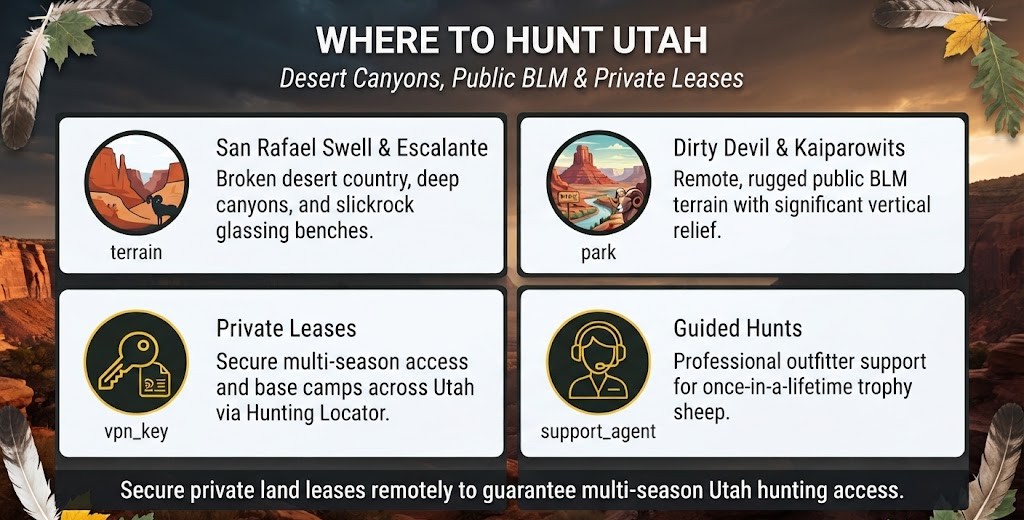
Private Land Hunting with Hunting Locator
A private lease does not replace a desert bighorn permit. You still need a drawn tag and a license, and a lease alone doesn’t make sheep huntable.
What a lease does give you is dedicated, less-pressured access and the chance to scout ahead. Buying hunting land goes a step further and gives you long-term access you can build on.
One Utah lease can also cover several seasons through the year, including Utah deer season, elk hunting in Utah, and pronghorn season. That makes it a good fit for sheep hunters who want time in adjacent country.
Hunting Locator connects hunters with landowners who lease or sell land. You can search by state and game type and contact landowners directly. To get started, browse Utah leases and land for sale and see what’s currently listed.
Guided Hunts
Many hunters choose a guide for a tag they’ll only ever hold once. Which route is right depends on your experience, fitness, and time.
If you’re weighing outfitters, ask these questions:
- How well do you know my specific unit?
- What pre-season scouting do you do?
- How do you handle pack-out, including stock or boat logistics?
- How do you judge rams, and what is your approach to age and trophy quality?
Hunting Locator also lists outfitters alongside landowners. You can look through Utah hunting land and outfitter options and compare them at your own pace.
Desert Bighorn Sheep Hunting Tips
These practices are built around open desert and broken canyon country. When it’s time to equip yourself, the Hunting Locator store carries gear by category, from optics to packs.
- Invest in quality optics: Pair binoculars for scanning with a spotting scope for detail. Glassing drives a desert hunt.
- Glass from high points: Sit, scan systematically, and let the sheep come to you before committing to a stalk. Spot first, then stalk.
- Carry a rangefinder: Canyon distances fool the eye, and a miss on a once-in-a-lifetime tag is costly.
- Bring a tripod or shooting sticks: On broken rock, prone shots are rare. A tripod gives height above rock, brush, and cactus, while a bipod works only when the terrain cooperates.
- Choose a pack that can haul out: It should carry water, optics, and a ram’s meat and cape.
- Plan your hydration: Early-season heat is real. Carry more water than you think you need and plan resupply.
- Train before the hunt: Steep, loose terrain punishes poor conditioning.
- Judge age before you shoot: A mature ram is worth patience on a once-in-a-lifetime tag.
- Plan the pack-out first: Know your route, stock, or boat access before you pull the trigger.
- Make safety a priority: Use a satellite messenger, share your plan with someone, and know the location of the nearest help.
- Hunt ethically and report your harvest: Take clean shots only, respect the land, and complete check-in and harvest reporting.
More Resources from Hunting Locator
These pages from Hunting Locator are grouped to help you plan.
Plan your sheep hunt
- Utah desert bighorn sheep hunting season: Our species page for quick reference on seasons and regulations.
- Hunting in Utah: A statewide overview of Utah hunting opportunities.
Find access
- Utah hunting leases and land for sale: Browse current Utah listings.
- Hunting Locator home: Search leases, outfitters, and guides across the country.
Gear
- Hunting Locator store: Gear for the field, from optics to packs.
Other once-in-a-lifetime species
- Utah moose hunting season: Dates, permits, and draw rules for moose.
- Utah bison hunting season: What to know about Utah’s bison hunts.
Utah big game
- Utah deer hunting season: Mule deer seasons and planning.
- Utah elk hunting season: Elk dates, permits, and where to hunt.
- Utah pronghorn hunting season: Pronghorn regulations and tips.
- Utah black bear hunting season: Bear season basics.
Birds and small game
- Utah turkey hunting season: Spring and fall turkey planning.
- Utah game bird hunting season: Upland and game bird seasons.
- Utah waterfowl hunting season: Ducks and geese across the state.
- Utah small game hunting season: Small game seasons and rules.
FAQ
When is Utah desert bighorn sheep season in 2026?
The Any Legal Weapon season typically runs September 1 – December 31. Specific hunt dates vary by unit, so your permit and the Utah DWR guidebook are the final word. Confirm your exact window before you plan travel, since individual hunts run shorter periods inside that framework.
How much does a non-resident desert bighorn tag cost in Utah?
The cost breakdown is a $21.46 application fee, a $147.17 365-day license, and a $4,075.74 total post-draw permit fee. If you don’t draw, you pay only the application fee and the license. The permit fee applies only once you’re drawn.
Is the Utah desert bighorn sheep a once-in-a-lifetime permit?
Yes. The limit is one ram, or one ewe on management tags, per lifetime. Once you draw, you can’t draw a desert bighorn permit again. Moose and bison share the same once-in-a-lifetime classification in Utah.
Can I apply as a group?
No. Group applications are not allowed for once-in-a-lifetime species, so each hunting partner applies individually. Partners can still plan together, but every application and its bonus points stand on their own.
Can I harvest a ewe?
Only if you draw a specific experimental or management ewe tag. Those tags are limited and specific to certain hunts. A drawn ewe tag counts toward your lifetime limit, so it uses your once-in-a-lifetime opportunity.
Do I need a hunting license in addition to the permit?
Yes. Residents need a valid Utah hunting license, and the DWR lists the current price. Non-residents need the 365-day license: $147.17 for adults or $44.97 for youth. The license is separate from the permit and required in addition to it.
Can I hunt desert bighorn on a private lease?
Only with a drawn permit and a license. A lease provides access, not a tag. Leases do add real value for other Utah species such as deer, elk, and pronghorn, which makes them useful for hunters who want access across several seasons.
How do bonus points work?
More points means better odds. Roughly half of permits go to top point holders and half go to a random draw, where points still add chances. Apply consistently to keep your points, and check the Utah DWR guidebook for current rules.
What gear do I need for desert sheep?
Plan on binoculars, a spotting scope, a rangefinder, a tripod, a pack built for hauling, and a solid hydration setup. You can browse gear categories at the Hunting Locator store before your trip.
The Final Shot
A Utah desert bighorn tag comes once in a lifetime, and the details are worth getting right. Know your unit dates, budget for the full cost, apply consistently, and plan your water and pack-out before you pull the trigger. Keep this guide handy as you prepare.
If you hold a tag this season, confirm your dates and check your gear one more time. If you’re still applying, mark the spring draw window and keep your points alive. Before any hunt, verify the latest rules in the current Utah DWR guidebook.
When you’re ready to find access for your next Utah season, search Hunting Locator’s Utah leases.


