Here’s what we’re covering in this Alabama hunting season guide:
- License costs broken down for residents and non-residents, including which trip licenses actually make sense
- Season dates for every zone and every major species
- Where to find huntable land, from public WMAs to private leases
Let’s jump into the basics: licenses, costs, and when you can actually hunt.
Quick Overview: Season Dates, Alabama Hunting Licenses, and Regulations
Alabama splits the state into hunting zones (A, B, C, D, E, plus the CWD Management Zone) to manage wildlife populations. Different zones mean different season dates and rules, so you need to know your zone before buying anything. Alabama offers diverse hunting opportunities for white-tailed deer, wild turkey, mourning doves, bobwhite quail, feral hogs, waterfowl, and more.
Heads up: Alabama requires Hunter Education certification if you were born on or after August 1, 1977. The course takes at least 10 hours plus an exam, covering hunter responsibility, wildlife laws, firearms safety, archery, muzzle-loading, and basic survival.
Alabama Hunting License Costs
| License/Permit Name | Description | Resident Fee | Non-Resident Fee | |
|---|---|---|---|---|
| Annual All Game Hunting | Required for residents (age 16-64) and non-residents (age 16+) to hunt all legal game, including deer and turkey | $34.35 | $399.50 | |
| Annual Small Game Hunting | Valid for all legal game, excluding deer and turkey | $22.75 | $130.25 | |
| All Game 10-Day Trip | Valid for all legal game, including deer and turkey, for 10 consecutive days | N/A | $246.60 | |
| All Game 3-Day Trip | Valid for all legal game, including deer and turkey, for 3 consecutive days | N/A | $173.90 | |
| Small Game 3-Day Trip | Valid for small game, excluding deer and turkey, for 3 consecutive days | N/A | $57.40 | |
| Lifetime Hunting | Provides hunting privileges for the lifetime of the resident | $300.00 | N/A | |
| Wildlife Management Area (WMA) | Required for hunting big game and waterfowl on state WMA lands (in addition to a primary hunting license) | $22.75 | $22.75 | |
| Baiting Privilege License | Allows taking white-tailed deer or feral swine by aid of bait on private or leased lands (required for all ages) | $18.45 | $63.40 | |
| Nighttime Feral Swine & Coyote | Allows hunting of feral swine and coyote at night on private or leased lands during special seasons | $18.00 | $61.65 | |
| State Duck Stamp | Required for hunting migratory waterfowl (in addition to Federal Duck Stamp and HIP registration) | $12.35 | $12.35 |
Quick math for trip planning: A 3-day license ($173.90) works for a weekend hunt. The 10-day ($246.60) makes more sense if you’re staying longer. Planning multiple trips? The annual license ($399.50) pays for itself after your second visit. Non-residents may also need additional permits like WMA access, baiting privileges for private land, and for waterfowl you’ll need the Alabama Duck Stamp, Federal Duck Stamp, and HIP registration.
Alabama Hunting Season Dates Overview
This table gives you the quick reference. Detailed zone info is in each species section below. Not sure about your zone? The Alabama Department of Conservation and Natural Resources has zone maps at OutdoorAlabama.com. Most zone boundaries follow county lines.
| Species | Season Type | Dates | Bag Limit | |
|---|---|---|---|---|
| White-Tailed Deer (Zones A, B, C) | Archery | Oct 15 – Feb 10 | 3 antlered bucks total (1/day); 2 unantlered/day (1 in Zone C) | |
| Youth | Nov 13 – 16 | Oct 15 – Feb 10 | ||
| Muzzleloader | Nov 17 – 21 | Oct 15 – Feb 10 | ||
| Gun (Zones A & B) | Nov 22 – Feb 10 | Oct 15 – Feb 10 | ||
| Gun (Zone C) | Nov 22 – Feb 10 | Mixed either-sex/antlered splits apply | ||
| White-Tailed Deer (Zones D & E) | Youth | Oct 30 – Nov 2 | Same limits | |
| Muzzleloader | Nov 3 – 7 | Same limits | ||
| Archery (Zone D) | Oct 1 – Jan 27 | Same limits | ||
| Gun (Zone D) | Nov 8 – Jan 15 | Same limits | ||
| Archery (Zone E) | Nov 8 – Jan 1 | Same limits | ||
| Gun (Zone E) | Nov 8 – Jan 1 | Same limits | ||
| Wild Turkey (Spring) | Zones 1 & 3 | Mar 31 – May 8 | 4 gobblers total (1/day) | |
| Zone 2 | Apr 7 – May 8 | Same as above | ||
| Wild Turkey (Fall) | Zone 3 Only | Nov 17–25 & Dec 8–30 | Included in annual limit | |
| Mourning Dove | North Zone Split 1 | Sep 5 – Oct 18 | 15/day | |
| North Zone Split 2 | Nov 21 – 29 | Same | ||
| North Zone Split 3 | Dec 12 – Jan 17 | Same | ||
| South Zone Split 1 | Sep 12 – Oct 25 | Same | ||
| South Zone Split 2 | Nov 28 – Dec 6 | Same | ||
| South Zone Split 3 | Dec 19 – Jan 24 | Same | ||
| Duck/Goose/Coot | Main Season | Nov 28–29 & Dec 5 – Jan 31 | 6 ducks/day (species restrictions apply); 5 dark geese/day | |
| Early Teal/Rail | Statewide | Sep 13 – 21 | Check current regulations | |
| Sandhill Crane | Permit Only | Nov 27 – Jan 3 & Jan 11 – 25 | 3 per permit | |
| Squirrel | Statewide | Sep 12 – Feb 28 | 8/day | |
| Rabbit | Statewide | Sep 12 – Feb 28 | 8/day | |
| Quail | Statewide | Nov 1 – Feb 17 | 8/day | |
| Feral Hog | Year-Round (Daytime) | No closed season | No limit | |
| Coyote | Year-Round (Daytime) | No closed season | No limit | |
| Alligator | Lottery Only | Aug – Sep 2026 | 1 per permit |
Alabama White-Tailed Deer Hunting
Alabama’s one of the best deer hunting states in the Southeast. You get generous bag limits (3 antlered bucks per season) and long seasons that run October through February in some zones. The zone system lets wildlife managers adjust regulations based on regional deer populations, creating different opportunities from the hardwood ridges up north to the river bottoms in the Black Belt.
Want more detailed deer hunting strategies and zone-specific tips? Check out our complete Alabama whitetail deer hunting season guide.
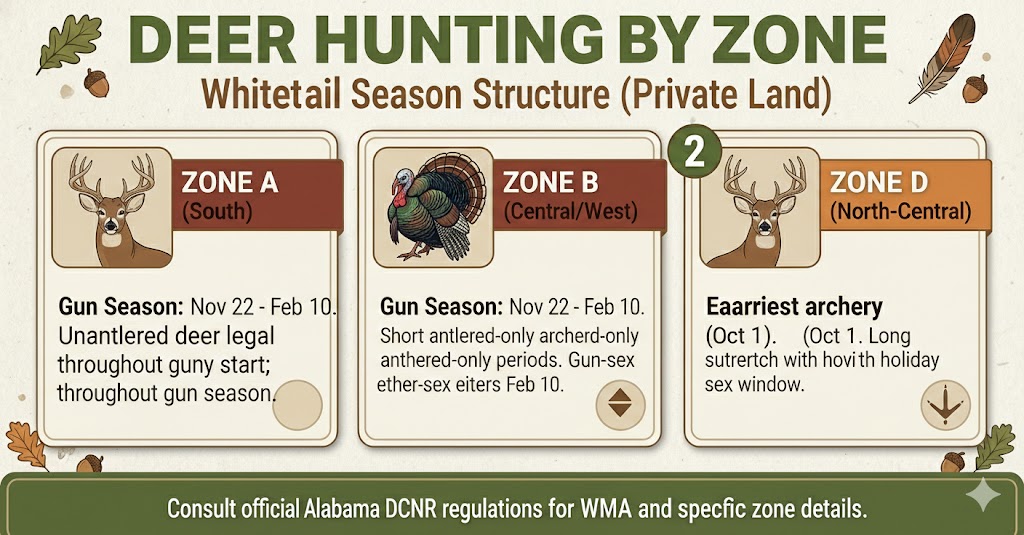
Alabama Deer Hunting Seasons
Zones A, B, and C (Private Land):
- Archery Season: October 15 – February 10
- Youth Season: November 13 – 16
- Muzzleloader Season: November 17 – 21
- Gun Season: November 22 – February 10
- Note for Zone C: Mixed either-sex and antlered-only periods during gun season. Check official regulations for specific split dates.
Zones D and E (Private Land):
- Youth Season: October 30 – November 2
- Muzzleloader Season: November 3 – 7
- Zone D Archery: October 1 – January 27
- Zone D Gun: November 8 – January 15
- Zone E Archery: November 8 – January 1
- Zone E Gun: November 8 – January 1
Coming from out of state? Zones A and B have the longest gun seasons (November 22 through February 10), giving you the most flexibility for planning. Zone D’s earlier archery opener (October 1) is great for bowhunters who want early-season action before everyone else shows up.
Youth Season Explained: Youth deer hunting is open to hunters who haven’t hit their sixteenth birthday yet. Each youth (or up to 2 youth together) needs a non-hunting adult age 21 or older with a valid hunting license. Both youth and adult must wear hunter orange.
Alabama Deer Hunting Regulations
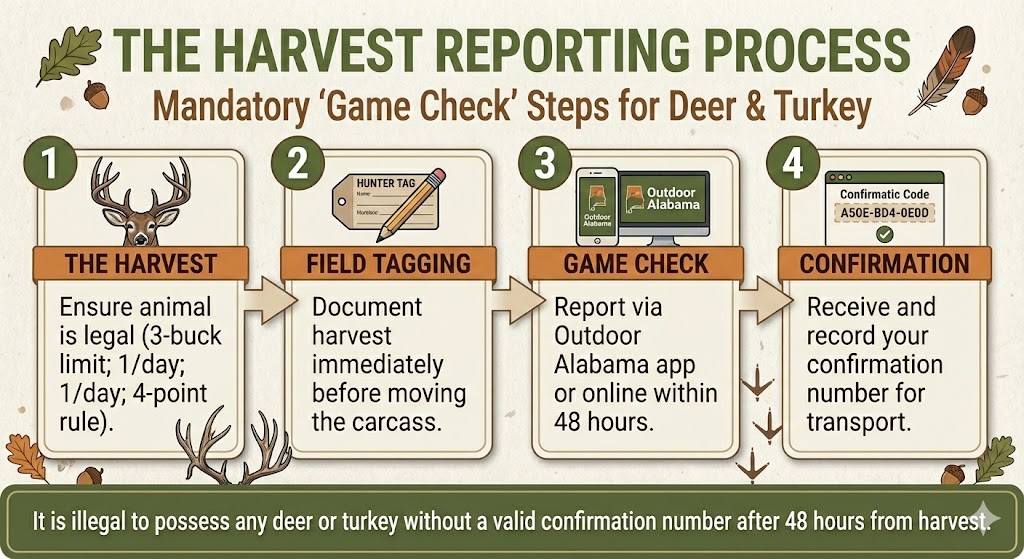
- Antlered Buck Limit: Male deer with one or more antlers visible above natural hairline are limited to one per day statewide, with three per hunter during all combined seasons. One of those three must have at least 4 antler points 1″ or longer on one antler. Exception: Barbour County requires minimum 3 points on one side.
- Unantlered Deer Limit: During unantlered deer gun seasons, zones A, B, D, E & CMZ allow two unantlered deer or one unantlered deer and one antlered buck per day. Zone C allows one unantlered deer and one antlered buck per day.
- Baiting Regulations: Hunting with the aid of bait is prohibited on all public lands (WMAs, National Forests, TVA lands, Corps of Engineers lands) and within the CWD Management Zone. On private land, you need a Baiting Privilege License ($18.45 resident / $63.40 non-resident).
- CWD Management Zone: Special restrictions in Colbert and Franklin Counties. Check current regulations for specific requirements including mandatory sampling.
- Legal Shooting Hours: One-half hour before sunrise to one-half hour after sunset for deer.
Finding quality deer hunting land is tough. If you’re looking beyond public WMAs or want private land access, Hunting Locator has a database of Alabama hunting leases from landowners actively seeking responsible hunters.
Alabama Turkey Hunting
Alabama’s got a strong wild turkey population and a solid tradition of spring gobbler hunting. It’s one of the few states with both spring and fall turkey seasons. Spring turkey hunting opportunities start with a special youth hunt the Saturday and Sunday before the regular season opens.
For calling strategies and public land recommendations, check out our complete Alabama turkey hunting guide.
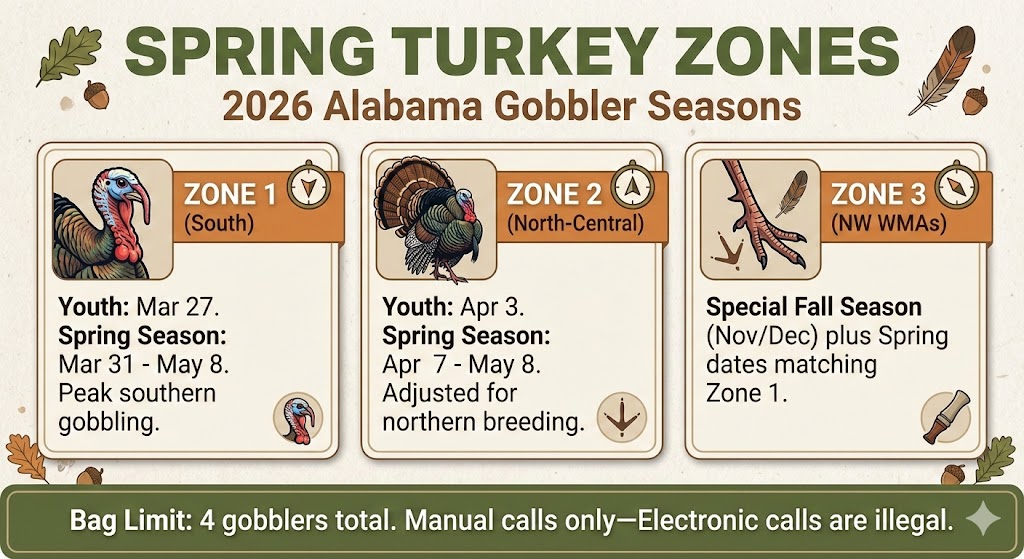
Alabama Turkey Hunting Seasons
Spring Season:
- Zones 1 and 3: March 31 – May 8
- Zone 2: April 7 – May 8
- Youth Turkey Hunt: The Saturday and Sunday before regular spring season opens (same regulations as youth deer hunt, except hunter orange is NOT required while turkey hunting)
Fall Season:
- Zone 3 Only: November 17 – 25 and December 8 – 30
Zone 3 is the only zone with both spring and fall seasons. The fall season lets you hunt gobblers when birds are in winter flocks and there’s less pressure, though your calling strategies need to be completely different from spring.
Alabama Turkey Hunting Regulations
- Bag Limit: 4 gobblers during combined fall and spring seasons; 1 gobbler per day maximum
- Legal Birds: Only bearded turkeys (gobblers and bearded hens) during spring season
- Hunting Hours: One-half hour before sunrise to 1:00 PM during spring season; all-day hunting during fall season
- Weapons: Shotguns, archery equipment, and crossbows are legal; rifles are prohibited
- Calling Restrictions: Electronic calls are prohibited for turkey hunting in Alabama
Alabama Waterfowl Hunting
Alabama sits along the Mississippi Flyway with diverse wetland habitats from Tennessee Valley reservoirs to Mobile Bay marshes. That creates exceptional waterfowl hunting. Duck, goose, and coot seasons follow federal frameworks with state-specific dates. All licensed hunters who hunt doves, woodcock, rails, snipe, coots, ducks or geese in Alabama are required by federal law to get a Harvest Information Program (HIP) permit before hunting (it’s free).
For detailed information about waterfowl hunting locations and strategies, see our Alabama waterfowl hunting season guide.
Alabama Waterfowl Hunting Seasons
Duck, Goose, and Coot:
- Main Season: November 28–29 and December 5 – January 31
- Daily Bag Limit: 6 ducks per day (aggregate limit with species-specific restrictions: max 2 female mallards, 3 wood ducks, 1 mottled duck, etc.); 5 dark geese per day
Early Teal and Rail:
- Season: September 13 – 21 (statewide)
Sandhill Crane:
- Season: November 27 – January 3 and January 11 – 25
- Bag Limit: 3 per person, per permit (requires limited quota permit)
Alabama Waterfowl Hunting Regulations
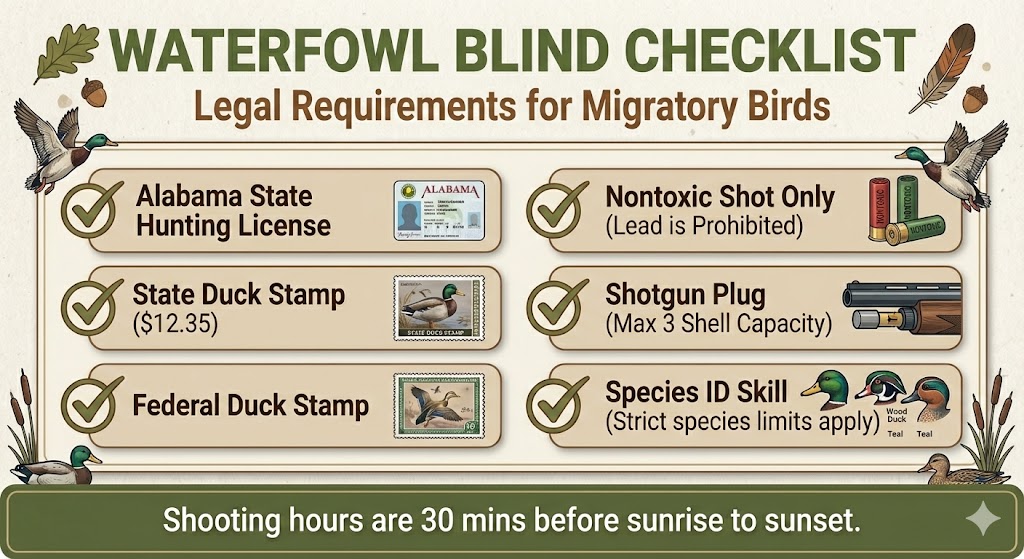
- Required Stamps: All hunters age 16 or older must purchase the Alabama Duck Stamp ($12.35) and the Federal Duck Stamp ($30) when hunting migratory waterfowl
- HIP Registration: Mandatory and free; you get it when purchasing your hunting license
- Shooting Hours: One-half hour before sunrise to sunset
- Plug Requirement: Shotguns must be plugged to hold no more than 3 shells (1 in chamber, 2 in magazine)
- Baiting Prohibition: Hunting over baited areas is federally prohibited for all waterfowl
Alabama Dove Hunting
Mourning dove hunting kicks off Alabama’s hunting season each September with fast-paced shooting over agricultural fields and food plots. Alabama’s dove seasons split into three segments in both north and south zones to match migratory bird patterns.
Alabama Dove Hunting Seasons
North Zone:
- Split 1: September 5 – October 18
- Split 2: November 21 – 29
- Split 3: December 12 – January 17
South Zone:
- Split 1: September 12 – October 25
- Split 2: November 28 – December 6
- Split 3: December 19 – January 24
Daily Bag Limit: 15 mourning and white-winged doves (aggregate)
Alabama Dove Hunting Regulations
- Legal Shooting Hours: One-half hour before sunrise to sunset
- Shotgun Requirements: Shotguns must be plugged to hold no more than 3 shells total
- HIP Registration: Required for all dove hunters (free when purchasing license)
- Baiting Prohibition: Hunting over baited areas is federally prohibited
- Field Preparation: Normal agricultural practices and crop manipulation are permitted; check current regulations for specific definitions
Alabama Minor Game Species Hunting
Beyond the major game species, Alabama offers small game and furbearer hunting that provides excellent training for new hunters and extra action for experienced ones throughout the extended seasons.
For comprehensive coverage of small game opportunities, visit our Alabama small game hunting season guide.
Alabama Squirrel and Rabbit Hunting Information
Season: September 12 – February 28 (statewide)
Daily Bag Limit: 8 squirrels per day (8 in possession); 8 rabbits per day (8 in possession)
Squirrel and rabbit hunting is accessible on both public and private lands throughout Alabama’s hardwood forests and agricultural edges. These species are perfect for young hunters learning woodsmanship, shooting skills, and game processing. The long season lets you hunt small game during gaps in deer and turkey seasons. Lots of hunters combine squirrel hunting with deer scouting during early fall.
Alabama Quail Hunting Information
Season: November 1 – February 17 (statewide)
Daily Bag Limit: 8 bobwhite quail per day (8 in possession)
Wild bobwhite quail populations have dropped significantly across Alabama over recent decades because of habitat loss. That makes quail hunting tougher than it used to be. However, managed properties with active habitat restoration and some public lands still offer quail hunting. Many hunters now pursue quail on commercial hunting preserves or private lands with intensive management programs.
Alabama Feral Hog and Coyote Hunting Information
Season: Year-round (no closed season during daylight hours on private land)
Bag Limit: No limit
Feral hogs and coyotes are nuisance species in Alabama because of their negative impacts on agriculture, native wildlife, and property. You can hunt these species year-round during daylight hours without bag limits on private land. A special Nighttime Feral Swine & Coyote permit ($18.00 resident / $61.65 non-resident) lets you hunt these species at night on private or leased lands during the special nighttime season (February 11, 2027 – October 14, 2027).
For more about year-round hunting opportunities, see our guide on what you can hunt year-round in Alabama.
Alabama Alligator Hunting Information
Season: August – September 2026 (lottery only)
Bag Limit: 1 per permit
Alabama’s alligator hunting program runs through a limited quota permit system distributed by lottery. You have to apply during the designated application period. Successful applicants get permits for specific management zones. Size restrictions apply in some areas, and you must follow strict tagging and reporting requirements. This is a highly specialized hunt requiring specific equipment and knowledge of alligator behavior.
For detailed information about this unique opportunity, read our Alabama alligator hunting season guide.
Alabama Sandhill Crane Hunting Information
Season: November 27 – January 3 and January 11 – 25
Bag Limit: 3 per person, per permit (requires limited quota permit)
Sandhill crane hunting is another limited-quota opportunity in Alabama. You need to apply for permits through a lottery system. This hunt appeals to waterfowl enthusiasts looking for a unique challenge, since sandhill cranes are large, wary birds that require specialized calling and decoying techniques. Successful hunters must follow strict reporting requirements and hunt only in designated management areas.
Learn more in our Alabama sandhill crane hunting season guide.
Where to Hunt in Alabama
Alabama’s landscape runs from Appalachian foothills in the northeast to coastal plains in the south, providing varied hunting across different habitat types. The Wildlife & Freshwater Fisheries Division manages 35 WMAs to provide public hunting opportunities. Private land options range from day leases to long-term agreements.
Best Public Hunting Lands in Alabama
Public Wildlife Management Areas offer accessible hunting for hunters without private land connections, though success usually requires more effort in scouting and understanding hunting pressure patterns.
- Barbour Wildlife Management Area – Located in southeast Alabama, Barbour WMA covers over 36,000 acres of diverse habitat including hardwood bottoms, pine plantations, and agricultural fields. Known for quality deer hunting with special antler restrictions (minimum 3 points on one side). Also offers excellent turkey and small game opportunities.
- Oakmulgee Wildlife Management Area – Spans over 18,000 acres in the Talladega National Forest. Oakmulgee provides classic Alabama hill country hunting with mixed pine-hardwood forests. Popular for deer and turkey hunting, with good populations of both species and less hunting pressure than some WMAs closer to major cities.
- Choctaw Wildlife Management Area – This 4,000+ acre WMA in southwest Alabama features river bottom hardwoods along the Tombigbee River system. Known for trophy deer potential and excellent squirrel hunting in the extensive oak-hickory forests.
- Fred T. Stimpson Sanctuary – Located in Baldwin County near Mobile Bay, this 1,100-acre WMA offers unique coastal hunting including waterfowl in managed wetlands and deer in mixed pine-hardwood uplands. The proximity to the coast creates excellent habitat diversity.
- Skyline Wildlife Management Area – Situated in northeast Alabama’s Cumberland Plateau region, Skyline WMA covers over 48,000 acres of mountain terrain with spectacular views and quality hunting for deer, turkey, and bear. The rugged topography reduces hunting pressure in backcountry areas.
WMA Hunting Tips: Hunting big game and waterfowl on WMAs requires both your regular hunting license and a WMA permit ($22.75 for both residents and non-residents). Show up early during opening weekends since popular areas get hammered. Consider hunting weekdays or later in the season for less competition.
Guided Hunts in Alabama
Guided hunting services provide turnkey experiences for hunters who want expert knowledge, quality hunting locations, and full-service support without investing in securing and managing their own hunting land.
Types of Guided Hunt Services:
- Fully Outfitted Hunts – Include lodging, meals, guide services, and often game processing. These premium experiences typically cost $2,000-$5,000+ for multi-day deer hunts or $500-$1,500 for single-day turkey hunts.
- Day Hunt Guide Services – Provide guide expertise and land access without lodging, typically ranging from $300-$800 per day depending on species and property quality.
- Semi-Guided Hunts – Offer land access and basic support (property orientation, stand locations) at lower cost ($150-$400 per day) with hunters providing their own equipment and handling their own logistics.
Selecting a Guide Service: Research outfitter reputations through references and online reviews. Verify that guides are properly licensed and insured. Clarify exactly what’s included in pricing (licenses, tags, processing, trophy fees). Ask about success rates, property size, and hunting pressure. Reputable outfitters will provide clear contracts and answer questions thoroughly.
Private Land Hunting in Alabama
Private land hunting offers real advantages: less hunting pressure, ability to implement management practices, and exclusive or limited access that improves game populations and hunting success.
Leasing Private Land:
Hunting land leases in Alabama vary widely in price based on location, property quality, amenities, and exclusivity. Annual leases typically range from $10-$30+ per acre, with premium properties commanding higher rates. Day leases and seasonal leases offer more affordable entry points for hunters who don’t need year-round access.
When evaluating lease opportunities, consider property size and habitat quality, proximity to your home, number of members sharing access, and what species and seasons are included. Review lease agreements carefully for liability provisions, guest policies, and property rules.
Buying Private Land:
Purchasing hunting land represents a long-term investment that provides permanent access, potential appreciation, and the ability to implement your own management vision. Alabama hunting land prices vary dramatically by region. Rural areas offer more affordable options ($1,500-$4,000 per acre) while properties near major cities or with exceptional features command premium prices.
Consider factors beyond hunting quality: property taxes, maintenance costs, access and road frontage, water sources and utilities, and potential for timber or agricultural income to offset ownership costs.
Finding Quality Private Land Opportunities:
Whether you’re looking to lease or buy, finding quality private land that matches your needs and budget can be challenging. Hunting Locator provides a comprehensive platform connecting hunters with landowners throughout Alabama who are actively offering lease and sale opportunities. Browse Alabama hunting leases by county, acreage, game species, and price range. Connect directly with landowners, view property details and photos, and secure your hunting access for the upcoming season.
Frequently Asked Questions
Do I need a hunting license to hunt on my own property in Alabama?
Resident landowners and immediate family (Alabama’s driver’s license required) can hunt their property without purchasing a license. However, this exemption only applies to the landowner and their immediate family members who are Alabama residents. Everyone else needs appropriate licenses, including friends and extended family. Also, even exempt landowners must follow all other regulations including seasons, bag limits, and harvest reporting requirements.
What is the CWD Management Zone and how does it affect hunting?
The Chronic Wasting Disease (CWD) Management Zone currently includes Colbert and Franklin Counties in northwest Alabama. It was established to monitor and manage the spread of this fatal deer disease. Within the CMZ, hunting with the aid of bait is prohibited on both public and private land, and special sampling requirements may apply for harvested deer. Check current regulations for the CMZ since boundaries and restrictions may expand if additional CWD cases are detected.
Can non-residents hunt on Alabama Wildlife Management Areas?
Yes, non-residents can hunt on Alabama WMAs with the appropriate licenses. You’ll need a non-resident hunting license (annual, 10-day, or 3-day depending on your plans) plus the WMA permit ($22.75, same price for residents and non-residents). Some WMAs have quota hunts or special regulations, so research your specific WMA before planning your trip.
How does Alabama’s baiting license work?
The Baiting Privilege License lets you take white-tailed deer or feral swine over bait (like corn, minerals, or other attractants) on private or leased lands. A bait privilege license is required for all hunters regardless of age or affiliation with the property owner. The license costs $18.45 for residents and $63.40 for non-residents. Important: Baiting is completely prohibited on all public lands and within the CWD Management Zone, even with this license.
What is the difference between antlered and unantlered deer in Alabama regulations?
Antlered deer are male deer with one or more antlers visible above the natural hairline. Unantlered deer include does (female deer) and button bucks (young male deer with antler buttons that don’t break through the hairline). This distinction matters because Alabama has different bag limits for each: 3 antlered bucks total per season (1 per day) and varying unantlered limits by zone (typically 2 per day in most zones, 1 per day in Zone C).
Do I need hunter education certification to hunt in Alabama?
Alabama requires Hunter Education certification for all hunters born on or after August 1, 1977. If you were born before this date, you can hunt without certification. The hunter education course requires at least 10 hours of instruction plus an exam, covering topics including hunter responsibility, wildlife laws, firearms safety, and basic survival skills.
How do I report my deer or turkey harvest in Alabama?
Hunters should review the requirements for Harvest Record for deer and/or turkey and Game Check, as Game Check is mandatory. Alabama uses an online Game Check system that lets you report harvests via smartphone, computer, or phone call. You must report deer and turkey harvests before moving the animal from the point of kill or before 10:00 PM on the day of harvest, whichever comes first.
What hunting opportunities does Alabama offer for youth and new hunters?
Alabama provides several programs to introduce young and new hunters to the sport. Special youth hunting seasons for deer and turkey happen before regular seasons with less competition. Alabama’s Adult Mentored Hunting Program helps new and returning hunters learn where to start, understand the laws, and build confidence with guidance from experienced mentors. Youth hunters (under 16) can participate in special seasons when accompanied by a licensed adult.
The Final Shot
Alabama’s 2026-2027 hunting seasons offer exceptional opportunities across diverse game species and landscapes. From extended deer seasons running October through February to specialized alligator and sandhill crane lottery hunts. Success starts with understanding the zone-based regulations, securing the right licenses, and finding quality hunting land that matches your goals and budget.
Whether this is your first Alabama hunt or your fiftieth, having reliable access to productive hunting land makes all the difference. Don’t let another season pass while you’re searching for that perfect hunting spot. Visit Hunting Locator today to explore available leases and land opportunities across Alabama, connect directly with landowners, and secure your access before the best properties are claimed. Make sure you’re equipped for success by checking out quality hunting gear at the Hunting Locator store.
For ongoing updates and detailed species-specific information throughout the season, bookmark this Alabama Hunting Season Guide and check back regularly. Here’s to a safe, legal, and successful 2026-2027 hunting season in Alabama.


