Here’s what you’ll find in this Alabama spring turkey guide:
- Exact 2026 season dates for Zone 1, Zone 2, plus youth and disabled hunts
- Complete licensing breakdown (residents pay $34.35, non-residents $399.50)
- Where to hunt: public WMAs, guided options, private land access
Let’s get into the dates and regulations you need to plan your 2026 season.
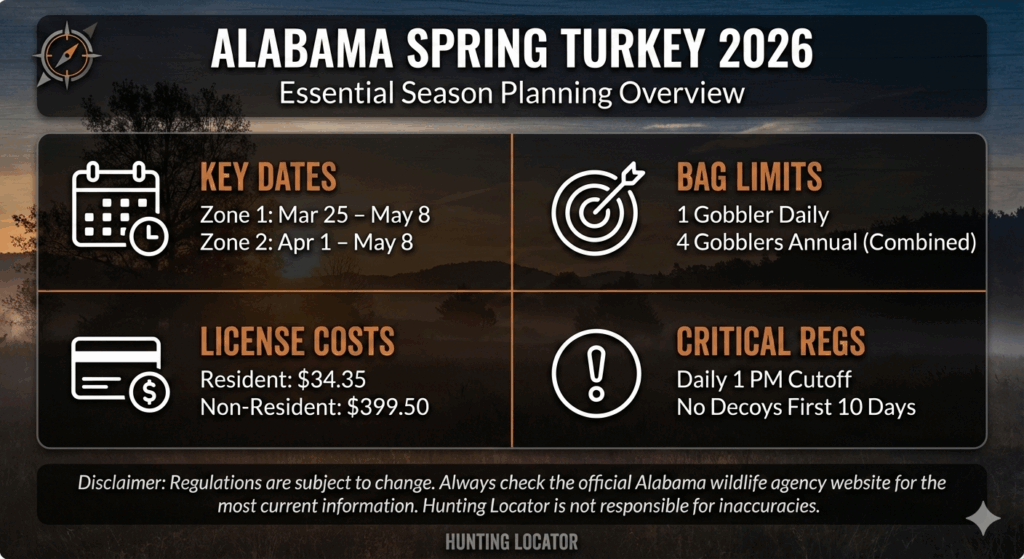
Quick Overview of Alabama Turkey Season 2026
Here’s your quick-reference for Alabama’s 2026 spring turkey season. All dates come straight from official Alabama DCNR regulations:
| Zone | Season Dates | Youth Hunt | Disabled Hunt | Decoys Allowed | Daily Bag Limit |
|---|---|---|---|---|---|
| Zone 1 | March 25 – May 8 | March 21–22 | March 24 | April 4 – May 8 | 1 gobbler |
| Zone 2 | April 1 – May 8 | March 28–29 | March 31 | April 11 – May 8 | 1 gobbler |
| Zone 3 | Fall Season Only | N/A | N/A | N/A | 1 gobbler |
Combined Annual Bag Limit (Fall & Spring): Four (4) gobblers total
License Requirements Quick List:
- All Game Hunting License: $34.35 (resident) / $399.50 (non-resident) — You need this to hunt turkeys, period
- Turkey Harvest Record: FREE — Mandatory for logging your harvest (paper or digital through Outdoor AL app)
- WMA License: $22.75 (annual, same price for everyone) — Required if you’re hunting Wildlife Management Areas
Legal Hunting Hours: Daylight to 1:00 p.m. during spring season.
Alabama Turkey Hunting Seasons
Alabama splits the state into three turkey hunting zones with different opening dates that match up with when gobblers get active in each region. Zone 3 doesn’t have a spring season (fall only), so if you’re chasing spring birds, focus on Zone 1 or Zone 2.
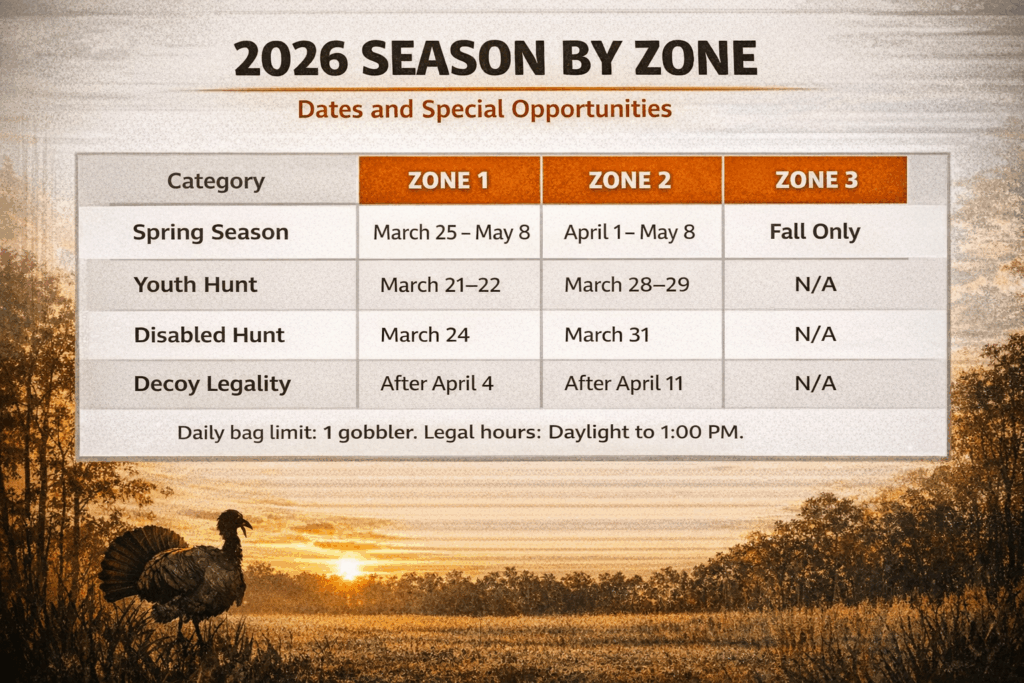
Zone 1 Spring Season
March 25 – May 8, 2026
Zone 1 covers northern and central Alabama counties. You get more than six weeks to hunt. Check the official Outdoor Alabama zone map to confirm your hunting spot’s zone.
No decoys for the first 10 days. Decoys become legal April 4 – May 8. Mechanical or motorized decoys are illegal everywhere in Alabama. You can hunt from daylight until 1:00 p.m. Most hunters score early morning around fly-down when gobblers are talking the most.
Zone 2 Spring Season
April 1 – May 8, 2026
Zone 2 covers southern Alabama. You get about five weeks of hunting. Double-check the official zone maps to make sure you’re legal.
Decoys are off-limits the first 10 days. They’re legal April 11 – May 8. Same daylight to 1:00 p.m. restriction applies all season.
Special Youth and Disabled Hunter Seasons
Youth Hunt Dates:
- Zone 1: March 21–22, 2026 (the Saturday and Sunday before general season)
- Zone 2: March 28–29, 2026
Disabled Hunter Dates:
- Zone 1: March 24, 2026 (day before general season)
- Zone 2: March 31, 2026
During youth and disabled hunts, you can hunt daylight to 1:00 p.m., and decoys are allowed. Youth hunters need a licensed adult with them who can’t carry a gun. These special seasons give you less-pressured birds before everyone else hits the woods.
Zone 3: Fall Season Only
Zone 3 has no spring turkey season. Turkey hunting here is fall only. If you want spring gobblers, hunt Zone 1 or Zone 2.
Alabama Turkey Licenses and Permits
Every turkey hunter in Alabama needs specific licenses and paperwork to hunt legally. All license info comes from official Alabama DCNR sources, prices are current for the 2025-2026 season.
Alabama Hunting Licenses
You need a valid All Game Hunting License to hunt turkeys in Alabama. Doesn’t matter if you’re on public or private land.
| License Type | Resident Cost | Non-Resident Cost | Notes |
|---|---|---|---|
| All Game Hunting License | $34.35 | $399.50 | Required for all legal game including turkey |
| 10-Day All Game License | N/A | $246.60 | Option for non-residents on shorter trips |
| WMA License | $22.75 | $22.75 | Required if hunting any Wildlife Management Area |
Non-residents need to factor in the significant license cost ($399.50 or $246.60 for 10-day) when planning their Alabama turkey trip. If you’re making multiple trips or hunting other species, the annual license makes more sense.
Born on or after August 1, 1977? You need to complete an approved hunter education course before buying a license. Alabama also has an Apprentice License for first-timers who haven’t finished hunter education yet.
Buy licenses online through the official Outdoor Alabama website, the Outdoor AL mobile app, or in-person at authorized vendors like sporting goods stores and county license offices. Non-resident licensed drivers need a valid Driver’s License, non-drivers need some form of ID, preferably with a picture. Get your licenses before you arrive so you’re ready to hunt.
Alabama Turkey Permits and Harvest Records
Turkey Harvest Record:
- Cost: FREE (residents and non-residents)
- Requirement: Mandatory for all turkey hunters, must have it with you while hunting
- Format Options: Paper record or digital through the Outdoor AL mobile app
- Compliance: As soon as you harvest a turkey, validate your harvest record. The tag stays with the bird during transport.
Game Check Reporting: You’ve got 48 hours to report harvested turkeys through the Game Check system. The Outdoor AL app lets you record immediately even without cell service—it’ll automatically complete the transaction once you get service.
WMAs may have quota hunts, special permit requirements, or restricted access days. Always check WMA-specific regulations before hunting. Some Wildlife Management Areas need you to check in and check out.
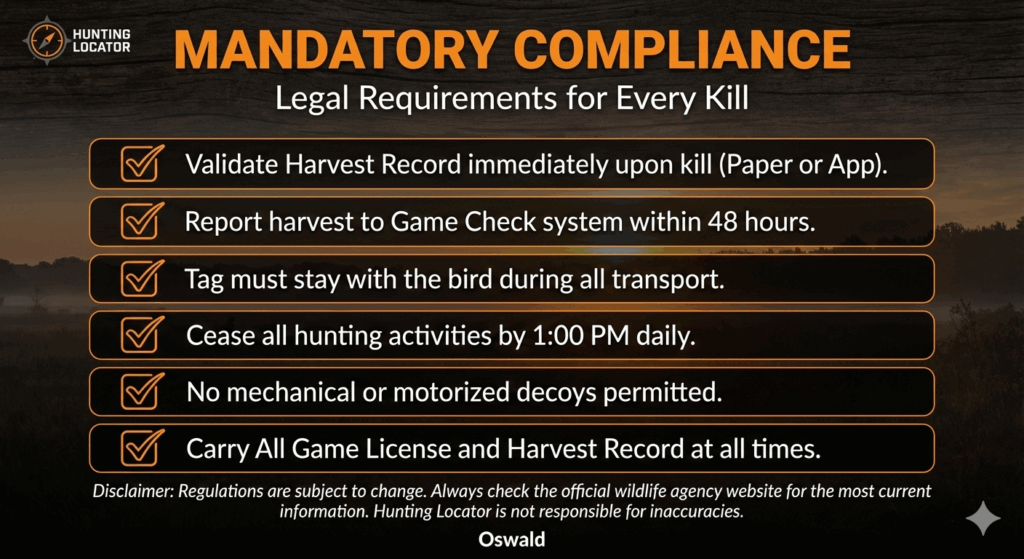
Where to Hunt Turkey in Alabama
Finding quality turkey hunting land is usually the biggest challenge. Alabama gives you options from public Wildlife Management Areas to guided hunts to private land access.
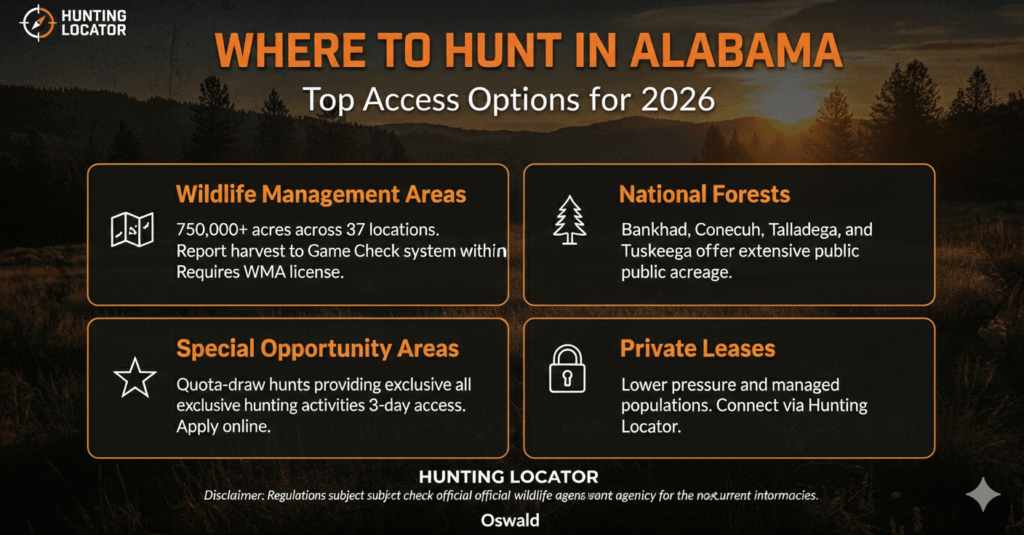
Best Public Lands for Turkey Hunting
Alabama manages more than 750,000 acres across 37 Wildlife Management Areas, plus extensive national forest land in the Bankhead, Conecuh, Talladega, and Tuskegee National Forests. Public land is accessible but comes with higher pressure, especially weekends.
Public Land Options:
- Wildlife Management Areas (WMAs): Need the $22.75 WMA license; many have specific turkey hunting dates and check-in requirements
- National Forests: Usually open every day of season; less restrictive than WMAs but can get hammered near access points
- Special Opportunity Areas: Quota-draw hunts that give you exclusive access for 3-day periods—apply through Outdoor Alabama
Public land turkeys in Alabama are “as hard-hunted and cagey as you will find anywhere—Eastern turkeys at their wariest and most stubborn”. That’s reality. Scouting and strategic planning are essential.
For less pressure and more consistent opportunities, private land access through platforms like Hunting Locator connects you directly with Alabama landowners offering hunting leases.
Guided Turkey Hunts in Alabama
Alabama has plenty of quality hunting lodges and outfitters offering guided turkey hunting. Guided hunts work great for non-residents who don’t know the terrain, hunters wanting a full-service experience, or anyone without established land access.
What Guided Hunts Typically Include:
- Experienced guide who knows local turkey patterns and calling
- Access to private land with managed turkey populations
- Lodging and meals (depends on the outfitter)
- Help with harvest processing and Game Check reporting
Book guided hunts way in advance. Popular outfitters fill up months before season, especially for prime early-season dates. Research multiple outfitters and check references before booking. For out-of-state hunters dropping serious money on non-resident licenses, a guided hunt can maximize your success in unfamiliar territory.
Private Land Hunting
Private land has real advantages: less pressure, you can scout and pattern birds before season, often higher success rates. The challenge? Finding quality private land access.
Private Land Access Options:
- Permission from Landowners: Traditional approach of building relationships with local landowners; takes time but can give you long-term access
- Hunting Leases: Paying for exclusive or shared access to private property; costs vary widely based on acreage, turkey population, amenities
Turkey hunting leases in Alabama range from seasonal agreements to annual contracts. Lease prices depend on property size, game populations, location, and whether access is exclusive or shared. For serious hunters making a long-term investment, buying hunting property gives you permanent access and the ability to manage habitat specifically for turkeys.
Hunting Locator is the nation’s most reputable platform connecting hunters with landowners who lease or sell hunting properties. Whether you’re searching for a seasonal turkey lease or exploring land purchase opportunities, Hunting Locator gives you direct access to Alabama landowners ready to work with qualified hunters. Browse Alabama hunting leases and connect with property owners who share your passion for ethical, memorable hunts.
Turkey Hunting Tips
Success in Alabama’s spring turkey season takes strategy, patience, and understanding gobbler behavior. Here are proven tips for increasing your success:
- Scout Before Season: Find roosting areas by listening for gobbles at dawn and dusk in the weeks before season. Set up your blind in high-movement areas like passageways and close to water sources where you’ve seen turkey sign.
- Master Calling Techniques: Electronic calls aren’t permitted for wild turkey hunting in Alabama; manual calls (box calls, slate calls, diaphragm calls) are legal. Practice realistic hen yelps, clucks, and purrs before season.
- Hunt Early Morning: Most hunters score early morning around fly-down when gobblers are most vocal. Mid-morning and late afternoon can produce too, especially later in season when birds have been pressured.
- Use Decoys Strategically: Once decoys become legal (April 4 in Zone 1, April 11 in Zone 2), position hen decoys 15-20 yards from your setup in open areas where approaching gobblers can see them. Mechanical turkey decoys are illegal in Alabama.
- Pattern Your Shotgun: Check your shotgun’s pattern at 20, 30, and 40 yards with turkey loads before season. Know your effective range and practice shooting from hunting positions.
- Stay Mobile: If a gobbler isn’t responding to your setup, relocate. Turkeys move throughout the day, and repositioning closer to active birds increases your chances.
- Respect the 1 p.m. Deadline: Legal shooting hours end at 1:00 p.m. during spring season. Plan accordingly and use afternoon hours for scouting future setups.
- Check Your Gear: Before heading out, make sure you have your All Game License, Turkey Harvest Record, WMA License (if applicable), and proper ID. Stock up on essential gear at the Hunting Locator store.
More Resources from Hunting Locator
Expand your Alabama hunting knowledge with these resources from Hunting Locator:
- Alabama Hunting Season Guide: Overview of all hunting seasons in Alabama including deer, waterfowl, and small game
- Alabama Turkey Hunting Season Guide: Additional turkey hunting insights and strategies for Alabama
- Alabama Whitetail Deer Hunting Season Guide: Plan your deer season alongside turkey hunting for year-round opportunities
- What Can I Hunt Year-Round in Alabama: Species available outside traditional seasons
- Alabama Waterfowl Hunting Season Guide: Maximize your hunting calendar with duck and goose seasons
- Alabama Small Game Hunting Season Guide: Rabbit, squirrel, and other small game opportunities
- Alabama Alligator Hunting Season Guide: Unique hunting experiences in Alabama’s coastal regions
- Alabama Sandhill Crane Hunting Season Guide: Specialized hunting opportunities for this migratory species
FAQ
When does turkey season start in Alabama for 2026?
Alabama’s spring turkey season starts on different dates depending on your zone. Zone 1 opens March 25, 2026, Zone 2 opens April 1, 2026. Special youth hunts happen the weekend before general season in each zone (March 21-22 for Zone 1, March 28-29 for Zone 2), and disabled hunter seasons are March 24 (Zone 1) and March 31 (Zone 2). Zone 3 doesn’t have a spring season.
How much does a non-resident turkey hunting license cost in Alabama?
Non-residents need an All Game Hunting License costing $399.50 for the annual license or $246.60 for a 10-day license. If you’re hunting Wildlife Management Areas, add a $22.75 WMA License. The Turkey Harvest Record is free but mandatory. Total investment for non-residents hunting WMAs ranges from $269.35 (10-day) to $422.25 (annual).
Can I use decoys during Alabama’s spring turkey season?
Yes, but with restrictions. Decoys are only permitted in spring season and can’t be used during the first ten days of each zone season. In Zone 1, decoys become legal April 4-May 8. In Zone 2, decoys are legal April 11-May 8. Mechanical turkey decoys are illegal statewide.
What is the bag limit for turkeys in Alabama?
Daily bag limit is one gobbler (bearded turkey) per day. Combined annual bag limit for fall and spring seasons together is four gobblers total. No more than two gobblers from any one WMA, Conservation Heritage Area, or National Forest Ranger District, and no more than one gobbler during the first 10 days of each season from each WMA, CHA, and National Forest Ranger District.
Do I need hunter education to hunt turkeys in Alabama?
Born on or after August 1, 1977? You need to complete an approved hunter education course before buying a hunting license. Alabama offers an Apprentice License for first-time hunters who haven’t finished hunter education yet, letting them hunt under supervision while working toward certification.
Where can I find the best public land turkey hunting in Alabama?
Alabama manages more than 750,000 acres across 37 Wildlife Management Areas, plus extensive national forest land in the Bankhead, Conecuh, Talladega, and Tuskegee National Forests. Special Opportunity Areas offer quota-draw hunts with exclusive 3-day access periods. Research specific WMAs through Outdoor Alabama for regulations, check-in requirements, and access details before hunting.
The Final Shot
Alabama’s 2026 spring turkey season offers exceptional opportunities for hunters willing to plan strategically and hunt smart. With one of the longest seasons in the Southeast, generous bag limits, and hunting options from public WMAs to private leases, Alabama delivers memorable gobbler pursuits for residents and visitors.
Success starts with understanding the zone system, securing proper licenses, and finding quality hunting land. Whether you’re a seasoned Alabama regular confirming dates or an out-of-state hunter planning your first trip, the investment in preparation pays off when a longbeard responds to your calling.
Ready to secure your Alabama turkey hunting access for 2026? Visit Hunting Locator to connect with landowners offering quality hunting leases across Alabama. From scouted properties with established turkey populations to exclusive access opportunities, Hunting Locator helps you find the perfect spot to make your 2026 season unforgettable.


