This guide is your comprehensive roadmap to successfully navigating Arizona deer hunting. We’ll break down everything from securing your tags through the 2025 draw, understanding complex season structures and new regulations, to proven field tactics for both mule deer and Coues whitetail, ensuring you’re fully prepared for your Arizona hunt.
Here’s what you’ll find:
- Navigating the 2025 Arizona Deer Draw: Licenses, bonus points, and application strategies for the June 3, 2025 deadline.
- Arizona’s Deer Demystified: In-depth profiles, habitats, and how to tell Mule Deer from Coues Whitetail.
- Mastering the Hunt: Proven tactics and essential gear specifically for Arizona’s diverse terrains and deer species.
- Where to Go: A guide to Arizona’s prime public lands, plus insights on private land opportunities and using Hunting Locator.
- Stay Legal & Ethical: Key regulations for 2025-2026, including new rules on trail cameras and archery harvest reporting.
Let’s equip you with the knowledge for a successful and memorable Arizona deer hunt.
Arizona Deer Hunting 2025-2026: What’s New and Essential
Planning your Arizona deer hunting trip requires knowing the latest information. Key dates for the 2025-2026 season are already set, and it’s important to be aware of recent regulatory updates from the Arizona Game and Fish Department (AZGFD).
Critical 2025 Dates & Deadlines:
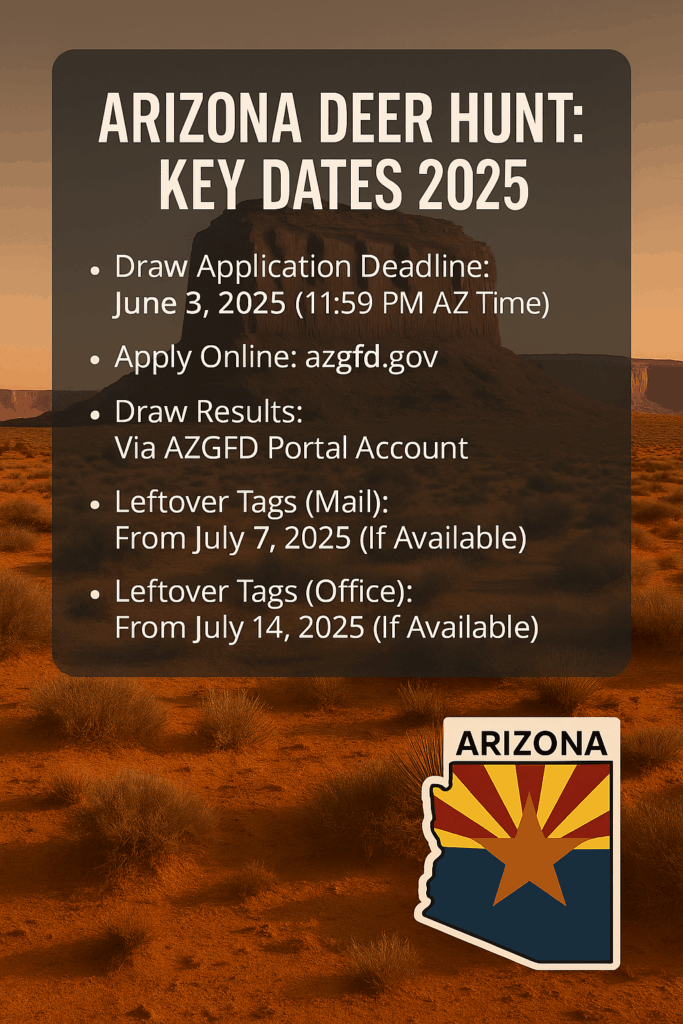
- Hunt Permit-Tag Application Deadline: All applications must be submitted online by Tuesday, June 3, 2025, at 11:59 p.m. Arizona time.
- Online Application Portal: Submit your applications through the official AZGFD website at azgfd.gov.
- Draw Results Viewing: You can check your draw results and view bonus points exclusively through your AZGFD portal account. The automated phone service is no longer available.
- First-Come Leftover Tags: If any tags remain after the draw, applications for these are typically accepted by mail on or after July 7, 2025, and permits may be available for purchase at Department offices after July 14, 2025, if any remain. These sell out quickly.
Key Regulatory Changes and Reminders for 2025-2026:
- Trail Camera Usage: A significant rule to note is Commission Rule R12-4-303.A.5. This states that a person shall not use any images, video, or data/information from a trail camera for the purposes of taking or locating wildlife, or aiding in the take of wildlife. This includes scouting prior to a hunt. This rule impacts how many hunters plan their scouting trips.
- Archery Deer (OTC) Harvest Reporting: For over-the-counter archery deer seasons, mandatory harvest reporting is required within 48 hours of taking a deer. Harvest limits are set by unit and species, and once the limit is reached, that unit will close to further archery deer hunting for that season. Hunters must check status online at www.azgfd.gov/ArcheryDeerReport or call 623-236-7961 before hunting.
- Credit Card Information: Ensure your credit card payment information in your AZGFD portal account is current. If your payment is declined during the draw, your application will not be processed.
- PointGuard Products: Arizona offers PointGuard and PointGuard Plus, allowing hunters to surrender a drawn tag (for specific reasons and prior to the hunt) and have their bonus points reinstated. This can provide peace of mind if unexpected circumstances prevent you from hunting.
- E-Tag System: Arizona has an E-Tag mobile app, allowing hunters to opt-in to receive licenses and big game tags electronically. This app also facilitates electronically tagging a harvested animal.
Core Requirements Overview:
- A valid hunting license is the first step for any Arizona hunt.
- A deer permit-tag, specific to the species, unit, and season, is required and most are obtained via the draw.
- The general bag limit is one (1) deer per calendar year, though exceptions can exist for specific management hunts.
- Hunter Education certification is mandatory for youth hunters aged 10 through 13 to hunt big game. It’s a good idea for all hunters to take the course.
- Be aware that Mexican Wolves are present in some Arizona units, and they are a federally protected species. Jaguars also inhabit parts of southern Arizona and are protected. Correctly identifying your target is crucial.
Understanding Arizona’s Deer: Mule Deer & Coues Whitetail
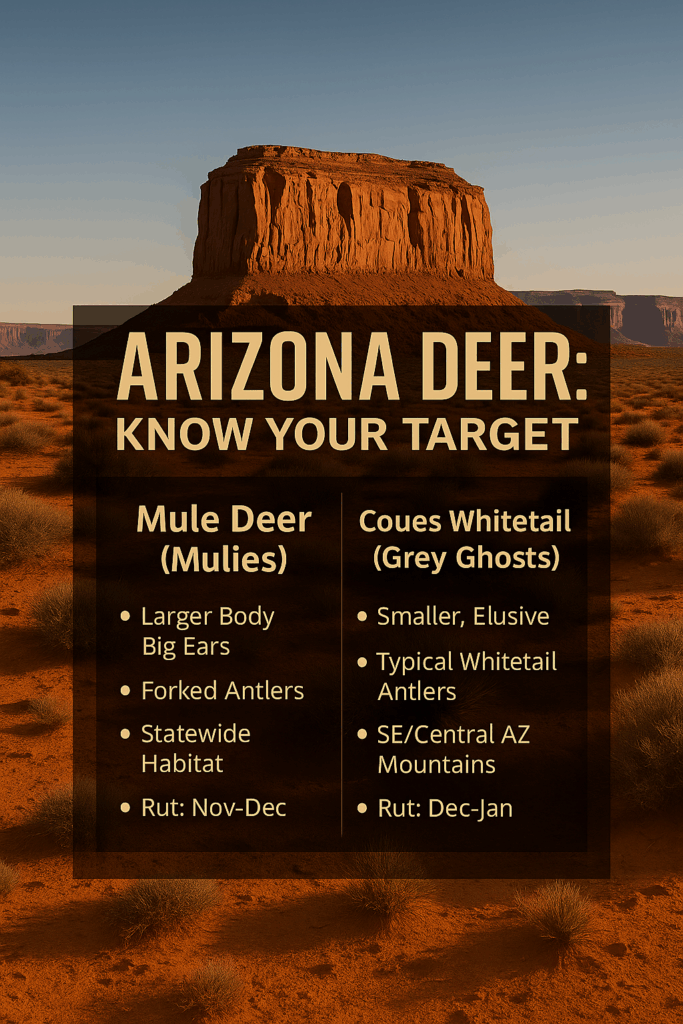
Arizona is a unique hunting destination because it offers hunters the chance to pursue two distinct and highly sought-after deer species: the iconic mule deer and the elusive Coues whitetail. Each presents a different challenge and a memorable trophy. Understanding their differences is key to a successful hunt.
Mule Deer (Odocoileus hemionus)
Arizona mule deer are a common sight across diverse habitats, from the low desert scrub to high mountain forests, including the famed Kaibab Plateau. They are larger than Coues deer, with impressive, branching antlers, large ears that give them their name, and a distinctive bounding gait when alarmed. These deer are popular for their size and the variety of hunting experiences they offer. The rut for mule deer typically occurs from November through December.
Coues Whitetail (Odocoileus virginianus couesi) – The “Grey Ghost”
Often called the “grey ghost” for their uncanny ability to vanish, the Coues whitetail is a small, wary subspecies of the whitetail deer. They thrive in the rugged desert mountain ranges of central and southern Arizona, favoring oak woodlands, chaparral, and brushy riparian areas. Their diminutive size, gray coloration, and nervous behavior make them an exceptionally challenging quarry. The Coues deer rut generally peaks from late December into January. Hunting these ghosts is often considered the ultimate test of a hunter’s glassing skills and patience.
Mule Deer vs. Coues Deer in Arizona: A Hunter’s Comparison
Choosing which species to pursue, or how to approach hunting both, requires understanding their key differences. While both are deer, their size, habits, and the tactics needed to hunt them successfully vary significantly.
| Feature | Mule Deer | Coues Whitetail Deer |
|---|---|---|
| Average Size | Larger (150-300+ lbs) | Smaller (65-120 lbs) |
| Antlers | Bifurcated (forked) branching | Typical whitetail (single main beam, tines) |
| Ears | Very large, mule-like | Proportionate to head, smaller than muley |
| Coloration | Grayish-brown, white rump patch, black-tipped tail | Grayish-brown, all-white underside of tail |
| Primary AZ Habitat | Statewide: deserts to high mountains | Central/Southern AZ: desert mountains, oak woodlands |
| Behavioral Trait | Can be curious, often in more open terrain | Extremely wary, prefers thick cover, “ghostly” |
| Glassing Approach | Gridding large areas, spotting at distance | Intense, meticulous picking apart of cover |
| Stalking Approach | Can involve longer stalks in open country | Often requires stealth in thick, steep terrain |
| Trophy Rating | Larger antlers, wider spreads often prized | Smaller, more delicate antlers; a unique trophy |
| Hunting Challenge | Varies by terrain, can be physically demanding | Extreme patience, exceptional optics & skill required |
Knowing these differences will help you plan ahead and tailor your strategy for these distinct Arizona deer.
Securing Your Arizona Deer Tag: Licenses, Draw, and OTC Options (2025-2026)
Most deer hunting opportunities in Arizona are allocated through a competitive draw system. However, there are also some limited over-the-counter (OTC) tags available, primarily for archery seasons. A valid hunting license is the first requirement before you can apply for any deer tag.
Licenses and Fees
You must possess a valid Arizona hunting license to apply for the deer draw or purchase an OTC tag. Several license options are available. Remember, short-term combination hunt and fish licenses are not valid for applying for the big game draw. Fees for the 2025 season are set, and it’s wise to confirm current pricing on the AZGFD website before applying.
Table: 2025 Arizona Hunting License & Deer Permit-Tag Fees
| License/Permit Type | Resident Cost | Non-Resident Cost | Youth Cost (Res/NR) | Notes |
|---|---|---|---|---|
| General Hunting License (18+) | $37 | $160 | N/A | Valid 365 days. |
| Youth Combo Hunt/Fish License (10-17) | $5 | $5 | $5 | Includes migratory bird stamp. |
| Deer Hunt Permit-Tag (Draw) | $58 | $315 | $30 / $28 (for Youth-Only Hunts) | Includes a non-refundable application fee ($13 Res, $15 NR). |
| Archery Deer Nonpermit-Tag | $45 | $300 | $40 / $38 (for Youth-Only Nonpermit) | Requires mandatory harvest reporting. |
| Bonus Point Only Application Fee | $13 | $15 | $13 / $15 | For those building points without applying for a hunt. |
Note: Fees are subject to change. Always consult the official AZGFD website for the most current fee schedule before purchasing.
The Arizona Fall Big Game Draw for Deer
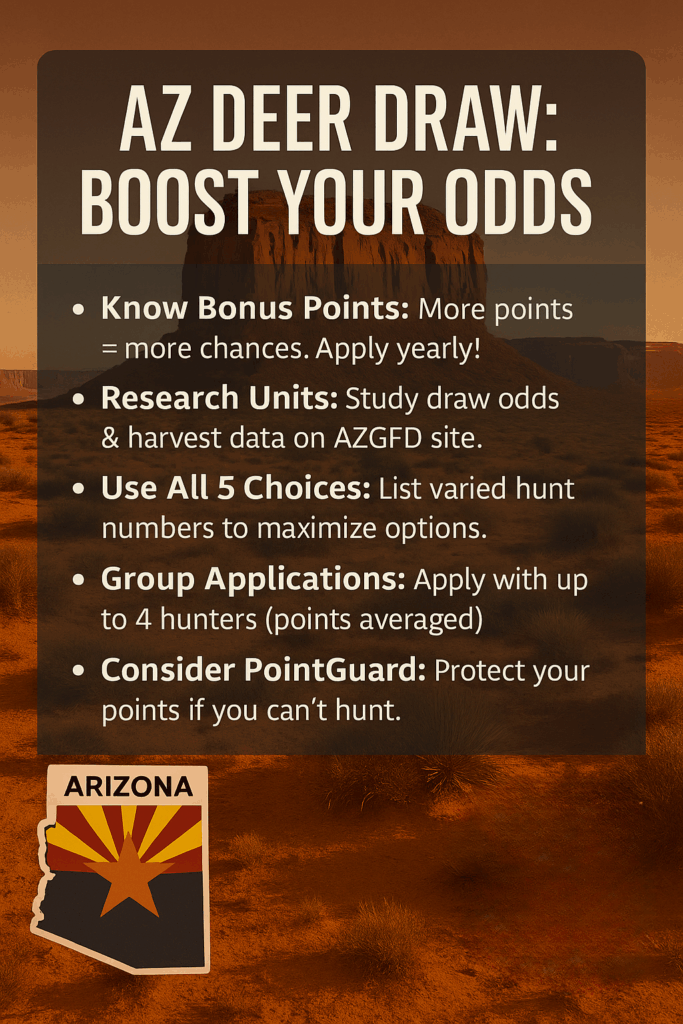
The primary way to get a deer tag for general firearm or muzzleloader seasons, and some archery deer hunts, is through the AZGFD’s fall big game draw. The hunt permit application deadline is Tuesday, June 3, 2025, at 11:59 p.m. Arizona time. Applications must be submitted online at azgfd.gov.
Understanding the Bonus Point System (R12-4-107): Arizona employs a bonus point system to give applicants who have been unsuccessful in previous draws a better chance over time. You earn one bonus point for each year you apply for a species and are not drawn, or if you apply specifically for a bonus point only. There’s also a permanent bonus point awarded for completing an Arizona Hunter Education course and potential loyalty bonus points for applying for five consecutive years. It’s important to understand this is a bonus point system, not a preference point system; more points give you more entries in the lottery, but don’t guarantee a tag at a certain point level.
Application Strategy:
- You can list up to five hunt choices on your application.
- Group applications are allowed for up to four hunters; the group’s bonus points will be averaged.
- Non-residents are generally capped at 10% of the permit-tags for most deer hunts.
- Thoroughly research draw odds and harvest data on the AZGFD website (www.azgfd.gov/surveydata ) to inform your unit choices. For more insights on Arizona’s hunting seasons overall, check out our Arizona Hunting Seasons overview.
- Consider purchasing PointGuard or PointGuard Plus when you apply. This allows you to surrender your tag if you can’t make the hunt and have your bonus points reinstated, subject to program rules.
After the draw, results are posted exclusively on your AZGFD portal account. If any tags remain, they are typically offered on a first-come, first-served basis.
Over-the-Counter (OTC) Archery Deer Opportunities
Arizona offers some over-the-counter (OTC) nonpermit-tags for archery deer hunts. These are popular because they don’t require going through the main draw.
- Availability: These tags are typically available for specific archery seasons, often in August/September and again in December/January, and are subject to harvest limits per unit.
- How to Purchase: Resident tags are available at AZGFD offices and authorized license dealers starting November 3, 2025. Some non-resident tags are available online only, also starting November 3, 2025, while others (for certain license holders like Pioneer or Lifetime) can be bought at AZGFD offices or by mail.
- Critical: Mandatory Harvest Reporting & Unit Closures: If you purchase an archery deer nonpermit-tag, you must report your harvest within 48 hours of taking a deer. This can be done online at www.azgfd.gov/ArcheryDeerReport or by telephone at 623-236-7961. Importantly, each unit has a harvest limit for these OTC hunts. Once that limit is reached, the unit closes to further archery deer hunting for that season. You are responsible for checking if your desired hunt unit is still open before hunting.
Arizona Deer Season Details (2025-2026)
Arizona’s deer hunting seasons are diverse, offering opportunities with various methods of take across numerous Game Management Units (GMUs). The specific season dates and permit numbers for the 2025-2026 deer hunts are detailed in Commission Order 2 of the official Arizona Game and Fish Department regulations booklet. Always refer to this document and the AZGFD Hunt Planner for the most accurate and up-to-date information.
Disclaimer: The following season information is a general guide based on the 2025-2026 Arizona Hunting Regulations. Always consult the official current year Arizona Game and Fish Department (AZGFD) regulations booklet (pages 26-33) and Hunt Planner for confirmed dates, specific hunt numbers, open units, and any last-minute changes. These can be found at www.azgfd.gov.
General Firearm Seasons
General firearm seasons are the most popular for deer hunts in Arizona. These typically occur in October, November, and December, with various hunt numbers assigned to different units and date ranges. Most of these permits are for “Any Antlered Deer,” but some hunts specifically designate “Antlered Mule Deer” or “Antlered Whitetail Deer”. These tags are available only through the draw and can be highly competitive, especially for units known for trophy bucks.
Archery-Only Seasons
Archery hunters enjoy extended opportunities.
- Permit-Tag Required Hunts: Some of the early archery season hunts, often in August and September, and hunts in premier units like 12A (Kaibab), 13A, or 13B, require a permit-tag obtained through the draw. Camp Navajo also has specific archery permit-tag hunts.
- Nonpermit-Tag (OTC) Hunts: Broader archery opportunities exist with OTC tags. These seasons typically run from late August to early September, and again from mid December through January. These are subject to unit-specific harvest limits and mandatory reporting.
Muzzleloader Seasons
For those who prefer primitive weapons, Arizona offers muzzleloader deer seasons. These hunts are typically in October or December and are limited to select units. Like general firearm tags, muzzleloader tags are draw-only.
Youth-Only Seasons
Arizona is committed to youth hunting, offering dedicated “Youth-Only” seasons for hunters ages 10-17. These hunts often have more favorable season dates or higher draw odds. Weapon types can be general firearm or muzzleloader, depending on the specific hunt. Several youth camps are often organized by groups like the Arizona Mule Deer Organization to support these young hunters.
CHAMP Hunts
The Challenged Hunter Access Mobility Permit (CHAMP) program provides special hunting opportunities for individuals with qualifying disabilities. Specific deer hunt numbers and seasons are set aside for CHAMP permit holders.
Top Regions and Units for Arizona Deer Hunting
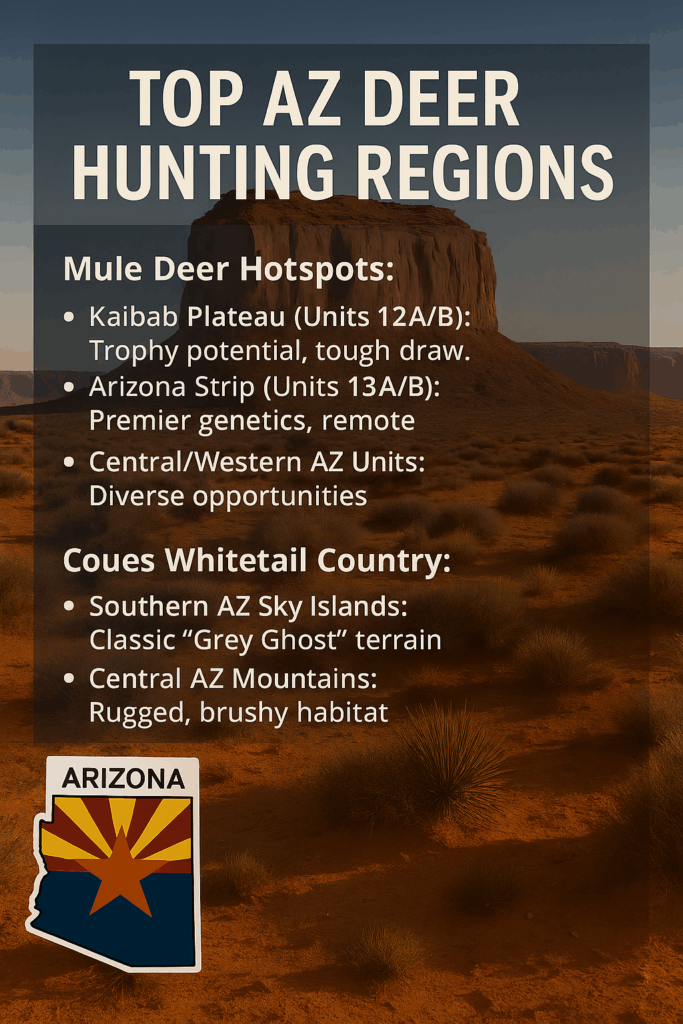
Choosing a hunting unit in Arizona is a critical step. The entire state offers deer, but specific units are managed for different experiences, from general opportunity to an emphasis on mature bucks. Your choice will depend on the species you’re targeting (mule deer or Coues whitetail), your desired experience, access considerations, and your accumulated bonus point total. Always consult AZGFD maps and the latest harvest/draw data (www.azgfd.gov/surveydata ) before applying.
Premier Mule Deer Units
Arizona is home to some legendary mule deer country.
- Kaibab Plateau (Units 12A East, 12A West, 12B): Located north of the Grand Canyon, the Kaibab Plateau is world-renowned for producing some of the largest bucks in North America. Tags are extremely difficult to draw but offer a hunt of a lifetime. Be aware of mandatory check-station requirements for some Kaibab hunts.
- Arizona Strip (Units 13A, 13B): Also north of the Grand Canyon, the Arizona Strip is famous for exceptional mule deer genetics and trophy potential. These are very remote and rugged only hunts, with tags being among the hardest to obtain in the West.
- Other Notable Mule Deer Units: Good populations of Arizona mule deer can be found in various central, southern, and western Arizona units. Research units like 10, 17A, 17B, 18A, 18B for varied terrain and opportunity.
Premier Coues Whitetail Units
Often called the “Grey Ghost,” the Coues whitetail provides a unique challenge.
- Southern Arizona Sky Islands (Units 29, 30A, 30B, 31, 32, 33, 34A, 34B, 35A, 35B, 36A, 36B, 36C): These isolated mountain ranges rising from the desert floor are classic Coues deer habitat. They offer numerous hunts with rifle, archery, and muzzleloader. Many hunters consider these units prime for Coues.
- Central Arizona Mountains (Units 21, 22, 23, 24A, 24B): These units offer good Coues deer populations in rugged, brushy terrain, often overlapping with mule deer habitat in transitional zones.
When selecting a Coues unit, factor in access, potential hunting pressure, and the physical demands of the steep terrain.
Accessing Public and Private Lands
Arizona offers extensive public land hunting.
Public Lands:
- U.S. Forest Service: The Kaibab, Coconino, Tonto, Apache-Sitgreaves, Prescott, and Coronado National Forests provide millions of acres open to hunting. Always check the current Motor Vehicle Use Maps (MVUMs) for vehicle restrictions and be aware of fire danger. You can find more information on the USFS Southwestern Region Hunting page.
- Bureau of Land Management (BLM): BLM lands are widespread and offer diverse hunting opportunities. Familiarize yourself with their regulations at the BLM Arizona Hunting page.
- Arizona State Trust Land: A recreational permit is required to access State Trust Lands for hunting.
- National Wildlife Refuges (NWRs): Some NWRs, like Kofa and Cabeza Prieta, allow deer hunting under specific refuge rules. Check the USFWS Arizona hunting page for details.
- National Recreation Areas (NRAs): Designated areas within Lake Mead NRA and Glen Canyon NRA are open to hunting. See the Lake Mead NRA hunting page for specifics.
- Wilderness Areas: These areas offer primitive hunting experiences but have strict regulations, including no motorized vehicles.
- Military Reservations: Access to Fort Huachuca, Yuma Proving Ground, Camp Navajo, and Barry M. Goldwater Range is restricted and requires special permits and adherence to military regulations.
Private Land Hunting:
- Always secure permission before accessing private land. Building good landowner relationships is key.
- Hunting Locator Connection: Finding private Arizona hunting land for sale or the perfect Arizona hunting lease can significantly enhance your deer hunting adventure. Hunting Locator is your direct connection to these opportunities, linking hunters with landowners offering leases and properties. For those seeking a guided experience, explore our directory of Arizona hunting outfitters. Don’t forget to explore more about general Arizona hunting seasons on our blog.
Field Strategies & Gear for Arizona Deer
A successful Arizona deer adventure hinges on adapting your tactics and gear to the specific species and the state’s often demanding environments. From the August archery season heat to the cold of a late season December hunt, being prepared is crucial.
Advanced Glassing Techniques for Arizona
Effective glassing is paramount in Arizona.
- Mule Deer: For mule deer hunts, especially in open desert or the vastness of the Kaibab, systematic gridding of terrain with quality optics is essential. Focus on shady slopes for bedded deer during warm parts of the day and transition areas during morning and evening.
- Coues Deer: Hunting the “Grey Ghost” is primarily a glassing game. This means hours behind high-power binoculars (15x or stronger) and a spotting scope, all mounted on a sturdy tripod. Patience is your best tool; meticulously pick apart every patch of cover on distant hillsides.
Stalking and Shot Placement
Once a buck is located, the stalk begins.
- Mule Deer: Stalks can be long and challenging, often in open country where careful attention to wind and minimal movement is critical. Prepare for potentially longer shots.
- Coues Deer: These deer are masters of using terrain to their advantage. Stalks are often steep, in thick cover, and may require navigating loose rock. Shots can be at sharp angles and often in tight windows before the buck disappears.
Essential Gear: Arizona Deer Hunter’s Checklist
Having the right gear can make or break your trip. This list covers essentials, with considerations for both mule deer and Coues deer across Arizona’s varied terrain.
Optics System: This is arguably the most important gear for Arizona.
- Binoculars: High-quality 10x42s are a minimum. For Coues deer, many hunters prefer 15x56s for their superior light gathering and magnification.
- Spotting Scope: A 20-60x scope is invaluable for evaluating distant animals and for Coues deer hunting.
- Tripod: A sturdy, lightweight tripod is non-negotiable for effective glassing.
- Rangefinder: Essential for accurate shot placement.
Weapon System:
- Rifle: Flat-shooting calibers like .270 Winchester, .30-06 Springfield, 7mm Remington Magnum, .300 Winchester Magnum, or 6.5 Creedmoor/PRC are popular. Ensure your rifle is accurately sighted in for the expected distances.
- Bow: A well-tuned bow with durable, sharp broadheads (at least 7/8 inch cutting width) is crucial for archery seasons. Practice in realistic hunting conditions.
- Muzzleloader: Modern inline muzzleloaders with quality sabots and bullets are effective.
Backpack: A comfortable, durable pack is needed. For day hunts, a 2500-3500 cubic inch pack may suffice. For multi-day backcountry hunts, consider 4000-6000+ cubic inches.
Footwear & Clothing:
- Boots: Well broken-in, durable hiking boots with good ankle support are critical for rugged terrain.
- Clothing: A layering system is key to adapt to Arizona’s temperature swings (hot days, cold nights, especially in the desert or during late season). Choose moisture-wicking base layers, insulating mid-layers, and a durable, quiet outer layer. Camouflage patterns should match the specific environment (desert scrub, pine forest, oak woodland).
Navigation & Communication: GPS unit or smartphone with downloaded hunting maps (e.g., OnX, GoHunt, Basemap), along with a traditional map and compass. Cell service is unreliable in most hunting areas. A satellite communication device (e.g., Garmin InReach, Zoleo) is highly recommended for safety.
Hydration & Nutrition: Arizona is extremely arid. Carry more water than you think you’ll need – at least 3-4 liters per person per day, more if hiking strenuously or in hot weather. A water filter or purification tablets are essential for backcountry trips. Pack high-energy snacks.
Game Care & Extraction: Sharp knives, a small saw, game bags (breathable, synthetic), and rope. Plan for how you’ll extract a harvested animal, especially in rough country; a lightweight pack frame can be invaluable.
Safety & Emergency: Comprehensive first-aid kit (including blister care, pain relievers, and any personal medications), snake bite kit (know how to use it, or better yet, avoid snakes), headlamp or flashlight with extra batteries, fire starters (waterproof matches, lighter, fire steel), and an emergency shelter (e.g., bivy sack or lightweight tarp).
Sun Protection: Wide-brimmed hat, sunglasses, and sunscreen are important year-round, even during fall and winter hunts.
Being in good physical condition will greatly enhance your ability to navigate Arizona’s often challenging terrain and enjoy your hunt.
After the Shot: Tagging, Reporting, and CWD
Your responsibilities don’t end when you’ve harvested a deer.
Tagging:
- Immediately after taking a deer, you must attach your tag to the carcass as prescribed by R12-4-302. If using the Arizona E-Tag mobile app, follow the electronic tagging procedure. Ensure you keep evidence of sex as required if regulations for your hunt specify.
Harvest Reporting:
- Archery OTC Deer: It is MANDATORY to report your archery deer harvest (or if you did not harvest) online at www.azgfd.gov/ArcheryDeerReport or by telephone at 623-236-7961 within 48 hours of taking a deer.
- Other Deer Hunts: For other deer hunts, you will likely receive a Hunter Harvest Questionnaire by mail, email, or text. Completing this accurately is crucial for wildlife management, providing the Fish Department with valuable data.
Chronic Wasting Disease (CWD):
- AZGFD actively monitors for CWD. Hunters can help by submitting samples from their harvested deer for testing, especially from units near states with CWD detections. Check the AZGFD website (www.azgfd.gov/cwd) for CWD information and sample submission locations.
- If hunting deer out-of-state, be aware of Arizona’s carcass transportation rules designed to prevent the introduction of CWD. Generally, only boneless portions of meat, clean hides/capes, clean skull plates/antlers without soft tissue, and finished taxidermy can be brought into Arizona.
Proper game care in the field is also essential to ensure the quality of the meat. Cool the carcass quickly, keep it clean, and process it or get it to a processor promptly.
Ethical Hunting in Arizona
Ethical hunting is the cornerstone of our heritage and ensures the future of wildlife and hunting opportunities.
- Respect Landowners and Other Users: Always get permission before entering private land. Leave gates as you find them. Be courteous to other recreationists.
- Waterhole Ethics: Do not camp within one-quarter mile of a waterhole in a way that denies wildlife or livestock access. Yield to hunters already at a waterhole.
- Fair Chase: Adhere to the principles of fair chase. The new regulations regarding trail cameras (no use for taking or locating wildlife) reinforce this.
- Effort to Recover Game: Make every possible effort to recover wounded game.
- Reporting Violations: Report any wildlife violations to Operation Game Thief at 1-800-352-0700.
FAQ: Arizona Deer Hunting
How hard is it to draw an Arizona deer tag?
Drawing an Arizona deer tag can range from relatively easy for some archery or youth only hunts to extremely difficult for premier mule deer hunts in units like the Kaibab or Arizona Strip, where it can take many bonus points. Coues deer hunts often have better odds than top-tier mule deer. Research draw odds on the AZGFD website before applying.
What is the best time of year to hunt deer in Arizona?
This depends on the species and method. Early archery seasons (August-September) can be hot but find deer in predictable patterns. The rut (November-December for mule deer, late December-January for Coues deer) is a popular time as bucks are more active. Late season rifle and archery hunts in December and January offer cooler weather but deer may be more wary.
Can non-residents hunt deer in Arizona?
Yes, non-residents can hunt deer in Arizona. They must purchase a non-resident hunting license and apply for deer tags in the draw, or purchase OTC archery tags when available. Non-residents are generally limited to 10% of the draw tags for most hunts.
What are the biggest mistakes first-time Arizona deer hunters make?
Common mistakes include underestimating the rugged terrain and extreme weather fluctuations, not carrying enough water, having inadequate optics (especially for Coues deer), not understanding the bonus point and draw system thoroughly, and not being prepared for the physical demands of hiking in Arizona’s backcountry.
Are there many public land hunting opportunities for deer in Arizona?
Absolutely. Arizona has millions of acres of public land open to hunting, including U.S. Forest Service lands, BLM lands, and State Trust Lands (which require a recreational permit). Many of the best deer hunts occur on these public lands. You can find more at the AZGFD’s where to hunt page.
Your Arizona Deer Adventure Awaits
Arizona offers a lifetime of deer hunting challenges and rewards. With careful planning, an understanding of the species, and respect for the land, your Arizona deer hunt can be an unforgettable adventure. Do your research, apply for those tags, and embrace the unique experiences that hunting mule deer and Coues whitetail in the Grand Canyon State provide. Good luck, and hunt safely! For additional resources on other Arizona game like elk, check out our Arizona Elk Hunting guide.
Start planning your trip and explore Arizona land opportunities at HuntingLocator.com. We also offer information on various outdoor skills events and youth camps which can be a great way to learn more. Don’t forget to check official sources for the latest updates before you camp or head out.


