I’ve pulled together everything you need from the Arkansas Game and Fish Commission into one place. No more jumping between websites or trying to decode regulation booklets at 5 AM in your truck.
Here’s what we’re covering:
- Every season date for 2026-2027, broken down by Arkansas’s zone system
- License costs and what you actually get for your money (residents vs. non-residents)
- Where to hunt—3+ million acres of public land plus private options
Let’s dive into the stuff you came here for: dates, licenses, and the rules that matter.
Quick Overview: Season Dates, Arkansas Hunting Licenses, and Regulations
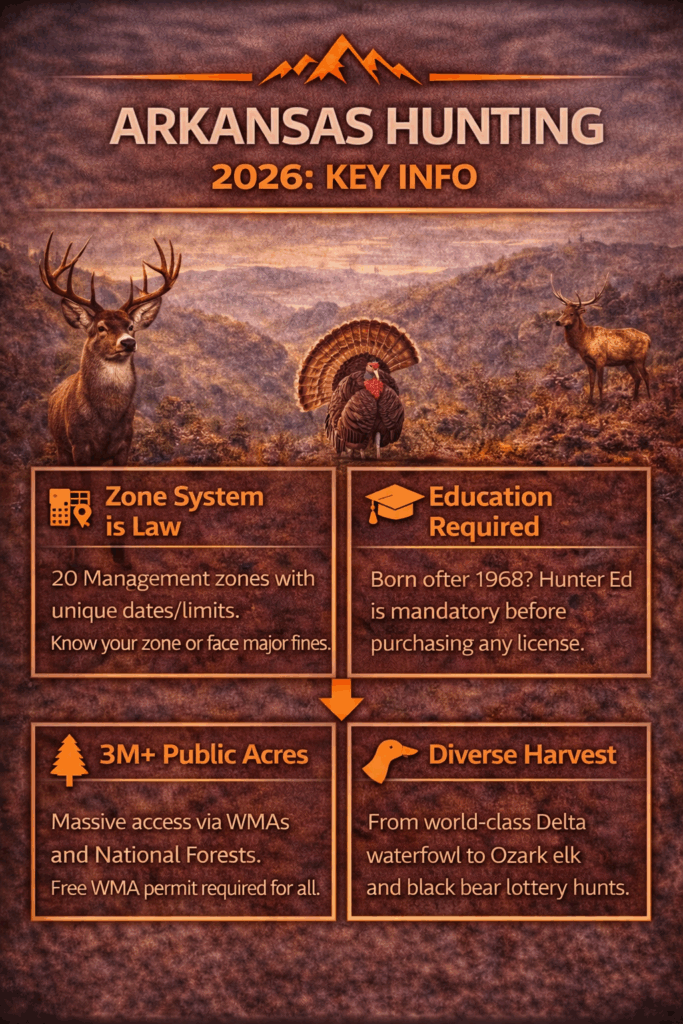
Arkansas splits deer management into 20 zones because what works in the Ozarks doesn’t necessarily work in the Delta. Each zone has its own season dates and bag limits based on local deer populations and habitat. You absolutely need to know your zone—hunting with the wrong dates can cost you big time.
But deer hunting is just the beginning. Arkansas delivers on turkey, waterfowl, bear, and specialty hunts like elk and alligator. The state’s zone system means you’ve got to do your homework before heading out.
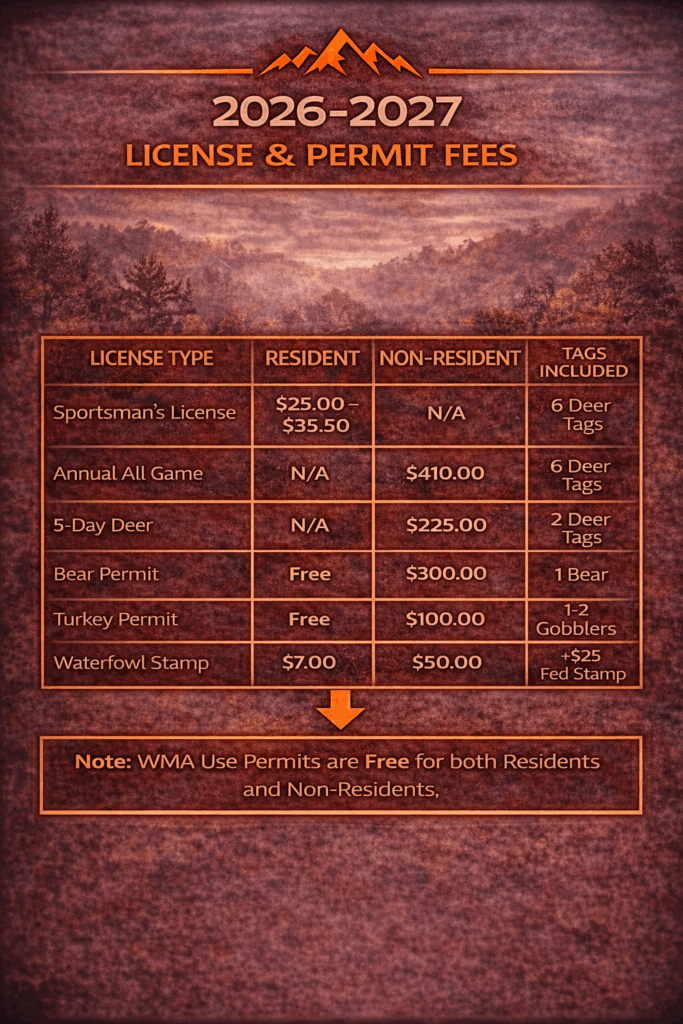
Arkansas Hunting License Costs 2026-2027
Quick heads up: if you were born after 1968, you need hunter education before you can buy a license. AGFC offers both online and in-person courses.
| License / Permit | Resident Fee | Non-Resident Fee | What You Get |
|---|---|---|---|
| Sportsman’s License (RS/CS) | $25 / $35.50 | N/A | 6 deer tags; Turkey/Bear tags available |
| Wildlife Conservation License | $10.50 | N/A | All small game; 1 deer tag |
| Annual All Game License | N/A | $410.00 | All game + 6 deer tags (Turkey/Bear extra) |
| 5-Day Deer License | N/A | $225.00 | 2 deer tags |
| 3-Day Deer License | N/A | $175.00 | 1 deer tag |
| Bear Permit | Free | $300.00 | Must have hunting license first |
| Turkey Permit/Tag | Free | $100.00 | Residents: 2 tags; Non-Residents: 1 tag |
| Waterfowl Stamp | $7.00 | $50.00 | Plus $25 Federal Duck Stamp & HIP registration |
| WMA Use Permit | Free | Free | Required for all state land |
Arkansas Hunting Season Dates 2026-2027
These dates change by zone and species. Always double-check your specific zone before hunting.
| Species | Season Type | Dates | Limits & Notes |
|---|---|---|---|
| Deer (Statewide) | Archery | Sept 26 – Feb 28, 2027 | 5 total (max 2 bucks) |
| Deer | Early Buck Archery | Sept 5–7 | Statewide |
| Deer | Youth Modern Gun | Oct 30 – Nov 1 & Jan 2–3 | Adult supervision required |
| Deer | Christmas Hunt | Dec 26–28 | Modern Gun |
| Deer (Zone 1) | Alternative Firearm | Oct 17–25 & Dec 12–14 | Northwest Arkansas |
| Deer (Zone 1) | Modern Gun | Nov 7–29 | Northwest Arkansas |
| Deer (Zones 2-4) | Modern Gun | Nov 7 – Dec 6 | Central Arkansas |
| Deer (Zones 5-15) | Modern Gun | Nov 7 – Dec 13 | Various zones |
| Deer (Zones 17-20) | Modern Gun | Nov 7 – Dec 27 | Southern Arkansas |
| Deer (Most Zones) | Alternative Firearm | Oct 17–25 & Dec 19–21 | Zone 16 closed |
| Bear (Zone 1) | Archery | Sept 16 – Nov 29 | 1 bear; Quota system |
| Elk (Zones 1 & 2) | Rifle | Sept 19–27 | Limited draw only |
| Elk (Zones 1 & 2) | Archery | Nov 21–29 | Limited draw only |
| Turkey (Spring 2027) | Youth Hunt | April 10–11 | All zones except Zone 3 |
| Turkey (Spring 2027) | Zone 1/1A | April 13 – May 10 | 2 gobblers (residents); 1 (non-residents) |
| Turkey (Spring 2027) | Zone 2/2A | April 20 – May 10 | 2 gobblers (residents); 1 (non-residents) |
| Turkey (Spring 2027) | Zone 3 | April 26 – May 10 | 2 gobblers (residents); 1 (non-residents) |
| Turkey (Fall) | Zone 3 Only | Nov 14–22 & Dec 12–27 | Limited opportunity |
| Waterfowl | Early Teal | Sept 19–27 | Special season |
| Waterfowl | Duck & Goose (Split 1) | Nov 21–30 | 6 ducks daily |
| Waterfowl | Duck & Goose (Split 2) | Dec 9–22 | 6 ducks daily |
| Waterfowl | Duck & Goose (Split 3) | Dec 26 – Jan 30 | 6 ducks daily |
| Light Goose | Conservation Order | Jan 31 – Feb 5 & Feb 8 – April 24 | 20 daily; no possession limit |
| Dove | Split 1 | Sept 5 – Oct 25 | 15 daily |
| Dove | Split 2 | Nov 21–30 | 15 daily |
| Dove | Split 3 | Dec 9 – Jan 14 | 15 daily |
| Dove (Eurasian Collared) | Year-round | Year-round | No limit |
| Quail | Regular Season | Nov 1 – Feb 14 | 10 daily |
| Squirrel | Regular Season | Nov 1 – Feb 14 | 12 daily |
| Rabbit | Regular Season | Nov 1 – Feb 1 | 8 daily |
| Crow | Regular Season | Sept 12 – Nov 20 | No limit |
| Furbearers | Trapping | Sept 1 – Feb 28 | No limit |
| Coyote | Daytime | Sept 1 – Mar 31 | No limit |
| Raccoon/Opossum/Nutria | Year-round | Year-round | No limit |
| Feral Hog | Year-round | Year-round | No limit; No license on private land |
| Alligator | Lottery Hunt | Sept 19–22 & Sept 26–29 (Night only) | 1 alligator (4ft+); Lottery required |
Some zones have specific bag limits of 3, 4, or 5 deer that override the statewide total. CWD zones have antler restrictions, and they just added Cleburne, Craighead, Mississippi, and Sharp counties to the CWD Management Zone.
Arkansas Deer Hunting
Arkansas whitetail hunting is legit world-class. You’ve got everything from Ozark ridges to Delta bottomlands, and the deer populations are healthy thanks to that complex zone system everyone complains about. Over 3 million acres of public hunting land means you don’t need to break the bank for access.
The zone system isn’t just bureaucracy—it actually works. AGFC biologists can fine-tune management for local conditions. What Zone 1 needs is completely different from Zone 15, and the regulations reflect that.
Want the full breakdown on zone-specific strategies and advanced tactics? Check out our complete Arkansas deer hunting guide.
Arkansas Deer Hunting Seasons
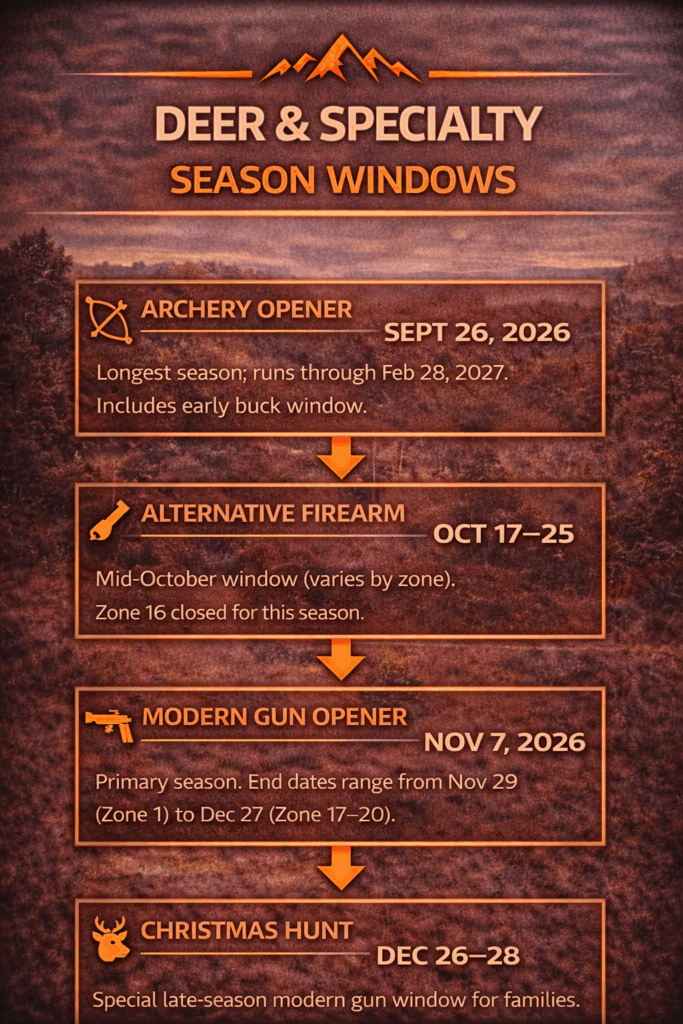
That archery season from September 26 through February 28? That’s gold. You get early season when deer are predictable, the rut when they’re crazy, and late season when they’re desperate for food. The Early Buck Archery season (September 5–7) is perfect for targeting mature bucks before they get spooked.
Youth hunts (October 30 – November 1 and January 2–3) are some of the best opportunities in Arkansas. These dates often hit peak movement periods, and you’re getting kids out there when the hunting is actually good.
Modern gun seasons vary by zone because Arkansas isn’t messing around with management. Zone 1 runs November 7–29. Zones 2-4 end December 6. Zones 5-15 go until December 13. Zones 17-20 get until December 27. This spreads out pressure and matches local deer behavior.
Alternative firearm seasons give you two shots: October 17–25 and a December period that depends on your zone. Just remember Zone 16 alternative firearm is closed.
Christmas Hunt (December 26–28) is perfect for family time in the woods during the holidays.
Arkansas Deer Hunting Regulations
Arkansas keeps it simple: sustainable harvest through smart management and CWD prevention.
- Bag Limits: 6 deer statewide, max 2 bucks, but some zones have their own limits of 3, 4, or 5 that take priority—check your zone
- Antler Restrictions: CWD zones have point restrictions; they just added Cleburne, Craighead, Mississippi, and Sharp counties to CWD management
- Tagging: Tag immediately after harvest; CWD zones require check-in for disease monitoring
- Legal Equipment: Modern firearms, archery, and alternative firearms during designated seasons
- Hunter Orange: Wear blaze orange when moving through areas with other hunters, especially during gun seasons
Arkansas Turkey Hunting
Arkansas spring turkey hunting is absolutely incredible. Healthy gobbler populations across diverse habitats, from bottomland hardwoods to oak ridges. The five-zone system with staggered openers lets biologists match seasons to local turkey behavior and spreads out hunting pressure.
Fall turkey is limited to Zone 3 (November 14–22 and December 12–27), but spring is where Arkansas really shines.
For zone maps, calling tips, and advanced strategies, hit up our Arkansas turkey hunting season guide.
Arkansas Turkey Hunting Seasons
Youth turkey hunt (April 10–11) works in all zones except Zone 3. Great mentorship opportunity when gobblers are still fired up from the opener.
Spring regular season has staggered openers that make sense. Zone 1/1A opens April 13. Zone 2/2A opens April 20. Zone 3 waits until April 26. Everyone closes by May 10 to protect nesting. This timing recognizes that turkey breeding cycles vary across Arkansas’s different regions.
Fall hunting in Zone 3 (November 14–22 and December 12–27) targets regrouped flocks after breeding season breaks up family units.
Arkansas Turkey Hunting Regulations
Gobbler-only harvest keeps breeding populations healthy.
- Bag Limits: Arkansas residents get 2 gobblers per season; non-residents get 1; daily limit is 1 turkey for everyone
- Legal Birds: Gobblers only during regular seasons—no jakes (except some youth hunts) or hens
- Permits: Turkey permit required; free for residents (2 tags), $100 for non-residents (1 tag, annual limit)
- Shooting Hours: 30 minutes before sunrise to sunset; best hunting is first few hours after legal time
- Legal Methods: Shotgun, archery, or crossbow; no electronic calls during regular season
Arkansas Waterfowl Hunting
Arkansas waterfowl hunting is legendary. We’re talking Mississippi Flyway, millions of birds, and Stuttgart calling itself the “Duck Capital of the World” for good reason. Arkansas offers world-class waterfowl hunting with flooded timber, ag fields, and managed impoundments that ducks and geese love.
The three-split season structure maximizes opportunities while staying within federal frameworks.
For WMA details, migration timing, and hunting strategies, check out our Arkansas waterfowl hunting season guide.
Arkansas Waterfowl Hunting Seasons
Early teal season (September 19–27) is your warm-up. Blue-wings and green-wings moving through while it’s still hot outside.
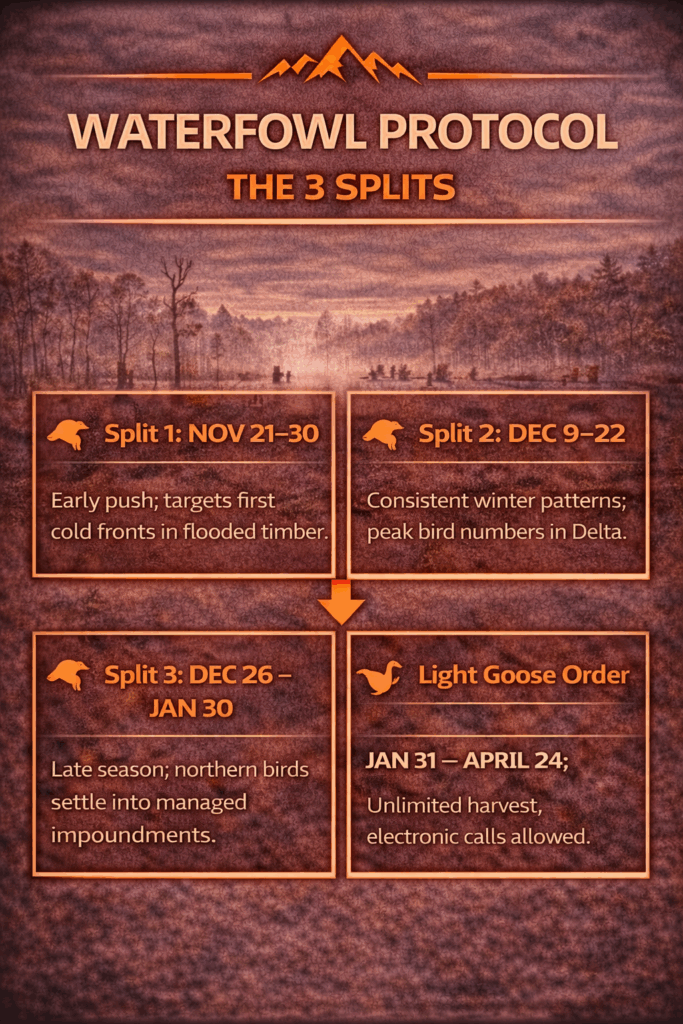
The three-split structure works perfectly. Split 1 (November 21–30) hits those first cold fronts pushing birds south. Split 2 (December 9–22) often gives you the most consistent hunting as birds settle into winter patterns. Split 3 (December 26 – January 30) extends through winter when northern birds keep moving.
Light Goose Conservation Order (January 31 – February 5 and February 8 – April 24) is unlimited harvest on snow geese, blue geese, and Ross’s geese. Electronic calls, unplugged guns—whatever it takes to manage these overabundant populations damaging Arctic habitat.
Arkansas Waterfowl Hunting Regulations
State seasons coordinate with federal frameworks for sustainable harvest.
- Bag Limits: 6 ducks daily with species limits; Canada geese vary between early (2 daily) and regular seasons (5 daily)
- Required Stamps: Arkansas Waterfowl Stamp ($7 residents, $50 non-residents), Federal Duck Stamp ($25), free HIP registration
- Legal Equipment: 10-gauge or smaller with non-toxic shot; 3-shell capacity (except Light Goose Conservation Order)
- Shooting Hours: 30 minutes before sunrise to sunset; best hunting is first few hours after legal time
- Hunter Education: HIP registration required annually for harvest monitoring
Arkansas Black Bear Hunting
Arkansas black bear hunting is as prestigious as it gets. Zone 1 only, quota-based, permit system. These bears came back from near extinction in the 1950s to a healthy population today—one of the great conservation success stories.
Bear hunting isn’t for everyone. You need to be in shape, patient, and ready for some of the most rugged terrain Arkansas has to offer.
For bear behavior, hunting strategies, and permit applications, visit our Arkansas black bear hunting season guide.
Arkansas Black Bear Hunting Seasons
Zone 1 archery season (September 16 – November 29) gives you the longest shot at Arkansas bears. This timing hits when bears are actively feeding for winter, making them more predictable around oak ridges and mast crops.
Early season bears focus on soft mast like berries. Late season they’re hitting hard mast like acorns. Season closes before denning to keep things ethical.
Arkansas Black Bear Hunting Regulations
Strict quota management protects this recovering population.
- Permits: Bear permit required ($300 non-residents, free residents); valid hunting license required; quota-based with limited permits
- Bag Limit: 1 bear per permit (either sex); season closes when quota fills
- Legal Equipment: Archery only during September 16 – November 29; specific broadhead and draw weight requirements
- Check-in: All bears must be checked within 24 hours at designated stations for data collection
- Zone Restrictions: Zone 1 only; know your boundaries—violations are serious
Arkansas Elk Hunting
Arkansas elk hunting is the ultimate exclusive opportunity. Zones 1 and 2 in the Ozarks, small growing population, competitive lottery system. Only a handful of permits available annually.
These elk came from western state relocations, and the population is carefully managed for habitat capacity and landowner relations. You need to be in incredible shape for the terrain and prepared to pack out a massive animal from remote locations.
For permit applications and elk strategies, check out our Arkansas elk hunting season guide.
Arkansas Elk Hunting Seasons
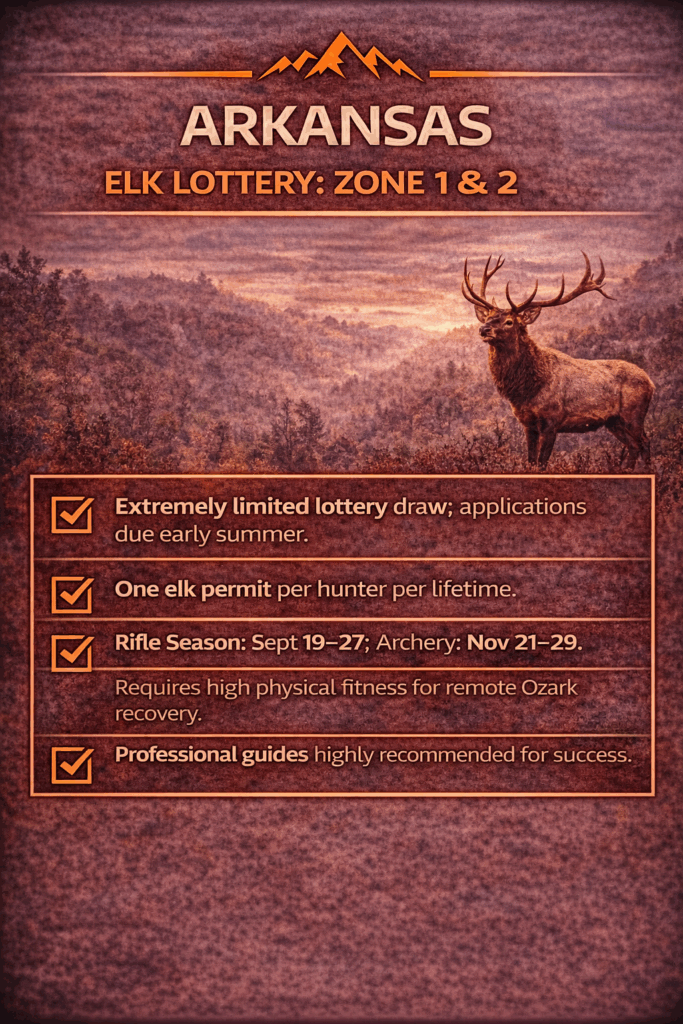
Rifle season (September 19–27) is your main opportunity, timed for early fall when elk are still in summer patterns but starting to move more. Best chance for success before the rut makes them unpredictable.
Archery season (November 21–29) is post-rut when elk have settled into winter patterns. Much more challenging—you need to get close to these wary animals.
Arkansas Elk Hunting Regulations
Most restrictive regulations of any Arkansas game species.
- Permits: Limited draw only; extremely competitive lottery; applications due early summer; one elk permit per hunter per lifetime
- Bag Limit: 1 elk per permit (either sex)
- Zone Restrictions: Zones 1 and 2 only; specific boundary maps provided; hunting outside zones prohibited
- Guide Recommendations: Not required but most successful hunters use professional guides
- Meat Care: Be prepared for proper care and transport of large animals from remote locations
Arkansas Minor Game Species Hunting
Arkansas minor game species provide action-packed hunting throughout fall and winter. Perfect for new hunters and great for extending your time afield.
Arkansas Small Game Hunting Information
Small game season runs November 1 through February 14 (rabbit ends February 1). Arkansas offers excellent small game opportunities across diverse habitats.
Squirrel hunting is an Arkansas tradition. Fox squirrels and grays are abundant in hardwood forests. Daily limit of 12 provides plenty of action and great training for young hunters. Rabbit hunting targets cottontails along field edges and brushy areas with an 8-rabbit daily limit.
Arkansas Dove Hunting Information
Dove season kicks off Arkansas hunting with three splits: September 5 – October 25, November 21–30, and December 9 – January 14. Daily limit of 15 mourning doves means fast-paced shooting, especially early season around sunflower fields and food plots.
Eurasian collared doves are year-round with no limit. Larger, more predictable birds perfect for training new shooters.
Arkansas Crow Hunting Information
Crow season (September 12 – November 20) offers unlimited harvest for hunters who enjoy outsmarting intelligent birds. Great practice for calling and decoy skills that transfer to other species.
Arkansas Furbearer and Predator Hunting Information
Furbearer trapping runs September 1 – February 28 with no limits. Coyote hunting is September 1 – March 31 during daylight with no restrictions.
Raccoon, opossum, and nutria are year-round with no limits. Great for staying active when other seasons are closed.
Arkansas Feral Hog Hunting Information
Feral hogs can be hunted year-round with no limits, no license required on private land. These invasive animals damage crops and native habitats.
Perfect training for deer hunting skills while helping landowners manage a destructive species.
Arkansas Alligator Hunting Information
Alligator hunting is nighttime-only during September 19–22 and September 26–29. Lottery-drawn permits target alligators 4 feet or longer in designated waters.
Specialized equipment and safety considerations required. Check out our Arkansas alligator hunting season guide for details.
Where to Hunt in Arkansas
Arkansas gives you incredible diversity from Ozark peaks to Delta bottomlands. Forests, rivers, and valleys throughout the state create beautiful and productive hunting opportunities. Over 3 million acres of public land through WMAs and national forests.
Public land, guided hunts, or private access—Arkansas has options for every style and budget.
Best Public Lands
Arkansas public lands reward hunters who put in the work scouting and learning terrain.
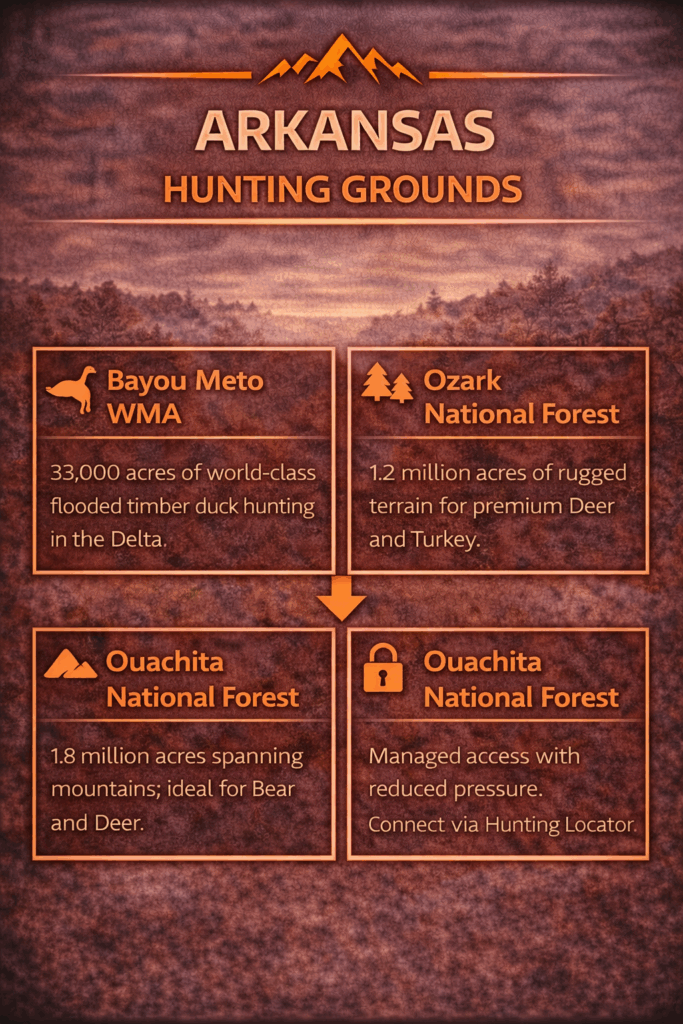
- Bayou Meto WMA: Famous for waterfowl, 33,000 acres in the Delta with world-class duck hunting in flooded timber
- Ozark National Forest: Diverse terrain across 1.2 million acres in north-central Arkansas for deer and turkey
- White River National Wildlife Refuge: Popular for waterfowl and deer, 160,000 acres along the White River in bottomland hardwoods
- Ouachita National Forest: Nearly 1.8 million acres across Arkansas and Oklahoma for deer, turkey, and bear in mountain terrain
- Cache River National Wildlife Refuge: Exceptional Delta waterfowl hunting with managed water levels
Guided Hunts
Guided hunts provide local expertise, equipment, and access without extensive scouting. Arkansas outfitters specialize in different species and hunting styles.
Professional guides offer pre-hunt scouting, equipment, local knowledge, and game care. Many include lodging, meals, and transportation—especially valuable for non-residents.
Consider reputation, success rates, included services, cancellation policies, and species specialization. Book well in advance, especially for peak waterfowl migration.
Private Land Hunting
Private land offers the best hunting quality and exclusivity. Managed properties often provide better opportunities than public land due to reduced pressure and habitat management.
Leasing provides exclusive access, better game populations, ability to implement improvements, and security of knowing your area is available. Annual agreements may include camping, fishing, or off-season access.
Purchasing hunting land gives complete control over pressure, habitat management, and access. Arkansas offers diverse properties from Delta duck holes to Ozark mountain tracts.
Hunting Locator connects hunters with quality private land opportunities nationwide. Whether you want a lease or considering purchase, Hunting Locator provides access to verified Arkansas landowners. The platform includes detailed property information, pricing, and direct landowner contact. Most hunters find suitable leases within two weeks, with tools for measuring properties, tracking hunts, and managing relationships.
FAQ
What hunting license do I need as an Arkansas resident?
Most Arkansas residents choose the Sportsman’s License ($25 for RS or $35.50 for CS), which includes 6 deer tags plus turkey and bear tag eligibility. For small game only, the Wildlife Conservation License ($10.50) covers all small game plus 1 deer tag. Hunters born after 1968 need hunter education before purchasing any license.
How much does it cost for non-residents to hunt in Arkansas?
Non-residents need the Annual All Game License ($410) with 6 deer tags, plus additional permits for turkey ($100) and bear ($300). Shorter options include 5-day deer licenses ($225 for 2 tags) or 3-day deer licenses ($175 for 1 tag). Waterfowl hunters add Arkansas Non-resident Waterfowl Stamp ($50) and Federal Duck Stamp ($25). Everyone needs a free WMA Use Permit for state land.
When is Arkansas deer season 2026-2027?
Statewide archery runs September 26 – February 28, 2027. Modern gun varies by zone: Zone 1 (November 7–29), Zones 2-4 (November 7 – December 6), Zones 5-15 (November 7 – December 13), Zones 17-20 (November 7 – December 27). Additional opportunities include Early Buck Archery (September 5–7), Youth Modern Gun (October 30 – November 1 and January 2–3), and Christmas Hunt (December 26–28).
What are Arkansas’s CWD zones and regulations?
Arkansas established CWD Management Zones to monitor and control disease spread. Cleburne, Craighead, Mississippi, and Sharp counties were recently added to CWD zones with special antler restrictions and mandatory check-in requirements for harvested deer.


