At HuntingLocator, we understand these frustrations firsthand. We’ve helped countless hunters solve power problems as fellow outdoorsmen who know that reliable scouting intel can make or break your season. Tactacam’s research shows that their “REVEAL Lithium Cartridge can replace up to 1,000 AA batteries”—proving that dependable power solutions exist and are worth understanding.
This guide will help you choose the right power solution for your specific hunting situation:
- How to choose between solar panels, external batteries, and combined systems
- Special power considerations for cellular trail cameras
- A quick selection guide to match solutions to your hunting situation
Understanding why standard batteries fail is the first step to solving the problem—let’s start there.
Understanding Trail Camera Power Needs
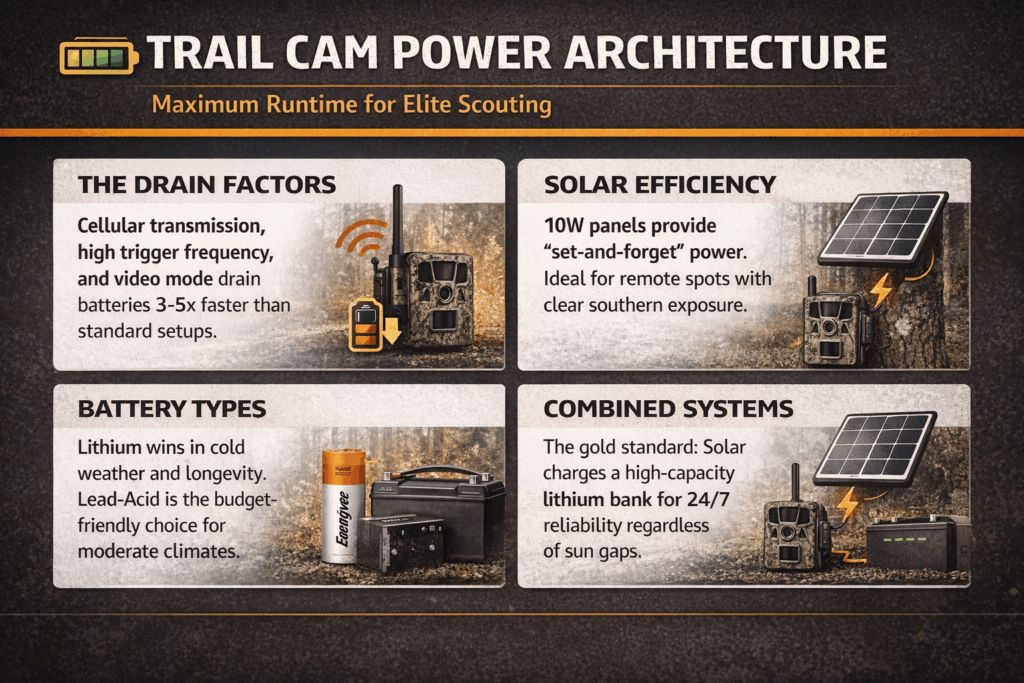
The scope of trail camera power problems is significant, especially with today’s advanced cameras. Research from Trail Cam Junkie shows that cellular trail cameras specifically drain batteries 3-5x faster than standard cameras, requiring battery changes “every 2-3 months” without solar assistance.
Three main factors drive power drain in trail cameras:
- Trigger frequency – High-traffic areas drain batteries faster as cameras activate more often
- Feature usage – Video recording, cellular transmission, and night vision all increase power demands significantly
- Environmental conditions – Cold weather dramatically reduces battery performance, especially with alkaline batteries
Cold Weather Reality Check: Lithium batteries maintain performance in temperatures where alkaline batteries fail completely, making them essential for hunters in northern climates or high-elevation areas.
Whether you’re managing remote property or running cellular cameras with video transmission, understanding these drain factors helps you size your power solution correctly.
Solar Panel Solutions for Trail Cameras
Solar panels offer the closest thing to “set it and forget it” power for trail cameras. SPYPOINT’s specifications/05548.html) show that their solar panel “constantly charges the integrated 15,000mAh battery so your camera can run for months”—demonstrating what’s possible with quality equipment properly matched to your needs.
Key Selection Criteria
When shopping for solar panels, use this checklist:
- Wattage – 10W panels are the standard for most trail camera applications (Field & Stream endorses Moultrie’s 10W Solar Power Pack for significantly boosting battery life)
- Integrated vs. Standalone – Some panels include built-in batteries; others require pairing with external battery packs
- Weather Resistance – Waterproof solar panels are essential for year-round outdoor use
- Cable Length – 15ft/4.6m cables provide flexibility for optimal panel positioning
- Compatibility – Verify compatibility with your specific camera brand
Honest Assessment: Pros and Cons
Pros:
- Continuous charging during daylight hours
- Reduced maintenance visits to remote locations
- Long-term cost savings over disposable batteries
Cons:
- Requires adequate sunlight exposure
- Initial investment higher than batteries alone
- Panel positioning can be challenging in dense forest
Spartan Camera’s guidance acknowledges that “solar panels can serve as the primary power source” but recommends pairing with backup batteries “to ensure longer battery life and continuous use”—especially for heavily shaded locations.
If you’re ready to explore solar options, browse our collection of trail camera solar panels and batteries to see what’s available for your setup.
External Battery Solutions
External battery packs serve as the workhorse solution for hunters who need extended runtime regardless of sunlight conditions. Spartan Camera’s research confirms that “one 12V external battery in a voltage regulating battery box” can keep “a camera running for a large portion of the year depending on camera settings and location.”
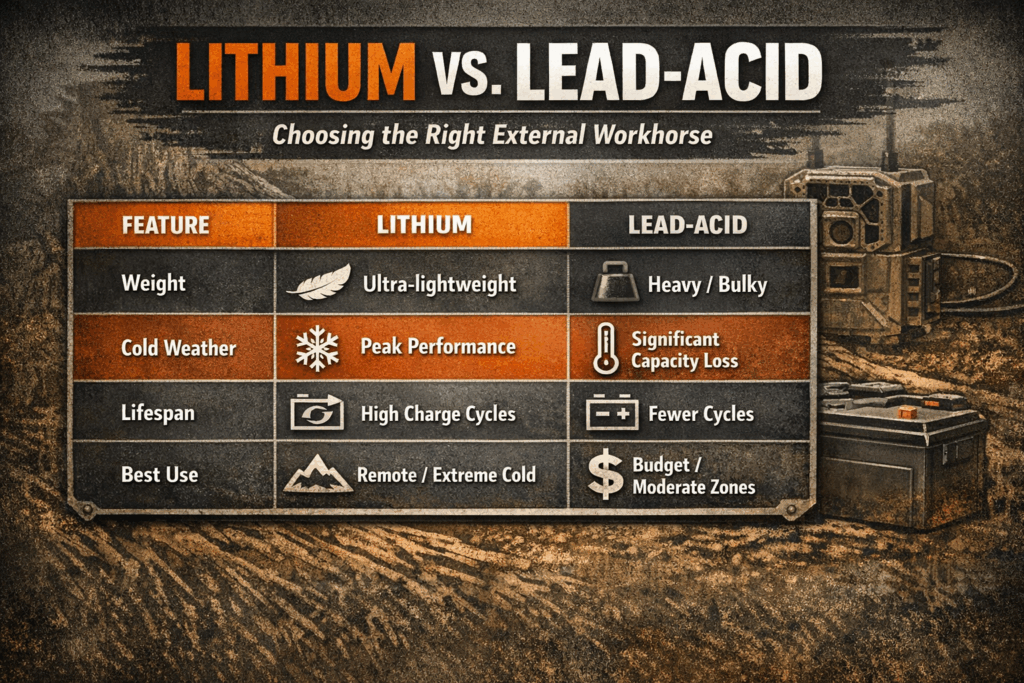
Lithium vs. Lead-Acid: Making the Right Choice
Understanding the differences between battery types helps you choose the right solution:
| Feature | Lithium Batteries | Lead-Acid Batteries |
|---|---|---|
| Weight | Significantly lighter | Heavier, bulkier |
| Cold Weather Performance | Maintains performance in extreme cold | Reduced capacity in cold temperatures |
| Lifespan | More charge cycles, longer overall life | Fewer cycles, may need replacement sooner |
| Initial Cost | Higher upfront investment | More affordable initially |
| Best For | Remote locations, cold climates | Budget-conscious hunters, moderate climates |
Hunt Em Up’s specifications show that “rechargeable lithium battery packs deliver extended run times and integrate directly into camera systems for seamless fit and hassle-free operation.”
Battery Capacity and Runtime
Key Specifications You Need to Know:
- 15,000-25,000 mAh – Standard capacity range for trail camera battery packs
- 12V output – Standard voltage for most trail camera external power connections
- Runtime varies – Based on camera settings, trigger frequency, and feature usage
Herd360’s high-capacity option features a “powerful 25,000 mAh lithium battery bank” as an example of maximum runtime capability.
What to Look For When Shopping
Use this checklist when evaluating external battery options:
- Built-in charge indicators for easy power level monitoring
- USB-C or micro USB recharging options for convenient charging
- Weather-resistant battery box for outdoor protection
- Compatible voltage output for your camera brand
- Secure mounting system (look for sturdy straps or Browning’s “twist lock plug” connections)
Combined Systems: Solar + Battery
Combined systems represent the gold standard for hunters who can’t afford camera downtime. Spartan Camera’s analysis explains that “when paired with an external battery, the cons of using a solar panel practically disappear, as solar panels keep cameras running all day and switch over to external battery power during the evening.”
Decision Tree: Is a Combined System Right for You?
Choose combined systems if:
- You manage property more than 30 miles from home
- You run cellular cameras requiring consistent power
- You need cameras operational during critical pre-season months
- You hunt areas with inconsistent sunlight due to weather patterns
Battery-only may suffice if:
- You check cameras weekly during active hunting periods
- You use standard (non-cellular) cameras with conservative settings
- You hunt areas with heavy forest canopy where solar isn’t practical
- Budget constraints require a phased approach to power solutions
Winterberry Wildlife’s research shows that “if the voltage from the external power supply exceeds the voltage of the internal battery by approximately 0.3 Volts, then all of the current for the camera comes from the external power supply”—ensuring seamless system integration.
Special Considerations for Cellular Trail Cameras
Cellular trail cameras have revolutionized scouting by delivering photos directly to your phone—but that convenience comes with significantly higher power demands. SPYPOINT’s specifications show that cellular cameras can “run continuously for up to 12-months with a LIT-22 rechargeable lithium battery or up to 6-months with AA batteries.”
Why Cellular Cameras Drain Faster
Cellular cameras consume more power for three main reasons:
- Data transmission requires significant power bursts during photo/video uploads
- Signal searching in weak coverage areas increases consumption as cameras work harder to maintain connection
- Video transmission capabilities multiply power needs compared to photo-only operation
If you’re considering upgrading to cellular cameras, explore our cellular trail camera selection to find models with efficient power management.
Optimization Tips for Cellular Camera Power
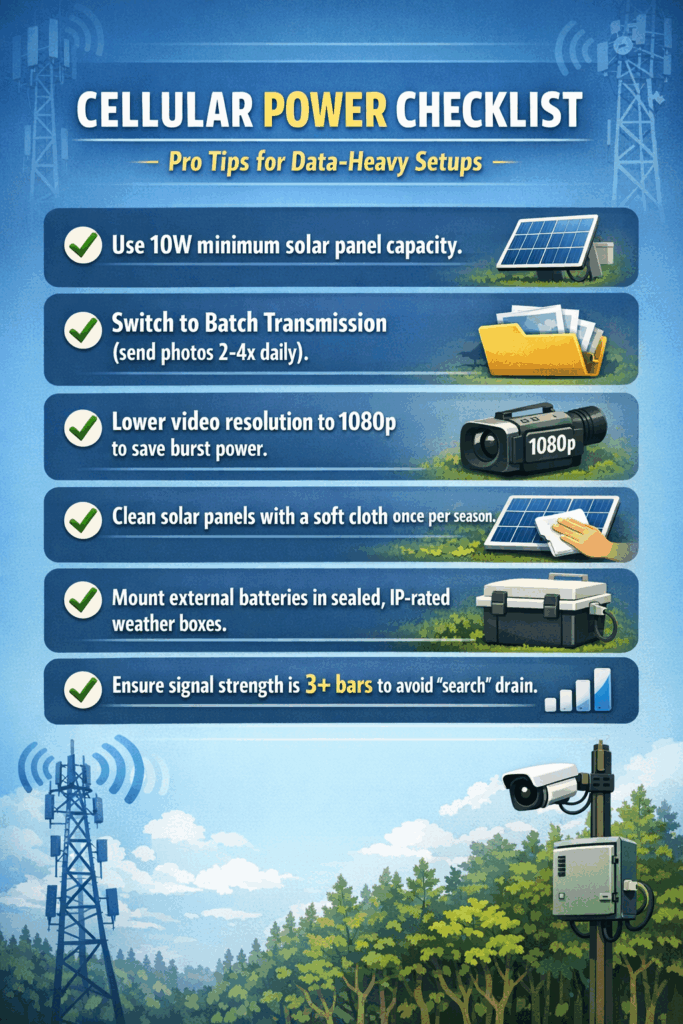
Reduce cellular camera power consumption with these strategies:
- Use motion-triggered recording rather than continuous monitoring (Reolink notes that “motion-triggered recording is more data-efficient compared to continuous recording”)
- Adjust transmission schedules to batch-send photos rather than instant transmission
- Lower video quality settings when high resolution isn’t critical
- Position cameras in areas with stronger cellular signal to reduce power used searching for connection
Power Solution Recommendations for Cellular Setups
Based on higher power demands, cellular cameras require:
- Minimum 10W solar panel for adequate charging capacity
- High-capacity lithium battery (20,000+ mAh) as backup power
- Combined systems strongly recommended for cellular setups to ensure consistent operation
Protecting Your Power Investment
Solar panels and battery packs represent a real investment—and in remote locations, protecting that gear matters as much as choosing the right equipment.
Weather Resistance
Quality power equipment should handle whatever nature throws at it:
- Look for IP-rated weather protection on all components
- Battery boxes should be fully sealed against moisture intrusion
- Solar panels designed for outdoor use can handle rain, snow, and temperature extremes
- Kent Faith’s specifications require equipment to “withstand harsh outdoor conditions including rain, snow, and extreme temperatures to ensure reliable performance”
Maintenance Tip: Regular cleaning of solar panels with a soft, dry cloth maintains charging efficiency and prevents debris buildup.
Security Considerations
Protecting your camera and power equipment investment is essential in remote locations. Browse our trail camera security boxes and locks for options that secure your entire setup.
Practical Security Tips:
- Position equipment out of obvious sight lines from trails and roads
- Use security boxes that accommodate both camera and battery pack
- Consider cable locks for solar panels mounted separately from cameras
- Choose camouflage or earth-tone equipment over bright colors
Quick Selection Guide: Matching Solutions to Your Situation
Every hunter’s situation is different—use this guide to identify which power solution matches your needs:
If you manage property 50+ miles from home and want minimal maintenance: → Combined system (solar panel + lithium battery pack) is your best investment. The upfront cost pays off in saved trips and continuous scouting data.
If you run cellular cameras for real-time updates: → High-capacity lithium battery with 10W+ solar panel. Cellular transmission demands robust power—don’t undersize your system.
If you hunt heavily forested areas with limited sunlight: → Large-capacity external battery pack (lithium preferred for cold weather). Solar may not be practical, so invest in battery capacity instead.
If you check cameras weekly and use standard (non-cellular) cameras: → Quality external battery pack may be sufficient. Consider adding solar if you want to extend time between visits.
If you’re on a tight budget but need better than AA batteries: → Start with a lead-acid external battery system. Upgrade to lithium or add solar as budget allows.
Think of battery capacity like planning a hunting trip—you pack enough supplies to handle unexpected delays. Similarly, size your power system for peak demand periods, not average usage.
Ready to find the right power solution for your setup? Browse our complete collection of trail camera batteries and solar panels—we stock options for every hunting situation and budget.
More Resources from Hunting Locator
Expand your trail camera setup with these additional resources:
- Trail Camera Collection – Complete selection of standard and cellular trail cameras from top brands
- Cellular Trail Cameras – Real-time photo transmission for instant scouting updates
- Security Boxes and Locks – Protect your camera and power equipment investment
- Mounts and Viewers – Professional mounting solutions and SD card viewers
FAQ
What’s the difference between 10W and 20W solar panels for trail cameras?
Most trail cameras work perfectly with 10W solar panels, which provide adequate charging for standard photo capture and even cellular transmission. 20W panels are overkill for single cameras but may be worth considering if you’re powering multiple cameras or running high-drain cellular cameras with frequent video transmission.
How long do external batteries last in cold weather?
Lithium batteries maintain performance in extreme cold, while lead-acid batteries lose significant capacity below freezing. SPYPOINT’s data shows cellular cameras can “run continuously for up to 12-months with a LIT-22 rechargeable lithium battery” in normal conditions, but expect reduced runtime in sustained cold weather regardless of battery type.
Can I use any 12V battery with my trail camera?
Most trail cameras accept 12V external power, but always verify compatibility with your specific model. Some cameras require voltage regulation to prevent damage, and Winterberry Wildlife’s research shows that voltage differences of “approximately 0.3 Volts” affect how cameras switch between internal and external power sources.
Do solar panels work in winter?
Solar panels work in winter but with reduced efficiency due to shorter days and lower sun angles. Snow covering panels stops charging completely, so combined solar + battery systems are essential for reliable winter operation in northern climates.
How do I know if my camera is compatible with external power?
Check your camera manual for external power specifications or look for a DC input port (usually covered by a rubber cap). Most modern trail cameras accept external power, but older models may not have this capability.
What’s the best way to mount solar panels away from cameras?
Use the longest cable your system provides (typically 15ft) to position panels in optimal sunlight while keeping cameras in ideal locations for game photography. Secure panels to sturdy trees or posts, and angle them south-facing for maximum sun exposure.
The Final Shot
Reliable power transforms your trail camera system from a frustrating maintenance chore into a dependable scouting tool that works when you need it most. Whether you choose solar panels for set-it-and-forget-it convenience, external batteries for consistent power regardless of conditions, or combined systems for maximum reliability, the right power solution pays dividends in better scouting intel and fewer missed opportunities.
The hunters who consistently tag mature bucks aren’t necessarily the best shots—they’re the ones with the best information. Don’t let dead batteries cost you another season of wondering what you missed.
Ready to gear up for your best trail camera season yet? Visit our store today! We stock the best solar panels, external batteries, and complete power systems to ensure your scouting success.


