Here’s what we’ve learned after digging through specs, expert advice, and countless hunting stories: choosing the right binoculars isn’t rocket science, but it does require understanding a few key principles. MeatEater Gear puts it perfectly: “8x are great for Eastern hunting applications while the extra power of 10x binoculars comes in handy when surveying the wide-open expanses of the West.” And here’s something that might surprise you – research discovered that a budget friendly pair of binoculars can serve just as much as the more refined, $3,000 one.
Here’s what we’ll cover:
- Decoding those confusing binocular numbers (and which ones actually matter)
- Matching your magnification to where and what you hunt
- Building a complete gear setup for hunting success
First things first: what do those numbers actually tell you?
Understanding Binocular Specifications: What the Numbers Actually Mean
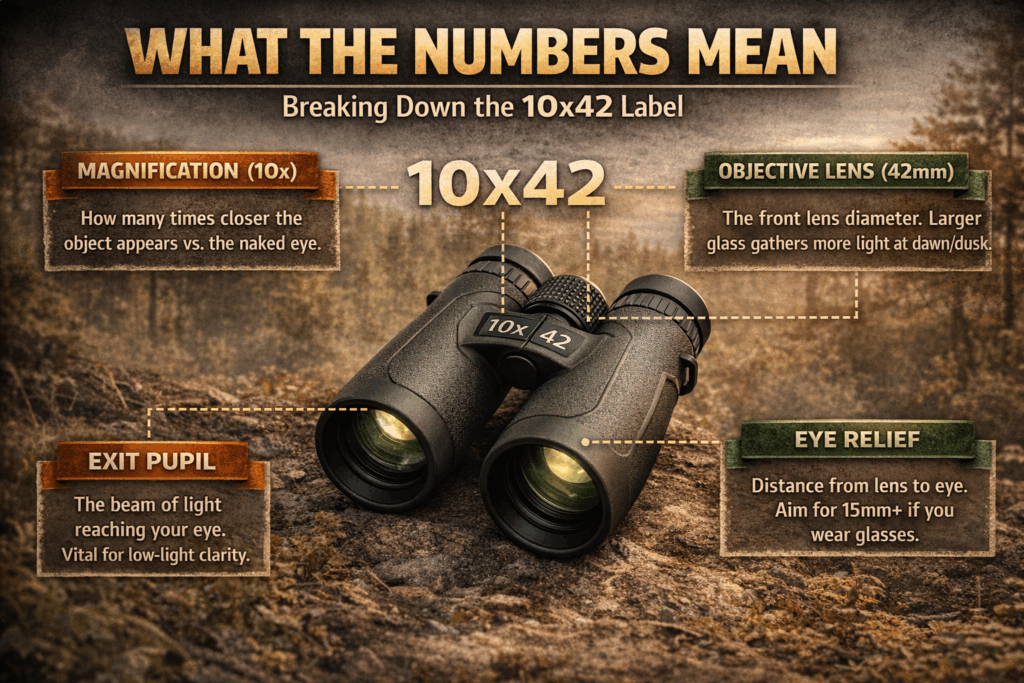
Those numbers aren’t as mysterious as they seem. Best Binoculars Reviews breaks it down simply: “the specifications of a typical binocular are stated as 7x35mm, 8x40mm, 10x42mm, or similar variations, where the number before the ‘x’ refers to magnification power and the number after refers to the objective lens diameter.”
Take 8×42 binoculars. The “8x” means that deer on a distant ridge appears 8 times closer than it would to your naked eye. The “42mm” tells you the diameter of those front lenses that collect light. Think of magnification as your zoom level, and that bigger number as how much light you’re gathering during those crucial first and last minutes of legal shooting time.
Magnification: More Isn’t Always Better
Here’s where things get interesting. Best Binoculars Reviews points out a critical trade-off: “Large magnifications make it difficult to keep the image still as any slight movement is magnified more, and they generally reduce the field of view, making it harder to spot game when scanning large areas.”
Higher magnification sounds great until you’re trying to track a buck moving through timber with shaky hands and a narrow view. Lower magnification gives you that wide-angle view for spotting movement but less detail for counting antler points.
Your magnification options:
- 8x: Wide view, steady image, perfect for thick cover and quick target acquisition
- 10x: More detail at distance, slightly tighter view, ideal for open terrain
- 12x+: Maximum zoom, needs rock-steady hands or tripod support
Objective Lens Size: Your Light Collector
This number matters more than most hunters realize. Best Binoculars Reviews explains that “full-size binoculars typically have 42mm objective lenses, while compact binoculars have 26mm or 22mm diameters; mid-size binoculars with around 32mm objective lenses offer a good compromise between portability and low-light performance.”
Why should you care? Because deer don’t follow human schedules. They move most during dawn and dusk when light is scarce, and bigger objective lenses gather more of that precious light.
The Great Debate: 8×42 vs 10×42
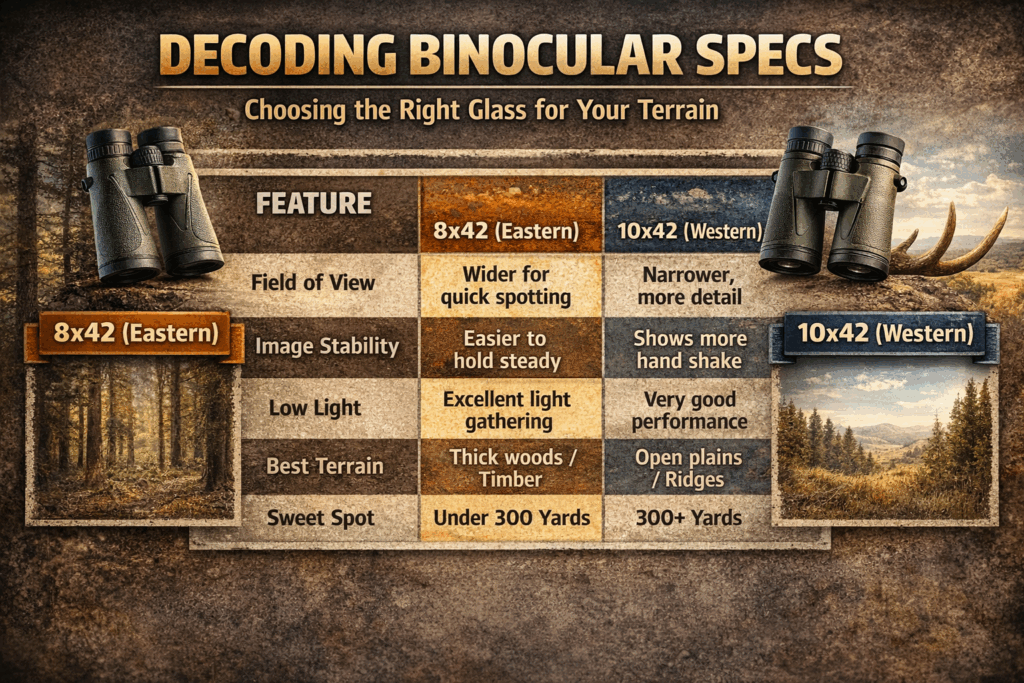
MeatEater Gear settles this debate with geography: “8x are great for Eastern hunting applications while the extra power of 10x binoculars comes in handy when surveying the wide-open expanses of the West.”
| Feature | 8×42 | 10×42 |
|---|---|---|
| Zoom Level | 8x closer | 10x closer |
| Field of View | Wider scanning area | Narrower but more detailed |
| Steadiness | Easy to hold steady | More hand shake visible |
| Best For | Dense woods, eastern forests | Open country, western mountains |
| Light Gathering | Excellent in low light | Very good |
| Sweet Spot | Under 300 yards | 300+ yards |
If you’re unsure about your primary hunting terrain, 8×42 is the safer bet. More forgiving, easier to use, and versatile enough for most situations.
Matching Magnification to Your Hunting Terrain
American Hunter shares this wisdom: “My favorite all-around size is 10×42, though I like an 8x glass for hunting thick cover, or a 15x binocular for hunting very elusive game like coues deer, or truly big country where I’m glassing miles away.”
Your terrain dictates your tool. When you’re ready to match binoculars to your hunting style, check out our hunting binoculars to find options that fit your specific needs.
Eastern Woods and Thick Cover
Hunting whitetails in dense timber creates unique challenges. Limited sight lines. Game appearing suddenly at close range. Quick shots through small openings. You need to spot movement fast and get on target quickly.
8×42 binoculars excel here. That wider field of view helps you catch movement in your peripheral vision, and the lower magnification means less image shake when you’re trying to identify that shape moving through the brush.
Western Open Country
Miles of terrain stretch before you. That elk could be anywhere on three different ridges. You need to glass systematically, picking apart distant timber and meadow edges for game that might be over a mile away.
10×42 becomes your primary tool, though serious western hunters often pair binoculars with spotting scopes for detailed evaluation at extreme distances.
All-Around Versatility
Hunt multiple species across different terrain? 10×42 offers the best compromise. Enough power for open country, still manageable in timber. Testing found exceptional performance in models like “the Zeiss SFL 10×40 came out last year and remains so superior to any new binocular tested that it received the Editor’s Pick Award for best overall binocular.”
Beyond Magnification: Features That Actually Matter
Magnification gets all the attention, but other features determine whether your binoculars perform when it counts.
Glass Quality and Coatings
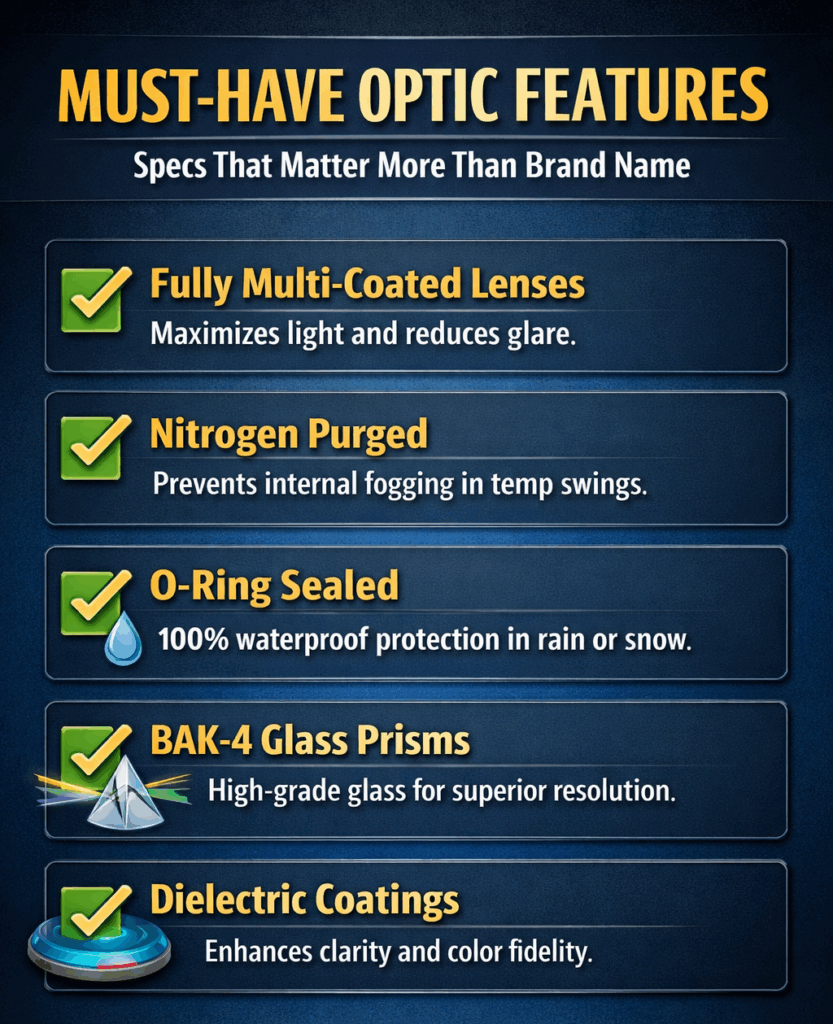
Deer Hunting Guide explains the technical stuff: “premium features include BAK-4 glass prisms for excellent resolution, phase-corrected dielectric coated prisms for maximum light gathering ability and clarity, and Hi-Lume Index-matched fully multi-coated lenses for reduced glare and high resolution.”
Translation: look for “fully multi-coated” on the spec sheet. This means every lens surface is treated to reduce glare and maximize light transmission. It’s the difference between clear, bright images and muddy, dim ones.
Weatherproofing That Works
Research confirms that “O-ring sealed and nitrogen-filled binoculars provide 100% waterproof and fogproof performance.” You’ll hunt in rain, snow, fog, and temperature swings. Waterproof and fogproof construction isn’t a luxury feature – it’s essential.
Eye Relief for Glasses Wearers
If you wear glasses while hunting, eye relief determines whether you can see the full image. Look for at least 15-16mm of eye relief – anything less and you’ll be frustrated by black edges around your view.
Budget Reality Check: What to Expect at Every Price Point
Success depends more on choosing the right specs than maxing out your credit card.
Budget Tier: $100-$300
Here’s the sweet spot: the golden middle for beginners is the $150–$300 range from trusted budget-friendly brands.
What you get: Solid optical performance, waterproof construction, adequate low-light capability. A quality 8×42 from a trusted brand in this range will serve you well for years.
Mid-Range Tier: $300-$700
What improves: Noticeably clearer optics, better performance in challenging light, more durable construction. This is where many serious hunters land for binoculars that last decades.
Premium Tier: $700+
Testing found that “the Swarovski NL Pure was the only binocular in the test to notch perfect scores in resolution and image quality.” These excel in the most demanding conditions and extended use.
Know Before You Go: Hunt Preparation Essentials
Quality binoculars are just one piece of successful hunting. Proper preparation sets you up for success before you even reach the field.
Check Your Regulations
Hunting regulations vary dramatically between states and even local areas. Legal hunting hours, required licenses, bag limits – all of this affects your hunt planning.
Take action: Get all necessary licenses and tags before your hunt. Many states offer online purchasing, but processing times vary.
Scout Your Area
Your binoculars become essential scouting tools for identifying key habitat features. Look for tracks, rubs, scrapes, and feeding areas that indicate recent animal activity.
Pro tip: Use GPS apps for pre-season scouting to identify potential hunting spots. Our GPS and mapping tools help you mark waypoints and plan access routes.
Get Ready Physically
Physical preparation varies by hunting style, but cardiovascular fitness and gear familiarity are always important. Practice with your binoculars in different lighting conditions before your hunt.
Complete Gear Setup: Beyond Just Binoculars
Successful hunting requires more than great binoculars. You need a complete system that works together.
Your Optics System
Think of binoculars as part of a complete optics package:
- Primary binoculars: 8×42 or 10×42 based on your terrain
- Spotting scope: For long-range identification in open country
- Rangefinder: Essential for accurate distance measurement
- Cleaning kit: Keep your optics clear in field conditions
Complete your setup: Browse our full selection of hunting optics including spotting scopes, rangefinders, and cleaning kits.
Clothing and Layering
Weather-appropriate clothing and effective camouflage make or break hunts. Focus on moisture-wicking base layers and insulated outer layers for temperature control.
Weapons and Ammunition
Choose appropriate calibers or bow setups for your target species. Practice extensively with your chosen setup before hunting season opens.
Improve your accuracy: Upgrade your weapon optics with our rifle scopes, red dot sights, or crossbow scopes.
The Must-Haves
Navigation and Safety:
- Compass and GPS device
- First aid kit
- Emergency communication device
Field Processing:
- Sharp knives for field dressing
- Disposable gloves
- Game bags
Field Tactics: Getting the Most from Your Binoculars
Having great binoculars is one thing. Using them effectively is another.
Prime Time Hunting
Game activity peaks during dawn and dusk when low-light performance becomes critical. This is when quality optics separate successful hunters from those squinting through cheap glass.
Wind and Scent Management
Understanding wind direction and controlling human scent are fundamental skills. Position yourself downwind of expected game movement and use scent control products religiously.
Hunting Strategies
Stand hunting: Use binoculars to identify optimal stand locations with good visibility and natural game funnels.
Still-hunting: Lower magnification (8x) works better when moving through cover and needing quick target acquisition.
Glassing: Higher magnification (10x+) excels for systematic scanning of open terrain from a stationary position.
Shot placement: Always identify ethical shot zones before taking any shot.
After the Shot: Post-Harvest Care
Your work doesn’t end when you squeeze the trigger. Proper post-harvest care ensures you maximize your harvest.
Tracking and Recovery
Use your binoculars to follow blood trails and mark the last known location of wounded game. Quality optics help you spot sign that might be invisible to naked eyes.
Field Dressing
Proper field dressing starts immediately after recovery. Cool the carcass quickly and prepare meat for transport according to local regulations.
Processing and Transport
Plan your meat processing and transport before the hunt. Know local processing facilities and transportation requirements for your hunting area.
More Resources from Hunting Locator
Expand your optics knowledge:
- Night Vision Equipment – Specialized low-light hunting applications
- Thermal Optics – Advanced technology for challenging conditions
- Monoculars – Lightweight alternatives for specific uses
- Scope Mounts – Secure mounting solutions
- Tripods – Stability systems for extended glassing
- Binocular Accessories – Harnesses, cases, and maintenance tools
- Boresighters – Precision tools for scope setup
FAQ
What magnification should I choose for my first hunting binoculars?
For most new hunters, 8×42 binoculars offer the best mix of versatility and ease of use. The 8x magnification provides a wide field of view that makes finding game easier, while 42mm objective lenses gather enough light for dawn and dusk hunting.
Are expensive binoculars worth it for hunting?
Research shows that a budget friendly pair can mean just as much as the really expensive one. Focus on finding binoculars with the right specs for your hunting style rather than spending maximum dollars.
How do I choose between 8×42 and 10×42?
Your hunting terrain makes this decision. MeatEater Gear explains that “8x are great for Eastern hunting applications while the extra power of 10x binoculars comes in handy when surveying the wide-open expanses of the West.”
What features matter most in hunting binoculars?
Essential features include waterproof and fogproof construction, fully multi-coated lenses, and appropriate magnification for your terrain. Research shows that “O-ring sealed and nitrogen-filled binoculars provide 100% waterproof and fogproof performance.”
Can I use the same binoculars for different hunting situations?
Absolutely. Versatile options like 10×42 models work well across multiple hunting scenarios. However, specialized hunting may benefit from specific magnifications – 8x for thick cover or 15x+ for long-range western glassing.
How do I maintain my hunting binoculars in the field?
Keep lenses clean and protected from scratches, avoid touching glass with your fingers, and keep binoculars dry. Use lens caps and cleaning cloths, and store in protective cases when not actively using them.
Wrapping Up
Choosing the right binocular magnification transforms your hunting from guesswork to precision. Whether you’re scanning eastern hardwoods with 8×42 binoculars or glassing western ridges with 10×42 optics, success comes from matching your tool to your terrain.
The key insight? Understanding what those numbers mean and how they apply to your specific hunting situations matters more than spending maximum money. Quality binoculars in the $150-$300 range will serve most hunters exceptionally well for many seasons.
Ready to upgrade your hunting optics? Visit our store for the best selection of hunting binoculars, spotting scopes, rangefinders, and optical accessories to ensure your success in the field.


