This bow stabilizers guide covers everything you need to know:
- The real impact stabilizers have on your bow and shooting accuracy
- How to pick the right setup for the way you hunt
- Practical setup steps you can use before your next trip
Whether this is your first stabilizer upgrade or you’re fine-tuning what you already have, getting the basics right makes a huge difference.
Why Stabilizers Matter for Hunting Success
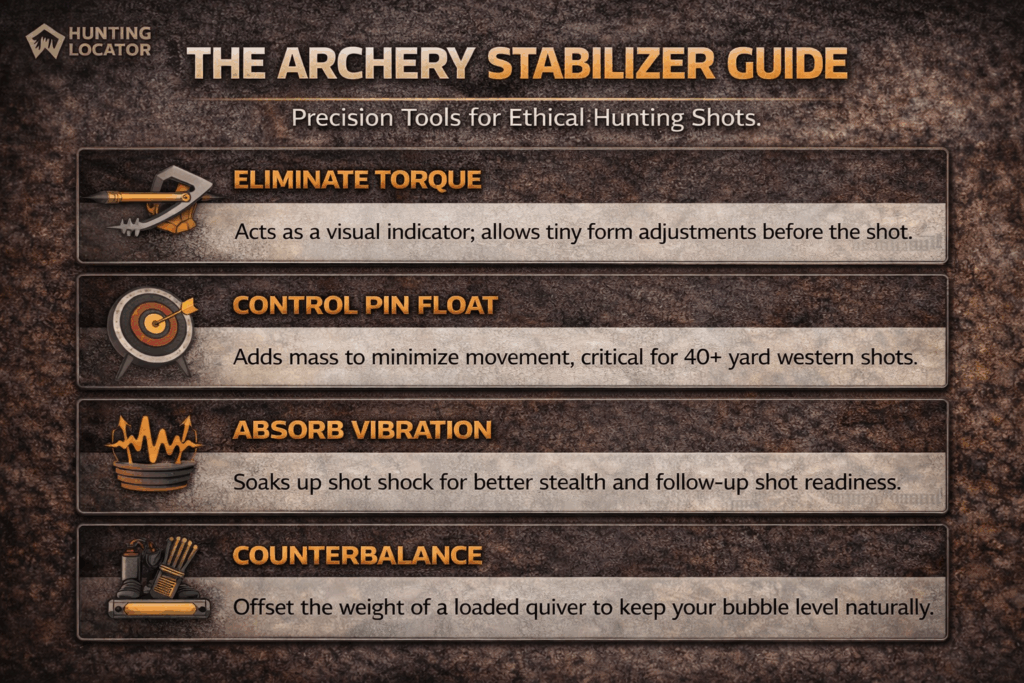
Think of stabilizers as precision tools that make ethical hunting possible at the distances western terrain throws at you. Mathews Inc. explains it well: stabilizers help your bow settle quickly so your pin naturally floats in a controlled pattern. That controlled float? It’s what separates a confident, ethical shot from a rushed attempt that could wound an animal.
Stabilizers tackle three major problems that get worse at longer hunting distances:
Eliminating Bow Torque: A front rod works like a torque indicator—when you’re torquing your grip, you’ll see the stabilizer end moving off-center, letting you make tiny adjustments to your form before taking the shot.
Controlling Pin Float: Excessive pin movement during aiming becomes a real problem when your target is 50+ yards out. Stabilizers give you the mass and balance needed to minimize this float, buying you more time to focus on precise shot placement.
Absorbing Vibration: Stabilizers soak up shot vibration for better comfort and hunting stealth—crucial when you might need a quick follow-up shot.
Western hunting regularly presents 40-60 yard opportunities where these benefits become critical. Born Hunting puts it perfectly: your bow, arrow, and accessories should be Western-ready and capable of putting down a heavy-boned bull quickly. Proper stabilization forms the foundation of that readiness.
Understanding Stabilizer Types and Configurations
Knowing your options helps you choose what works best for your specific needs and budget. The three main setups range from simple to advanced, each offering unique advantages for different hunting situations.
Front Stabilizer Bar (Single Bar Setup)
The front bar extends forward from your bow’s riser and forms the backbone of any stabilizer system. Front stabilizers provide resistance to movement and create a tighter hold at full draw, making them perfect for hunters who want better stability without added complexity.
Length becomes your main decision: shorter bars (6-10 inches) give you maximum maneuverability for treestand hunting, while longer bars (10-15 inches) deliver enhanced stability for open-country hunting where longer shots are normal.
Side Bar / Back Bar Stabilizer
Side bars mount at an angle from your bow’s riser to counter-balance the front bar, dramatically improving left-right balance. Rear back bars and V-bars help with right and left balance of the bow, addressing a stability dimension that front bars alone can’t control.
This setup is especially valuable for fixing balance issues that show up when hunting with a loaded quiver. Many hunting back bars include quick-disconnect mounts for practical field use. The Nock On Gripper Mount offers multiple angle adjustments and includes a quick-release system that lets you easily remove the rear stabilizer when moving through tight spaces.
V-Bar Configuration
V-bar setups use a mounting bracket to attach two side bars at specific angles, creating maximum balance control in all directions. V-bars really shine when it comes to right and left balance, and the angle they’re placed at helps resist your bow from leaning one way at full draw.
While more common in target archery, some hunters use simplified V-bar setups for maximum stability in open-country hunting where maneuverability matters less than precision.
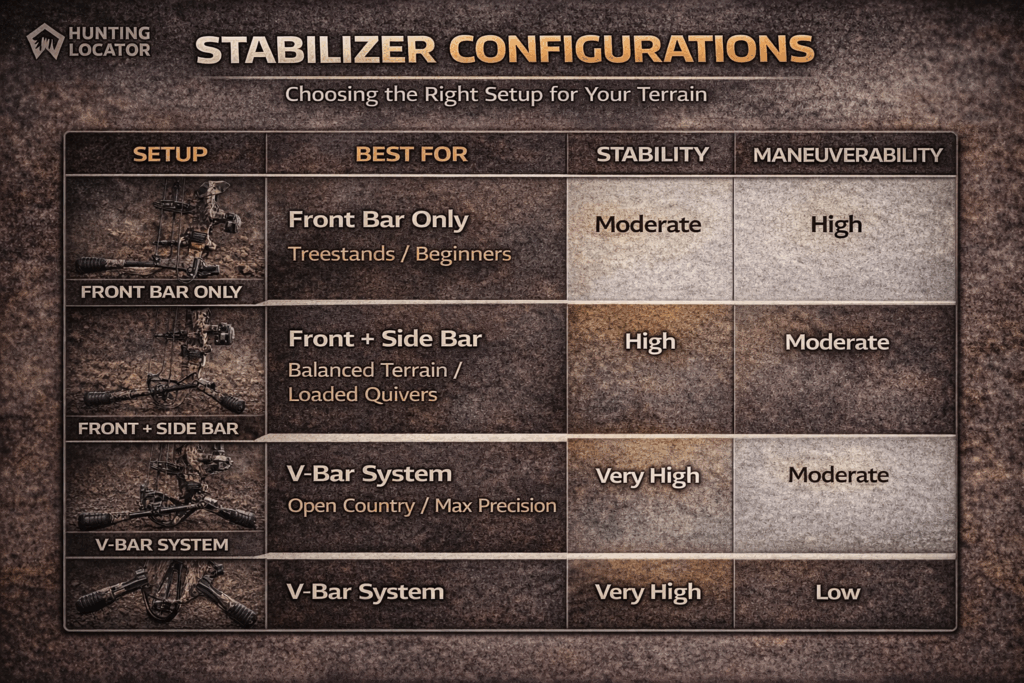
Configuration Comparison
| Configuration | Best For | Stability Level | Maneuverability | Complexity |
|---|---|---|---|---|
| Front Bar Only | Beginners, tight cover hunting | Moderate | High | Low |
| Front + Side Bar | Intermediate hunters, balanced terrain | High | Moderate | Medium |
| V-Bar System | Open country, maximum precision | Very High | Lower | Higher |
Most hunting experts suggest starting with a front bar and adding a side bar as you develop your preferences and shooting skills.
Selecting the Right Stabilizer for Your Hunt
Matching your gear to your specific hunting situation ensures the best performance and value.
Stabilizer Length: Finding Your Balance
Length is your primary decision point, directly affecting both stability and maneuverability in hunting situations.
For long-range western hunting, experienced hunters recommend using a front stabilizer between 12 and 15 inches in length. However, most hunters prefer keeping their stabilizers under 10″ for versatility in different hunting conditions.
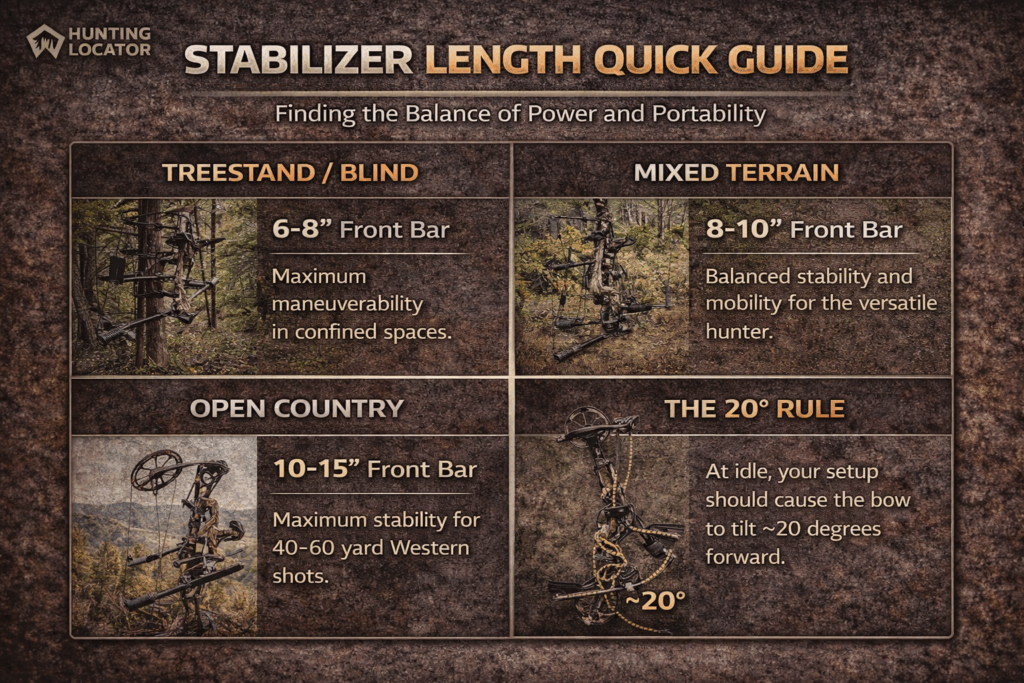
Stabilizer Length Quick Guide:
- Treestand/Blind Hunting: 6-8″ front bar for maximum maneuverability in confined spaces
- Mixed Terrain Hunting: 8-10″ front bar for balanced stability and mobility
- Open Country/Western Hunting: 10-15″ front bar for maximum stability at longer shots
Here’s something you can remember: the front bar should cause your bow to tilt about 20 degrees forward at idle, because your hand (the pivot point) sits below the center of the bow. This 20-degree benchmark gives you a concrete way to check whether your length choice is working.
Stabilizer Weight: Dialing In Your Setup
Weight at the stabilizer end increases moment of inertia—your bow’s resistance to rotation—which directly improves stability. Rotational resistance comes from the weight positioned out on the ends of the rods.
For optimal balance, experienced long-range hunters find that the bow aims best with three one-ounce weights on the front bar and two on the back. However, treat this as a starting point rather than a rule.
Be careful when adding weight: a common mistake is placing too much weight on the stabilizer, which can lead to decreased control and accuracy. Additionally, for those new to shooting long bars and weight, starting with 2-3oz on the front is recommended until building up muscle.
Materials: Carbon Fiber vs. Aluminum
Stabilizers are primarily made from carbon or aluminum, with carbon tending to be lighter and better at vibration dampening. For hunting applications, carbon fiber wins for its weight savings during long pack-ins and superior vibration dampening for stealth.
Ready to explore your options? Browse our bow stabilizer collection to find configurations that match your hunting style—from simple front bars to complete front-and-back setups.
Setting Up Your Stabilizer: A Step-by-Step Guide
This practical guidance comes from experienced bowhunters who understand that finding your optimal setup is a matter of learning your body and bow and going through trial and error.
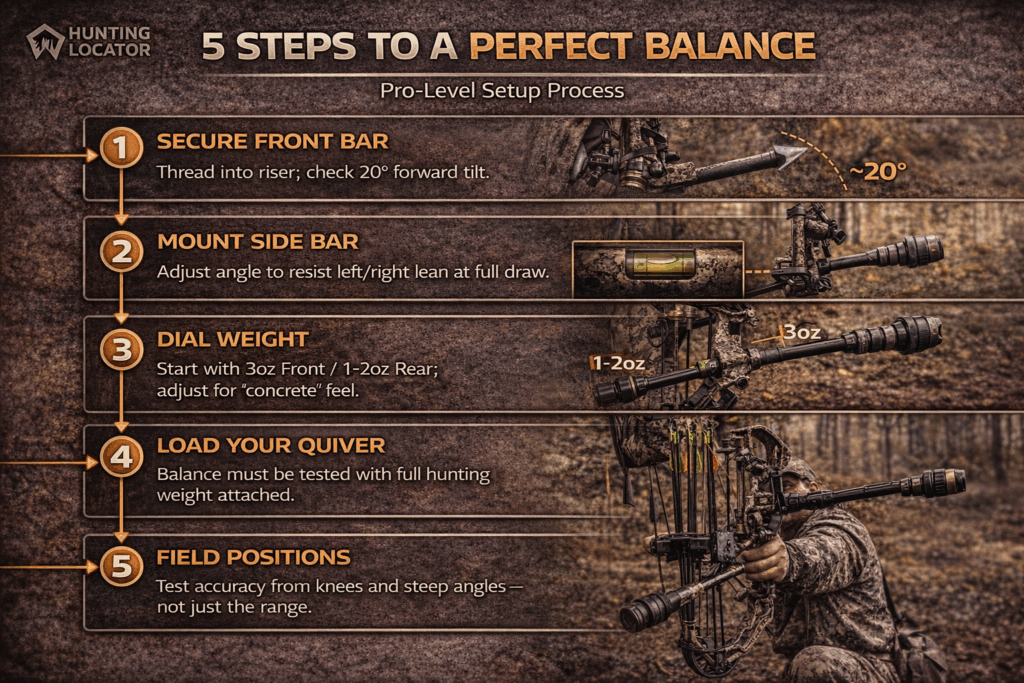
- Install Your Front Bar – Thread your front stabilizer directly into the standard 5/16-24 bushing on your bow’s riser. Make sure the connection is secure but don’t overtighten, which can damage the threads or riser.
- Check Initial Balance – Test your bow’s natural balance using the 20-degree benchmark. Hold your bow by the grip in the full-draw position and see how it naturally tilts. If your bow doesn’t tilt forward about 20 degrees, you may need additional weight on the front bar.
- Add Side Bar (If Using) – Mount your side bar bracket to the appropriate bushing on your riser, then attach the side bar at your chosen angle. The angle affects how the bar resists the bow leaning left or right at full draw.
- Fine-Tune Weight Distribution – If you run a front and back bar, experiment with weights until you find a combo that makes the bow feel like it’s sitting in concrete at full draw. Start with this basic formula: length of front stab times the weight, divided by the length of your back bar as your baseline.
- Test and Adjust – Advanced tuning involves adjusting weight on the front bar to correct up/down patterns, moving the back bar to correct left/right patterns. Practice at different distances to evaluate your setup.
Hunting-Specific Considerations
What experienced western hunters have learned about stabilizer use in the field goes beyond basic setup—it’s about adapting your configuration to real hunting scenarios.
Terrain and Hunting Style
Western Open Country: Born Hunting notes that shots are typically 40 yards and in, but open meadows can present longer opportunities. Longer stabilizers (12-15 inches) provide the stability needed for these extended-range shots.
Eastern Timber/Treestand: Shorter stabilizers maintain maneuverability in confined spaces. Consider that a quiver can upset the balance of the bow, and to level the bow you may have to muscle the grip counter-clockwise, which can result in mediocre shots. A properly configured back bar helps counteract this issue.
Mixed Terrain: The 8-10 inch range offers versatility for hunters who face different conditions throughout their season.
Practice Positions
Once you have your bow setup the key is to practice from all different types of shooting positions; knees, uphill, downhill, etc., because you don’t know what the west will throw at you. Your stabilizer setup should be tested in realistic hunting positions, not just standing flat on a range.
Transport and Field Considerations
Quick-disconnect systems prove their worth during actual hunts. A light, maneuverable bow that carries well in hand and can be lashed to a backpack is preferred for western hunting. Some hunters remove back bars during stalks and reattach before shooting.
For protecting your stabilizer setup during transport, explore our bow case collection designed to accommodate different stabilizer configurations.
Core Gear Checklist: Complete Your Hunting Setup
Your stabilizer is just one piece of a complete hunting system. Here’s how to make sure every component works together for maximum field performance.
Archery Accessories: The Foundation
Beyond your stabilizer, several accessories work together to create a precision hunting system:
Arrow Rests: Drop-away rests offer increased accuracy and better arrow flight, especially when shooting the longer yardages that might happen on your western hunt. Browse our arrow rest selection for options that complement your stabilizer setup.
Bow Sights: Precision sights become critical when your stabilizer enables longer, more accurate shots. Check our archery sights collection for hunting-specific options.
Release Aids: A quality release works with your stabilizer to minimize torque and improve consistency. Explore our bow release aids for options that match your shooting style.
Arrows and Broadheads: Completing the System
Your stabilizer setup must work with your complete arrow system. Quality arrows and broadheads are essential for realizing the accuracy benefits your stabilizer provides.
Practice and Preparation
Target Practice: Regular practice with your complete setup builds the muscle memory needed for field success. Our archery targets help you train at different distances.
Accessory Integration: A proper compound bow setup can go a long way toward helping you shoot more accurately and execute better shots in hunting situations. Browse our complete archery equipment collection to ensure every component works together.
More Resources from Hunting Locator
Expand your hunting knowledge and preparation with these additional resources:
- Complete Archery Equipment Guide – Everything you need for a complete bow hunting setup, from stabilizers to accessories
- Archery Accessories – Specialized gear to fine-tune your bow’s performance
- Bow and Crossbow Cases – Protect your investment during transport and storage
- Arrows, Points and Broadheads – Complete your arrow system for maximum accuracy
FAQ
What’s the best stabilizer length for a beginner bowhunter?
Start with an 8-10 inch front stabilizer for versatility. This length provides noticeable stability improvement without overwhelming maneuverability, making it ideal for learning proper form and building confidence. You can always upgrade to longer or add side bars as your skills develop.
How much should I expect to spend on a quality hunting stabilizer setup?
A good front stabilizer typically ranges from $50-150, with premium carbon fiber options at the higher end. Adding a side bar and mounting system can bring a complete setup to $150-300. Remember that stabilizers are a long-term investment that will work with multiple bows over many seasons.
Can I use the same stabilizer setup for both target practice and hunting?
While possible, most hunters benefit from slight modifications between practice and field use. Your hunting setup may need adjustments to account for a loaded quiver, different clothing, or field shooting positions. Practice with your exact hunting configuration whenever possible.
How do I know if my stabilizer weight is properly balanced?
Your bow should feel like it’s sitting in concrete at full draw when properly balanced. The bow should naturally tilt about 20 degrees forward when held by the grip, and your pin float should be minimal and controlled. If you’re fighting the bow or experiencing excessive fatigue, adjust your weight distribution.
Should I remove my stabilizers when traveling to hunt?
Quick-disconnect systems allow you to remove stabilizers for compact transport, then quickly reattach in the field. This is especially valuable for airline travel or backpack hunts where space is limited. Always verify your setup remains zeroed after reassembly.
What’s the difference between hunting and target archery stabilizers?
Hunting stabilizers prioritize portability, durability, and quick adjustment over maximum length and weight. They often feature camouflage finishes, quick-disconnect systems, and shorter lengths for maneuverability. Target stabilizers focus purely on maximum stability and precision, often with longer lengths and more weight.
The Final Shot
Proper stabilizer setup transforms your bow from a basic hunting tool into a precision instrument capable of ethical long-distance shots. Whether you’re preparing for your first western hunt or upgrading your existing setup, the principles covered in this guide will help you make confident decisions about your equipment.
Remember that stabilizers work as part of a complete system. The accuracy gains you achieve through proper stabilization are maximized when combined with quality accessories, proper practice, and thorough preparation.
Ready to gear up for your best hunting season yet? Visit our store today! We stock the best archery equipment, stabilizers, and accessories to ensure your success in the field.


