The quota clock starts ticking on August 15 with the archery opener, and every bear harvested across every zone counts against the same number. If you’re planning a 2026 California bear hunt and haven’t settled on your zone, land access, and timeline, you’re already behind.
This guide consolidates the official CDFW dates, tag costs, zone structures, and regulations so you can plan without digging through a stack of reg booklets — whether you’re a California resident confirming this year’s opener or an out-of-state hunter pricing out a first trip.
What’s covered:
- Exact 2026 season dates by method and zone, plus how the 1,700-bear statewide quota works in practice
- Resident and nonresident license and tag costs, plus education and post-harvest requirements
- Where to hunt — public land options, private leases through Hunting Locator, and guided hunt considerations
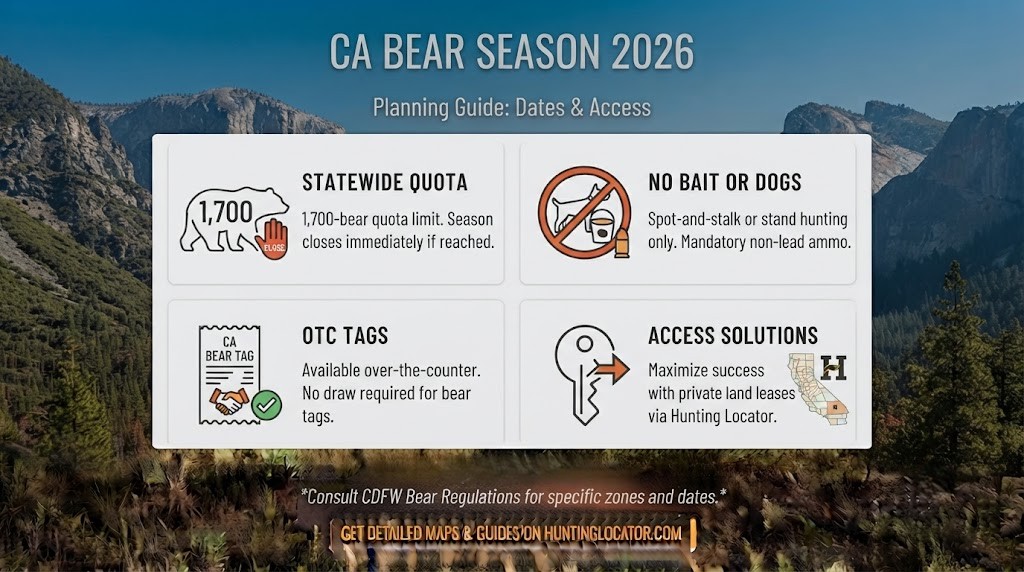
Quick Overview: 2026 California Bear Season at a Glance
California runs two distinct bear season structures — an archery season open statewide and a zone-based general season — both drawing from a single combined statewide quota managed by the California Department of Fish and Wildlife (CDFW). Understanding how those pieces fit together before you purchase a tag is the first step toward a legal, productive hunt.
| Season Type | Zones | Dates | Bag Limit |
|---|---|---|---|
| Archery (All Zones) | All bear hunt zones | Aug 15 – Sept 6, 2026 | 1 adult bear per season |
| General | A, B, C, D, X8, X9A, X9B, X10, X12 | Aug 29 – Dec 27, 2026 | 1 adult bear per season |
| General | X1, X2, X3a, X4, X6a, X6b, X7a, X7b | Oct 13 – Dec 27, 2026 | 1 adult bear per season |
Quota Notice: Per official CDFW regulations, the season closes early statewide if the 1,700-bear quota — archery and general seasons combined — is reached before December 27. Monitor the current harvest count at wildlife.ca.gov/Hunting/Bear or call (888) 277-6398.
These are the official 2026 regulations — always verify current details with CDFW before purchasing a tag.
Before you head out, confirm you have the licensing side handled. Every bear hunter needs:
- Hunting license — a valid California base hunting license is required before any tag purchase
- Bear tag — a separate over-the-counter purchase; one bear per hunter per season
- Hunter education — first-time hunters must complete certification before purchasing their first license; out-of-state certificates are recognized
- Non-lead ammunition — mandatory statewide for all hunting methods
- Legal methods only — spot-and-stalk, stand hunting over natural food sources, or calling; dogs and baiting are both prohibited under California law
California Bear Hunting Seasons
California structures its bear season around hunting method and deer-hunt zone boundaries, with every tag — archery or general — drawing from the same statewide pool. According to CDFW, the season can close the moment 1,700 bears are reported taken, so plan your hunt early and track harvest totals throughout the season.
Tags are easy to get, but success takes work. In 2024, only 808 bears were harvested despite more than 30,000 tags sold — a gap that reflects how much scouting, terrain knowledge, and preparation actually matter. Our full California bear hunting breakdown goes deeper on what drives those numbers. The general bear season also aligns with deer zone boundaries, which creates a practical combo-trip opportunity for hunters targeting both species on a single outing.

Archery Season (All Zones): Aug 15 – Sept 6, 2026
The archery season runs August 15 through September 6, 2026 across the entire black bear hunt area — a uniform three-week window that opens before any general zone comes online. Bears are actively feeding in late summer, patterns are predictable around food sources, and hunting pressure is minimal before the general season begins. All standard regulations apply: non-lead arrows, spot-and-stalk or stand hunting only, no baiting or dogs. Draw weights of 60 pounds or higher are recommended, paired with heavy arrows and broadheads designed for large game.
General Season — Zones A, B, C, D, X8, X9A, X9B, X10, X12: Aug 29 – Dec 27, 2026
The general season for Zones A, B, C, D, X8, X9A, X9B, X10, and X12 opens August 29 and runs through December 27, 2026 — nearly four months that offer real flexibility across the fall. Per our California hunting seasons research, these zones align directly with general deer season, so hunters can pursue both species on a single trip with the right licenses and tags. Confirm your specific zone boundaries using CDFW’s bear zones map before your season starts; zone lines don’t always follow county or landmark boundaries in ways that are easy to anticipate.
General Season — Zones X1, X2, X3a, X4, X6a, X6b, X7a, X7b: Oct 13 – Dec 27, 2026
For hunters in Zones X1, X2, X3a, X4, X6a, X6b, X7a, and X7b, the general season opens later, running October 13 through December 27, 2026. The later window suits hunters who prefer cooler fall and early winter conditions, and it can coincide with pre-hibernation feeding patterns when bears are pushing hard to add weight before denning. Regardless of your zone’s listed closing date, the 1,700-bear statewide quota applies universally — if it’s reached before December 27, all zones close immediately.
California Bear Licenses and Permits
Hunting black bear legally in California requires two separate purchases: a base hunting license and a bear-specific tag. Neither alone is sufficient. First-time hunters must also complete hunter education certification before purchasing any license.
California Hunting Licenses & Bear Tags
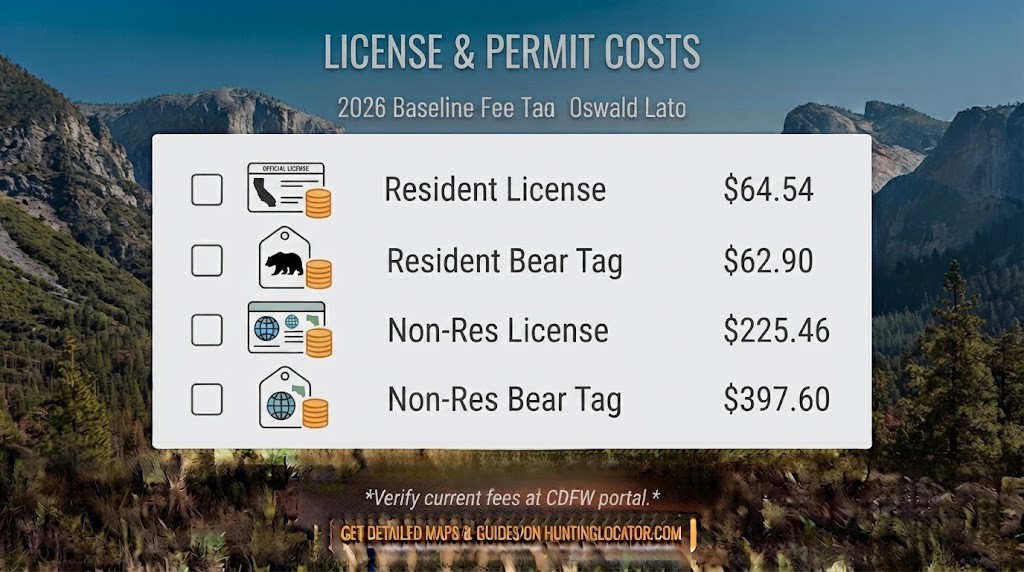
Bear tags in California are available over the counter — no draw, no lottery, no application deadline. Tags can be purchased online through CDFW’s licensing portal at ca.wildlifelicense.com or at any authorized license vendor statewide.
| Item | Resident | Nonresident |
|---|---|---|
| Hunting License | $65 | $225.46 |
| Bear Tag | $63 | $398 |
| Total | $127 | $623 |
The hunting license covers your legal right to hunt in California; the bear tag is a separate purchase on top of that. Only one bear may be taken per hunter per season regardless of tags purchased. Verify current fees directly on CDFW’s licensing portal before purchasing, as fees are subject to annual adjustment.
California Hunting Permits & Requirements
Hunter Education
First-time hunters must complete hunter education before purchasing any license. Proof of certification is required at point of purchase if you haven’t previously held a California hunting license. Out-of-state certificates from any state or province are recognized, which simplifies things for nonresident hunters already certified at home. Courses are available online and in person through CDFW-approved providers.
Post-Harvest Obligations
California’s post-harvest requirements are mandatory and time-sensitive. Know them before you head out:
- Tag validation — the bear tag must be countersigned by CDFW staff before transporting the animal, except when traveling to the nearest authorized validator en route home
- Premolar tooth submission — mandatory for CDFW age analysis; hunters must present the bear skull to a department representative for tooth extraction
- Harvest reporting — required whether successful or not, with a deadline of February 1, 2027; report online at ca.wildlifelicense.com
- Wanton waste law — all edible meat must be removed from the field; California law prohibits waste of bear meat, and selling bear parts is illegal
- Guide documentation — if using a licensed guide, the guide must provide their license number before the hunt, and the hunter must record it on the bear tag
For real-time quota tracking during the season, monitor wildlife.ca.gov/Hunting/Bear or call CDFW directly at (888) 277-6398.
Where to Hunt Bear in California
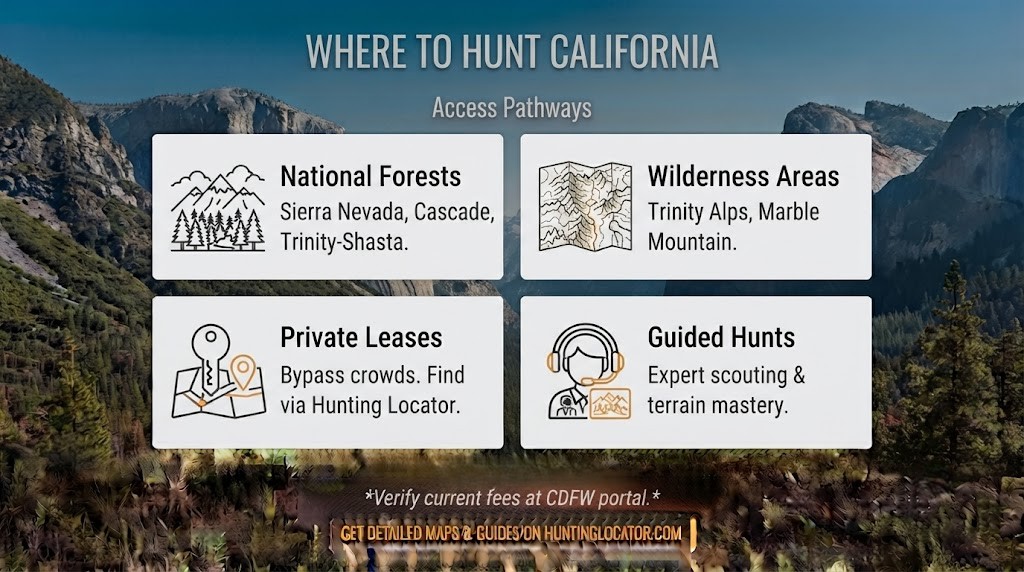
California’s black bear range stretches from the Oregon border south through the Sierra Nevada, Cascade Range, and coastal mountains — an estimated population of 25,000 to 40,000 animals spread across a varied and rugged landscape. Access to that range comes through three primary paths: public land, private land leases, and guided hunts.
Best Public Lands for California Bear Hunting
California’s public land network is extensive, and much of it sits within prime bear habitat. National Forests are the standard choice for big game like deer, bear, and wild turkey, while BLM lands serve desert and foothill hunting better. These regions consistently offer strong bear hunting opportunity:
- Sierra Nevada Range — consistently produces trophy-class black bears with mature boars reaching impressive sizes; areas near Lake Tahoe, the Mammoth Lakes region, and Yosemite’s periphery offer good access across Plumas, Eldorado, and Tahoe National Forests
- Northern California Wilderness Areas — the Trinity Alps and Marble Mountain Wilderness provide access to bears with minimal human contact; Zones C1, C2, and C3 cover Trinity, Siskiyou, and Shasta counties with remote forested terrain
- Shasta-Trinity National Forest — one of California’s largest national forests, with a mix of accessible trailheads and deep backcountry that concentrates bears around water and food sources
- Plumas National Forest — situated in the northern Sierra Nevada in prime Zone D country, with strong bear densities and good public road access for base-camp style hunts
- Mendocino National Forest — coastal range terrain with active bear populations and less hunting pressure than the more popular Sierra Nevada corridors
When hunting public land, focus your glassing on oak woodland hillsides, berry patches, and meadow edges during morning and evening feeding periods. Bears follow food, and hunters who put in scouting time before the opener consistently outperform those who show up cold.
Private Land Hunting with Hunting Locator
Public land is a reasonable starting point, but hunting property where you’ve had exclusive access to learn the terrain, travel corridors, and food sources is a different proposition. That’s the core advantage of leasing private land, and it matters more in California than in many states, where bear hunting is already a low-odds endeavor on the best ground.
Private land leases give you consistent, exclusive access throughout the season. You control the scouting timeline, run trail cameras without worrying about other hunters bumping your spots, and hunt ground that doesn’t absorb the same opening-week pressure as the nearest national forest trailhead. For nonresident hunters planning a single trip, that preparation window is difficult to replicate on public ground.
Hunting Locator connects hunters with landowners willing to lease or sell hunting land across the country, and California is well represented. Browse available properties by location, acreage, and game type, contact landowners directly, and secure access well ahead of the August opener. Browse current California hunting leases on Hunting Locator to find private land options that match your target zone, budget, and hunt style. For hunters thinking longer-term, Hunting Locator also connects buyers with landowners selling California hunting properties — worth exploring if you’re building a permanent base for bear and deer hunting in the state.
Guided Hunts
For nonresident hunters unfamiliar with California’s zone system — or anyone new to bear hunting — a guided hunt is an efficient way to get on productive ground from the start. Professional outfitters provide real value for hunters working through California’s zone structure, particularly those pursuing mature animals.
Guided bear hunts typically focus on spot-and-stalk methods in the Sierra Nevada and Northern California ranges, where outfitters have developed glassing points, food source locations, and bear movement patterns over multiple seasons. Full-service operations generally include lodging and meals alongside guide services. When evaluating a California bear hunting outfitter, look for:
- CDFW licensing — your guide must hold a valid California guide license, and you are legally required to record their license number on your bear tag
- Zone-specific experience — ask which zones the outfitter hunts and what their success rates have been in recent seasons
- Transparent method disclosure — all California bear hunting is spot-and-stalk or stand hunting; no outfitter can legally offer baited hunts or hound hunting
- References and reviews — a reputable guide will have verifiable hunter testimonials and a track record of compliant operations
Hunting Locator’s California hunting overview includes outfitter and guide resources for hunters looking to connect with experienced professionals in the state.
Bear Hunting Tips for California Success
California’s statewide ban on using dogs, prohibition on baiting, and mandatory non-lead ammunition create a demanding environment that rewards preparation, physical fitness, and patience. These are the habits and tools that tend to separate successful hunters from those who tag out on nothing:
- Glass first, move second — the most productive method for finding bears is extensive glassing of oak woodland hillsides, berry patches, and meadow edges during morning and evening feeding periods; spend more time behind glass than on your feet; a quality rangefinding binocular from the Hunting Locator store is worth the investment in this terrain
- Find the food, find the bear — bears follow predictable patterns based on food availability, water sources, and security cover; oak mast, berry patches, and riparian corridors are your primary scouting targets; adjust focus as food sources shift through the season
- Run trail cameras early — cameras provide useful intelligence about bear size, movement patterns, and preferred travel times; get them on food sources and water at least four to six weeks before your hunt; browse cellular trail camera options at the Hunting Locator store to monitor locations remotely without burning your spots
- Read fresh sign constantly — look for fresh tracks, scat, claw marks on trees, and feeding areas; bears will flip rocks and tear apart logs looking for insects, and the freshness of those disturbances tells you how recently they passed through
- Get physically ready for the terrain — California’s bear hunting favors physically prepared hunters, especially in the Sierra Nevada and Northern California wilderness zones where successful stalks often involve serious elevation gain and dense brush; start conditioning well ahead of the August opener
- Choose the right rifle and ammunition — popular calibers include .30-06, .300 Winchester Magnum, and .338 Winchester Magnum, all paired with non-lead projectiles as required by state law; check the Hunting Locator store for non-lead ammunition options and rifle accessories suited for Western big game
- Commit to a zone and learn it — picking an area and getting to know it well rather than bouncing around consistently produces better results; study topographic maps, identify travel corridors between bedding and feeding areas, and hunt the same ground multiple times before drawing conclusions about bear activity
- Know your post-harvest obligations before you shoot — tag validation, tooth submission, and harvest reporting are all mandatory and time-sensitive; review the requirements in the licenses section of this guide before the season opens so you’re not scrambling after a successful stalk
More Resources from Hunting Locator
Hunting Locator covers California hunting planning from season dates and land access to gear and guided hunts. The resources below are most relevant to California bear hunters and the broader hunting opportunities the state offers:
- Hunting in California — Complete Overview — a broad introduction to California hunting covering public land access, zone structures, license requirements, and what out-of-state hunters need to know before their first trip
- California Bear Hunting Season — a dedicated look at California black bear hunting, including historical harvest data, zone breakdowns, and tactical considerations beyond what a season-dates guide covers
- California Hunting Leases — browse available private land hunting leases in California by location and game type; the most direct tool for securing exclusive bear hunting access ahead of the August opener
- Hunting Locator Gear Store — optics, trail cameras, ammunition, and field gear selected for Western big game hunters
- California Deer Hunting Season — since general bear seasons in Zones A, B, C, D, and key X zones align with deer season, this guide is a useful companion for planning a combo hunt
- California Elk Hunting Season — limited elk hunting opportunity worth knowing about for hunters exploring California’s full big game calendar
- California Wild Pig Hunting Season — wild pigs are huntable year-round in California with the right license and tag, making them a practical addition to any bear hunting trip
- California Turkey Hunting Season — spring and fall turkey seasons for hunters who want to extend their time in the state
- California Upland Game Hunting Season — quail, pheasant, dove, and other upland birds provide additional opportunity through the fall and winter
- California Waterfowl Hunting Season — California’s Central Valley is one of the premier waterfowl destinations in the country; this guide covers duck and goose season timing and zone structure
- California Pronghorn Hunting Season — limited draw pronghorn tags are available in select northeastern California units for hunters willing to invest in the application process
- California Bighorn Sheep Hunting Season — California offers some of the most sought-after desert and Sierra bighorn sheep tags in the West for those playing the long-odds draw game
Frequently Asked Questions
When does the 2026 California bear season open?
The earliest opportunity is the archery season, which opens August 15, 2026 across all bear hunt zones statewide. The general season opens August 29 for Zones A, B, C, D, X8, X9A, X9B, X10, and X12, and October 13 for Zones X1, X2, X3a, X4, X6a, X6b, X7a, and X7b. All seasons run through December 27, 2026, or until the 1,700-bear statewide quota is filled — whichever comes first.
How does the 1,700-bear quota work, and has it ever closed the season early?
The 1,700-bear quota applies to archery and general seasons combined. Since California banned the use of dogs for bear hunting in 2013, the quota has not been met in any season. In 2024, only 808 bears were harvested despite more than 30,000 tags sold. The quota remains the legal trigger for early closure, so monitor real-time harvest totals at wildlife.ca.gov/Hunting/Bear throughout the season.
Do I need to enter a draw to get a California bear tag?
No. Bear tags are available over the counter for both residents and nonresidents — no draw, no lottery, no application deadline. Purchase a base hunting license and a bear tag, and you’re legal to hunt in your zone during the open season. Tags can be purchased online through CDFW’s licensing system at ca.wildlifelicense.com or at any authorized license vendor.
What does it cost for a nonresident to hunt bear in California in 2026?
The total licensing cost for a nonresident is $623.06 — a $225.46 nonresident hunting license plus a $397.60 nonresident bear tag. That covers your legal authorization to hunt; travel, gear, and land access are separate. The nonresident bear tag is among the higher-priced in the western states, but California’s large public bear population and over-the-counter access make it a workable destination hunt.
What are the legal methods for hunting bear in California?
Using dogs to track or tree bears has been illegal in California since 2013, and baiting is also prohibited. All bear hunting must be conducted via spot-and-stalk, stand hunting over natural food sources, or calling. Non-lead ammunition is mandatory statewide for all hunting methods, including archery equipment. These restrictions apply equally to residents, nonresidents, and guided hunters.
What do I need to do immediately after harvesting a bear?
Per CDFW regulations, you must immediately complete and notch the bear tag and attach it to the bear’s ear. You cannot transport the bear until the tag has been countersigned by a CDFW employee — with the limited exception of traveling to the nearest authorized validator en route home from the field. Following validation, you must submit to a premolar tooth extraction for age analysis and report your harvest by February 1, 2027 at ca.wildlifelicense.com, whether successful or not. All edible meat must be removed from the field, and selling bear parts in California is illegal.
Closing Notes
California’s no-dogs, no-bait restrictions and mandatory non-lead ammunition requirement put the outcome squarely on the hunter’s preparation. Every bear taken here comes from glassing, scouting, physical conditioning, and knowing the ground — not from shortcuts. If you’re building a 2026 season plan, start with your zone, confirm your land access early, and give yourself enough time to scout before August 15.
Browse available California hunting leases on Hunting Locator to find private ground that fits your target zone and budget. Locking in access now gives you the scouting time that opening-day success usually requires.


