With fewer than a thousand bighorn tags issued annually across the entire United States, California’s allocation is among the most restricted big-game opportunities in the country.
This guide covers the 2026 season dates, zone breakdowns, licensing costs, the draw process, and hunting access across public and private land — whether you’re a California resident watching the draw calendar or a non-resident planning a western trip. The California Department of Fish and Wildlife (CDFW) governs all regulations, dates, and fees; we’ll point you there throughout for official verification.
Here’s what this guide covers:
- The exact 2026 season dates for Zone 1–9 hunts and the specialized Newberry/Rodman/Ord hunt periods
- The draw process, June 2 application deadline, and full fee breakdown for both residents and non-residents
- Where to hunt — public land zones, private lease access through Hunting Locator, and guided hunt options
Quick Overview: California Bighorn Sheep Season at a Glance
| Species | Season Type | Dates | Bag Limit |
|---|---|---|---|
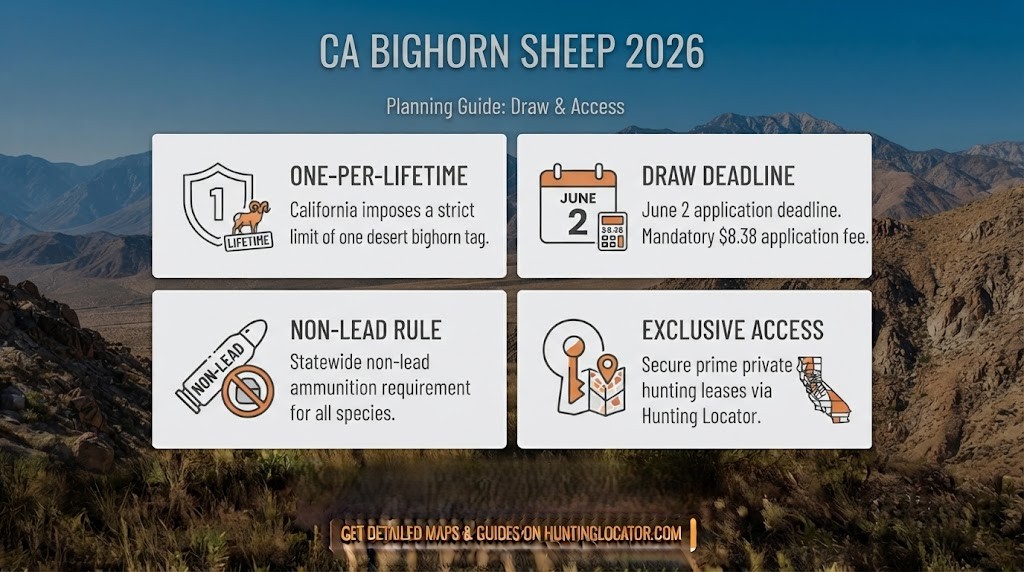
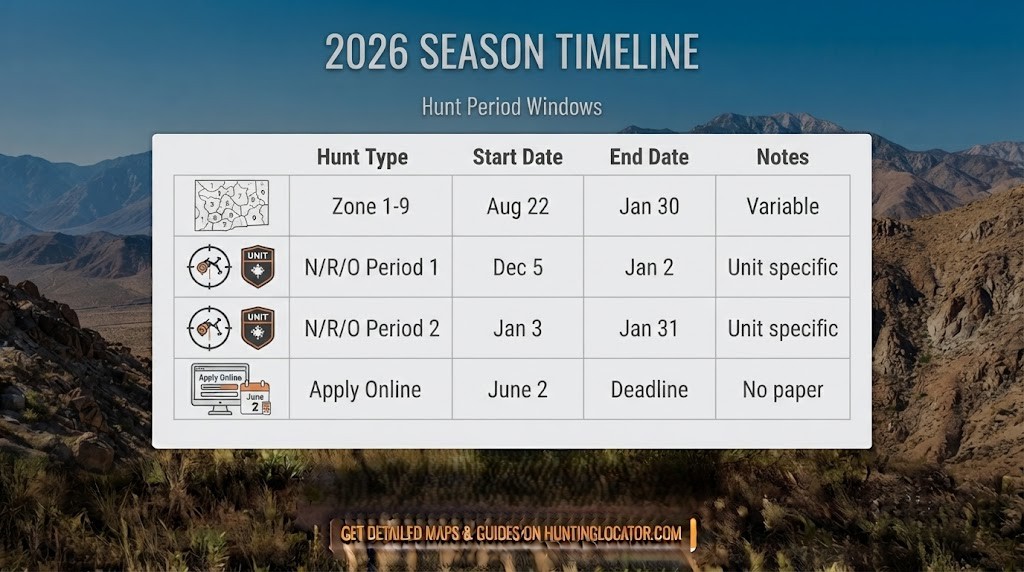
| Desert Bighorn Sheep | Zone 1–9 Hunts | Aug 22, 2026 – Jan 30, 2027 | 1 per lifetime |
| Desert Bighorn Sheep | Newberry/Rodman/Ord — Period 1 | Dec 5, 2026 – Jan 2, 2027 | 1 per lifetime |
| Desert Bighorn Sheep | Newberry/Rodman/Ord — Period 2 | Jan 3 – Jan 31, 2027 | 1 per lifetime |
Two rules worth keeping front of mind: every California Desert Bighorn tag carries a one-per-lifetime bag limit — draw one, harvest one, and you’re done in California permanently. California also enforces a statewide non-lead ammunition requirement; lead cannot be used anywhere in the state for any species, including bighorn sheep.
Always verify tag counts and dates against the final CDFW Big Game Digest before submitting your application.
License, Permit & Education Requirements
Before you can apply for a California bighorn sheep tag, you’ll need the following:
- Hunter education certification — All first-time hunters in California must complete a hunter education course before purchasing a license. The online portion takes 4–6 hours, followed by a 4-hour in-person session. Hunters who hold a valid license from another state may qualify for an exemption.
- A valid California annual hunting license — Required to enter any CDFW big game draw; must be in hand before you submit your application.
- A drawing application with the $8.38 non-refundable application fee — Paid at application regardless of draw outcome.
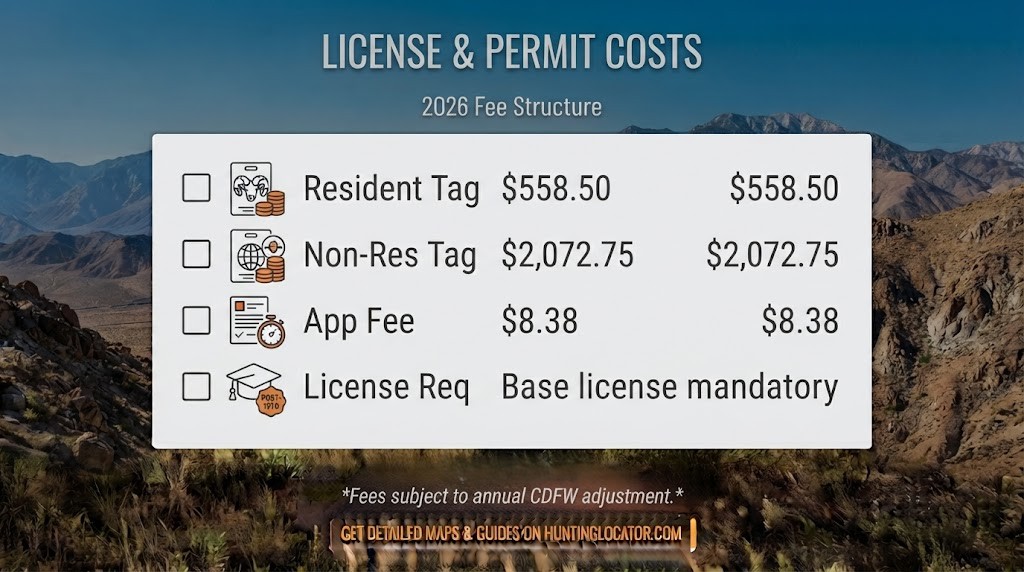
- The bighorn sheep tag fee — Paid only if drawn. Resident tag fee: $558.50. Non-resident tag fee: $2,072.75. Full details in the Licenses & Permits section below.
Desert Bighorn Sheep are a subspecies native to California’s dry southeastern mountain ranges. Tags are issued through a competitive draw — not over the counter — because demand far outweighs supply and the animals are managed conservatively. The one-per-lifetime limit applies to both residents and non-residents.
California Bighorn Sheep Hunting Seasons
California’s 2026 Desert Bighorn Sheep season runs from late summer through January 2027 across zone-specific and unit-specific hunt periods. Which dates apply depends entirely on which zone or unit you draw, so understanding the structure before you apply helps you select the right opportunity for your schedule, fitness level, and goals.
Zone 1–9 Hunts
The Zone 1–9 hunts run from August 22, 2026 through January 30, 2027, with a bag limit of 1 per lifetime.
These zone hunts cover the widest range of terrain, access, and timing across the state. Some California sheep hunts take place at elevations over 10,000 feet in extremely rugged country, so physical fitness is a genuine factor in zone selection — apply only to units that match your actual capability. Your zone determines both where you’re legally authorized to hunt and when your season opens and closes, so this decision shapes every aspect of the hunt.
California’s desert bighorn habitat spans open desert valleys, ridges, and eroded canyons with deep, often extremely long washes — terrain that demands quality optics, physical endurance, and careful pre-hunt scouting regardless of which zone you draw.
Newberry/Rodman/Ord — Period 1
The first specialized hunt period for the Newberry, Rodman, and Ord units runs December 5, 2026 through January 2, 2027, with the same 1 per lifetime bag limit.
For hunters targeting rams scoring 175″ or better, the Newberry, Rodman, and Ord units are consistently worth monitoring. Period 1 puts you in the field during early winter — cooler conditions that make glassing and physical pursuit more manageable than the peak summer heat of the early zone openers.
Newberry/Rodman/Ord — Period 2
The second window for these same units runs January 3 through January 31, 2027, with a 1 per lifetime bag limit.
| Hunt Unit | Period | Dates | Bag Limit |
|---|---|---|---|
| Newberry/Rodman/Ord | Period 1 | Dec 5, 2026 – Jan 2, 2027 | 1 per lifetime |
| Newberry/Rodman/Ord | Period 2 | Jan 3 – Jan 31, 2027 | 1 per lifetime |
Period 2 offers a later winter option in the same units — useful for hunters whose schedules don’t align with the earlier window. Verify your preferred period against the final CDFW Big Game Digest before applying, as permit allocations can vary between periods.
California Bighorn Sheep Licenses and Permits
Securing a California Desert Bighorn tag is a two-step process: first, you need a valid base hunting license to enter the draw; then, if selected, you pay the tag fee. CDFW manages the entire process from application through tag issuance.
California Hunting Licenses
Every applicant must hold a valid California annual hunting license before submitting a bighorn sheep draw application. The tag fee is only due if you draw, but the license is a prerequisite regardless of outcome.
| Fee Type | Resident | Non-Resident |
|---|---|---|
| Drawing Application Fee | $8 | $8.38 |
| Bighorn Sheep Tag Fee | $559 | $2,073 |
Non-residents face an additional constraint beyond the higher tag fee: they are capped at up to 10% of total bighorn sheep tags issued statewide. With only 29 tags available, that means non-residents are competing for a single-digit allocation — roughly two or three slots in the entire draw.
Always confirm final 2026 fee amounts against the CDFW Big Game Digest before applying, as fees are subject to adjustment. California’s statewide non-lead ammunition requirement applies to bighorn sheep hunting, so plan your ammunition selection before the season opens.
California Bighorn Sheep Permits & the Draw Process
The application deadline for the 2026 California bighorn sheep draw is June 2, 2026. Missing this window means waiting another full year — and another year without accumulating a preference point.
California’s bighorn sheep tags are issued through a limited-entry drawing because demand far outweighs supply and CDFW manages permit allocation conservatively to protect the population. Most applicants don’t draw in any given year, which is what makes the tag worth something when they do.
California uses a modified preference point system where unsuccessful applicants earn one preference point per species for each year they apply, giving returning applicants a statistical edge over first-time entrants. Points are species-specific — not tied to a particular zone or weapon type — so your bighorn sheep points accumulate regardless of which zone you apply to each year.
Applications can be submitted online through CDFW’s license sales portal, through the CDFW License App, at authorized license agents and select license offices, or by phone through CDFW telephone sales. The $8.38 application fee is non-refundable regardless of draw outcome.
The one-per-lifetime rule has a specific strategic implication: once you harvest a California Desert Bighorn, you are permanently ineligible to draw again in this state. For non-resident hunters pursuing a North American sheep slam, this makes your California draw attempt a once-and-done commitment. California bighorn sheep are one of four huntable bighorn subspecies — alongside Rocky Mountain, desert, and Baja — that make up the full scope of North American sheep hunting opportunities. Choose your application zone carefully.
All permit holders must submit a mandatory harvest report, whether they harvest an animal or not. Failure to report is a regulatory violation — build this into your post-hunt checklist.
Where to Hunt California Bighorn Sheep
Best Public Lands for California Bighorn Sheep
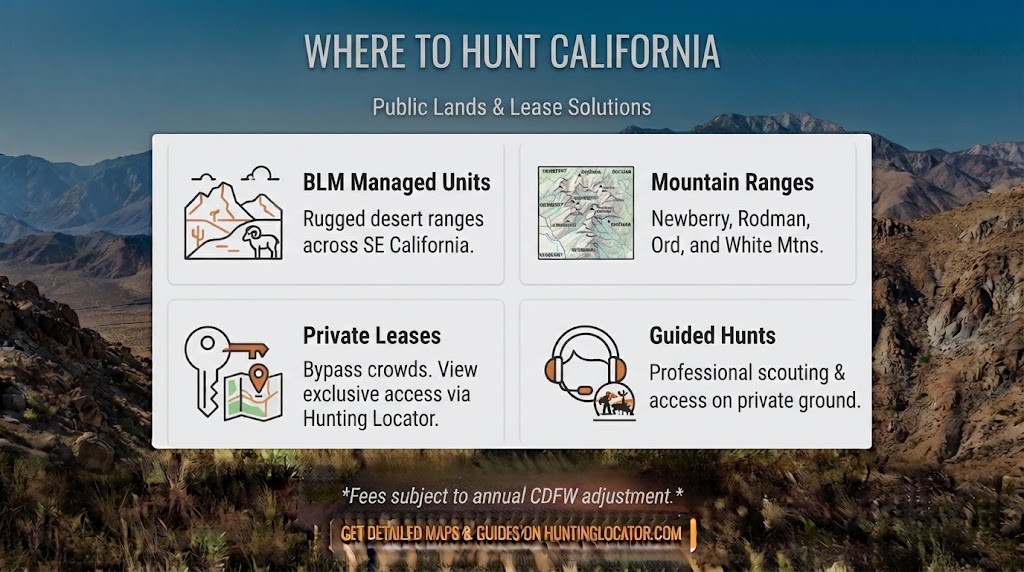
Most of California’s bighorn sheep zones overlap with Bureau of Land Management (BLM) and other federally managed public lands across the state’s southeastern desert ranges. This habitat encompasses open desert valleys, ridges, eroded canyons, and deep washes — navigable on foot but demanding serious preparation.
Key public land areas associated with California’s bighorn sheep zones include:
- Clark and Kingston Ranges — Known for producing rams scoring 175″ or better, this is one of California’s premier bighorn units within BLM-managed desert terrain
- San Gorgonio Mountains — A high-trophy-potential zone with sheep occupying rugged mountain terrain accessible via public land
- Newberry, Rodman, and Ord Mountains — Three connected unit areas in the Mojave Desert frequently monitored for mature rams
- White Mountains — Capable of producing 170″ rams but widely considered one of California’s most physically demanding sheep hunts, with elevations that challenge even experienced backcountry hunters
- Mojave National Preserve Area (Zones 11–13) — Three newly adopted hunt zones between I-15 and I-40 — Granite and North Bristol, Providence/Woods/Hackberry, and Castle Mountains/Piute Range — represent the first new desert bighorn zones since 2019, with the latter two offering potential for Boone and Crockett-class rams
Dispersed camping is permitted in BLM areas as long as the site has been previously used as a camping area, giving hunters flexibility for multi-day glassing and scouting operations in remote terrain.
Private Land Hunting with Hunting Locator
Public land is accessible, but private land hunting offers controlled access, reduced pressure, and the ability to build familiarity with a specific piece of ground before your season opens. On a once-in-a-lifetime tag, that kind of access has real practical value.
Leasing private land gives you exclusive hunting rights for a defined period. You pay a negotiated fee to a landowner in exchange for access — no competing pressure from other hunters, and the ability to invest in pre-season scouting without worrying about who else is on the property.
Hunting Locator is a platform that connects hunters directly with landowners willing to lease or sell their land for hunting. Instead of cold-calling landowners or relying on word-of-mouth leads, you can browse verified California hunting properties, contact landowners directly, and secure access well before the season opens.
Browse current California hunting leases on Hunting Locator to find private land opportunities in or near California’s bighorn sheep zones.
Guided Hunts
For many Desert Bighorn tag holders — especially first-timers and non-residents unfamiliar with California’s remote sheep terrain — a guided hunt is a meaningful investment in a successful outcome.
Pre-season scouting is the key to a successful hunt, and professional guides conduct ample pre-season scouting as a core part of their service. When you arrive in camp, you’re not starting from scratch — your guide already knows where rams are moving, where water sources concentrate sheep, and which drainages to glass first.
Dry Creek Outfitters is one example of a fully licensed, bonded, insured, and permitted professional guiding service specializing in Trophy Desert Bighorn Sheep hunts in California, with additional offerings for mule deer, elk, and pronghorn. Ambler’s Bighorn Guiding offers California bighorn hunts at elevations between 1,500 and 3,000 feet in areas that require minimum physical ability compared to higher-elevation zone hunts, and their hunts generally take less than a week to harvest an animal — a reasonable option for hunters who want a genuine sheep experience without the extreme physical demands of the highest-elevation zones. Huntin’ Fool also works directly with sheep guides in California and recommends calling their consultation team if you draw a Desert Bighorn permit.
When evaluating a guide or outfitter for a once-in-a-lifetime California bighorn tag, look for:
- Full licensing, bonding, and insurance with CDFW compliance
- Documented pre-season scouting in your specific unit
- Verifiable references from previous bighorn tag holders
- Clear understanding of zone-specific terrain and sheep behavior
- Transparent pricing with a detailed breakdown of what’s included
California Bighorn Sheep Hunting Tips
- Glass first, move second. Desert bighorn country rewards patience over miles. Invest in quality optics and spend the majority of your time behind a spotting scope or binoculars before committing to a stalk — rams blend into rocky terrain well, and moving too early ends stalks before they begin. Find quality optics at the Hunting Locator store.
- Match your zone to your fitness level. Some California bighorn hunts occur at elevations above 10,000 feet in genuine backcountry terrain. Apply to zones that match your honest physical capability and train specifically for elevation if you’re targeting high-country units.
- Use non-lead ammunition — no exceptions. Non-lead ammunition is mandatory for all hunting with firearms throughout California. Test your loads well before the season to confirm accuracy at hunting distances.
- Scout before the opener. Pre-season scouting is the key to a successful hunt. Whether you hire a guide or put in your own time on the ground, knowing where sheep move, where they water, and which drainages hold rams before opening day is the single biggest advantage you can give yourself.
- Prepare for long-range shots. California’s open desert and mountain terrain often demands shots at extended distances. Practice from field positions in uneven terrain — not just from a bench — at realistic hunting ranges. The Hunting Locator store carries long-range shooting equipment suited to western big-game hunting.
- Plan for mandatory harvest reporting. All bighorn sheep permit holders must submit a harvest report, regardless of whether an animal was taken. Build this into your post-hunt plan before you leave the field.
- Evaluate every ram carefully before you shoot. On a once-in-a-lifetime tag, shot selection carries weight that doesn’t apply to any other hunt. Take the time to assess age, mass, spread, and curl before committing.
More Resources from Hunting Locator
- Hunting in California — A broad overview of California hunting opportunities, regulations, and planning considerations for residents and non-residents
- California Bighorn Sheep Hunting Season — Hunting Locator’s dedicated bighorn sheep resource page for additional season information and planning tools
- California Deer Hunting Season — Detailed guide to California deer hunting, a natural complement for hunters pursuing multiple species in the state
- California Elk Hunting Season — California’s tule elk hunting guide for hunters interested in pursuing multiple big-game species
- California Pronghorn Hunting Season — Pronghorn season dates, zones, and planning information for another of California’s limited-entry species
- California Bear Hunting Season — Season guide for California black bear hunting, a more accessible big-game pursuit while building bighorn preference points
- California Wild Pig Hunting Season — Year-round opportunity guide for wild pig hunting, one of California’s most accessible big-game pursuits
- California Upland Game Hunting Season — Season dates and regulations for quail, pheasant, and other upland species
- California Turkey Hunting Season — Spring and fall turkey season guide for California hunters
- California Waterfowl Hunting Season — Duck and goose season guide for California’s productive waterfowl zones
- California Hunting Leases on Hunting Locator — Browse available private land leases in California for bighorn sheep or any other California species
- Hunting Locator Store — Optics, hunting equipment, and accessories for western big-game hunting
FAQ
How many California Desert Bighorn Sheep tags are available in 2026?
Currently, 29 Desert Bighorn Sheep tags are listed as available statewide for the 2026 season. Note that three new hunt zones — Zones 11, 12, and 13 — were adopted by the California Fish and Game Commission for the 2026–27 season in the Mojave National Preserve area, which may affect final tag allocation. Verify the final total against the CDFW Big Game Digest before applying.
What is the application deadline for the 2026 California bighorn sheep draw?
The application deadline is June 2, 2026. Missing it means waiting until the following year’s draw cycle with no exceptions. Submit your application with the $8.38 non-refundable fee through CDFW’s online portal, the CDFW License App, an authorized license agent, or by phone through CDFW telephone sales.
Can a non-resident draw a California bighorn sheep tag?
Yes, but the opportunity is extremely limited. Non-residents are capped at up to 10% of total bighorn sheep tags issued statewide, meaning with 29 tags available, non-residents are competing for roughly two or three slots in the entire draw. The non-resident tag fee is $2,072.75 if drawn, plus the cost of a California non-resident hunting license.
What does the one-per-lifetime bag limit mean for bighorn sheep in California?
You may only draw and harvest one California bighorn sheep tag in your lifetime. Once you’ve filled a California bighorn tag, you are permanently ineligible to draw again in this state. This applies to both residents and non-residents.
Do I need hunter education to apply for a California bighorn sheep tag?
Yes, if you are a first-time hunter in California. All first-time hunters must complete a hunter education certification before purchasing a California hunting license, which is a prerequisite for entering the bighorn sheep draw. Hunters who already hold a valid hunting license from another state may qualify for an exemption — contact CDFW directly to confirm your eligibility before the June 2 deadline.
How does the California preference point system work for bighorn sheep?
California uses a modified preference point system where unsuccessful applicants earn one preference point per species for each year they apply. Points are species-specific — your bighorn sheep points don’t carry over to elk or pronghorn, and they aren’t tied to a specific zone or weapon type. Accumulated points improve your statistical odds over time, though with only 29 total tags available, competition remains intense regardless of point total.
The Final Shot
A California Desert Bighorn tag is among the rarest tags in North American hunting. With 29 tags statewide, a June 2 application deadline, and a one-per-lifetime bag limit, there’s little margin for casual preparation. The hunters who succeed plan early, apply consistently to build preference points, choose their zone with care, and arrive in the field ready for what California’s sheep country actually requires.
Get your California hunting license in hand, submit your draw application before June 2, and start building your access plan now — not after you draw. Browse California hunting leases on Hunting Locator to explore private land options in sheep country, and check the Hunting Locator store to start assembling the optics and gear this kind of hunt demands.


