Picture this: while hunters across the western states are still counting down weeks until their seasons open, you’re already tracking blacktail through California’s coastal redwoods on July 11th. Zone A’s archery opener gives you a massive head start on deer season, but here’s where things get tricky. California’s zone system looks like it was designed by someone who really, really loves complicated puzzles. Miss that April 15–June 2 draw window? You’re sitting out premium tags for an entire year.
Look, I’ve watched too many hunters get lost in California’s maze of zones, subzones, and preference points. They end up frustrated, confused, and sometimes hunting the wrong zone entirely. This guide cuts through all that noise and gives you exactly what you need to plan a killer 2026 deer hunt.
You’ll get the real deal on all five major hunting zones (A, B, C, D, X), the actual costs that matter, and where to find deer without fighting crowds on every piece of public land. Plus, I’ll show you how to navigate California’s preference point system without losing your mind or your points.
Here’s what we’re covering:
- Zone-by-zone season dates and bag limits that actually make sense
- The true cost breakdown for residents and non-residents (spoiler: it’s not cheap)
- Public land alternatives and private access options that produce results
Let’s jump into the zone breakdown first, then we’ll tackle the money side of things.
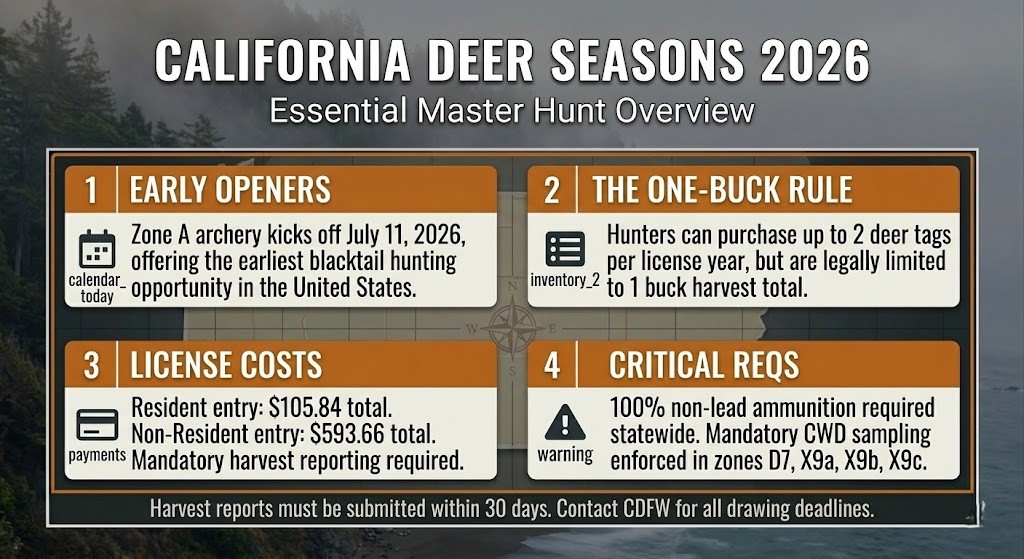
Quick Overview of California Deer Season 2026
California splits deer hunting into five zones that reflect the state’s crazy geographic diversity. Zone A kicks things off in July with coastal blacktail, while Zone D stretches the party through November 1st. Each zone has its own personality, from fog-soaked redwood groves to high-desert mule deer country where trophy bucks disappear into vast landscapes.
The zone system follows Section 360 and 361 of California Code of Regulations Title 14, which basically means the state has very specific ideas about where you can hunt what.
| Zone | Season Type | Start Date | End Date | Bag Limit | Notes |
|---|---|---|---|---|---|
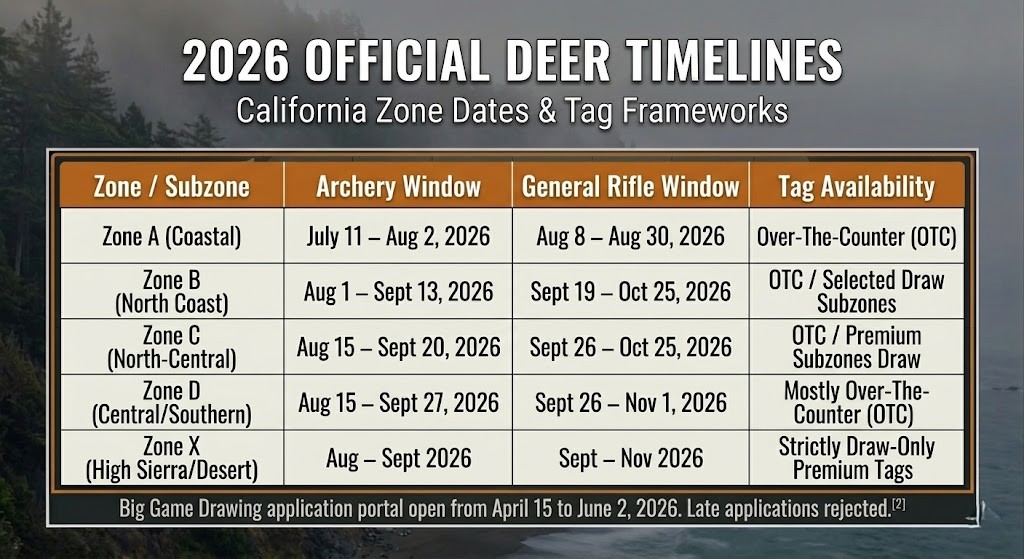
| Zone A (Coastal) | Archery | July 11, 2026 | Aug 2, 2026 | 1 buck per tag | Earliest CA season; blacktail deer |
| Zone A (Coastal) | General Rifle | Aug 8, 2026 | Aug 30, 2026 | 1 buck per tag | OTC tags available |
| Zone B (North Coast) | Archery (B1-B6) | Aug 1, 2026 | Sept 13, 2026 | 1 buck per tag | True blacktail country |
| Zone B (North Coast) | General Rifle (B1-B6) | Sept 19, 2026 | Oct 25, 2026 | 1 buck per tag | Some subzones draw-only |
| Zone C (North-Central) | Archery (C1-C4) | Aug 15, 2026 | Sept 20, 2026 | 1 buck per tag | Mixed blacktail/mule deer |
| Zone C (North-Central) | General Rifle (C1-C4) | Sept 26, 2026 | Oct. 25, 2026 | 1 buck per tag | Some premium tags draw-only |
| Zone D (Central/Southern) | Archery (D3-D19) | Aug. 15, 2026 | Sept 27, 2026 | 1 buck per tag | Largest zone; mostly OTC |
| Zone D (Central/Southern) | General Rifle (D3-D19) | Sept 26, 2026 | Nov. 1, 2026 | 1 buck per tag | Latest rifle season |
| Zone D7 | Special Archery | Aug. 18, 2026 | Sept 9, 2026 | 1 buck per tag | CWD mandatory sampling |
| Zone X (High Sierra/Desert) | Archery | Aug–Sept 2026 | Sept–Oct 2026 | 1 buck per tag | Premium mule deer; draw-only |
| Zone X (High Sierra/Desert) | General Rifle | Sept–Nov 2026 | Oct–Nov 2026 | 1 buck per tag | Trophy potential; preference points |
Before you even think about hitting the field, you need these basics locked down:
- Valid California hunting license (resident or non-resident)
- Deer tag for your specific zone
- Hunter education certification (first-time California license holders)
- Non-lead ammunition (mandatory statewide since July 2019)
- Completed harvest report within 30 days (successful or not)
California Deer Hunting Seasons by Zone
California’s zones aren’t just random lines on a map. They reflect everything from coastal fog patterns to high-altitude mule deer migration routes. Hunting experts break it down like this: “California is broken down into six regions, then split into five zones: A, B, C, D and X, which are further divided into subzones.” Each zone has its own challenges, opportunities, and quirks you need to understand.
Zone A: Coastal Blacktail (Sonoma, Mendocino, Santa Cruz)
Zone A gives you the earliest deer action in the country. Archery runs July 11–August 2, 2026, followed by general rifle August 8–August 30, 2026. One buck per tag for both seasons. California kicks off deer season earlier than most states, which means you’re hunting while everyone else is still buying gear.
This is blacktail country through and through. Dense vegetation, morning fog that can last until noon, and deer that know every escape route in their redwood and oak habitat. These aren’t the biggest deer you’ll ever see, but they’re smart, tasty, and challenging as hell to hunt in thick cover.
The July archery opener means dealing with warm temperatures and vegetation so thick you might walk past deer at 20 yards. Focus on water sources, morning feeding areas, and those magical first and last hours of legal light when blacktail actually move.
Zone A tags are over-the-counter, which makes this perfect for hunters who missed draw deadlines or just want guaranteed tags. Recent data shows 25,947 tags issued with 25.6% success rates. Not amazing, but not terrible for challenging terrain.
Zone B: North Coast Blacktail (B1-B6)
Zone B is where serious blacktail hunters go to test themselves. Archery season runs August 1–September 13, 2026, with general rifle September 19–October 25, 2026. One buck per tag across all B-zone subunits. This zone includes some of the most pristine deer habitat left in California.
We’re talking about Shasta-Trinity National Forest’s 2.1 million acres of mountain terrain that’ll humble even experienced hunters. The extended seasons give you more opportunities, but success requires serious commitment and patience.
B-zone splits into subzones (B1-B6), and you need to check whether your target area offers OTC or draw-only tags. Some premium B-zone subunits require the Big Game Drawing, while others stay available over-the-counter. Recent success data shows 35,000 tags issued with 18.2% success. That’s tough hunting, but the rewards match the challenge.
Zone C: North-Central Transition (C1-C4)
Zone C offers archery August 15–September 20, 2026, and general rifle September 26–October 25, 2026. One buck per tag. This is transition country where blacktail and mule deer ranges overlap, creating unique hunting opportunities as terrain shifts from coastal influence to interior mountains.
The mid-August archery opener hits during California’s hottest, driest period. Deer concentrate around water sources, north-facing slopes with green vegetation, and shaded bedding areas. If you’re not hunting the first and last hour of legal light, you’re probably wasting your time.
Some C-zone tags are premium and require the Big Game Drawing (April 15–June 2). This makes C-zone attractive for hunters building preference points. California’s preference point system awards unsuccessful applicants one preference point per species each year they apply, with points being species-specific rather than hunt, zone, or weapon-specific.
Zone D: Central and Southern California (D3-D19)
Zone D covers California’s largest deer hunting area. Archery runs August 15–September 27, 2026, general rifle September 26–November 1, 2026, and special D7 archery August 18–September 9, 2026. All seasons maintain one buck per tag. That November 1st rifle closure gives you the latest hunting opportunity in the state.
This massive zone encompasses everything from coastal ranges to interior valleys. Terrain varies wildly, deer populations fluctuate by area, and hunting pressure can be intense near major population centers. Many D-zone tags are available over-the-counter, making this zone accessible for hunters wanting guaranteed tags.
For 2026, CDFW requires mandatory CWD sampling for deer harvested in D7. If you hunt this subzone, you must comply with sampling requirements. California takes chronic wasting disease surveillance seriously.
Zone X: High Sierra and Desert Mule Deer
Zone X represents California’s premier mule deer hunting. Archery seasons run August–September 2026, general rifle seasons September–November 2026 (dates vary by subzone). One buck per tag, but the trophy potential far exceeds other zones. According to hunting experts, “Zone X is where California’s best mule deer hunting occurs. Sub-units like X3a (Surprise Valley), X9a/b/c (Round Valley), and X12 (Goodale) are legendary for trophy-class bucks.”
Zone X tags are draw-only and require entering the Big Game Drawing (April 15–June 2). California’s preference point system becomes critical here: “Unsuccessful applicants will earn one preference point per species each year they apply. Preference points are species specific, not hunt, zone, or weapon specific.” But here’s the catch: drawing a premium deer tag as your first choice costs you ALL accumulated preference points.
Smart hunters can earn preference points without competing by using species-specific points-only codes in their applications. CWD sampling requirements apply to zones X9a, X9b, and X9c for 2026.
California Deer Licenses and Permits
California hits you with a double charge: hunting license AND deer tag. The costs differ dramatically between residents and non-residents, so understanding the full investment helps you plan your budget and decide between guaranteed over-the-counter tags versus competitive draw opportunities.
California Hunting Licenses
Everyone needs a base hunting license before buying deer tags. First-time California license holders must complete the state’s hunter education program. California requires hunter education training for anyone who has never held a California hunting license, lacks a hunter education certificate, or doesn’t have a hunting license from another state or province issued within the past two years.
| License Type | Cost (2026-2027) | Notes |
|---|---|---|
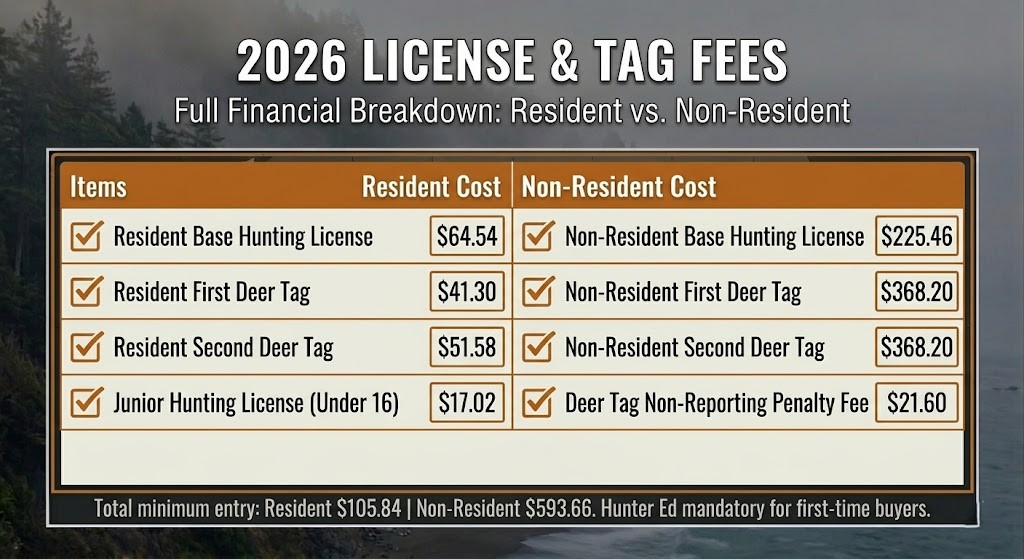
| Resident Hunting License | $65 | Valid for one license year |
| Non-Resident Hunting License | $225 | Required for out-of-state hunters |
| Junior Hunting License (Under 16) | $17 | Reduced rate for youth hunters |
California’s hunter education includes an in-person follow-up class beyond online coursework. This distinguishes it from states offering purely online certification. The requirement ensures new hunters get hands-on safety training and practical instruction before hitting the field.
You can buy licenses online through CDFW, at department offices, and at license dealers statewide. Fail to submit your mandatory harvest report? That’ll cost you a $21.60 non-reporting fee, whether you shot anything or not.
California Deer Tags and Permits
Deer tags are zone-specific permits required beyond the hunting license. California allows up to two deer tags per license year, but only one buck may be harvested regardless of tags held. This “one buck rule” applies statewide and prevents multiple buck harvests even with multiple tags.
| Tag Type | Resident Cost | Non-Resident Cost |
|---|---|---|
| First Deer Tag | $41 | $368.20 |
| Second Deer Tag | $52 | $368.20 |
| Deer Tag Non-Reporting Fee | $22 | $21.60 |
Here’s what a complete California deer hunt actually costs:
- Resident Total (license + first tag): $105.84
- Non-Resident Total (license + first tag): $593.66
Over-the-counter tags are available anytime during the season for zones A, most B-zone subunits, and many D-zone areas. Draw-only tags require entering the Big Game Drawing (April 15–June 2) and include most X-zone units plus premium B and C-zone subunits.
The preference point system lets hunters build points over time, but hunters lose all accumulated preference points if drawn for a premium deer tag as their first choice. Strategic hunters can earn points without competing by using species-specific points-only codes.
California Deer: Where to Hunt
California offers hunting across 38 million acres of public land plus extensive private land options. You can choose from rugged mountain ranges, sprawling valleys, deserts, and coastal regions. However, increasing hunting pressure on easily accessible public areas has many hunters seeking private land alternatives for better success rates and less competition.
Best Public Lands
California’s public land system provides extensive deer hunting opportunities across multiple agencies and terrain types. National Forests, Bureau of Land Management areas, and state wildlife areas each offer unique hunting experiences:
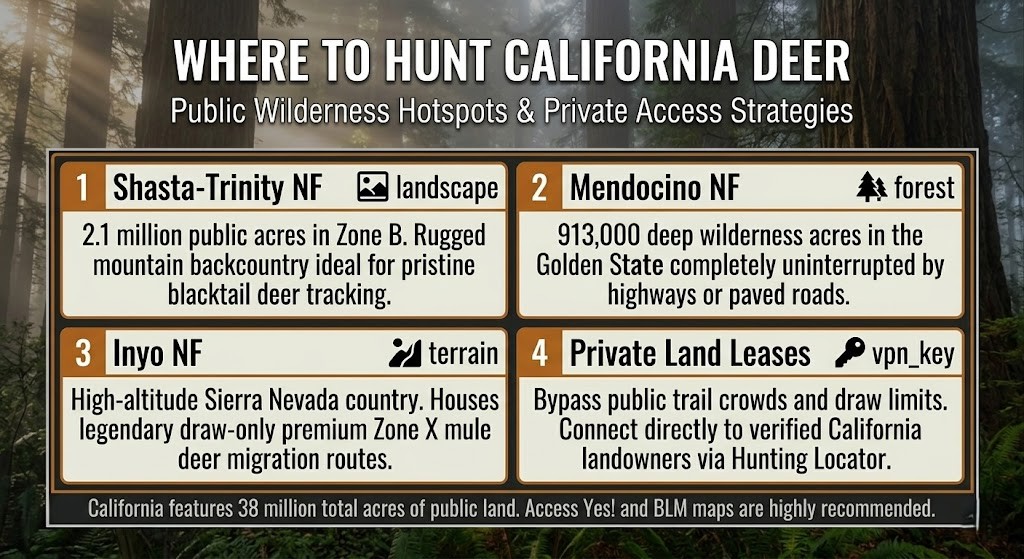
- Shasta-Trinity National Forest – 2.1 million acres of mountain terrain in Zone B, offering some of California’s best blacktail hunting with minimal road access and pristine habitat
- Mendocino National Forest – The only forest in the Golden State which isn’t intersected by a highway or paved road, encompassing 913,000 acres of wooded wilderness perfect for backcountry hunting
- Angeles National Forest – Zone D hunting with terrain ranging from chaparral to high-elevation pine forests, accessible to Southern California hunters
- Inyo National Forest – High-elevation X-zone mule deer habitat along the Sierra Nevada, requiring draw tags but offering trophy potential
- BLM Desert Areas – Vast expanses of X-zone desert habitat where mule deer thrive in harsh but productive environments
Public land hunting requires understanding that “access regulations are complex and state-specific, and quality varies enormously—research individual areas before driving hours to hunt.” Successful public land hunters scout extensively, hike farther from roads, and focus on areas requiring more effort to access.
Guided Hunts
Professional guides and outfitters provide valuable services for hunters unfamiliar with California’s diverse terrain or those seeking to maximize their limited hunting time. California offers fully guided mule deer and blacktail deer hunts in X and C zones, where “California’s limited entry units for mule deer consistently produce quality bucks.”
Guided hunt options include:
- Backcountry Pack Trips – Multi-day hunts in wilderness areas with horses or mules for gear transport
- Day Hunts – Single-day guided experiences on private ranches or accessible public lands
- Semi-Guided Options – Lodging and basic guidance with hunters pursuing deer independently
- Trophy Hunts – Premium guided experiences targeting mature bucks in X-zone units
Quality guides provide local knowledge, field care expertise, and connections to processing facilities that prove invaluable for traveling hunters.
Private Land Hunting with Hunting Locator
Private land hunting offers significant advantages over crowded public areas: reduced hunting pressure, better deer populations, and exclusive access to prime habitat. Private land hunts in areas like the Central Coast and Northern California provide the best access to trophy blacktail deer while avoiding the competition found on easily accessible public lands.
Leasing private land for hunting has become increasingly popular as public land pressure intensifies. Many California ranchers and landowners welcome responsible hunters who respect their property and follow established guidelines. Private land leasing typically involves annual agreements that provide exclusive or semi-exclusive hunting rights during specific seasons.
For hunters considering purchasing private land, California offers opportunities ranging from small hunting parcels to large ranches with diverse wildlife populations. Land ownership provides ultimate control over hunting pressure, habitat management, and access timing.
Hunting Locator revolutionizes private land access by connecting hunters directly with landowners throughout California who lease or sell hunting properties. Our comprehensive database includes verified listings with detailed property information, game populations, access details, and direct landowner contact information. Whether you’re seeking a weekend blacktail lease in Zone A or a long-term mule deer property in X-zone country, Hunting Locator’s California listings provide the private land access that transforms good hunters into consistently successful ones.
Deer Hunting Tips
Success in California’s diverse deer hunting zones requires adapting your strategy to specific terrain, weather conditions, and deer behavior patterns. Early season success from mid-August through September depends on locating water sources and morning feeding areas where deer concentrate during hot, dry conditions.
- Focus on Water Sources – Find springs, seeps, and reliable water during California’s dry summer and early fall seasons. Deer must drink daily, making water sources productive hunting areas.
- Hunt North-Facing Slopes – These areas retain moisture longer and provide green vegetation when south-facing slopes are brown and dry. Deer prefer the cooler temperatures and better feed.
- Glass During Prime Time – The first and last hour of legal shooting light produce the most deer movement. Set up in glassing positions before dawn and stay until dark.
- Use Non-Lead Ammunition – California requires 100% non-lead ammunition for all hunting since July 1, 2019. Use certified copper, bismuth, or other non-lead bullets for legal compliance.
- Scout Escape Routes – California deer are pressured and educated. Identify bedding areas and escape routes deer use when disturbed, then position yourself along these travel corridors.
- Adapt to Terrain – Coastal blacktail require different tactics than high-desert mule deer. Study your target zone’s specific characteristics and adjust your hunting methods accordingly.
- Plan for Weather – California’s hunting seasons span from hot July days to cold November mornings. Layer clothing systems and prepare for dramatic temperature swings.
- Master Spot-and-Stalk – Dense vegetation in many California zones makes stand hunting less effective. Develop spot-and-stalk skills for approaching deer in thick cover.
More Resources from Hunting Locator
Hunting Locator provides comprehensive resources to help you succeed across California’s diverse hunting opportunities. Our platform connects hunters with the information, access, and gear needed for memorable outdoor experiences:
- California Hunting Overview – Complete guide to all hunting opportunities throughout the Golden State
- California Upland Game – Detailed information on quail, dove, pheasant, and other upland birds
- California Wild Pig – Year-round hunting opportunities for wild boar
- California Elk – Premium draw opportunities for Roosevelt and tule elk
- California Pronghorn – Exclusive draw hunts for pronghorn antelope
- California Bear – Black bear hunting opportunities with quota management
- California Bighorn Sheep – Once-in-a-lifetime draw opportunities
- California Waterfowl – Duck and goose hunting in Pacific Flyway regions
- California Turkey – Spring and fall turkey hunting opportunities
FAQ
When do California deer season applications open for 2026?
The Big Game Drawing application period runs April 15–June 2, 2026, for all premium deer zones including most X-zone units and select B and C-zone subunits. Premium zones require entering the Big Game Drawing during this specific window, and late applications aren’t accepted. Over-the-counter tags for zones A, most B-zone areas, and many D-zone subunits are available for purchase anytime during the season.
How much does a non-resident California deer hunt cost?
Non-resident hunters pay $225.46 for a hunting license plus $368.20 for their first deer tag, totaling $593.66 before considering travel, lodging, and other expenses. Non-resident combination licenses can cost significantly more than resident fees—often 7.5 to 25 times higher in some western states. California’s non-resident costs reflect this trend but provide access to some of the earliest deer seasons in the United States.
What’s the difference between California blacktail and mule deer hunting?
Blacktail deer are found primarily in zones A and B along California’s coast and are smaller, darker, and adapted to dense forest environments. True blacktails inhabit the northern portion of A-Zone and the entirety of B-Zone. Mule deer dominate the interior zones, especially X-zone, and are larger with different antler characteristics and habitat preferences. Hunting tactics differ significantly, with blacktail hunting requiring close-range skills in thick cover while mule deer hunting emphasizes long-range glassing and spot-and-stalk techniques.
Do I need hunter education to hunt deer in California?
California requires hunter education training for anyone who has never held a California hunting license, lacks a hunter education certificate, or doesn’t have a hunting license from another state or province issued within the past two years. California’s program includes both online coursework and a mandatory in-person follow-up class, ensuring hands-on safety training before hunters enter the field.
Can I buy multiple deer tags in California?
California allows hunters to purchase up to two deer tags per license year, but only one buck may be harvested regardless of the number of tags held. This “one buck rule” applies statewide and prevents multiple buck harvests even with multiple tags. The second deer tag costs $51.58 for residents and $368.20 for non-residents, but serves primarily as a backup option if the first tag is lost or damaged.
What are California’s CWD sampling requirements for 2026?
For the 2026 hunting season, CDFW has implemented mandatory CWD sampling for deer harvested in zones D7, X9a, X9b, and X9c. Hunters in these zones must comply with sampling requirements as part of California’s proactive chronic wasting disease surveillance program. Specific sampling procedures and locations will be provided with tag purchases for affected zones.
The Final Shot
California’s 2026 deer season offers incredible diversity, from July blacktail opportunities along the fog-shrouded coast to November mule deer hunts in the high desert. Success depends on understanding the zone system, securing the right tags, and finding quality hunting access away from increasingly crowded public lands. Whether you’re building preference points for a trophy X-zone hunt or planning an annual blacktail adventure in Zone A, thorough preparation and strategic planning make all the difference.
The Golden State’s complex regulations and competitive draw system can seem overwhelming, but the rewards justify the effort. Start planning your 2026 California deer hunt today by exploring our comprehensive database of private hunting leases, connecting with experienced guides, and accessing the resources that transform good hunters into consistently successful ones.


