Picture this: you’re checking your phone during lunch break when a photo notification pops up. There’s the buck you’ve been tracking, walking past your camera in broad daylight. Meanwhile, your buddy won’t know what’s on his property until he drives out this weekend to swap SD cards.
That’s the cellular vs. SD card camera debate in a nutshell. After years of testing both technologies in the field, we’ve learned that neither is universally “better”—but one might be perfect for your specific hunting situation. Field & Stream’s gear experts agree: “Each camera type has its place, and one isn’t necessarily better than the other.”
This isn’t another generic comparison. We’re breaking down the real costs (including the hidden ones), practical deployment strategies, and a decision framework that actually helps you choose based on how you hunt.
Here’s what you’ll learn:
- The true cost difference between technologies (spoiler: it’s not just the camera price)
- When cellular cameras fail you and SD cards shine
- A practical decision tree based on your hunting situation
Whether you’re upgrading your current trail camera setup or starting from scratch, you’ll know exactly which technology fits your needs by the end.
How Each Technology Actually Works
SD Card Trail Cameras
These are the workhorses of trail camera technology. Motion triggers the camera, it snaps photos or video, stores everything on an SD card. No monthly bills, no cell towers required, no connectivity headaches. You set it, forget it, then physically visit to collect your intel.
The downside? You’re flying blind until you make that trip. Could be empty cards, could be the buck of a lifetime—you won’t know until you’re there.
Cellular Trail Cameras
Think of these as your remote scouts. They capture images just like SD cameras, but then transmit them straight to your phone via cellular networks. Modern cellular cameras like Tactacam’s Reveal series automatically find the strongest signal, switching between carriers as needed.
The catch? They need cell coverage to work, and every photo costs money to transmit.
The Real Comparison: Beyond the Marketing
Trail cameras have come a long way from those clunky film models, and both technologies have gotten seriously good. Here’s how they actually stack up:
| Factor | SD Card Cameras | Cellular Cameras |
|---|---|---|
| Upfront Cost | ~$70 for solid models | ~$80+ for entry-level |
| Monthly Costs | Zero (just SD cards) | $5-10 per 1,000 photos |
| Getting Photos | Drive out and swap cards | Instant phone delivery |
| Cell Coverage | Not needed | Absolutely critical |
| Battery Life | Months typically | Weeks in busy areas |
| Best Use | Local properties, budget builds | Remote spots, out-of-state hunts |
| Theft Appeal | Lower (cheaper target) | Higher (more valuable) |
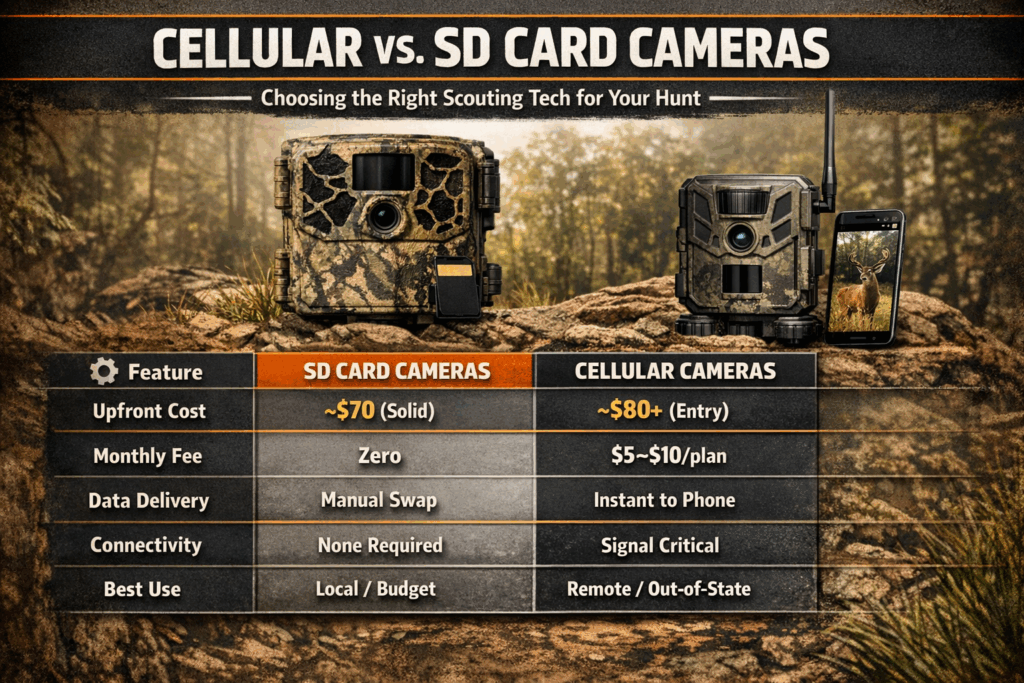
The Money Talk: What You’ll Really Spend
Quality cameras in both categories start around the same price point. You can grab a decent SD card camera for $70, and cellular options like the Spypoint Flex-M hit $80.
But here’s where it gets interesting. Cellular data plans typically run $5-10 per 1,000 photos. That adds up fast.
Let’s do some real math:
SD Card Strategy: 4 cameras × $70 = $280 total investment Cellular Strategy: 2 cameras × $80 + ($8/month × 12 months × 2 cameras) = $352 first year, then $192 every year after
For what you’d spend on cellular service, you could buy another camera or two. But if you can’t check those extra cameras regularly, more coverage doesn’t help much.
Convenience vs. Control
Here’s the trade-off that matters most: SD cards mean trips to check cameras, cellular means photos delivered to your couch.
Take the hunter who lives in Alabama but leases Iowa ground. He sets cameras in July and doesn’t return until December. Without cellular, he’s hunting completely blind. With cellular, he’s been watching deer patterns for months.
There’s another angle too. Cell cameras let you monitor bedding areas without walking in there to pull cards. Less pressure on deer can mean better hunting.
Coverage Reality Check
Let’s be blunt about cellular cameras: no cell coverage means no cellular camera option, period. Test your phone signal at camera locations before buying. Dead zones are more common than you think, especially in the remote spots where big bucks live.
Even with good coverage, cellular isn’t perfect. Some hunters report cellular cameras missing photos or failing to send images. Don’t bet your hunt on a single camera, regardless of type.
If you’ve got solid cell coverage, cellular trail cameras can completely change your scouting game.
Battery Life Reality
Every photo transmission drains power. In high-traffic areas, cellular cameras might need fresh batteries every few weeks instead of every few months. Photo settings, temperature, placement, and activity levels all affect battery life.
Cold weather kills batteries faster regardless of camera type, but cellular transmission adds another power drain. Many hunters solve this with solar panels, eliminating battery-change trips entirely.
For long deployments, trail camera batteries and solar panels are game-changers.
Theft: The Expensive Reality
Trail camera theft is getting worse as more cameras hit the woods. Losing a $150 cellular camera hurts more than losing a $70 SD model.
The upside? Many cellular cameras include GPS tracking, which can help recover stolen gear. Some even send theft alerts when moved unexpectedly.
Whatever camera type you choose, security boxes and locks are worth every penny.
Advanced Features That Actually Matter
Cellular cameras offer capabilities SD models simply can’t match:
Auto-carrier selection: Top cellular cameras automatically connect to the strongest network, switching carriers as needed
GPS tracking: Know exactly where your cameras are and get theft alerts
Remote updates: Firmware updates without retrieving the camera
App control: Adjust settings and manage multiple cameras from your phone
The Tactacam Reveal X Gen 3.0 combines 96-foot detection range, 4K photos, and auto-connect cellular technology in one package.
Want to see what’s available? Browse our complete trail camera selection to compare options and prices.
Which Technology Fits Your Hunting?
Both approaches work when matched to the right situation. The key is honest assessment of how you actually hunt.
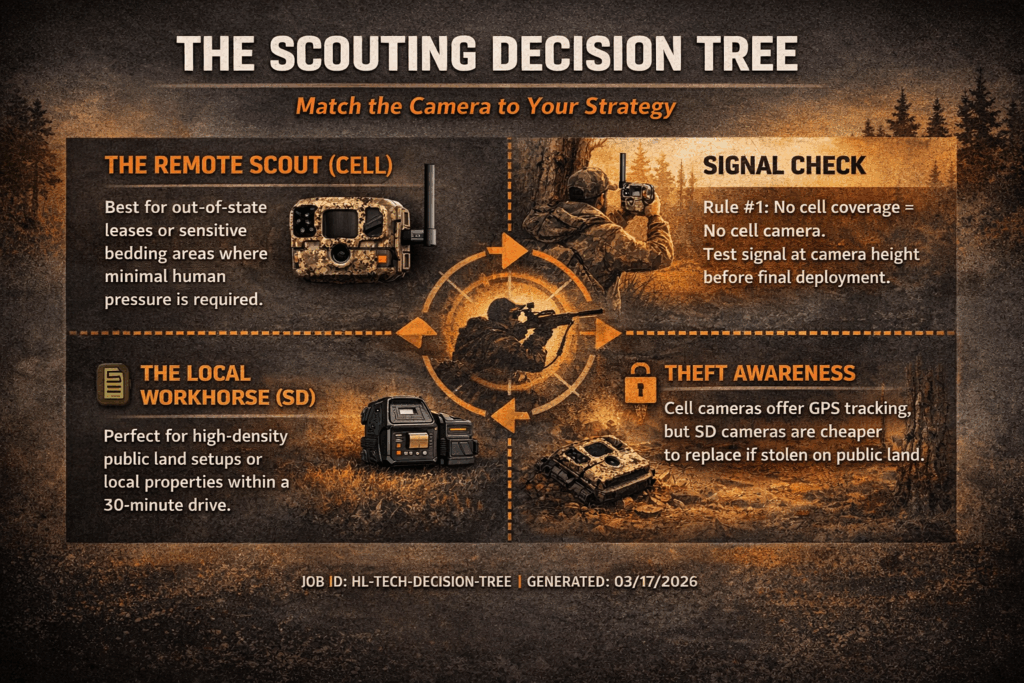
Go Cellular If You…
Hunt out-of-state or remote properties you can’t check regularly
Have significant money invested in a hunt and need maximum intel
Want to avoid disturbing sensitive areas like bedding zones
Have confirmed reliable cell coverage (test this first!)
Need real-time alerts for your hunting strategy
Value convenience over camera quantity
Stick with SD Cards If You…
Hunt local properties within 30-45 minutes of home
Want maximum camera coverage on a tight budget
Deal with poor or nonexistent cell coverage
Enjoy the scouting aspect of checking cameras and reading sign
Need to deploy lots of cameras cost-effectively
Hunt public land where theft risk runs high
The Smart Hybrid Strategy
Experienced hunters often use both technologies strategically:
Cellular cameras on the most productive or hardest-to-reach spots
SD card cameras for broader coverage and less critical areas
Cellular for real-time intel during peak rut activity
SD cards for season-long pattern analysis
Deployment Strategies That Work
Good camera placement beats expensive technology every time.
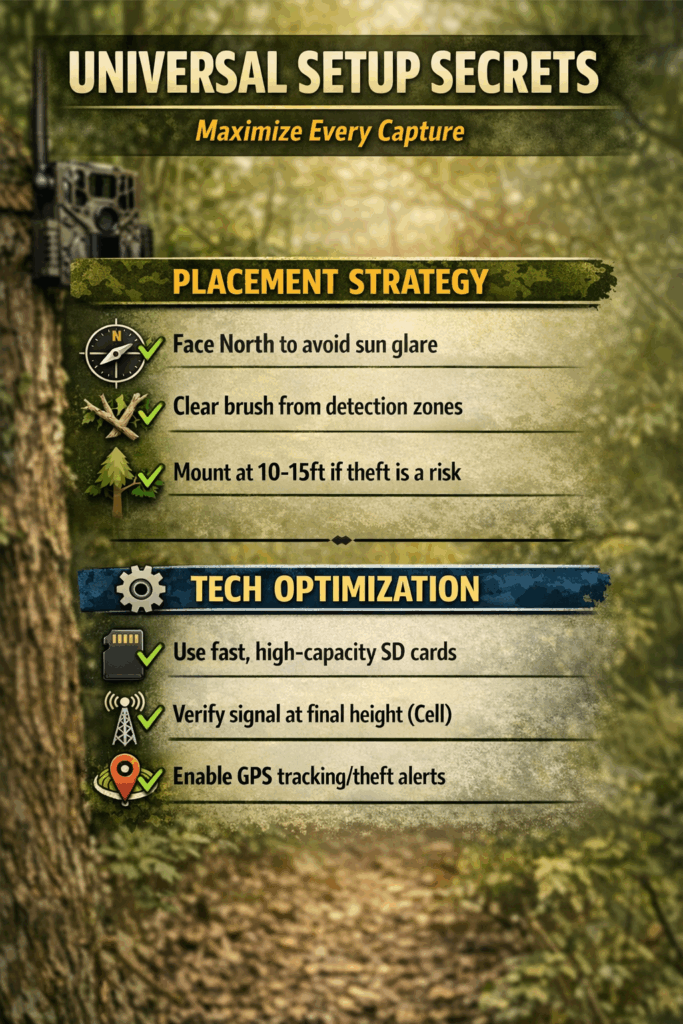
Where to Put Cameras
Travel corridors: Pinch points between bedding and feeding areas produce the most consistent photos
Water sources: Especially valuable during dry spells when deer concentrate
Food sources: Crop edges, oak groves, food plots during peak feeding times
Bedding area edges: Monitor without entering sensitive zones
Setup Tips for Success
Universal best practices:
- Test detection zones before leaving the camera
- Clear shooting lanes of brush and branches that trigger false photos
- Face cameras north when possible to avoid sun glare issues
- Use quality mounting hardware for stability
Cellular-specific setup:
- Verify signal strength at actual camera height, not just ground level
- Start with conservative photo settings to control data costs
- Enable GPS tracking for security and easier camera management
- Test app connectivity before final deployment
SD card optimization:
- Carry spare cards and batteries for quick field swaps
- Use high-capacity, fast cards for video recording
- Mark camera locations on GPS for easy retrieval
- Plan to check cameras every 2-3 weeks during active periods
Complete Your Camera Setup
The right supporting gear makes any camera system more effective:
- Trail Camera Security – Quality security boxes and locks that actually deter theft and protect your investment in the field.
- Power Solutions – Long-lasting batteries and solar panel systems that eliminate frequent battery changes and extend deployment time.
- Mounting & Accessories – Professional mounting systems and card viewers that make deployment easier and image review more efficient.
- Complete Camera Selection – Our full range of cellular and SD card cameras from proven brands, with options for every budget and hunting situation.
Common Questions Answered
What do cellular camera data plans actually cost?
Most cellular trail camera plans run $5-10 per 1,000 photos transmitted. Basic plans start around $5 monthly for light usage, while unlimited plans can reach $15-20. High-activity cameras in good deer areas can burn through photo allowances quickly.
Will cellular cameras work without cell phone service?
Absolutely not. No cellular coverage means you’re limited to traditional trail cameras. Always test signal strength with your phone at actual camera locations before investing in cellular technology.
How much shorter is battery life in cellular cameras?
It varies dramatically based on activity levels and settings. Photo transmission settings, temperature, placement, and deer activity all impact battery life. SD cameras typically run 3-6 months on batteries, while cellular cameras might need changes every 1-3 months in busy areas.
Are cellular cameras stolen more often?
Yes, their higher value makes them more attractive targets. Trail camera theft reports are increasing as more cameras appear in the woods. However, GPS tracking and theft alerts in many cellular cameras can help with recovery. Security boxes help protect both camera types.
Can I mix cellular and SD card cameras?
Definitely. Many hunters use cellular cameras for key locations and real-time intel while deploying SD cameras for broader coverage. This hybrid approach maximizes both convenience and cost-effectiveness.
Do cellular cameras take worse photos than SD cameras?
Not at all. Image quality depends on the camera’s sensor and lens, not how it stores or transmits photos. Both camera types now offer excellent image quality, with many cellular models providing 4K photos and HD video comparable to any SD camera.
Making Your Choice
The cellular vs. SD card decision isn’t about which technology is superior—it’s about matching the right tool to your hunting situation. Hunt local properties you can check regularly and want maximum coverage? SD cards deliver proven results without ongoing costs. Investing in remote hunts or need real-time intel from hard-to-access spots? Cellular technology can transform your success rate.
Field & Stream’s gear experts put it perfectly: “Each camera type has its place, and one isn’t necessarily better than the other.” The best choice matches your hunting reality, budget, and scouting strategy.
Ready to upgrade your scouting game? Check out our complete trail camera selection for the best cellular cameras, SD card models, security accessories, and power solutions. Whatever technology you choose, we’ve got the gear to make your scouting more successful.


