Field & Stream recently pointed out that “camo face paint is popular again”—smart hunters are figuring out what actually works versus what looks cool in catalogs. Here’s the thing: all that pricey camo clothing is worthless if your shiny face is a dead giveaway. Real concealment means covering what moves most—your face and hands.
This isn’t another gear review that tells you to buy everything. Instead, you’ll learn:
- Which face paint actually works (and which stuff to skip)
- How to build a concealment system that works together
- Application tricks that keep you hidden when it matters
Let’s get you invisible.
Know Before You Go: Essential Prep
Smart hunters handle the boring stuff first so they can focus on what’s fun. Getting busted because you didn’t check regulations or scout properly? That’s just painful.
Regulations Check
Some states get picky about blaze orange requirements, and that directly impacts your concealment game plan. Hunting safety folks are clear about this: “choose camouflage that matches your hunting environment to stay hidden from the game, but ensure it includes safety features like hunter orange if required.”
Hunting out of state? Double-check both your home rules and where you’re headed. Nothing ruins a hunt like a game warden with a citation book.
Do this first: Get your license and tags sorted before you buy gear. Then you can hunt instead of worrying about paperwork.
Scouting & Habitat
Your concealment strategy depends completely on where you’re hunting. What works in Western sage brush will make you stick out like a sore thumb in Eastern hardwoods. Green early season vegetation needs different colors than late season brown everything.
Know your hunting area inside and out. Find the tracks, rubs, scat, and feeding spots during scouting—these are exactly where your concealment gets tested hardest. GPS and mapping tools help you plan your approach and identify key terrain features before you ever step foot in the woods.
Physical & Gear Readiness
Get yourself in shape for your hunt, but once you can handle the physical demands, the right equipment becomes your secret weapon. Now let’s talk about staying invisible when animals are close enough that every detail matters.
The Gear Advantage: Why Concealment Matters
Here’s what research tells us: “camo face paint is undoubtedly more useful and more effective than a hunting facemask, but only if you get the right type.” Knowing why this stuff works helps you buy smarter.
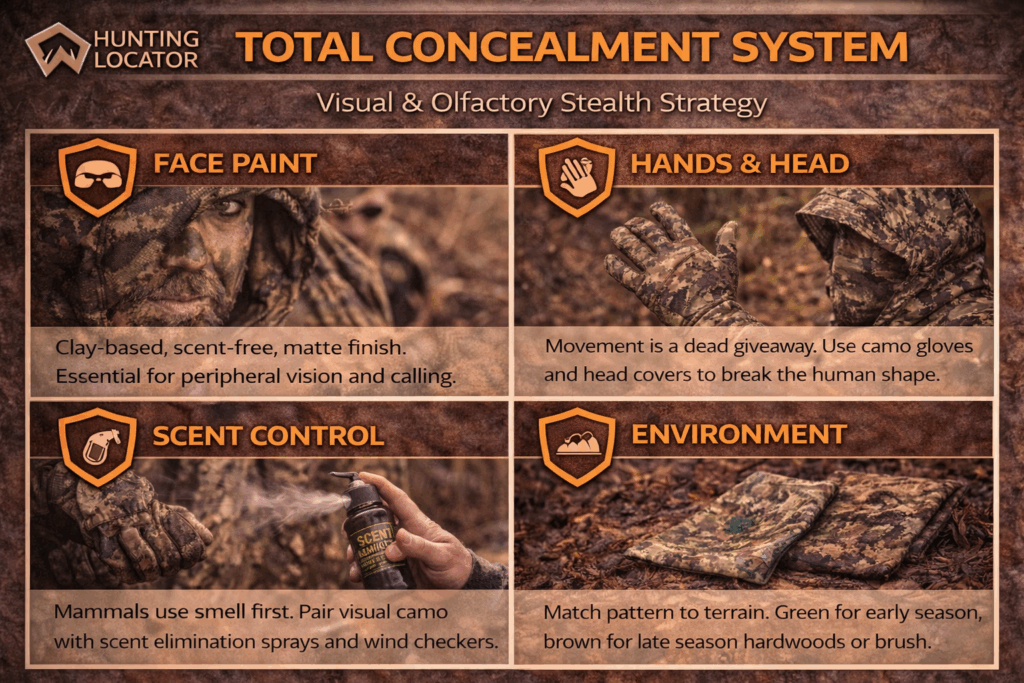
Game animals spot hunters through movement, weird shapes, and smell. Your face and hands move the most, making them priority number one for concealment. Animals recognize human face shapes instantly—even when you think you’re hidden behind cover.
Face paint handles the visual problem, but only if it’s part of a complete system. Hunting pros know this: “sight may be the most important sense for humans, but most mammals use smell to avoid danger.” Perfect camouflage means nothing if you smell like a human.
Visual concealment plus scent management equals your best shot at staying undetected across different hunting situations.
Core Gear Checklist: Our Top Recommendations
Here’s what actually works, tested by hunters who’ve used this stuff across different terrain and game species.
Face Paint Selection: What Actually Works
The experts are crystal clear: “what you are looking for in a camouflage face paint is a clay-based, scent-free, hardy but easy to remove face paint.” These aren’t marketing buzzwords—they’re field-tested requirements that separate good products from junk.
What to look for:
- Clay-based formula: Better coverage, feels natural, comes off easier than synthetic stuff
- Scent-free: Absolutely critical—research proves “if your face paint has an unnatural scent, animals will get scared by it and run away”
- Water-resistant: Has to survive sweat, light rain, humidity without running or fading
- Matte finish: Any shine can blow your cover, especially during low-light hunting
- Skin-safe ingredients: Hypoallergenic matters, especially around your eyes
Check out face paint options that meet these proven standards instead of falling for “military-grade” marketing nonsense.
Face Paint Application: The Technique That Works
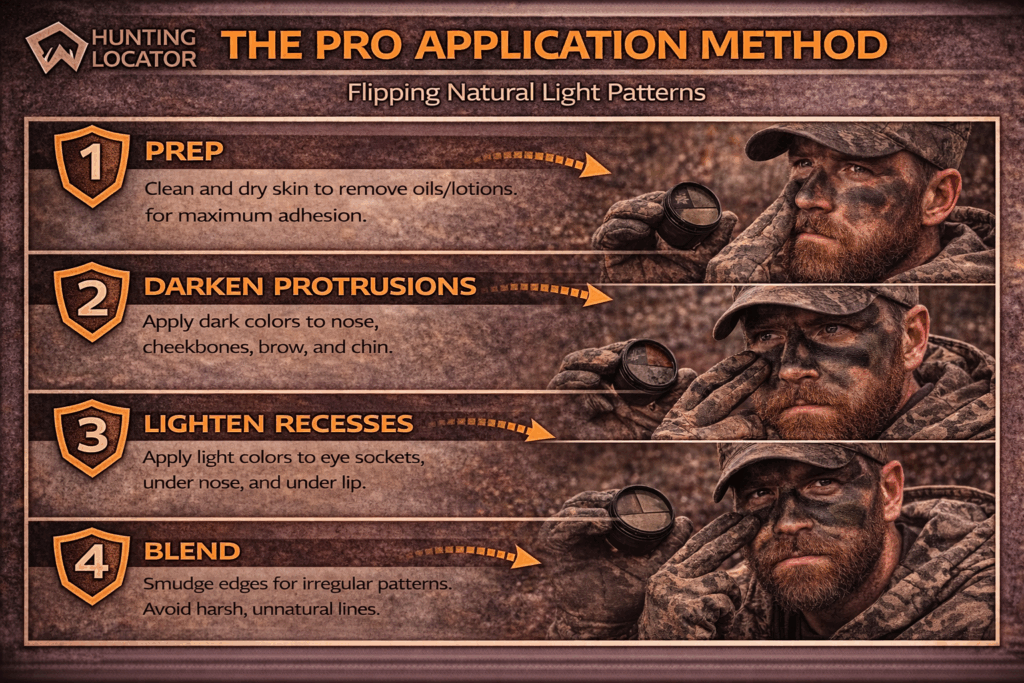
Good application makes all the difference between effective concealment and wasted time. The proven method breaks up your recognizable facial features by flipping natural light and shadow patterns.
Here’s how to do it right:
- Clean, dry skin first – Get rid of oils, lotions, anything that stops paint from sticking
- Apply base in irregular patterns – Blotches, lines, weird shapes—not uniform coverage
- Darken what sticks out – Dark brown, green, black on nose, cheekbones, brow, chin
- Lighten what’s recessed – Light green, tan, gray in eye sockets, under nose, under bottom lip
- Blend edges smooth – Harsh lines look unnatural and give you away
- Cover everything exposed – Ears, neck, any skin that shows
The key principle: Experts emphasize this: “the colors should be lightest in your most recessed features and darkest in your furthest-protruding areas.” This flips the natural light patterns that make human faces instantly recognizable.
Face Paint vs. Face Mask: Making the Choice
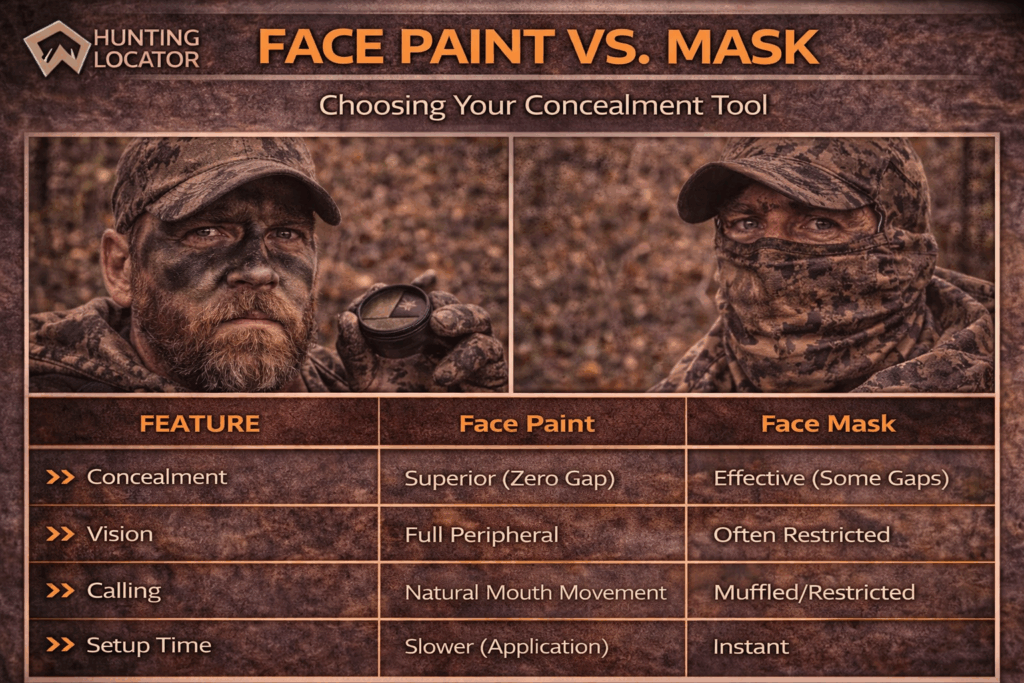
Both have their place. Understanding the trade-offs helps you pick the right tool for your specific situation.
Face Paint Wins:
- More effective concealment (research backs this up)
- Full peripheral vision
- Better for calling (your mouth moves naturally)
- Customize to specific terrain and conditions
Face Mask Wins:
- Faster to put on in the field
- No cleanup needed afterward
- Keeps you warm in cold weather
- Solid backup option
Our take: Use face paint as your go-to, keep a quality face mask as backup or cold-weather option. For turkey hunting specifically, experts recommend “head-to-toe camouflage, including a face mask and gloves, to conceal yourself from the turkey’s keen vision.”
Complementary Concealment Accessories
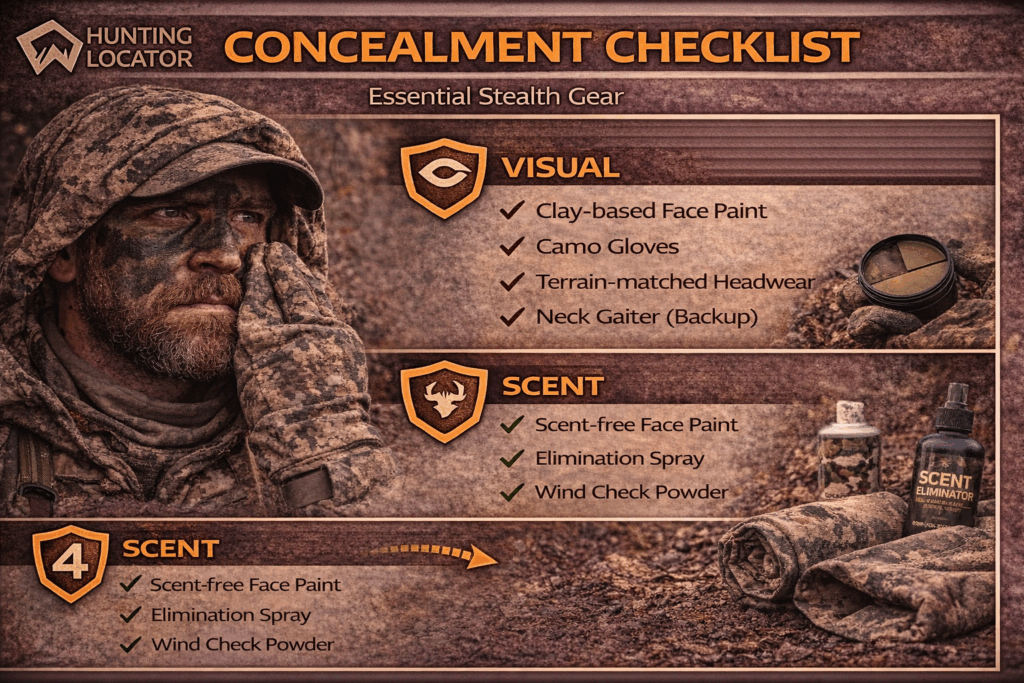
Face paint covers your face, but your hands and head need equal attention. Research confirms this: “effective camouflage clothing helps conceal you from deer, which rely heavily on sight.”
Must-have accessories:
- Camo gloves: Hands move constantly and give you away; pick gloves that don’t mess with trigger finger or bow string control
- Head cover/hat: Completes your facial concealment; match the pattern to where you’re hunting
- Neck gaiter: Covers exposed neck skin; works as backup face concealment too
Build your complete system with accessories that work together instead of random pieces that don’t support your overall strategy.
Clothing & Layering Strategy
Pattern selection matters way less than proper concealment principles. Experts agree: “match your camo pattern to your specific hunting environment (forest, grassland, or snow)” rather than chasing the latest pattern technology.
Layering basics:
- Moisture-wicking base layers for comfort and scent control
- Insulating mid-layers for temperature regulation
- Weather-resistant outer layers for protection
Research supports this approach: “waterproof or water-resistant clothing is useful in every environment, and moisture-wicking clothing will also help keep you comfortable” across different hunting conditions.
Bottom line: face paint and accessories matter more than having the “perfect” camo pattern. Movement discipline and scent control beat pattern selection every single time.
Ready to build your concealment system? The right gear gives you confidence to stay invisible when it counts. Check out our face paint and hunting accessories to get ready for your next hunt.
Tactics & Strategy: Using Concealment Effectively
Having the gear is just step one. Knowing how to use your concealment system effectively separates successful hunts from watching game walk away.
Peak Activity Times
Most game moves hardest during early morning and late evening when light conditions change fast. These low-light periods affect how your camouflage performs—matte finishes become even more important at dawn and dusk when any shine shows up like a beacon.
Time your concealment prep around these peak periods. Give yourself enough setup time to be fully concealed before animals start moving.
Wind & Scent Control
Perfect camouflage means nothing if you get winded. Research is clear on this: “sight may be the most important sense for humans, but most mammals use smell to avoid danger.”
Wind strategy basics:
- Always hunt with wind in your face or crossing your position
- Use wind checkers to monitor direction changes during your hunt
- Position yourself where terrain helps control your scent cone
Complete concealment means pairing your face paint with solid scent elimination and cover scents that handle the scent problem your visual camo can’t touch.
The Approach: Getting Close
Different hunting methods need different concealment applications, but movement discipline stays constant. The best camo pattern fails with poor movement discipline—slow, deliberate movements beat pattern perfection every time.
Stand placement: Concealment helps good positioning but can’t fix bad stand placement. Pick spots where natural cover supports your camouflage system.
Still-hunting: Face paint becomes critical when you’re moving through game habitat. Your face and hands are the most likely giveaways during stalking.
Shot placement: Concealment gets you the opportunity; ethical shot placement honors the animal. Know your effective range and practice with your gear before the hunt.
Post-Harvest Care: The Work After the Shot
Success brings new responsibilities. Proper post-harvest care shows respect for the animal and ensures quality meat for your table.
Tracking & Recovery
Patience during tracking often leads to better recovery. Even with perfect shot placement, waiting before following the blood trail reduces the chance of pushing wounded game further away.
Mark your shooting position and where the animal was when you shot before starting your tracking.
Field Dressing & Processing
Quick cooling and proper field care preserve meat quality and honor your harvest. This means immediate field dressing, proper cooling, and safe transport prep.
Get quality field dressing and game processing tools that make the job easier and safer. Sharp, reliable hunting knives are essential for proper field care and meat preparation.
More Resources from Hunting Locator
Whether this is your first hunt or your fiftieth, these resources help you prepare for success:
- Hunting Face Paint – Clay-based, scent-free options for complete facial concealment
- Scent Elimination & Cover Scents – The invisible partner to your visual concealment system
- GPS & Navigation – Pre-scouting tools and in-field navigation equipment
- Game Processing – Field dressing and meat care essentials
- Hunting Knives – Sharp, reliable tools for field dressing and processing
- Hunting Survival & First Aid – Safety equipment for responsible hunting
FAQ
What’s the difference between face paint and face masks for hunting?
Research shows that “camo face paint is undoubtedly more useful and more effective than a hunting facemask, but only if you get the right type.” Face paint gives better concealment, doesn’t block peripheral vision, and lets your mouth move naturally for calling. Face masks are convenient and warm but less effective for concealment.
How do I choose the right face paint for hunting?
Look for clay-based, scent-free formulas that are water-resistant with a matte finish. Expert guidance confirms that “what you are looking for in a camouflage face paint is a clay-based, scent-free, hardy but easy to remove face paint.” Skip products with artificial scents that alert game animals.
Do I really need camo accessories beyond clothing?
Absolutely. Hunting experts note that “essential concealment typically means camouflage, sturdy boots, gloves, rugged pants, and underlayers.” Your face and hands move the most, so game animals notice them first. Complete concealment requires covering these critical spots.
How important is scent control with visual camouflage?
It’s everything. Research emphasizes that “most mammals use smell to avoid danger. If your face paint has an unnatural scent, animals will get scared by it and run away.” Visual concealment fails completely if you get detected by scent first.
What concealment gear should new hunters prioritize?
Hunting education experts recommend that new hunters “let your experience be your guide, and consider replacing or upgrading only the gear that solves a problem or limitation caused by your current equipment.” Start with basic face concealment (paint or mask), camo gloves, and proper clothing before buying advanced accessories.
How do hunting regulations affect concealment choices?
Some states require blaze orange that impacts your concealment strategy. Safety experts advise to “choose camouflage that matches your hunting environment to stay hidden from the game, but ensure it includes safety features like hunter orange if required.” Always check local regulations before finalizing your concealment system.
The Final Shot
Real invisibility comes from understanding that concealment is a system, not just individual pieces of gear. Face paint, accessories, and scent control work together to keep you undetected when game animals are close enough to matter. Hunters who succeed consistently prepare thoroughly, choose gear based on what actually works rather than marketing hype, and practice their concealment techniques before the season starts.
Your next successful hunt starts with confidence that you’re truly invisible when it counts. Every piece of your concealment system—from face paint that breaks up your human outline to scent control that manages your invisible signature—contributes to those critical moments when everything comes together perfectly.
Ready to gear up for your best hunting season yet? Visit our hunting accessories store today! We stock the best face paint, concealment accessories, and scent control products to ensure your success in the field.


