This Colorado black bear guide puts the dates, fees, and rules in one place so you don’t have to dig through multiple sources to plan your season. It works whether you’re a DIY hunter working public land close to home, an out-of-state traveler booking a fall trip, or someone adding bear to an existing deer or elk hunt. Here’s what’s covered below:
- Exact 2026 season dates, bag limits, and the rules that shape bear hunting here — including the baiting and hound bans
- Resident and nonresident license costs plus the tag application process, step by step
- Where to hunt — public land, private-land leases, and guided hunt options
Start with the fast facts below.
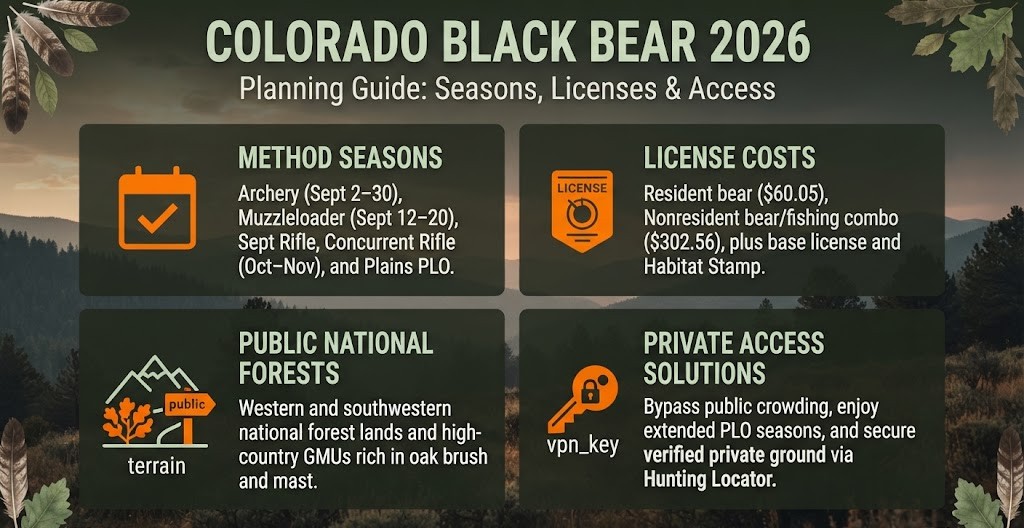
Quick Overview: 2026 Colorado Black Bear Season at a Glance
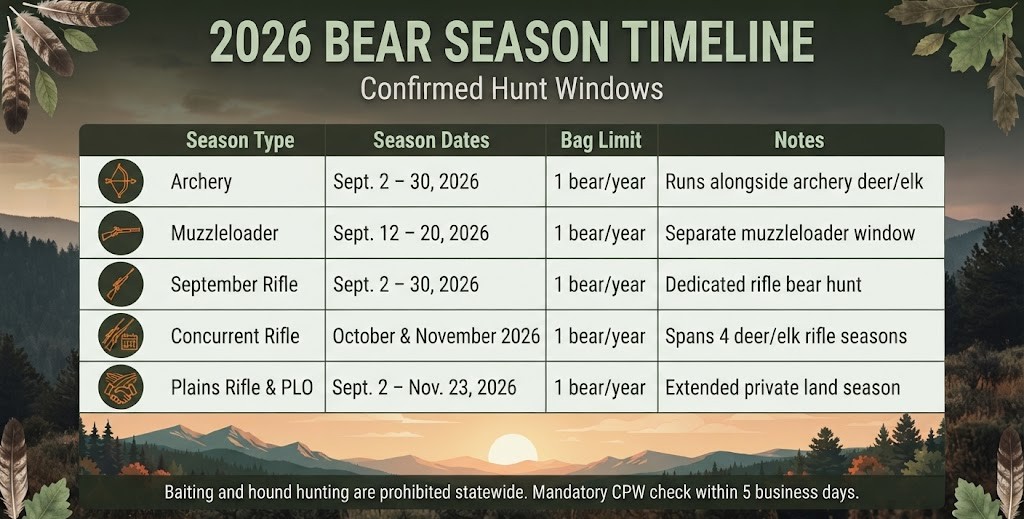
Black bear (Ursus americanus) hunting is one of Colorado’s fall traditions, and the table below shows when you can hunt one in 2026 depending on weapon choice.
| Season Type | Dates (2026) | Bag Limit | Key Notes |
|---|---|---|---|
| Archery | September 2 – 30, 2026 | 1 bear/year (either sex) | Runs alongside archery deer/elk |
| Muzzleloader | September 12 – 20, 2026 | 1 bear/year | Separate muzzleloader window |
| September Rifle | September 2 – 30, 2026 | 1 bear/year | Separate September rifle season |
| Concurrent Rifle | October & November (alongside the four deer/elk rifle seasons) | 1 bear/year | Combo opportunity with deer/elk |
| Plains Rifle & Private Land Only (PLO) | September 2 – November 23, 2026 | 1 bear/year | Private-land-focused extended season |
A few rules matter more than the rest: the daily limit is 1 bear, the season limit is 1 black bear per year, and sows with cubs at side and cubs under 50 lbs may not be legally harvested. Baiting and hunting bears with hounds or dogs are prohibited statewide, and every harvested bear must be personally presented to Colorado Parks and Wildlife within 5 business days for a tooth-sample extraction and skull/hide inspection.
These dates reflect the current 2026 season structure, but exact hunt codes and unit-specific windows can vary. Colorado Parks and Wildlife has released the 2026 hunting brochure covering bear alongside deer, elk, pronghorn, and moose — worth a check before you lock in travel plans. For more on strategy and history, see our Colorado black bear guide.
License, Permit & Education Requirements at a Glance
Before you can hold a bear tag, you’ll need to stack a few requirements:
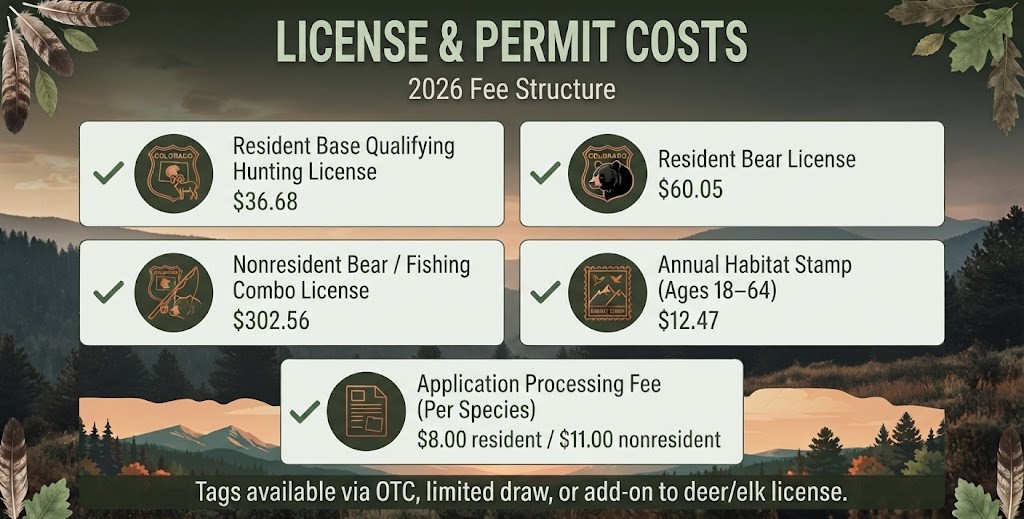
- A qualifying base hunting license is required to hunt bear (resident base hunting license: $36.68).
- The bear license itself: resident $60.05; nonresident bear/fishing combo $302.56.
- Annual Habitat Stamp: $12.47, mandatory for hunters aged 18–64.
- Application processing fee: $8.00 for residents, $11.00 for nonresidents, per species.
- Bear tags come via three pathways — OTC, limited draw, or add-on to a deer or elk license — detailed further below.
2026 Colorado Black Bear Hunting Seasons
Colorado’s season structure gives hunters flexibility in how they chase a bear tag, from a full month of September archery to a rifle hunt that runs concurrent with elk season. Here’s how each window breaks down.
Archery Bear Season (September 2 – 30, 2026)
The archery bear season runs the entire month of September, overlapping directly with archery deer and elk. That makes it a natural fit if you’re already planning a backcountry archery trip, since you can hunt bear and big game on the same license period. It’s close-range work that rewards patience, but a well-placed shot on a fall bear is worth the effort it takes to get there.
Muzzleloader Bear Season (September 12 – 20, 2026)
The muzzleloader season is a tighter nine-day window, running September 12 through 20. It’s separate from both archery and rifle, with its own weapon restrictions, so if you’re hunting with a muzzleloader, mark these exact dates on your calendar.
September Rifle & Concurrent Rifle Seasons
Rifle hunters have two paths to a bear tag in the fall.
The September Rifle season runs September 2 – 30, 2026, as its own dedicated rifle bear hunt. This one behaves more like a limited, draw-issued hunt by unit and hunt code than a simple over-the-counter purchase, so check your specific hunt code before assuming availability.
The Concurrent Rifle Seasons let you take a bear during any of the four regular deer/elk rifle seasons spanning October and November. This is where combo hunting works well: if you’re already hunting elk this fall or chasing Colorado deer, a bear tag can ride along with minimal extra planning. Exact concurrent windows can shift slightly by unit, so confirm dates in the CPW brochure before heading out.
Plains Rifle & Private Land Only (PLO) Season (September 2 – November 23, 2026)
The PLO season is the longest window on the calendar, running from September 2 to November 23 — nearly three months compared to the shorter public-land windows. This private-land-focused season widens your opportunity considerably if you’ve got access to the right ground. Getting that access is the next question, and it’s covered further down.
Colorado Black Bear Licenses & Permits
Licensing trips up more hunters than the hunt itself. Here’s the breakdown, organized so you can find your column and move on.
Colorado Bear Hunting Licenses
Before you can hold a bear license, Colorado Parks and Wildlife requires a qualifying base hunting license. Here’s how the fees stack up for residents versus nonresidents:
| License / Fee | Resident | Nonresident |
|---|---|---|
| Base qualifying hunting license | $37 | (varies — confirm with CPW) |
| Bear license | $60 | $302.56 (bear/fishing combo) |
| Annual Habitat Stamp (ages 18–64) | $12.47 | $12 |
| Application processing fee (per species) | $8.00 | $11 |
All of these fees include small statutory add-ons — a search-and-rescue fee and a Wildlife Education Fund contribution baked into the total. Because hunt codes and unit availability shift year to year, cross-check the official CPW brochure before finalizing your application strategy.
Colorado Bear Hunting Permits & Application Process
Once you know which license type fits your plan, the application follows a straightforward sequence:
- Purchase a qualifying base hunting license first — this is required before anything else in the process.
- Add the Habitat Stamp — mandatory for hunters aged 18–64.
- Choose your pathway — apply in the primary draw for limited licenses, buy OTC where available, or add a bear tag onto a deer/elk license.
- Pay the per-species application processing fee — $8 for residents, $11 for nonresidents.
- Complete the transaction — nonresidents should make sure the qualifying license is added to the cart first, before the draw application.
Most bear licenses not issued in the primary draw become available through a secondary draw, so missing the first round doesn’t end your options. This five-step sequence covers the full process — there’s no hidden step between purchasing your base license and holding a valid bear tag.
Where to Hunt Black Bear in Colorado
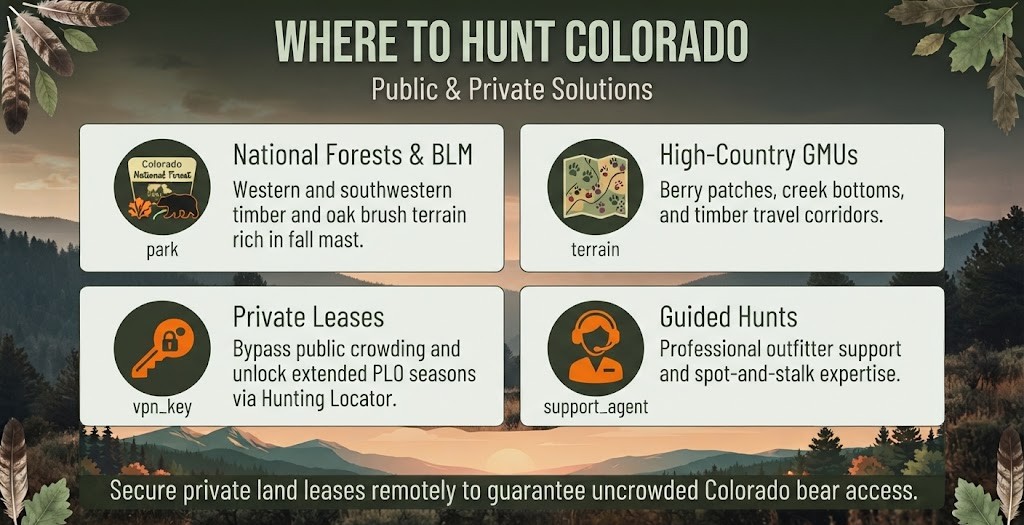
Once your license is sorted, the next question is where to hunt. Colorado hunters generally choose between public land, private-land leases, and guided hunts, and the right fit depends on time, budget, and how far you’re traveling.
Best Public Lands for Bear Hunting
Colorado’s national forests and public game management units hold strong bear numbers, particularly in oak brush and berry-rich terrain during the fall. This is when black bears enter fall hyperphagia feeding behavior, an intense feeding drive that pushes them toward high-calorie food sources ahead of winter and makes public timber and brush country especially productive.
Public-land bear hunters generally focus on:
- National forest land in western and southwestern Colorado, where oak brush and mast-producing terrain concentrate bear activity in fall
- BLM units bordering national forest ground, often overlooked but holding solid bear numbers
- High-country GMUs with a mix of berry patches, creek bottoms, and timber that bears use as travel corridors
- Areas already popular for elk, since concurrent rifle seasons make bear a natural add-on to an existing public-land elk trip
Private Land Hunting with Hunting Locator
Public land works, but it comes with more hunters, more competition, and less predictability. Private land avoids that, and in Colorado’s case it comes with a real bonus: the extended PLO season gives private-land hunters nearly three extra months of opportunity compared to the general public-land windows. Securing your own ground removes a major source of stress for both residents and traveling hunters.
There are two real paths here: leasing ground for the season, or buying land outright for long-term access. Leasing gets you into a quality bear area without the long-term commitment — useful if you’re testing a new region or don’t want to tie up capital in real estate. Buying suits hunters who want permanent access year after year without worrying about losing a lease to someone else’s higher bid.
Hunting Locator connects hunters directly with landowners who are ready to lease or sell property for hunting. Instead of cold-calling landowners or hoping a Facebook group turns up something decent, you get a searchable, vetted database built for hunters looking for real access, not listings that sit stale for a season.
Take a look at current Colorado leases and see what’s available for the 2026 season. You can browse Colorado hunting leases now and start narrowing down ground that fits your budget, target GMU, and timeline before the September opener fills up the good spots.
Guided Bear Hunts
If you’d rather not navigate GMU selection, tag strategy, and land access on your own, a guided hunt is worth considering, especially for nonresidents or first-timers. A guide brings local knowledge of bear movement and food sources, handles land access on your behalf, and takes care of logistics that eat up planning time for out-of-state hunters.
Guided hunts tend to work best for two groups: nonresidents unfamiliar with Colorado’s terrain and regulations, and beginners who want a shorter learning curve before hunting bear on their own. Many hunters pair the two approaches, booking a guided hunt for their first season while also securing a private lease, which gives them guaranteed access to return to in future years without relying on a guide every time.
Black Bear Hunting Tips
Colorado’s baiting and hound bans reshape strategy compared to states where those methods are legal. Here, success comes down to woodsmanship — reading terrain, food sources, and bear behavior — rather than shortcuts. Spot-and-stalk is the default legal method, and it rewards patience and preparation.
- Master spot-and-stalk: With baiting and hounds off the table, spot-and-stalk bear hunting is the go-to legal method. Glass open feeding areas at dawn and dusk, then close the distance slowly once you spot a bear.
- Hunt the food sources: In fall, bears enter hyperphagia and gorge on acorns, berries, and other high-calorie forage. Find the food source and you’ll find bear activity nearby.
- Glass with quality optics: Long-range glassing matters when you’re relying on spot-and-stalk instead of bait. A solid pair of binoculars and a spotting scope will save you miles of unnecessary hiking — gear up at our store if your optics need an upgrade before season.
- Judge before you shoot: Learn to identify sows with cubs and bears under 50 lbs before you settle into a shooting position. Misidentification is illegal and one of the harder skills for a beginner to develop.
- Prepare for the pack-out: Bears are heavy and often taken in rugged, steep country. A quality pack frame, sharp knives, and game bags make the difference between a manageable pack-out and a miserable one.
- Plan for the mandatory check: Bring what you need to properly preserve the skull and hide, and know where your nearest CPW office is — you have 5 business days to present the bear for inspection.
More Resources from Hunting Locator
Planning your 2026 season doesn’t stop at bear. Here’s where to go next, organized by what you’re likely hunting alongside your bear tag.
- Start Here: Hunting in Colorado — our broad hub covering everything Colorado hunters need across seasons and species.
- Companion Bear Guide: Colorado Black Bear Hunting Season — a deeper evergreen resource on bear-specific strategy and regulations.
- Colorado Elk Hunting Season: Colorado Elk Hunting Season — your guide to the concurrent-season combo hunt many bear hunters take advantage of.
- Colorado Deer Hunting Season: Colorado Deer Hunting Season — another natural combo opportunity during the fall rifle seasons.
- Colorado Moose Hunting Season: Colorado Moose Hunting Season — for hunters eyeing Colorado’s other big-game draw opportunities.
- Colorado Pronghorn Hunting Season: Colorado Pronghorn Hunting Season — a fast-paced plains hunt that pairs well with a fall trip.
- Colorado Mountain Lion Hunting Season: Colorado Mountain Lion Hunting Season — another Colorado predator hunt worth exploring.
- Colorado Turkey Hunting Season: Colorado Turkey Hunting Season — for hunters planning ahead into spring.
- Colorado Upland Game Hunting Season: Colorado Upland Game Hunting Season — a good option for filling out a multi-species fall trip.
- Colorado Waterfowl Hunting Season: Colorado Waterfowl Hunting Season — Colorado’s duck and goose opportunities.
- Colorado Sandhill Crane Hunting Season: Colorado Sandhill Crane Hunting Season — a distinct bird hunt for those looking to diversify their season.
- Gear: Round out your kit at the Hunting Locator store, where you’ll find optics, packs, and field gear built for this kind of hunt.
Frequently Asked Questions
What are the 2026 Colorado black bear season dates?
Archery runs September 2–30, muzzleloader runs September 12–20, September rifle runs September 2–30, concurrent rifle seasons fall within October and November, and the Plains Rifle & PLO season runs September 2 – November 23, 2026. Confirm unit-specific hunt codes in the CPW 2026 Big Game Brochure before finalizing plans.
How much does a Colorado black bear license cost in 2026?
A resident bear license runs $60.05, plus the $36.68 base hunting license. Nonresidents pay $302.56 for the bear/fishing combo. Both residents and nonresidents also need the $12.47 Habitat Stamp (ages 18–64) and a per-species processing fee — $8 for residents, $11 for nonresidents.
Is baiting or hound hunting legal for bear in Colorado?
No. Both baiting and hunting bears with hounds or dogs are prohibited in Colorado. That restriction is why spot-and-stalk has become the default legal method, and it’s one of the bigger adjustments hunters coming from other states need to make.
Are Colorado bear tags OTC or draw?
Both, plus a third option. Bear licenses come via limited draw (primary and secondary), over-the-counter (restricted to certain units, seasons, and methods), or as an add-on to a deer or elk license.
What is the mandatory bear check in Colorado?
Every harvested bear must be personally presented to Colorado Parks and Wildlife within 5 business days for a tooth-sample extraction and skull/hide inspection. This is a compliance requirement, not an optional courtesy, so plan your post-harvest timeline around it.
How can nonresidents secure land for a Colorado bear hunt?
Nonresidents can hunt public land, look into CPW’s Walk-in Access Program, or secure a private-land lease directly. Browsing Hunting Locator’s Colorado lease listings is often the fastest route to guaranteed private access before the season opener.
Can beginners hunt black bear without a guide?
Yes, but it demands solid woodsmanship and physical preparation given the spot-and-stalk-only rules. First-timers should scout food sources ahead of season, practice identifying sows with cubs, and consider pairing a guided hunt or private lease with their first season to shorten the learning curve.
The Final Shot
Colorado’s 2026 black bear seasons open September 2, with three license pathways — OTC, draw, and add-on — giving hunters real flexibility in how they build their season. The baiting and hound bans mean spot-and-stalk is the game here, and where you hunt often matters as much as when. Land access remains one of the biggest factors you control heading into fall.
Confirm your exact dates against the CPW brochure, lock in the right license for your situation, and start securing ground and gear now rather than waiting until August.
If private access is part of your plan, browse Colorado hunting leases and get your ground locked in before the September opener arrives.


