This Colorado deer guide covers 2026 season dates, license costs, and where to hunt — for residents planning a trip close to home, non-residents budgeting an out-of-state hunt, and first-timers who just finished hunter education. Every figure below comes from a 2026 dataset, but Colorado Parks and Wildlife (CPW) has final say on all regulations.
What’s ahead:
- Season dates & bag limits — every 2026 archery, muzzleloader, and rifle window
- License costs & the draw — resident and nonresident fees, the habitat stamp, and the April 7 application deadline
- Where to hunt — best public-land GMUs, private-land leases, and guided options
Start with the numbers: the dates and limits governing your 2026 season.
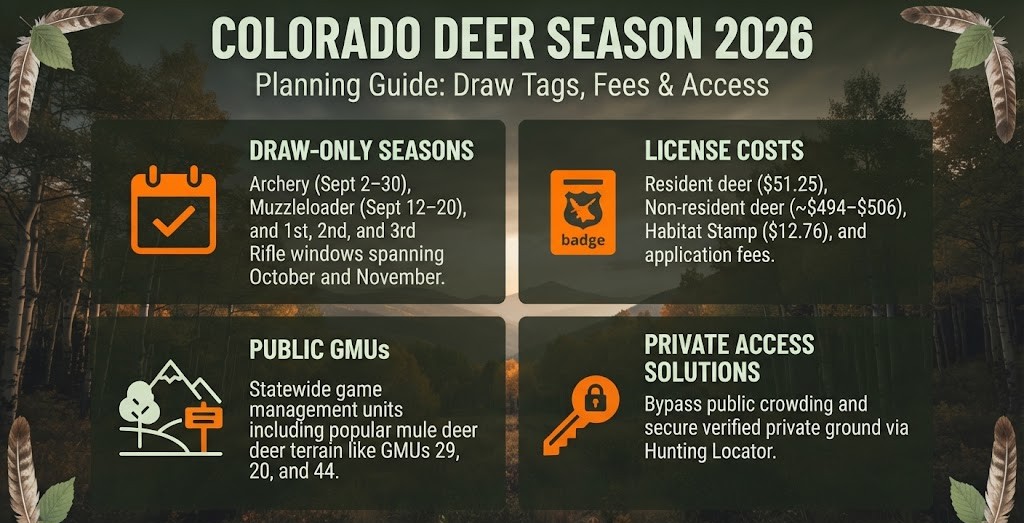
Quick Overview: Colorado 2026 Deer Season at a Glance
Colorado deer tags are draw-only for 2026. Instead of buying an over-the-counter tag at a shop, you apply through a limited draw and hope your number comes up for a specific game management unit, or GMU — the geographic zone where your tag is valid. That fact shapes everything else in this guide.
Here’s how the 2026 season breaks down by weapon type:
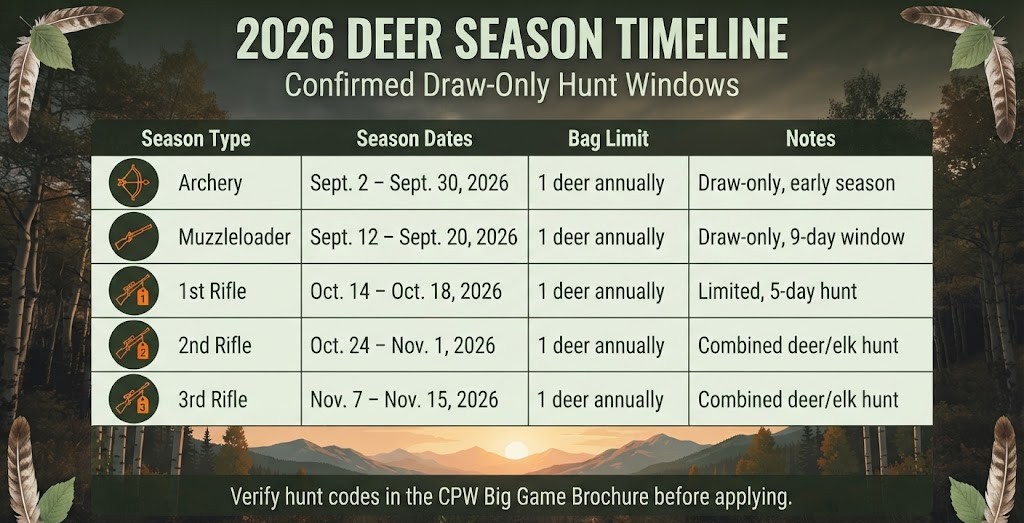
| Season Type | Dates (2026) | Notes |
|---|---|---|
| Archery | Sept 2 – Sept 30, 2026 | Draw only |
| Muzzleloader | Sept 12 – Sept 20, 2026 | Draw only |
| 1st Rifle | Oct 14 – Oct 18, 2026 | Limited, 5-day hunt |
| 2nd Rifle | Oct 24 – Nov 1, 2026 | Combined deer/elk |
| 3rd Rifle | Nov 7 – Nov 15, 2026 | Combined deer/elk |
Confirm these dates against your physical license and the current 2026 Big Game Brochure before you head out — CPW updates hunt codes and boundaries year to year, and your license is the final authority.
Colorado’s general bag limit is one deer per hunter annually. Your specific hunt code — List A, B, or C — determines what you can take: each list designates a particular sex (buck or doe) and a specific GMU, so your license tells you precisely where and what you’re allowed to harvest.
Before you can apply for a tag, a few requirements have to be checked off:
- Hunter education — required for anyone born on or after Jan 1, 1949; new hunters must complete it before buying a license
- Qualifying license — a qualifying hunting license (such as small-game) must be purchased before applying for the big-game draw
- Habitat stamp — required for hunters ages 18–64 ($12.76 annual)
- Draw application — the main draw deadline is April 7, 2026
Colorado also shifted to a new multi-year Big Game Season Structure covering 2025 through 2029, so even veteran hunters should check the 2025–2029 season structure rather than assume last year’s rules still apply. For the complete regulatory picture, Colorado Parks & Wildlife publishes the definitive Big Game Brochure every year — that’s the source of truth when dates or hunt codes are in question.
Colorado Deer Hunting Seasons
Colorado structures its deer seasons around weapon type, and for 2026, every one of them is draw-only. Archers, muzzleloader hunters, and rifle hunters all need to apply and draw a tag before heading into the field. Here’s what sets each season apart.
Archery Season (Sept 2 – Sept 30, 2026)
This early window rewards hunters willing to get close — deer haven’t been pushed by rifle pressure yet, and the aspens are turning gold. At nearly a full month, it’s the longest window of any weapon season. The trade-off is that bow hunting demands closer range and sharper stalking skills than a rifle hunt.
Muzzleloader Season (Sept 12 – Sept 20, 2026)
Muzzleloader season runs a tight nine days and overlaps with the tail end of archery. A muzzleloader is a single-shot, front-loading rifle that splits the difference between primitive bow hunting and a modern rifle setup — a bit more range than archery, but still a slower, more deliberate shot process.
Rifle Seasons (1st, 2nd, 3rd)
Rifle season comes in three windows, each with its own character:
| Season | Dates (2026) | What Makes It Different |
|---|---|---|
| 1st Rifle | Oct 14 – Oct 18 | Limited, 5-day hunt with fewer hunt codes available |
| 2nd Rifle | Oct 24 – Nov 1 | Combined deer/elk — hunt both species with the right licenses |
| 3rd Rifle | Nov 7 – Nov 15 | Combined deer/elk, later-season timing |
The 2nd and 3rd rifle seasons both allow combined deer/elk hunting, meaning you can pursue both species in the same window if you’re carrying the right licenses for each. Timing matters: deer spread out across higher terrain during the early seasons, then concentrate at lower elevations as weather and snow push them down by late October and early November. Cross-check the final 3rd rifle date against your license before planning your last hunt of the year.
Colorado Deer Licenses and Permits
Colorado deer hunting requires a license plus a habitat stamp, and for nearly every hunt code, you’ll go through the draw first. Here’s what that costs and how the process works.
Colorado Hunting Licenses
The table below breaks down the fees to budget for in 2026:
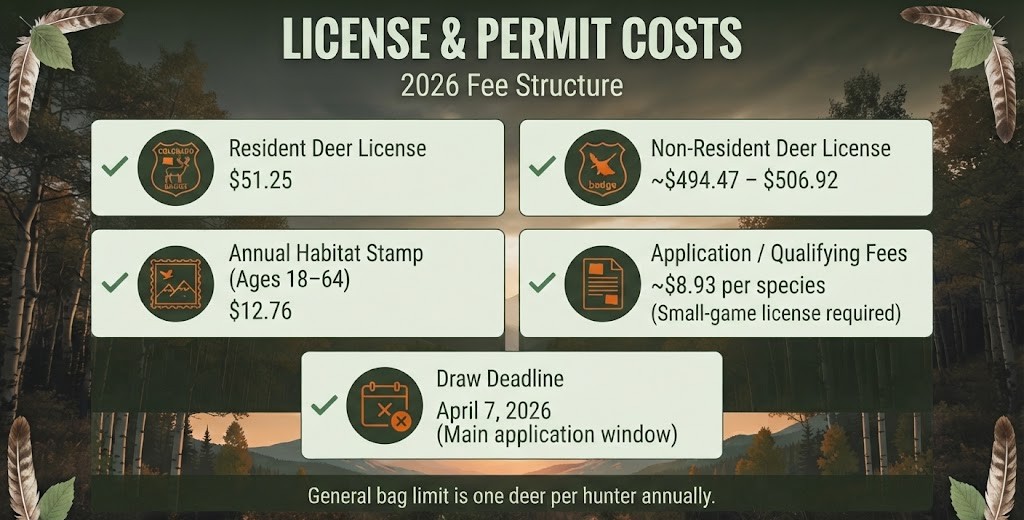
| License / Fee | Cost (2026) | Notes |
|---|---|---|
| Resident Deer License | $51 | Or $49.15 base depending on qualifying add-ons |
| Nonresident Deer License | ~$494.47 – $506.92 | Varies by specific draw/management fees |
| Habitat Stamp (ages 18–64) | $12.76 | Required annually |
| Application / Qualifying Fees | ~$8.93 per species | Plus required small-game qualifying license for the draw |
For nonresidents, one commonly referenced figure for the deer/fishing combo license lands at $506.92, though your nonresident deer license fee can shift depending on the exact hunt code and combo you select.
These totals can include small statutory add-ons — a search-and-rescue fee and a contribution to the Wildlife Education Fund — that stack on top of the base license cost. The CPW Shop shows your final payable total before checkout. If you’re between 18 and 64, the habitat stamp is mandatory before you can buy or apply for a license, resident or not. Budget for the full stack — license, stamp, qualifying license, and application fees — rather than just the headline number.
Colorado Hunting Permits & the Draw
Nearly every Colorado deer hunt — archery, muzzleloader, and all three rifle seasons — is a limited, draw-only permit rather than something you can buy over the counter. You’re allowed one deer per hunter annually, and you’ll purchase your license and submit your draw application directly through CPW or the CPW Shop online.
The 2026 timeline: the application window runs March 1 through April 7, draw results release in late May, and any leftover licenses go on sale later in the summer for hunters who didn’t draw the first time. April 7 is the single most important date on your calendar.
Your hunt code falls under List A, B, or C — designations that specify which sex and which GMU your license covers. There’s also an alternate path worth knowing: landowner vouchers, which some private landowners can issue to grant hunting access outside the standard draw. If you’re applying as a non-resident, a capped percentage of licenses in each hunt code is set aside for out-of-state hunters, which is why applying early and strategically matters for your odds.
Where to Hunt Deer in Colorado
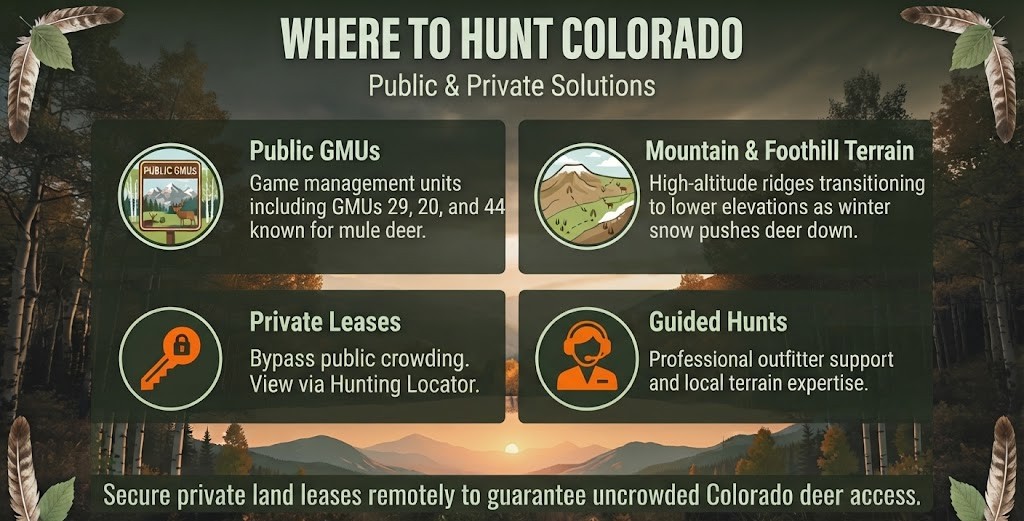
Once your license and tag are sorted, the real question is where you’re actually going to hunt. Colorado hunters generally have three paths: public land, which is free but often crowded; private leases, which trade a cost for access and less competition; and guided hunts, which bring in extra support for hunters who want it.
Best Public Lands
Colorado has plenty of free, legitimate public hunting land — a solid option if you’re working with a tighter budget. Some GMUs consistently stand out for quality mule deer hunting:
- GMU 29
- GMU 20
- GMU 44
For a deeper look at top Colorado deer GMUs, including terrain breakdowns and access points, our blog covers each unit in more detail. Public land here ranges from beginner-friendly terrain to genuinely challenging backcountry, so there’s an option across experience levels. The trade-off: popular GMUs draw plenty of company during rifle season, and pressured deer get harder to find as the week goes on.
Private Land Hunting with Hunting Locator
That pressure is why so many hunters — resident and non-resident alike — turn to private land. You’ve got two real paths: leasing land for the season, or buying a piece of hunting ground outright. Both get you away from the crowds and onto ground where deer haven’t been pushed around by a dozen other hunters.
Leasing works simply: you secure exclusive or semi-exclusive access to a landowner’s property for the season, which means better odds, less competition, and a hunt on your terms. It’s a strong option for non-residents who don’t want to gamble their entire trip on a crowded public GMU, and for residents tired of losing good spots to whoever gets there first.
This is where Hunting Locator does its best work. We connect hunters directly with landowners across Colorado who are ready to lease or sell their land for hunting — no middleman, no guesswork about whether a listing is legitimate. You browse available properties, connect with the landowner, and secure your access before the season fills up. With limited time to scout before opening day, having a trusted place to search saves you weeks of cold-calling landowners on your own.
Browse current Colorado deer leases and lock in your access before the good ground gets claimed.
Guided Hunts
If you’d rather not navigate unfamiliar terrain alone, a guided hunt is worth considering. Guided hunts tend to suit a specific set of hunters:
- Non-residents unfamiliar with Colorado terrain who want local knowledge of deer movement and access points
- Beginners wanting mentorship through their first real hunt, from scouting to field dressing
- Time-scarce hunters who need to make the most of a short trip without days of trial and error
Many private-land opportunities come bundled with outfitter or landowner support, so the same relationships that get you access to quality ground can also connect you with guidance when you want it.
Colorado Deer Hunting Tips
A successful 2026 hunt comes down to preparation more than luck. Fundamentals worth building your season around:
- Scout before the season — learn deer movement, water sources, and bedding areas in your GMU before opening day
- Follow the elevation — deer concentrate at lower elevations as snow pushes them down in late October and early November
- Match your weapon to the season — pick archery, muzzleloader, or rifle based on your skill level and whichever tag you actually draw
- Dress for the mountains — Colorado weather swings fast, so layer for cold mornings and warmer midday temperatures
- Gear up early — quality optics, a reliable pack, and weather layers tend to sell out as opening day approaches
Solid binoculars for glassing distant ridgelines, a pack that can handle a long day in rough terrain, and layers that adapt to swinging mountain weather are worth prioritizing before you head out. To fill gaps in your kit, our hunting gear and optics selection is built for this kind of season.
More Resources from Hunting Locator
Beyond this guide, we’ve built a handful of resources to help you plan every angle of your 2026 Colorado hunt:
- Colorado hunting leases — browse private-land deer leases and connect directly with landowners across Colorado
- Hunting Locator store — gear, optics, and essentials to prep for the season ahead
- Colorado hunting seasons guide — deeper context on the 2025–2029 Big Game Season Structure and key application deadlines
- Colorado deer hunting blog — GMU breakdowns, mule deer vs. whitetail insight, and season strategy
Frequently Asked Questions
What are the Colorado deer season dates for 2026?
Archery runs September 2–30, muzzleloader runs September 12–20, 1st rifle runs October 14–18, 2nd rifle runs October 24–November 1, and 3rd rifle runs November 7–15. All are draw-only for 2026. Verify these against your physical license and CPW’s Big Game Brochure before heading out.
How much does a nonresident Colorado deer license cost in 2026?
Nonresident deer licenses run roughly $494.47 to $506.92 depending on the specific draw and management fees attached to your hunt code. On top of that, budget for the $12.76 habitat stamp (ages 18–64) and around $8.93 in application fees. The CPW Shop displays your exact final payable total.
Do I have to enter a draw to hunt deer in Colorado?
Yes. Nearly all Colorado deer tags for 2026 are draw-only rather than over-the-counter. The main application window runs March 1 through April 7, 2026, with draw results released in late May and any leftover licenses going on sale later that summer.
What is a habitat stamp and do I need one?
It’s a $12.76 annual stamp required for every hunter aged 18 to 64, funding wildlife habitat programs across the state. You must have it before you can buy or apply for a hunting license, and it applies equally to residents and non-residents.
What is a GMU in Colorado hunting?
A GMU, or game management unit, is a designated geographic zone with its own regulations, season dates, and access points. Your license and hunt code specify exactly which GMU and which sex — buck or doe — you’re permitted to hunt. GMUs 29, 20, and 44 are known for particularly strong mule deer hunting.
Where can I find private land to hunt deer in Colorado?
Hunting Locator connects hunters directly with landowners across Colorado who are leasing or selling hunting land, giving you a lower-pressure alternative to crowded public units. Browse current Colorado deer leases to see what’s available for the 2026 season.
What license does a first-time deer hunter need in Colorado?
New hunters need a hunter education card (from Colorado or their home state), a qualifying hunting license to enter the draw, the deer license itself, and a habitat stamp if they’re between 18 and 64. Check with CPW directly for hunter-education course details and requirements.
The Final Shot
Success in Colorado’s 2026 deer season comes down to knowing your dates, budgeting the full cost of your license and stamps, and locking in your access before someone else does. The April 7, 2026, draw deadline is the pivot point — miss it, and you’re waiting on next year’s season instead of this one.
Start simple: confirm your season and dates with CPW, plan your license purchase and draw application around the April deadline, and then decide where you’re actually going to hunt. For final regulatory details, hours, and any late-season corrections, Colorado Parks & Wildlife and the current Big Game Brochure remain the source of truth — double-check your physical license before you head afield.
We focus on land access and planning, and we’ll always point you back to CPW on the regulations. When you’re ready to stop competing for pressured public ground, browse Colorado deer leases and secure your spot for the 2026 season.


