This Colorado elk guide covers the 2026 season dates, license costs, land-access options, and gear basics in one place, useful whether you’re a resident working out preference points or a non-resident booking a first trip west.
Here’s what you’ll find below:
- Exact 2026 season dates by hunting method and what they mean for your hunt
- License, permit, and fee breakdowns for both residents and non-residents
- Where to hunt — public land, private leases, and guided options
Start with the numbers.
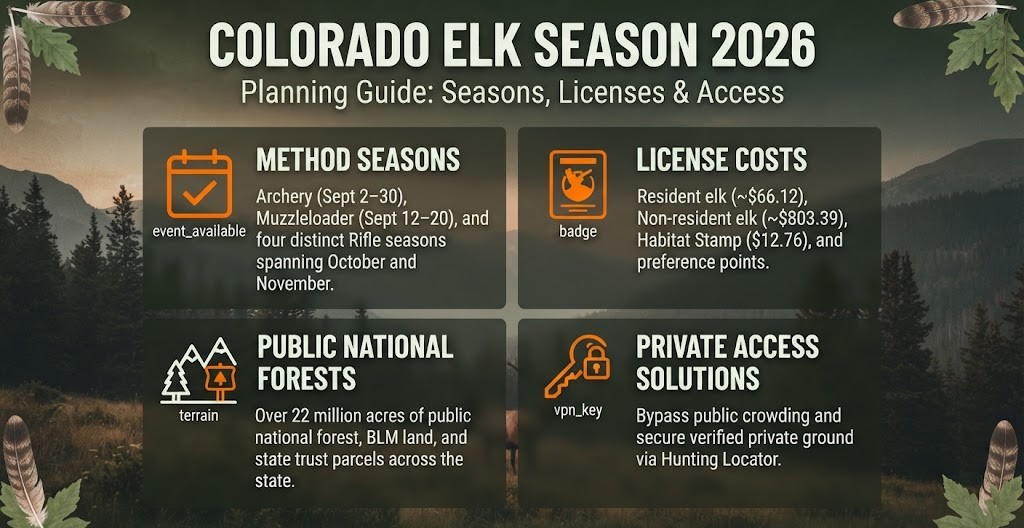
Quick Overview: 2026 Colorado Elk Seasons at a Glance
Confirmed dates, license types, and bag limits for every hunting method:
| Season Type | Dates (2026) | License Type | Bag Limit | Notes |
|---|---|---|---|---|
| Archery | Sept 2 – 30, 2026 | Draw/OTC varies | One elk per legal license | Non-resident OTC archery restricted west of I-25 & GMU 140 |
| Muzzleloader | Sept 12 – 20, 2026 | Limited/Draw | One elk per legal license | .50 caliber min; no scopes |
| 1st Rifle | Oct 14 – 18, 2026 | Limited (draw) | One elk per legal license | Limited license only |
| 2nd Rifle | Oct 24 – Nov 1, 2026 | OTC/Limited | One elk per legal license | OTC options available |
| 3rd Rifle | Nov 7 – 15, 2026 | OTC/Limited | One elk per legal license | OTC options available |
| 4th Rifle | Nov 18 – 22, 2026 | Limited (draw) | One elk per legal license | Limited license only |
Non-residents can no longer buy over-the-counter archery elk licenses for GMUs west of I-25 or GMU 140 — these are draw-only starting this year. It’s one of the biggest shifts coming out of the 2026 Colorado season structure changes, and it changes how out-of-state bowhunters need to plan.
Beyond the season you choose, Colorado requires a handful of licenses, stamps, and certifications before you’re legal in the field:
- Valid elk license — resident licenses run about $66.12; non-resident licenses run about $803.39 (2026 estimates & rates)
- Habitat Stamp — required for hunters ages 18–64 at $12.76 per year; funds go toward wildlife habitat conservation and it’s required to purchase most licenses
- Hunter education — required for hunters born on or after January 1, 1949, per Colorado Parks and Wildlife
- Preference points — an optional draw-strategy tool costing $40 for residents and $100 for non-residents, used to improve your odds in future draws for limited units
Per the official Colorado Parks and Wildlife elk page, all license fees include a $1.25 search-and-rescue fee and a $1.50 Wildlife Education Fund fee where applicable — small add-ons worth budgeting for.
A quick note on terminology: a GMU is a Game Management Unit (Colorado’s way of dividing hunting land into specific zones), OTC means over-the-counter (no draw required), and bag limit refers to how many animals your license legally allows you to harvest.
Colorado Elk Hunting Seasons
Colorado structures its elk seasons by weapon type, running from early-September archery through late-November rifle. The dates below reflect confirmed 2026 research for this guide, but cross-check final details against the official CPW brochure before locking in travel plans.
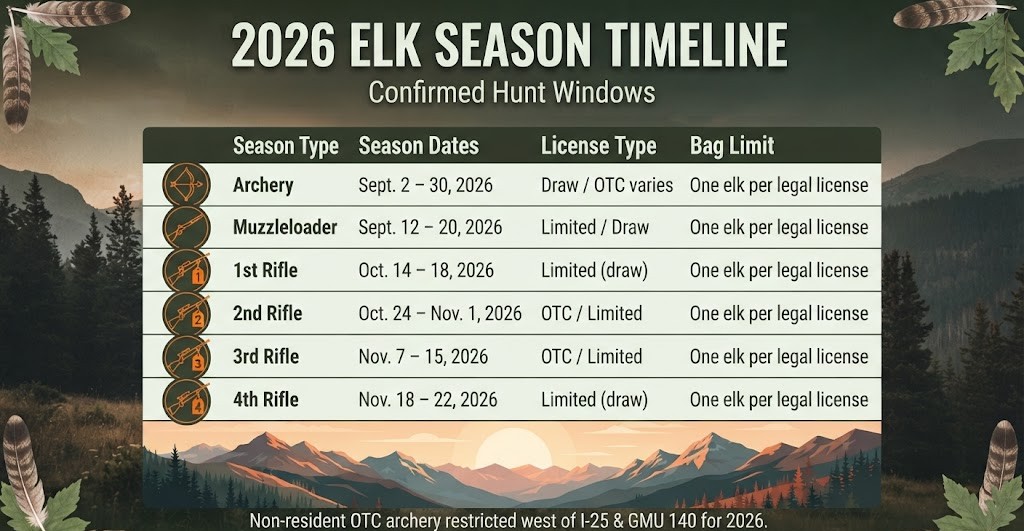
Archery Season (Sept 2 – 30, 2026)
Archery season runs September 2 through September 30, 2026 — the longest window of any Colorado elk season and prime time to catch bulls still bugling during the rut. Only recurve, compound, or longbows are legal; crossbows are prohibited unless medically permitted.
The biggest planning change for 2026 hits archery hunters hardest: non-resident OTC archery licenses are no longer available west of I-25 or in GMU 140, and these areas are now draw-only. If you’re new to bowhunting elk, know that it demands close-range skill, patience, and solid physical conditioning — closing the distance on a bull in thick timber is not easy.
Muzzleloader Season (Sept 12 – 20, 2026)
Muzzleloader season runs September 12 through September 20, 2026, overlapping the rut and offering a shorter, less-crowded window than rifle season. It’s a limited/draw season, so plan your application accordingly.
Weapons must be at least .50 caliber, with no pelletized powder and no scopes allowed. For hunters who want a primitive-weapon challenge without the full archery skill requirement, this season hits a reasonable middle ground.
Rifle Seasons (Four Seasons, October – November 2026)
Colorado runs four distinct rifle seasons, each with its own dates and license structure:
- 1st Rifle (Limited): October 14 – 18, 2026 — draw only, no OTC option
- 2nd Rifle (OTC/Limited): October 24 – November 1, 2026 — OTC licenses available in eligible units
- 3rd Rifle (OTC/Limited): November 7 – 15, 2026 — OTC licenses available in eligible units
- 4th Rifle (Limited): November 18 – 22, 2026 — draw only, no OTC option
For hunters who don’t want to build preference points, 2nd and 3rd rifle offer the fastest path into the field since OTC options are available. Earlier seasons tend to see less snow and less elk migration, while later seasons can push herds down to lower elevations — worth weighing against your own hunting style.
Some units saw changes for 2026: the Colorado Parks and Wildlife Commission eliminated OTC bull elk tags for 2nd and 3rd rifle in the Gunnison Basin (GMUs 54, 55, and 551). Confirm your specific GMU’s current rules directly with CPW before finalizing plans.
Colorado Elk Licenses and Permits
Once you know when you’re hunting, the next question is cost and eligibility. Here’s the breakdown of Colorado’s elk licensing system for both residents and non-residents.
Colorado Elk Hunting Licenses
Colorado’s elk license fees vary significantly between residents and non-residents, with several required add-ons stacking onto the base license cost.
| License / Fee | Resident | Non-Resident | Notes |
|---|---|---|---|
| Elk License | ~$66.12 | ~$803.39 | Bull, either-sex, or cow variations by hunt code |
| Habitat Stamp | $12.76/yr | $12.76/yr | Required, ages 18–64 |
| Preference Point Fee | $40.00 | $100 | Optional draw-strategy tool |
These figures are 2026 estimates & rates, and all CPW license fees include the $1.25 search-and-rescue and $1.50 Wildlife Education Fund add-ons where applicable. Your bag limit is one elk per legal elk license, but the specific sex and antler rules depend on your hunt code. An antlerless license means you can only harvest a cow or calf without antlers, while an either-sex license lets you take a bull or a cow, depending on what you draw or purchase.
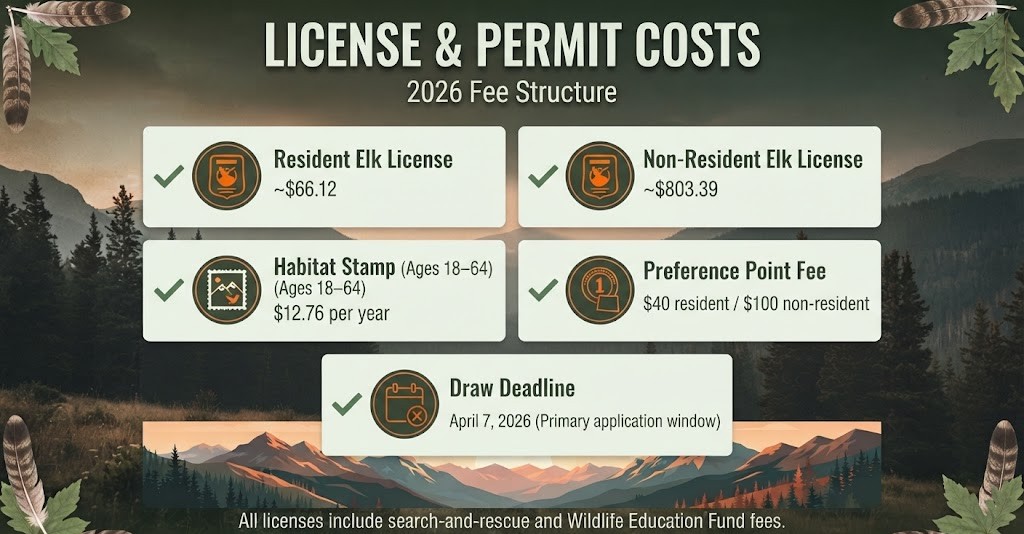
Colorado Elk Hunting Permits & the Draw
Colorado’s draw system is the key to landing a quality tag, especially for limited units. Here’s how the 2026 timeline breaks down:
- Primary draw opens — March 1, 2026, when applications become available through CPW
- Primary draw deadline — April 7, 2026, at 8:00 p.m. MST
- Results posted — Beginning May 26, 2026
- Secondary draw opens — Around June 19, 2026, for hunters who didn’t draw in the primary round
- Leftover licenses — Become available after both draws are complete
Licenses and preference points are purchased directly through Colorado Parks and Wildlife — online, by phone, or through a licensed agent.
Preference points accumulate over time and improve your odds of drawing limited units in future seasons. Many hunters follow a simple strategy: hunt OTC or second-choice units while building points, then spend those points every few years on a premium hunt. It’s not a one-size-fits-all rule, but it’s a common approach worth considering.
If you’re a non-resident counting on an OTC license, don’t wait until the last minute. These licenses typically go on sale in early August and can sell out within minutes for popular units.
Where to Hunt Elk in Colorado
Knowing when to hunt only gets you halfway there — where you hunt matters just as much. Colorado hunters generally choose between three paths: public land, private land, and guided hunts. Each comes with its own trade-offs in cost, competition, and convenience.
Best Public Lands
Colorado offers over 22 million acres of public hunting land, giving both residents and visiting hunters plenty of room to roam. Here’s where most public-land elk hunters focus their efforts:
- National Forests — Vast, elk-rich terrain spanning multiple GMUs, ideal for backcountry hunts
- BLM Land — Bureau of Land Management acreage offering additional public access across the state
- State Trust Lands — Public parcels that supplement National Forest and BLM options
- Northwest Colorado / Meeker area — Commonly cited as beginner-friendly, elk-rich country with a mix of meadows, forests, and mountains
Public land can get crowded during rifle seasons, especially in popular units, and it’s not uncommon for the elk you’re after to be found two or more miles from the nearest trailhead. A solid GPS mapping app goes a long way toward finding pressure-free terrain and staying clear of trespassing issues.
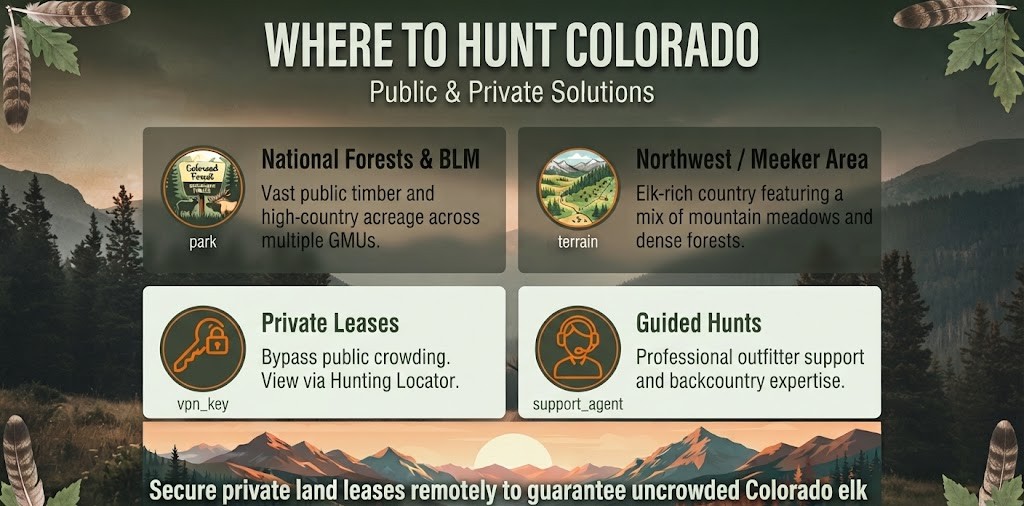
Private Land Hunting with Hunting Locator
If public-land crowding or draw odds have you looking for another way in, private land offers two paths: leasing access for a season or more, or buying land outright for long-term hunting rights. Hunters turn to private ground mainly for less competition and more consistent access, away from the crowded OTC units that see heavy pressure every fall.
That’s where Hunting Locator comes in. We connect hunters directly with landowners who are ready to lease or sell their land for hunting — no middleman guesswork, no cold-calling strangers, just a way to find ground you can legally hunt this season. Whether you’re searching for a multi-year lease near your home unit or looking to buy a piece of Colorado elk country outright, you can browse Colorado elk hunting leases and connect directly with landowners who understand what hunters are looking for.
Some private land can also open doors to landowner-voucher opportunities in certain units through Colorado’s Landowner Preference Program, which generally requires qualifying acreage and consistent elk activity on the property. Confirm specifics with CPW, since requirements vary by unit.
Whether you’re a resident looking to skip the draw entirely or a non-resident who wants certainty before booking travel, private land access removes a major variable from your hunt planning.
Guided Hunts
For hunters who want local knowledge, handled logistics, and better odds on unfamiliar terrain, a guided hunt is worth considering. Colorado supports everything from fully DIY public-land hunts to semi-guided packages, drop camps, and fully outfitted trips.
Guided hunts tend to suit two types of hunters especially well: first-timers who want an experienced hand showing them the ropes, and time-limited non-residents who can’t afford to burn vacation days scouting unfamiliar country. Colorado requires registered outfitters to be bonded and insured, which adds a layer of accountability to the arrangement.
The choice between guided and DIY comes down to budget, timeline, and comfort level in the backcountry. For hunters exploring their land-access options further, the More Resources section below and the Colorado leases page are good starting points.
Elk Hunting Tips for 2026
Success in elk country comes down to preparation as much as opportunity. These are fundamentals many Colorado elk hunters rely on, season after season:
- Get in shape early and acclimate to elevation. Colorado elk live in steep, high-elevation country. Start building cardio months ahead, and if you’re coming from lower elevation, arrive a day or two early to reduce your risk of altitude sickness.
- Learn elk sign and behavior. Know what fresh sign looks like, understand food sources, and study bedding and travel patterns before you ever step into the field.
- Dress in layers. Choose merino wool or quick-dry synthetics for your base layers and socks, and skip cotton entirely — Colorado weather swings fast, and you need gear that keeps up.
- Navigate smart. A reliable GPS or mapping app helps you find pressure-free ground and stay clear of private property boundaries you didn’t mean to cross.
- Go where others won’t. Elk taken on public land are frequently found well beyond the trailhead — the extra mile often makes the difference.
- Practice basic elk calling. A few well-timed bugles or cow calls can turn a quiet morning into an active one, even for beginners.
If you need to round out your layering system or pick up new navigation tools before the season opens, check out the elk hunting gear in our store before you head into the backcountry.
More Resources from Hunting Locator
Planning tools for the 2026 season:
- Land Access: Colorado Hunting Leases — Browse current private-land leases across Colorado to secure legal elk access before the season fills up.
- Gear: Hunting Locator Store — Shop layering, navigation, and field gear for a 2026 Colorado elk hunt.
- Planning/Regulations: Colorado Hunting Seasons Guide — A deeper look at the 2026 Big Game Season Structure and the OTC restriction changes affecting non-residents.
Frequently Asked Questions
What are the 2026 Colorado elk season dates?
Archery runs September 2–30; muzzleloader runs September 12–20; 1st Rifle runs October 14–18; 2nd Rifle runs October 24–November 1; 3rd Rifle runs November 7–15; and 4th Rifle runs November 18–22, 2026. Confirm final dates against the official CPW brochure before booking travel.
How much does a non-resident elk license cost in Colorado in 2026?
Expect to pay approximately $803.39 for a non-resident elk license in 2026, plus the required $12.76 habitat stamp and applicable CPW add-on fees. If you’re building preference points, the non-resident fee is $100 per point. Exact costs vary depending on your specific hunt code.
Do I need hunter education to hunt elk in Colorado?
Yes — Colorado Parks and Wildlife requires hunters born on or after January 1, 1949, to complete a hunter education course before purchasing a license. Courses are widely available online and in person, and most hunters complete the requirement quickly.
What is the 2026 Colorado elk draw deadline?
The primary draw opens March 1, 2026, and closes April 7, 2026, at 8:00 p.m. MST, with results posted beginning May 26 and a secondary draw following in June. Missing the primary deadline significantly reduces your odds of drawing a premium unit.
Can non-residents still buy over-the-counter archery elk tags in Colorado?
Not west of I-25 or in GMU 140 — those areas are now draw-only for 2026, a change made by the Colorado Parks and Wildlife Commission. OTC archery options remain available in eligible units elsewhere, along with OTC options in certain rifle seasons.
Where can I legally hunt elk in Colorado without drawing a public tag?
Hunt OTC-eligible public units during 2nd or 3rd rifle season, or secure private-land access through a lease. Browsing Colorado leases through Hunting Locator gives you a way to lock in legal ground without competing for crowded public units or waiting on a draw.
The Final Shot
Planning a successful 2026 Colorado elk hunt comes down to three things: knowing your season dates, budgeting for your license and fees, and locking in where you’ll actually hunt. Keep the two biggest 2026 changes in mind — non-resident OTC archery restrictions west of I-25 and GMU 140, and unit-specific tag eliminations like those in the Gunnison Basin — and verify the fine print against the official CPW brochure before you finalize your plans.
The next-move checklist is simple: confirm your season and hunting method, sort out your license or preference points before the April 7 deadline, and secure your access now rather than waiting until the crowds show up. Hunting Locator exists to make that last step simple — connecting you directly with landowners who have quality Colorado elk ground ready to lease or sell, without the last-minute scramble for access.
Browse Colorado elk hunting leases today and take the guesswork out of your 2026 Colorado elk hunt.


