This guide covers Colorado moose seasons for two groups: 2026 tag holders in the field now, and the larger group of residents and non-residents planning for the 2027 primary draw. Hunting Locator connects hunters with private land, outfitters, and gear.
Inside:
- 2026 season dates, bag limits, and the once-in-a-lifetime bull rule
- Licenses, total costs, and how the CPW draw and points work
- Where to hunt (public land, private leases, guided hunts), plus field tips and gear
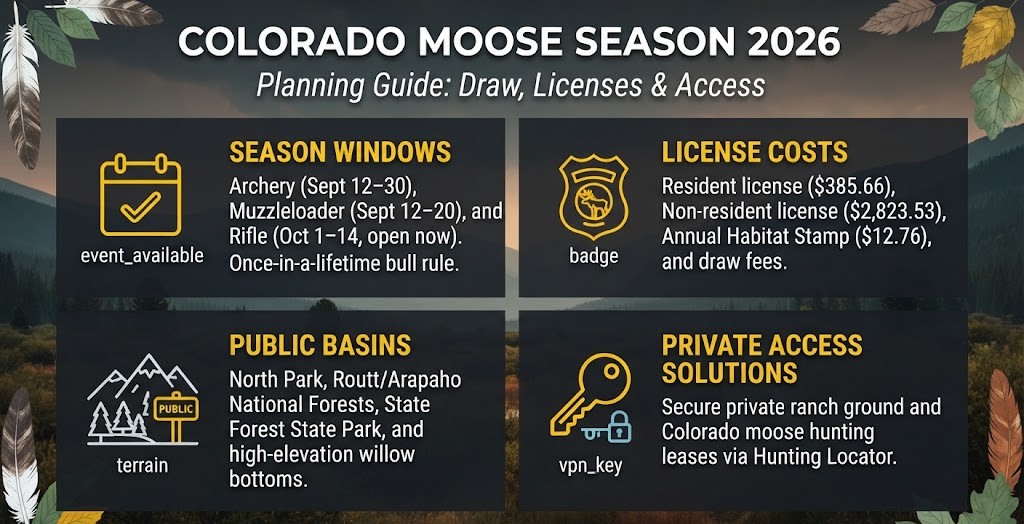
Colorado Moose Season 2026: Quick Overview
Colorado moose season has three methods in 2026: archery September 12–30, muzzleloader September 12–20, and rifle October 1–14. Every license is limited-entry through the Colorado Parks and Wildlife (CPW) primary draw, and you may take one antlered moose per lifetime.
| Season | Dates | Method | Bag Limit | Notes |
|---|---|---|---|---|
| Archery | Sept 12–30, 2026 | Archery | 1 moose per license; 1 antlered per lifetime | Overlaps the September rut; closed |
| Muzzleloader | Sept 12–20, 2026 | Muzzleloader | Same | Short rut window; closed |
| Rifle | Oct 1–14, 2026 | Rifle (antlered and antlerless) | Same | Open now; hunt-code dates can vary |
Before you apply or head afield, make sure these requirements are covered:
- Hunter education: Required for anyone born on or after January 1, 1949, per CPW.
- Annual Habitat Stamp: $12.76, required for ages 18–64.
- Qualifying license: Required if applicable. Confirm with CPW.
- Draw application: A successful CPW primary draw application is required for every moose license.
Before you go: Rifle and other hunt-code dates can vary, so confirm your code in the current CPW big game brochure.
If you drew a tag, private access can shape the hunt. Browse Colorado leases before your next trip.
Colorado Moose Hunting Seasons
Colorado splits moose hunting into three “manner of take” seasons for its Shiras moose. Antlered and either-sex licenses are valid in every season, which is what season choice means. Cow licenses are limited to one season.
If you’re pairing a moose tag with a deer or elk hunt, our guides to Colorado elk hunting season and Colorado deer hunting season can help you plan the trips together.
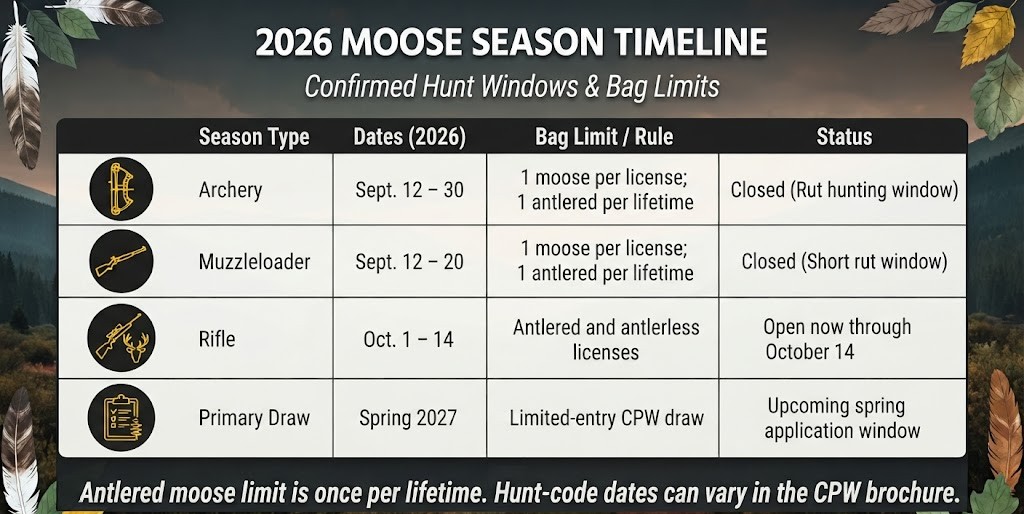
Archery Season (Sept 12–30)
Archery season has closed for 2026. It falls during the September rut, when cow moans and grunts can bring a bull in close. Shots come at short range and reward patience. For 2027, archery suits hunters who want the rut and a quieter backcountry.
Muzzleloader Season (Sept 12–20)
Muzzleloader is the shortest window and has also closed. Its rut timing matches archery. It sits between bow and rifle in effective range, which makes it a reasonable choice for 2027 if you want rut activity with a bit more reach.
Rifle Season (Oct 1–14)
Rifle season is open now through October 14 and covers antlered and antlerless licenses. By October, moose are post-rut and feeding in willow bottoms along creeks and lakes. Glass from ridges, then move slowly with the wind in your face.
Weather can swing from freezing mornings to warm afternoons, so meat care matters. Hunt-code dates can vary, so check the CPW brochure for your code.
Colorado Moose Licenses and Permits
Every moose license is limited-entry through the CPW primary draw. For statewide license basics, see our Colorado hunting guide. The sections below cover license types, the lifetime rule, points, and costs.
Colorado Hunting Licenses
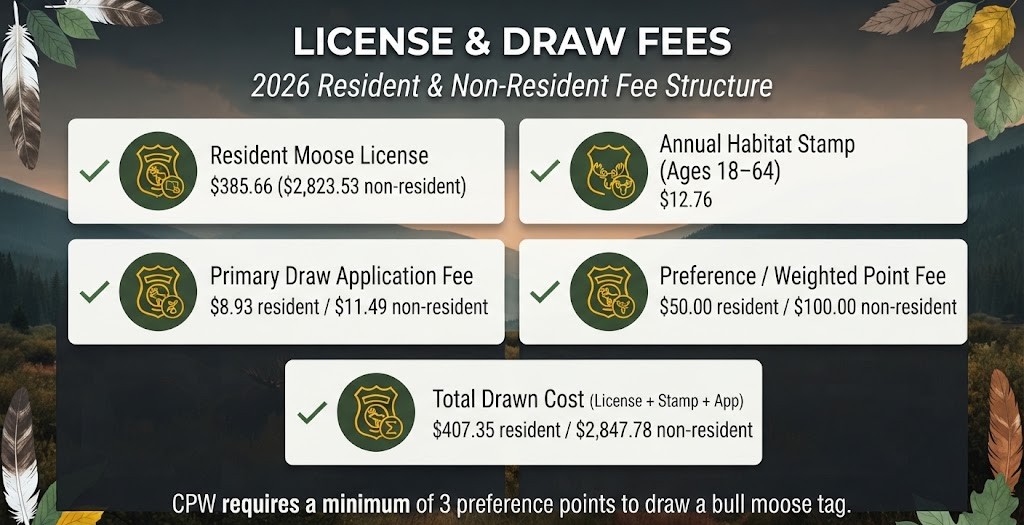
A resident moose license costs $385.66 and a non-resident license costs $2,823.53. Add the $12.76 Annual Habitat Stamp (ages 18–64) and an application fee of $8.93 for residents or $11.49 for non-residents. Moose point fees are $50 for residents and $100 for non-residents.
Colorado offers three moose license types:
- Bull (antlered): Valid in any season you choose.
- Cow (antlerless): Limited to one season.
- Either-sex: Valid in any season you choose.
Harvesting an antlered moose prevents you from applying for antlered or either-sex licenses in future draws. A cow tag lets you hunt now and keep your bull eligibility. Antlerless licenses have no point minimum, per CPW.
| Item | Resident | Non-Resident |
|---|---|---|
| Moose license | $386 | $2,824 |
| Annual Habitat Stamp (18–64) | $12.76 | $12.76 |
| Application fee | $8.93 | $11.49 |
| Preference/weighted point fee | $50 | $100 |
| Total if drawn (license + stamp + app) | $407.35 | $2,848 |
| Total in a point-building year (stamp + app + point) | $71.69 | $124.25 |
CPW charges the point fee when you apply for a point code or are unsuccessful in drawing your first choice. A qualifying license may be required, so check with CPW. Travel, processing, taxidermy, and guide fees are extra. For the latest rules, see CPW’s official moose hunting page.
Colorado Hunting Permits
Moose permits come through the draw. A few terms are worth defining first:
- GMU: A game management unit, the geographic area tied to your hunt code.
- Preference point: A point earned each year you apply, similar to time in line.
- Weighted point: Weighted points add extra entries to a random drawing.
CPW requires a minimum of 3 preference points to draw a bull. The weighted drawing is still random, so points improve your chances without guaranteeing a tag. Non-residents compete for a small, CPW-capped share of licenses, so expect a longer timeline.
With more than 60,000 applicants for about 761 tags, drawing a bull can take many years, but each point you build counts toward it.
To apply:
- Complete hunter education, if you were born on or after January 1, 1949.
- Create or confirm your CPW account and buy the habitat stamp and any qualifying license.
- Research GMUs and hunt codes in the CPW brochure.
- Apply in the spring primary draw. Choose a hunt code or a point-only code.
- Check results around late May, as reported by Rocky Mountain PBS. Confirm exact 2027 dates with CPW.
- If you draw, line up access and gear early.
For context, Colorado’s moose population roughly tripled over 25 years, and 215 moose were transplanted from the late 1970s through 2010. CPW’s goal is to prevent over-browsing of willow and aspen communities.
Colorado Moose: Where to Hunt
Moose live in high mountain basins with riparian willow and aspen. Access, public and private, shapes your success.
Best Public Lands
These areas have established moose country. Check unit terrain and public land acreage in the CPW brochure before you commit.
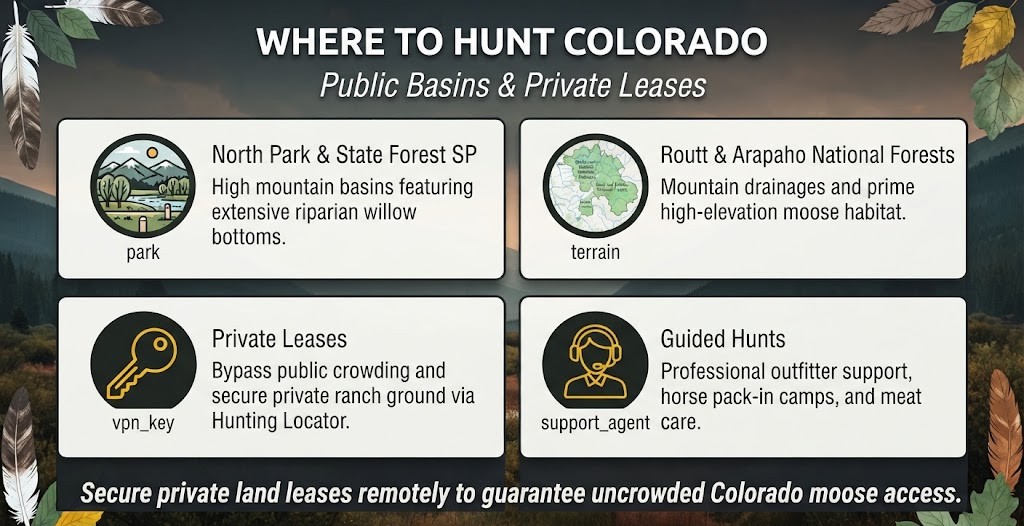
- North Park and State Forest State Park: High basins with extensive willow bottoms.
- Routt and Arapaho National Forests: Mountain drainages with riparian habitat.
- Grand Mesa National Forest: Large public acreage with aspen and willow pockets.
- The Flat Tops: Remote high country that rewards hunters willing to pack in.
- Rio Grande National Forest and the upper Rio Grande: Riparian corridors and high-elevation basins.
- The Front Range near Unit 19: Moose are seen regularly outside Fort Collins.
- Northwest Colorado’s Unit 12: Productive moose terrain in the state’s northwest.
Private Land Hunting with Hunting Locator
Moose concentrate on private willow bottoms and ranch ground. A Colorado hunting lease can improve access and reduce crowding. Leasing gives you seasonal access, while buying hunting land gives you long-term access to moose country.
Hunting Locator connects you directly with landowners who lease or sell land. Browse by state, game, and acreage, check each listing for terrain and game species, and reach out on your own timeline.
To start looking, browse Colorado hunting leases and explore land for sale.
Guided Hunts
A guided hunt removes much of the guesswork from a limited-entry tag. A weeklong hunt often includes horses, camp, food, and guiding.
Ask every outfitter these questions:
- Do they hold a license and permits?
- Which units do they hunt?
- What are the camp style and physical demands?
- How do they handle meat care and pack-out?
- What are the references, deposit, and refund terms if the tag isn’t drawn?
A guide makes the most sense for a non-resident unfamiliar with the terrain, short on time, or facing a remote pack-out. Check CPW rules for any guide requirements. You can connect with outfitters through Hunting Locator.
Moose Hunting Tips
A moose can weigh 1,000 pounds, so bring gear suited to the job. The Hunting Locator store is a good place to start. These tips cover the hunt and the recovery.
- Confirm bull vs. cow before you shoot: Look for antlers and the bell. Matching your tag is a legal and ethical duty.
- Glass willow bottoms at first light: Moose feed along creeks and lakes early in the day.
- Play the wind: Move slowly through timber with the wind in your face.
- Call during the rut: Use cow moans and grunts in September to draw in curious or territorial bulls.
- Choose ethical shot placement: Aim for the heart and lungs behind the shoulder. Most shots are at close range, and standard calibers such as .270, .30-06, or larger work well with quality bullets.
- Plan the pack-out before the shot: Bring game bags and a sturdy pack frame so you’re ready to move meat.
- Cool meat fast: Weather swings from freezing to warm, so quick cooling is essential.
- Bring quality optics: A good set of binoculars and a rangefinder helps you find moose in timber and willow.
- Know proof-of-sex and inspection rules: Confirm requirements in the CPW brochure.
- Stay alert in moose country: Moose are not typically aggressive, but a cow protecting her young can be dangerous. Bears share this habitat too, so read our Colorado black bear hunting season guide.
For gear, the Hunting Locator store carries what you need.
More Resources from Hunting Locator
These Hunting Locator guides cover the rest of Colorado’s hunting seasons.
Colorado essentials
- Hunting in Colorado: The statewide overview for licenses, regulations, and land.
- Colorado moose hunting season: An evergreen companion to this guide.
Big game
- Colorado elk hunting season: Seasons and strategy for elk.
- Colorado deer hunting season: Seasons and tips for mule deer and whitetail.
- Colorado black bear hunting season: What to know before you hunt bear.
- Colorado mountain lion hunting season: Seasons and regulations for lion.
- Colorado pronghorn hunting season: Antelope on the plains.
Spring and upland
- Colorado turkey hunting season: Spring and fall turkey details.
- Colorado upland game hunting season: Pheasant, grouse, and more.
Birds and waterfowl
- Colorado waterfowl hunting season: Ducks and geese.
- Colorado sandhill crane hunting season: Season details for cranes.
FAQ
When is the Colorado moose season in 2026?
Archery runs September 12–30, muzzleloader September 12–20, and rifle October 1–14. Hunt codes can vary, so check the current CPW big game brochure to confirm the dates for your specific code before you head out.
How much is a non-resident Colorado moose license?
A non-resident moose license costs $2,823.53. Add the $12.76 Annual Habitat Stamp and the $11.49 application fee, and the drawn total comes to $2,847.78. Travel, processing, and guide costs are extra.
How many points do I need for a bull?
CPW requires a minimum of 3 preference points to draw a bull moose. Weighted points improve your chances by adding extra entries, but the drawing is still random, so points never guarantee a tag.
Is the bull moose limit once in a lifetime?
Yes. You may take one antlered moose per lifetime. Harvesting an antlered moose prevents you from applying for antlered or either-sex licenses in future draws. A cow tag lets you hunt now while keeping your bull eligibility.
Can I hunt every Colorado moose season with my tag?
It depends on your license. Antlered and either-sex licenses are season choice, valid in archery, muzzleloader, and rifle. Cow licenses are limited to one season, so check your hunt code before you plan.
Do I need hunter education?
Yes, if you were born on or after January 1, 1949. Complete the course before you apply, and confirm current requirements with CPW.
Do I need a habitat stamp?
Yes, if you’re ages 18–64. The Annual Habitat Stamp costs $12.76 and is part of your total cost, whether you’re applying for points or drawing a tag.
When is the 2027 application?
The primary draw is typically held in spring, with results around late May. Check CPW for the exact 2027 application dates and deadlines so you don’t miss your window.
Can I hunt moose on private land?
Yes, with landowner permission and a valid drawn license. Start with the Colorado leases page to find landowners offering access.
Do non-residents need a guide?
Not necessarily, but check CPW rules for any requirement. A guide helps if you’re unfamiliar with the terrain, short on time, or facing a remote pack-out, though it doesn’t replace knowing the regulations.
The Final Shot
Colorado moose hunting takes patience, planning, and respect for the animal. If you’re holding a tag now, handle the hunt and the meat with care. If you’re planning ahead, this Colorado Moose Season Guide for 2026 lays out the path forward.
Your 2027 steps:
- Buy a point. Every year in the draw moves you closer.
- Budget using the cost table above. Know your total before you apply.
- Line up access. Private land and outfitters book early.
Start with Colorado leases to find your next piece of moose country, and pick up gear at the Hunting Locator store.


