This guide covers what you need to plan a 2026 season, resident or non-resident, first cat or tenth:
- Exact 2026 season dates, bag limit, and the GMU quota system that governs when and where you can hunt
- Resident vs. non-resident license and Habitat Stamp costs
- Where to hunt — public land, private leases, and guided options — so you can lock in access before the opener
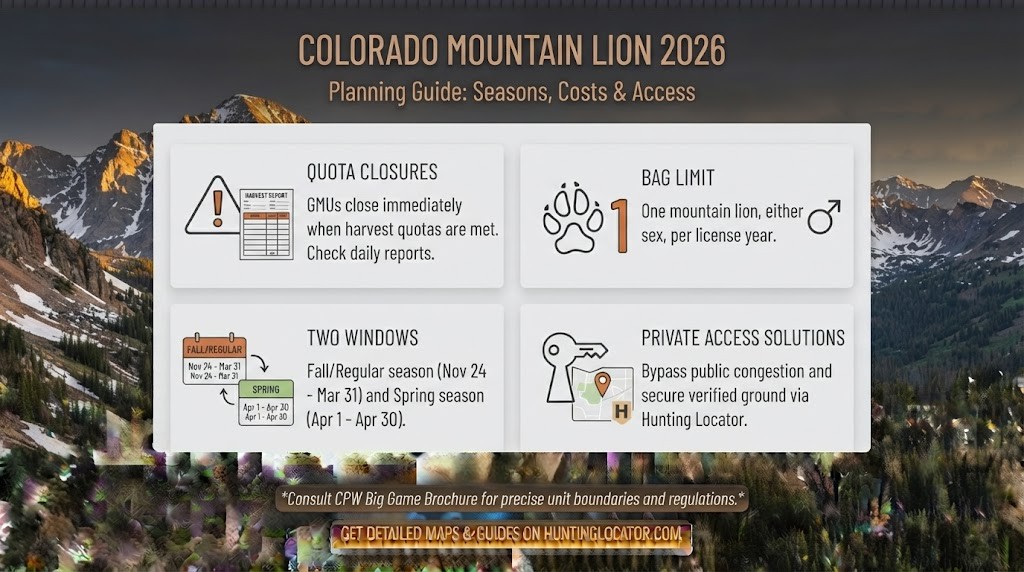
Quick Overview: 2026 Colorado Mountain Lion Season at a Glance
The regulatory details below come from Colorado Parks and Wildlife (CPW), the state’s governing authority on mountain lion hunting. For more detail beyond the basics, see our Colorado mountain lion guide.
| Season Type | Dates (2026) | Bag Limit | Method | Key Regulation |
|---|---|---|---|---|
| Fall/Regular Season | November 24 – March 31 | One mountain lion, either sex, per license year | Varies by GMU (hounds common) | Unit closes when harvest quota is met — check daily |
| Spring Season | April 1 – April 30 | (Same license-year limit applies) | Varies by GMU | Only certain units open; verify unit status |
License costs for 2026: Resident $61.62 · Nonresident $825.03 · Annual Habitat Stamp $12.47 (fee structure per CPW).
Units close the moment their harvest cap is hit, first-come first-served. Per CPW, you need to check the daily harvest-limit report before heading into the field — hunting a closed unit is illegal, no exceptions.
Before you can chase a tag, here’s what’s required:
- Valid hunting license with your Customer Identification (CID) number attached
- Annual Habitat Stamp ($12.47), required alongside your license
- Hunter education certification, with proof required per CPW regulations
- Daily harvest-limit report check before you hunt any open unit
- Immediate harvest reporting and inspection, per CPW rules, once you’ve tagged out
Colorado Mountain Lion Hunting Seasons
Colorado runs two season windows, and which one applies to you depends on your GMU. Per CPW, units without an April season open the day after the close of the big game 4th rifle season in late November — so your unit’s calendar may not match a neighboring one. Worth understanding up front, whether it’s your first lion hunt or your tenth.
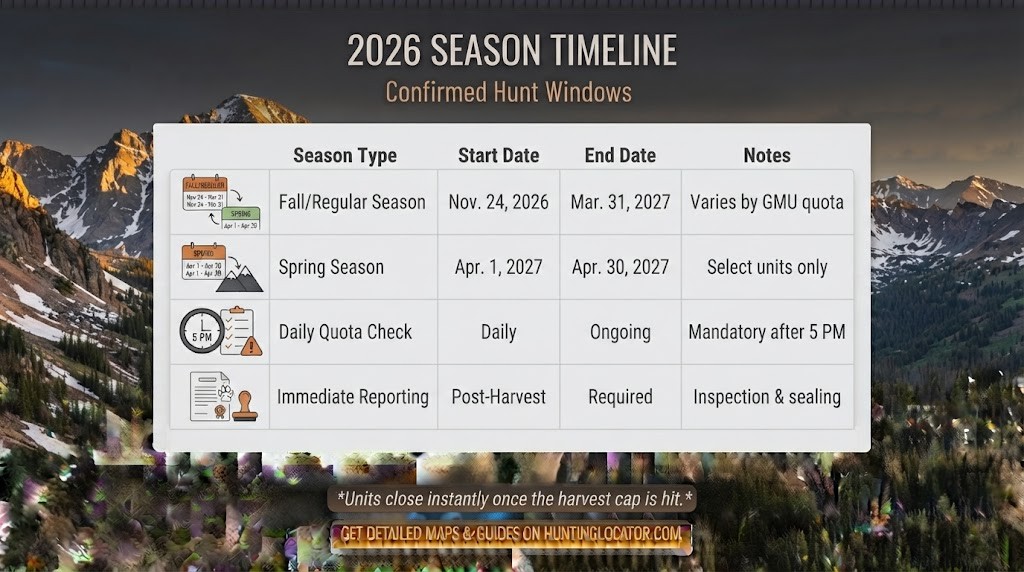
Fall/Regular Season (November 24 – March 31)
This is the extended, primary window, running late November through the end of March. It covers the heart of winter, when snow conditions typically make tracking most favorable for houndsmen working fresh sign. Per CPW, exact unit-opening timing follows the close of the 4th rifle season in your area.
The daily harvest-limit report check applies here just as it does everywhere else. Once your unit hits its quota, it’s closed, and hunting it after that point is illegal under CPW regulations.
Spring Season (April 1 – April 30)
The spring season is a single 30-day window, April 1 through April 30. Not every unit carries an open spring season — CPW lists which units are eligible with their specific April dates in the annual report, so check before assuming yours is included.
Your license year runs through March 31, which means the spring season falls into a new license year with a fresh bag limit. Line up that either-sex, one-lion limit against your license year timing before planning a spring hunt.
Colorado Mountain Lion Licenses and Permits
Getting licensed comes first: license, then permit/tag, then access. CPW governs each part of this, so here’s the order you’ll actually work through it.
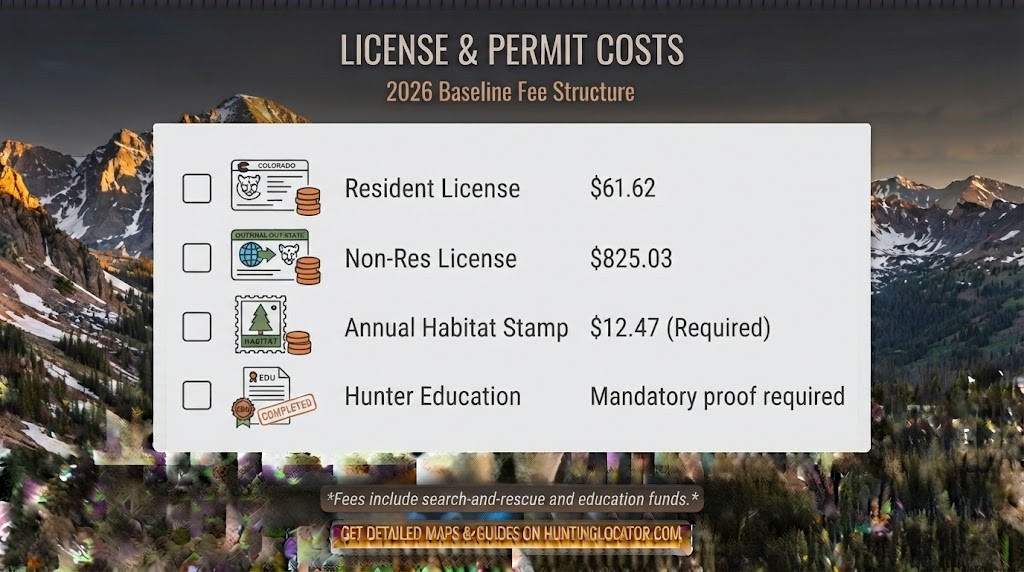
Colorado Hunting Licenses
Mountain lion licenses in Colorado are sold over-the-counter (OTC), and per CPW, they go on sale each year in March. You’ll need to carry a valid license with your CID number attached any time you’re in the field.
Costs break down as follows:
| License / Item | Resident | Non-Resident |
|---|---|---|
| Mountain Lion License | $62 | $825 |
| Annual Habitat Stamp (required) | $12 | $12 |
The gap between resident and non-resident pricing runs over $760, which is consistent with how most Western states structure big-game access to balance in-state and out-of-state demand. Per CPW, license prices also include small mandatory fees supporting search-and-rescue operations and the Wildlife Education Fund, so part of every purchase goes back into the broader hunting and outdoor system.
Verify current figures directly with CPW before purchasing, since fee structures can be updated. You’ll also need proof of hunter education certification on hand to be eligible for a license.
Colorado Hunting Permits & Quota System
Every GMU carries its own harvest quota, and per CPW, the unit closes the moment that quota is reached, regardless of how much season is technically left. That’s why the daily harvest-limit report check isn’t optional — CPW requires hunters to verify unit status after 5 p.m. the day prior to hunting.
Licenses are purchased OTC directly through CPW, with sales opening each March. Non-residents age 12 or older need a Social Security number or Individual Taxpayer Identification Number (ITIN) on file, per federal law. Not every GMU is open for both the fall and spring windows, so check your target unit’s specific season dates before committing.
Once you’ve made your harvest, the work isn’t over. Per CPW, all harvests require immediate reporting and inspection, and your carcass tag along with evidence of sex must stay attached during transport. If your animal is wearing a collar or ear tag, you’re required to report the details — number, color, harvest location, and date — and return the collar to CPW.
There’s also a legal dimension worth knowing: Colorado statute §33-6-119 requires hunters to make a reasonable attempt to care for the edible portions of harvested wildlife, including mountain lions, a rule rooted in the state’s ethical hunting standards.
For the specific field regulations governing quotas, tagging, and reporting, review CPW’s mountain lion field regulations directly, including the in-the-field requirements for full compliance details.
Where to Hunt Mountain Lions in Colorado
Once your license and permit details are squared away, the next decision is access — public land, a private lease, or a guided hunt. Each comes with trade-offs, and most experienced hunters end up using some combination of all three over their hunting careers. Hunting in Colorado as a whole opens up more terrain than most out-of-state hunters realize.
Best Public Lands
Colorado offers an enormous amount of public terrain, much of it well-suited to lion hunting given the rugged, high-elevation habitat lions favor. If you’re willing to put in the scouting time, public land can be a genuinely productive option.
A few categories worth knowing:
- BLM land — vast, open western-slope terrain that’s often less pressured than areas closer to population centers
- National Forest — high-country habitat favored by lions, particularly in winter when prey moves to lower elevations
- State Trust / State Wildlife Areas — access rules vary, so verify current status per CPW before you head out
Public-land units are subject to the same quota closures as everywhere else — check the daily harvest-limit report no matter where you’re hunting.
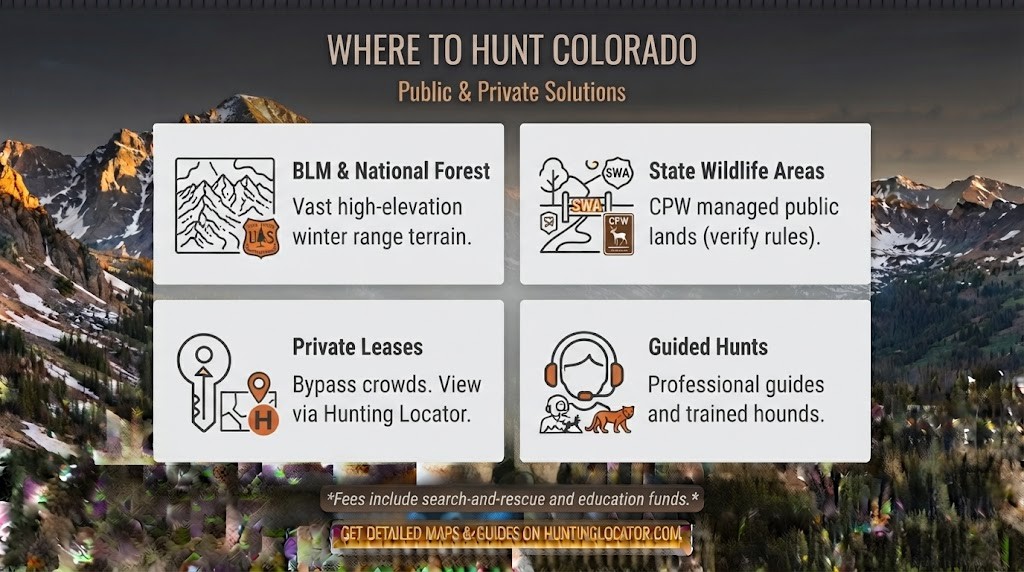
Private Land Hunting with Hunting Locator
Private land offers reduced hunting pressure, more consistent access, and terrain that’s frequently better managed for the game you’re after. For residents, that might mean a quality lease close to home. For non-residents without local connections, it can be the difference between a frustrating scramble and a hunt that comes together.
There are two real paths here: leasing private land for the season, or buying land outright as a long-term investment in your hunting future. Both solve the same core problem — access without the guesswork.
This is where Hunting Locator comes in. It’s a platform built to connect hunters directly with landowners who are ready to lease or sell their land, without a middleman or cold-calling. Because access anxiety is real, especially against a season clock, the marketplace surfaces current, vetted opportunities directly. For Colorado, listings are pulled live, so you’re looking at what’s actually available now rather than outdated information from last season.
Browse current Colorado leases at huntinglocator.com/leases/state/colorado and see what’s open before your season window closes.
Guided Hunts
Guided hunts suit non-residents unfamiliar with the terrain and beginners who want expert guidance on their first lion pursuit. Professional guides and trained hounds can make a difficult hunt far more accessible, especially without your own dogs or local knowledge of the country.
If you’re evaluating a guided hunt, here’s what to look at:
- What’s typically included — lodging, meals, transportation from regional airports, trained hounds, and hands-on field guidance are common, though packages vary widely
- Questions to ask — hunt length, whether licensing help is provided, and what gear you’re expected to bring versus what the outfitter supplies
- How to vet credibility — look for a solid reputation, willingness to provide references, and clear compliance with CPW’s ethical and legal requirements
- How to find outfitters through Hunting Locator — the platform connects hunters with landowners and outfitter relationships, another avenue beyond a basic web search
Guided lion hunts run at a premium compared to DIY access, so confirm exact pricing directly with your chosen outfitter before committing. Costs vary considerably based on what’s included, so don’t assume any two packages are comparable without asking specifics.
Mountain Lion Hunting Tips
Success in the lion woods comes down to preparation, patience, and respect for the animal you’re pursuing. Whether this is your first cat or your fifth, these tips will help you hunt smarter and more ethically.
- Get in shape first — lion hunts often mean covering serious ground in deep snow and steep elevation. Build your cardio and practice hiking with a loaded pack well before opening day.
- Learn to read sign — mountain lions don’t leave the obvious signs that elk or deer do. Study tracks, scrapes, and kill sites ahead of time so you recognize them in the field.
- Hunt the snow — fresh snow after a storm creates some of the best tracking conditions of the entire fall/regular window, making it easier to cut a fresh track.
- Understand hound hunting — the most effective method for pursuing lions involves trained hounds. If you don’t have your own dogs, teaming up with an experienced houndsman or guide can make a real difference.
- Dress for cold and mobility — quality boots and layered clothing built for both warmth and movement matter more on a lion hunt than almost any other big-game pursuit.
- Choose an ethical, adequate setup — make sure your rifle and caliber are matched for a clean, ethical harvest, and practice with your setup before the season starts.
- Check the daily harvest-limit report — always confirm your unit is still open before you head out, per CPW requirements.
For gear — GPS dog tracking collars, cold-weather boots, optics, and everything in between — the Hunting Locator store is a solid place to stock up before the season.
More Resources from Hunting Locator
Planning a lion hunt is just one piece of the puzzle — many Colorado hunters chase multiple species throughout the year, and we’ve built guides to help with all of them.
Closest related reads:
- Colorado Mountain Lion Hunting Season — the full companion deep-dive to this guide, with more detail on regulations and strategy.
- Hunting in Colorado — the broad state hub for planning any Colorado hunt, from big game to birds.
For other seasons, these guides cover the rest of Colorado’s game calendar:
- Upland Game — seasons and tips for Colorado’s upland bird hunting.
- Turkey — spring and fall turkey planning across the state.
- Pronghorn — antelope season dates and access details.
- Waterfowl — ducks and geese across Colorado’s flyways.
- Black Bear — overlapping units and seasons with lion country.
- Deer — mule deer and whitetail planning.
- Elk — Colorado’s flagship big-game hunt.
- Moose — limited-draw moose opportunities.
- Sandhill Crane — specialty crane season details.
Frequently Asked Questions
Is mountain lion hunting legal in Colorado?
Yes, mountain lion hunting is legal and fully regulated by CPW. The state runs two season windows — Fall/Regular from November 24 to March 31, and Spring from April 1 to April 30 — with a bag limit of one mountain lion, either sex, per license year.
What are the 2026 Colorado mountain lion season dates?
The Fall/Regular Season runs November 24 through March 31, while the Spring Season runs April 1 through April 30. Exact dates can vary by GMU, and per CPW, units close as soon as their harvest quota is reached, so verify your unit’s status before heading out.
How much does a Colorado mountain lion license cost in 2026?
Residents pay $61.62 for a mountain lion license, while non-residents pay $825.03. Both also need the required $12.47 annual Habitat Stamp. Per CPW, verify current figures before purchasing, since fee structures can be updated.
What is the mountain lion bag limit in Colorado?
The bag limit is one mountain lion, either sex, per license year, which runs from April 1 to March 31. Each GMU carries its own harvest quota, and per CPW, the unit closes the moment that quota is reached, regardless of remaining season time.
Do non-residents need hunter education to hunt mountain lions in Colorado?
Yes — proof of hunter education certification is required for all hunters, residents and non-residents alike. Non-residents age 12 and older also need a Social Security number or ITIN on file, per federal law, before they’re eligible to purchase a license.
Do beginners need hounds to hunt mountain lions?
Not necessarily, but hound hunting is the most effective and widely used method in Colorado. Beginners often benefit from teaming up with a guide or experienced houndsman who has trained dogs, and it’s always worth checking the daily harvest-limit report and hunting ethically regardless of method.
The Final Shot
Fall/Regular Season runs November 24 through March 31, Spring Season runs April 1 through April 30, and the bag limit is one either-sex mountain lion per license year. Residents pay $61.62 for a license, non-residents pay $825.03, and everyone needs the $12.47 Habitat Stamp — plus a daily quota check before heading afield.
Confirm your dates and license details directly with CPW, then turn your attention to locking in access. All the regulations in this guide trace back to CPW as the governing authority, so when in doubt, verify with them directly, especially daily unit status, which can change fast once a quota starts closing in.
Browse current Colorado leases to find your access, or head to Hunting Locator to explore the platform’s full offering for mountain lion hunting in Colorado this season.


