This Colorado pronghorn guide consolidates confirmed dates, fees, and deadlines so you’re not cross-referencing multiple CPW pages. It covers resident and non-resident licenses, how the preference point draw works, and three access pathways — public land, private leases through Hunting Locator, and guided hunts.
Here’s what’s inside:
- When to hunt — confirmed 2026 archery, muzzleloader, and rifle season dates from CPW
- What it costs and how to draw — resident and non-resident license fees, plus a plain-English breakdown of the Colorado Parks & Wildlife (CPW) draw and preference point system
- Where to hunt — public land options, private leases through Hunting Locator, and guided hunt considerations
Jump to the Quick Overview for the short version, or read through for the full planning picture.
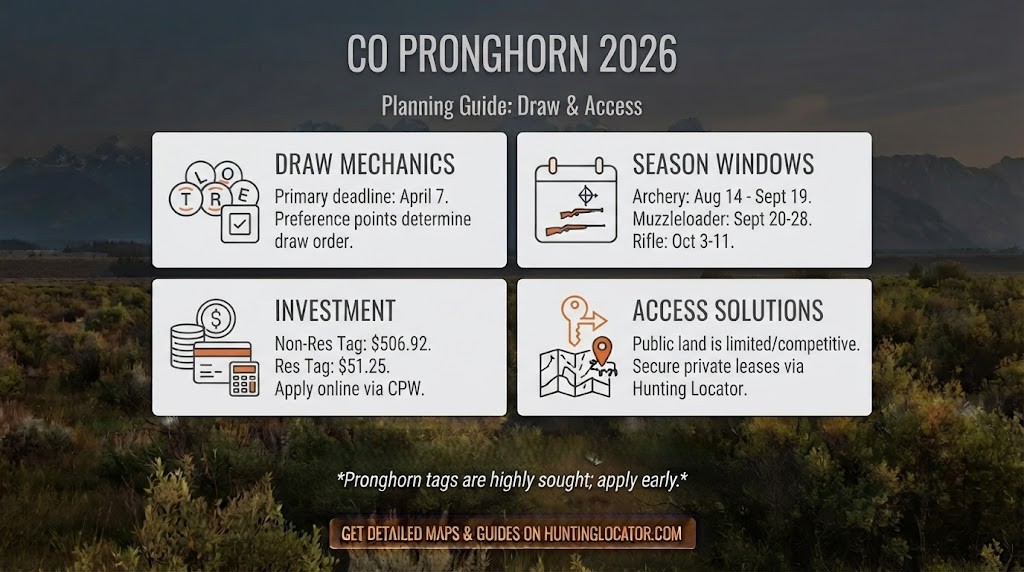
Quick Overview: Colorado Pronghorn Season at a Glance
Confirmed 2026 season dates, bag limits, and entry requirements before you can legally hunt pronghorn in Colorado.
| Species | Method | Start Date | End Date | Bag Limit |
|---|---|---|---|---|
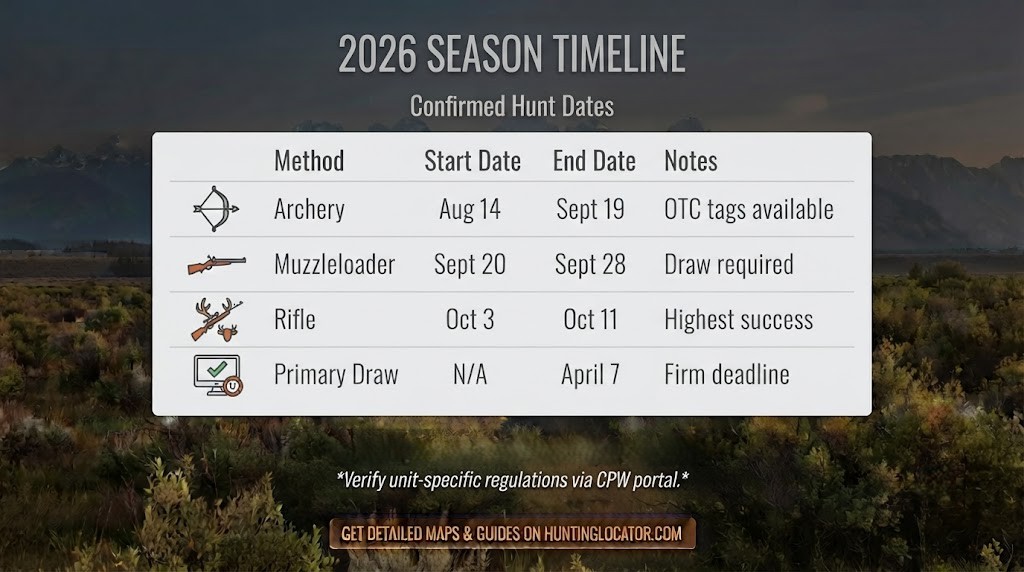
| Pronghorn | Archery | Aug 14, 2026 | Sep 19, 2026 | 1 pronghorn |
| Pronghorn | Muzzleloader | Sep 20, 2026 | Sep 28, 2026 | 1 pronghorn |
| Pronghorn | Rifle | Oct 3, 2026 | Oct 11, 2026 | 1 pronghorn |
Per Colorado Parks & Wildlife (CPW), every hunter must meet the following requirements before purchasing a tag or entering the field:
- Hunter Education — All hunters born on or after January 1, 1949 must complete an approved hunter education course before purchasing a Colorado hunting license. Proof of completion from another state may be accepted.
- A Valid Hunting License — Required before you can apply for or purchase a pronghorn tag.
- Bag Limit — One pronghorn per valid license, regardless of method.
- Draw Application — Most pronghorn tags are issued through CPW’s limited draw. The primary application deadline is April 7, 2026 at 8 p.m. MDT.
Colorado Pronghorn Hunting Seasons
Colorado offers three pronghorn seasons by method: archery, muzzleloader, and rifle. Together they span mid-August through mid-October. Each has its own draw demand, effective range constraints, and field tactics — and the method you choose shapes your gear list, your access needs, and how you’ll spend your time in the field. Pronghorn hunting here is largely a spot-and-stalk pursuit across the wide-open Eastern Plains.
Colorado Pronghorn Archery Season 2026
The 2026 archery season runs August 14 through September 19 — the longest window of any method. OTC archery licenses are available for hunters who want to skip the draw; they go on sale in August and are not unit-specific, which gives you flexibility on where you hunt.
The trade-off is range. Getting within bow range of a pronghorn on open ground is one of the harder challenges in western hunting. Waterhole blinds and spot-and-stalk are the standard approaches, and warm early-season temperatures put real pressure on field care once you connect.
Colorado Pronghorn Muzzleloader Season 2026
The 2026 muzzleloader season runs September 20 through September 28 — nine days. Tags are draw-based and typically require fewer preference points than rifle tags, which makes this a reasonable target for hunters who have been accumulating points for a few years and want to hunt before a rifle tag becomes realistic.
Getting a pronghorn within effective muzzleloader distance on open terrain requires patient glassing and a willingness to commit to long stalks. The point requirement is lower, but the hunt doesn’t give much back on the execution side.
Colorado Pronghorn Rifle Season 2026
The 2026 rifle season runs October 3 through October 11. Rifle tags offer the best in-field success odds — longer effective ranges and generally favorable fall weather — but drawing a tag in a high-demand unit requires significant preference points. In recent years, some units have required up to 16 points for residents and up to 26 for non-residents.
That kind of wait is why private land access and guided hunts have become more common among rifle hunters who want quality ground without committing a decade of points to a single tag. If you’re early in building your bank, plan accordingly. If you have points saved, rifle season is when they become useful.
Colorado Pronghorn Licenses and Permits
Colorado Hunting Licenses & Costs
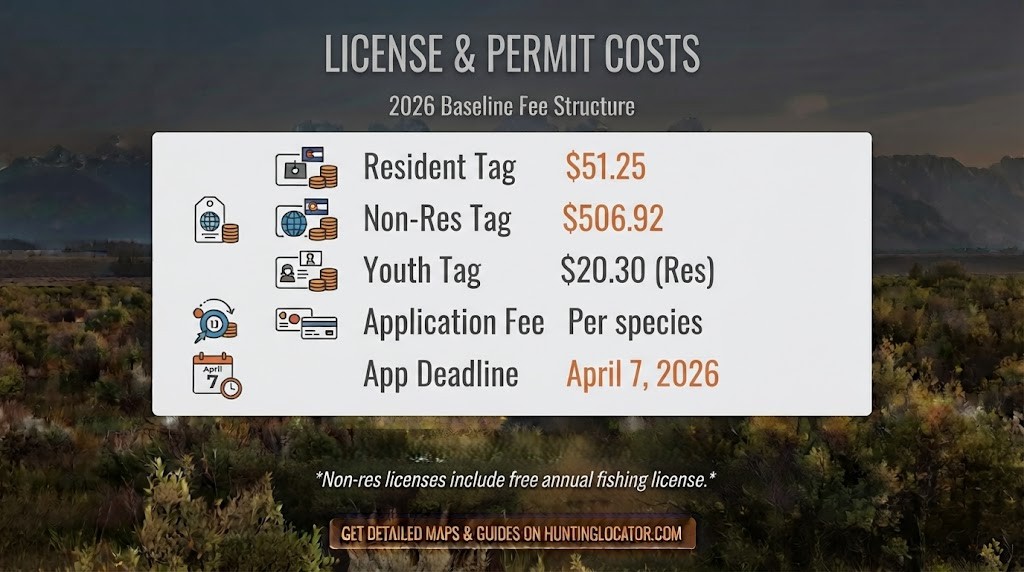
License fees are set by Colorado Parks & Wildlife. The 2026 figures for pronghorn:
| License Type | Resident | Non-Resident |
|---|---|---|
| Adult pronghorn license | $51 | $506.92 |
| Youth pronghorn license (under 18) | $20.30 | $130.07 |
Beyond the base license, CPW may require additional purchases including a habitat stamp for hunters ages 18–64 and a per-species application fee for draw hunts. For the complete fee schedule and unit-specific requirements, visit cpw.state.co.us and download the 2026 Big Game Brochure.
Colorado Pronghorn Permits & the Draw Process
Colorado’s pronghorn tag system is primarily draw-based, managed by Colorado Parks & Wildlife.
Key Deadlines:
- Primary Draw Deadline: April 7, 2026 at 8 p.m. MDT — missing it means waiting another year or hoping for leftover tags.
- Secondary Draw Window: June 18–30, 2026 at 8 p.m. MT — licenses not issued in the primary draw are available here, open to anyone regardless of whether you applied in the primary draw.
How the Preference Point System Works:
Per CPW, Colorado runs a true preference point system:
- Points accumulate per species. The more you have, the better your odds of drawing your first-choice tag.
- If you don’t draw in the primary draw, you automatically receive one preference point for that species.
- To build toward a future season without entering the current draw, apply using a preference point only hunt code — you won’t be entered for a tag, but you’ll bank a point for next year.
- Under Colorado’s true preference point system, tags go to applicants with the most points first — someone with 5 points draws before someone with 4.
Where to Apply:
All applications are submitted online through CPW. Visit cpw.state.co.us to create or log in to your account and submit your 2026 draw application before April 7.
For Non-Residents:
Non-residents have full access to both the primary and secondary draws, can purchase leftover and OTC licenses, and receive a free annual fishing license with any non-resident big game license purchase.
Where to Hunt Pronghorn in Colorado
Access determines more about a Colorado pronghorn hunt than almost any other variable. Public land on the Eastern Plains is limited — mostly federal grasslands and scattered state parcels — and hunting pressure on those units is real. That pushes many hunters toward private land, where pronghorn numbers are higher and competition is lower. Below is a clear look at all three access pathways.
Best Public Lands for Colorado Pronghorn
Colorado hunters have access to more than 23 million acres of public hunting land, and the Eastern Plains are the center of pronghorn range. Public options here are more limited than in some western states, but real opportunities exist for hunters willing to research before they commit. Colorado is divided into Game Management Units (GMUs), each with its own rules and tag quotas — use the Colorado Hunting Atlas on the CPW website to explore unit boundaries, access points, and terrain.
The main public land options for pronghorn hunters:
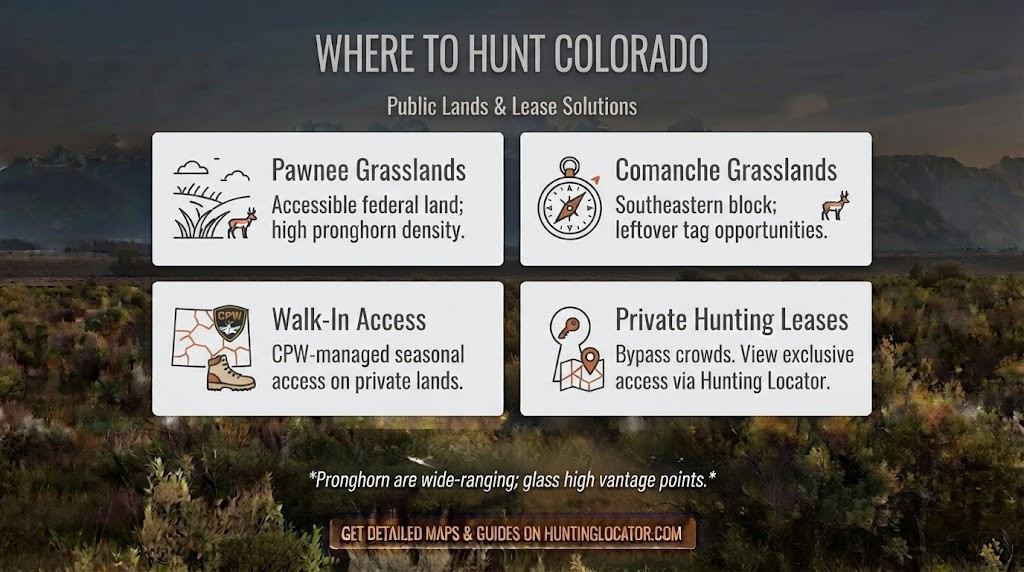
- Pawnee National Grasslands (northeastern Colorado) — One of the most accessible federal grassland units in the state, with documented pronghorn populations and open terrain suited to spot-and-stalk hunting. Managed by the U.S. Forest Service with free public access.
- Comanche National Grasslands (southeastern Colorado) — A federal grassland block in the southeast, with late-season leftover tags often available in surrounding units. Worth considering for hunters who miss the primary draw.
- BLM-administered Eastern Plains parcels — Scattered BLM ground throughout eastern Colorado provides additional access. Use the Colorado Hunting Atlas to find specific parcels within your target GMU.
- State Trust Land with public hunting access — CPW designates certain State Land Board parcels for public hunting access. Check current-year maps carefully, as access designations can change between seasons.
- Walk-In Access Program (WIAP) properties — CPW’s Walk-In Access Program provides seasonal hunting access on private lands enrolled by cooperating landowners — a useful option for hunters who want expanded access without a formal lease.
One practical note: public land pronghorn hunting on the Eastern Plains can be competitive during rifle season, with most huntable terrain within a few miles of roads. If you want distance from other hunters and better trophy potential, private land is worth considering.
Private Land Hunting with Hunting Locator
On quality private ranch land, it’s not uncommon to see hundreds of animals in a single day — a significant contrast to pressured public units where pronghorn have learned to avoid roads. The traditional challenge has been finding willing landowners without spending days cold-calling ranchers or knocking on rural doors.
Hunting Locator is a platform that connects hunters directly with Colorado landowners ready to lease or sell their property for hunting access. You can browse verified Colorado lease listings, filter by game type and location, and contact landowners who have opted in to working with hunters.
Browse current Colorado hunting leases on Hunting Locator for available private land for your 2026 pronghorn season. Listings include acreage, available game, and contact information. The platform also lists properties for sale if you’re interested in owning Colorado hunting ground outright.
Guided Hunts
For hunters who want private land access and local knowledge without the DIY planning, a guided Colorado pronghorn hunt is worth considering. Hunting the eastern side of Colorado is generally more successful with an outfitter, given the combination of private land access and stronger pronghorn populations.
What guided Colorado pronghorn hunts typically include:
- Private land access — Most reputable Colorado outfitters operate on exclusively leased private ranch land, with some covering 60,000+ acres across multiple ranches.
- High opportunity rates — Quality operations on private ground report 100% opportunity rates, meaning legitimate shots at mature bucks during your hunt.
- Trophy potential — Colorado pronghorn bucks typically score in the 70–78″ range, with exceptional bucks exceeding 80″. Guided hunts on private plains ranches offer the best access to mature animals.
- Multiple method options — Most outfitters accommodate archery, muzzleloader, and rifle hunters, with archery hunters often hunting from pre-set waterhole blinds in addition to spot-and-stalk.
- Combo hunt opportunities — Multi-day elk/pronghorn combo hunts are a popular option, letting early-season elk hunters pursue pronghorn during midday hours when elk are less active.
If you’re new to Colorado, a non-resident without local contacts, or done competing on pressured public land, a guided hunt on private ground is one of the more reliable ways to fill a tag. Find guided hunt options through Hunting Locator to connect with outfitters who know the Eastern Plains.
Pronghorn Hunting Tips
Pronghorn have vision roughly equivalent to 8x binoculars and can sustain speeds around 55 mph. Colorado’s open terrain doesn’t hide much. Success here depends on patience, optics, and getting your approach right before you move.
- Glass first, move second — Set up a quality spotting scope on a tripod and work the terrain from high vantage points before committing to a stalk. Pronghorn will see you approaching long before you close the distance if you skip this step.
- Use the terrain — The Eastern Plains look flat but hold subtle drainages, creek cuts, and rolling swells that provide stalk cover. Study topo maps and plan approach routes that use every available contour.
- Hunt water sources early season — During archery season, pop-up ground blinds over waterholes and stock tanks are among the most effective tactics. Set them up several days before your hunt to let animals adjust to the new structure.
- Choose the right caliber — Pronghorn are often taken at longer ranges than most big game. Flat-shooting calibers like .243 Win, .270 Win, or 6.5 Creedmoor suit the open terrain and distances you’ll encounter.
- Prioritize meat care — Early archery season temperatures can spoil meat quickly. Have a cooler with ice in your vehicle, field dress immediately after harvest, and get the meat cooled as fast as possible.
- Ask for permission early — If you’re pursuing landowner access on private ground, make the ask well in advance of the season, not the morning you plan to hunt. Many Colorado ranchers are receptive to hunters who approach professionally and with enough lead time.
- Dial in your rangefinder — Long shots are common in pronghorn country. A quality rangefinder and the practice to use it reliably are both necessary. Find rangefinders and other pronghorn gear at the Hunting Locator store.
More Resources from Hunting Locator
Hunting Locator covers Colorado hunting from season planning through land access. Useful resources for pronghorn hunters and Colorado sportspeople:
- Colorado Hunting Leases — Browse available private land leases in Colorado, filterable by species and location.
- Hunting in Colorado — Complete Guide — A broad overview of Colorado hunting opportunities, regulations, and planning considerations for residents and non-residents.
- Colorado Pronghorn Hunting Season — Additional context and depth for planning your pronghorn season.
- Colorado Elk Hunting Season — Elk season dates, draw information, and land access guidance for combo hunt planning.
- Colorado Deer Hunting Season — Season dates, license info, and access options for mule deer on the Eastern Plains.
- Colorado Turkey Hunting Season — Spring turkey season breakdown.
- Colorado Black Bear Hunting Season — Season dates, licensing, and tips for Colorado black bear.
- Colorado Mountain Lion Hunting Season — Season information and planning resources for mountain lion hunting in Colorado.
- Colorado Upland Game Hunting Season — Pheasant, grouse, and other upland birds across Colorado.
- Colorado Waterfowl Hunting Season — Duck and goose season dates, access options, and planning resources.
- Colorado Moose Hunting Season — One of Colorado’s most limited tags. Start your research here.
- Colorado Sandhill Crane Hunting Season — An underrated Colorado hunting opportunity worth knowing about.
- Hunting Locator Store — Optics, apparel, and accessories for western hunting conditions.
FAQ
When does Colorado pronghorn season open in 2026?
The archery season opens August 14, 2026 — the earliest of the three methods. Muzzleloader follows on September 20, and rifle opens October 3. All three close by October 11, 2026.
Can non-residents hunt pronghorn in Colorado?
Yes. Non-residents are fully eligible to apply in the primary and secondary draws, purchase OTC archery licenses, and buy leftover or reissued tags. The non-resident adult license fee is $506.92. Non-residents also receive a free annual fishing license with the purchase of any non-resident big game license.
How hard is it to draw a Colorado pronghorn tag?
It depends on the method and unit. OTC archery licenses are available without a draw for many units. Muzzleloader draw tags require moderate preference points. Rifle tags in high-demand units are the most competitive — some units have required up to 16 preference points for residents and up to 26 for non-residents in recent years. Lower-demand units are more accessible, particularly for first-time applicants.
What is the preference point deadline for 2026?
The primary draw deadline is April 7, 2026 at 8 p.m. MDT. To bank a point without entering the current tag draw, apply using a preference-point-only hunt code on your primary draw application. The secondary draw window opens June 18–30, 2026 for tags not issued in the primary draw.
Is private land hunting worth it for Colorado pronghorn?
For most hunters — especially rifle hunters in competitive units — the answer is generally yes. Private land outfitters report 100% opportunity rates on guided pronghorn hunts, and trophy quality on private eastern Plains ranches is consistently higher than on pressured public land. Hunting Locator’s Colorado lease listings offer a direct path to private land access.
Do youth hunters have special pronghorn opportunities in Colorado?
Yes. Youth hunters ages 12–17 with an unfilled pronghorn doe or either-sex license can participate in extended December or January doe seasons after their primary season closes. Youth hunters must be accompanied by a mentor who is 18 or older and also meets hunter education requirements.
Planning Summary
Colorado’s 2026 pronghorn seasons are confirmed, and the primary draw deadline — April 7, 2026 — comes before most people start thinking about fall. Resident or non-resident, if you’re planning a pronghorn hunt this year, the application window is what determines whether you go.
Browse Colorado hunting leases on Hunting Locator for private land access, and gear up at the Hunting Locator store for optics and field gear suited to open-country hunting.


