This guide covers the 2026 season dates, bag limits, required licenses and stamps, and where to find huntable ground, drawing directly from the CT DEEP Migratory Bird Hunting Guide.
One transparency note before you read further: some final 2026 dates are still pending publication in the upcoming official state guide. Where that’s the case, we’ve flagged it clearly.
Here’s what this guide covers:
- When you can hunt — 2026 season dates and bag limits for snipe, rails, and crow
- What you need — licenses, the Connecticut Migratory Bird Conservation Stamp, HIP registration, and non-resident costs
- Where to go — public lands, guided hunts, and private leases through Hunting Locator
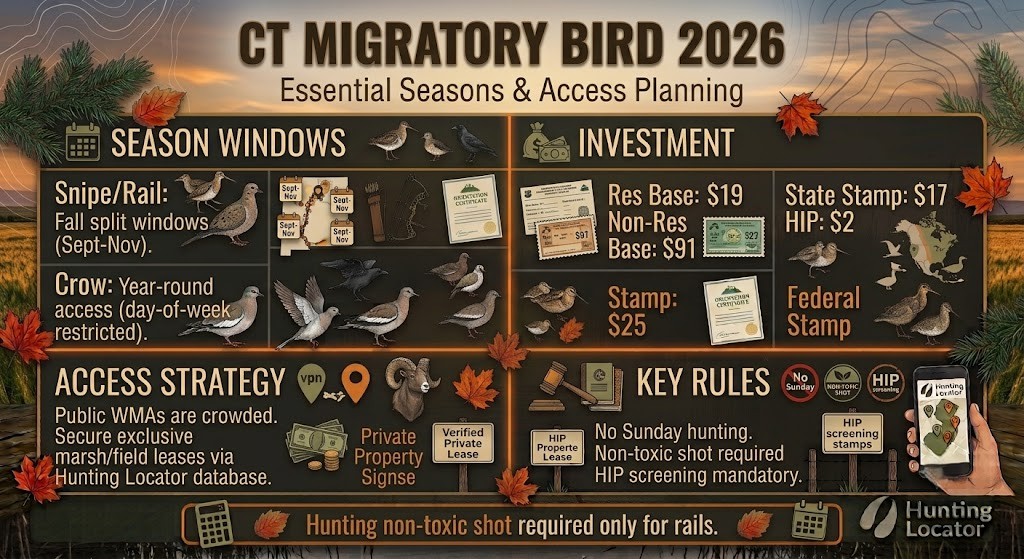
Quick Overview: Connecticut Migratory Bird Season at a Glance
According to the CT DEEP Migratory Bird Hunting Guide, the 2025–2026 framework covers snipe, rails, and crow across split-season windows. Confirm 2026 dates in the upcoming official guide before you head out.
| Species | 2026 Season Dates | Daily Bag Limit | Key Regulations / Notes |
|---|---|---|---|
| Wilson’s Snipe | Sept 3–Oct 25, 2025 & Nov 3–29, 2025 (new 2026 dates pending official guide) | Confirm in official guide | No non-toxic shot required; stamp required; closed Sundays |
| Rails (Virginia & Sora) | Sept 3–Oct 25, 2025 & Nov 3–29, 2025 (new 2026 dates pending) | 25/day | Non-toxic shot required; stamp required; closed Sundays |
| Clapper Rail | Same rail framework (pending 2026 confirmation) | 10/day (max 1 King rail) | Non-toxic shot required; King rail ID required for compliance |
| Crow | Aug 8–Oct 9 (Wed/Fri/Sat); Oct 17–Nov 28 (Wed/Fri/Sat); Dec 21–Mar 20, 2027 (Mon–Sat) | Confirm in official guide | Day-of-week restricted; no non-toxic shot required; closed Sundays |
Note: Final 2026 dates will be published in the upcoming CT DEEP guide. Always confirm at portal.ct.gov/DEEP before heading out.
License, Permit & Education Requirements at a Glance
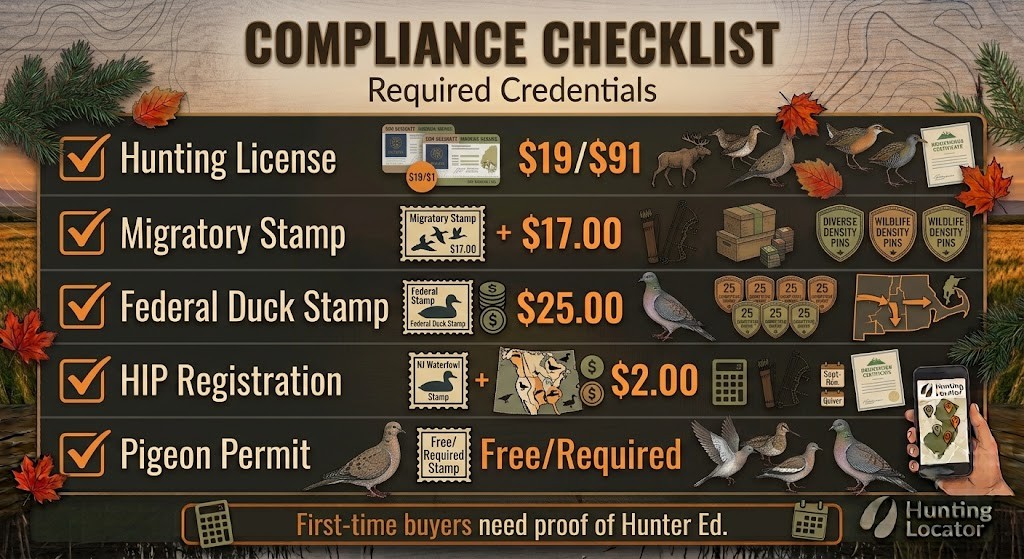
- Hunting License — Required for all hunters. Per the current fee schedule, adult resident licenses cost $19 and non-resident licenses cost $91.
- Connecticut Migratory Bird Conservation Stamp — Required for all snipe, rail, and crow hunters regardless of age. Cost is $17 for adults (16+) and $9 for youth ages 12–17. The stamp includes HIP enrollment.
- Federal Duck Stamp — $25 for hunters 16+; required for waterfowl hunters in addition to the state stamp. Confirm applicability to snipe and rail directly with CT DEEP before your season.
- HIP Registration — Required for migratory bird hunters and included with the state stamp purchase. Hunters purchasing stamps at a third-party vendor must complete HIP screening questions themselves by calling 1-877-337-4868 or using the Online Hunter Reporting System.
- Hunter Education — Required to purchase a first hunting license in Connecticut. Non-residents may present an equivalent certification from their home state.
⚠️ Critical Compliance Flag: The 2025 Connecticut Migratory Bird Conservation Stamp expires December 31, 2025. Any hunter pursuing migratory birds in early 2026 must purchase a 2026 stamp and 2026 hunting license before heading afield. Do not carry over your 2025 credentials.
Connecticut Migratory Bird Hunting Seasons by Species
Snipe, rails, and crow run on distinct schedules with meaningfully different rules — and mixing them up is one of the more common compliance mistakes in the field. According to CT DEEP, shooting hours for all migratory birds are one-half hour before sunrise to sunset. Migratory bird hunting is closed on Sundays on all land types — this prohibition explicitly extends to private land, even under the new Sunday hunting law effective October 1, 2025. That closure applies to every species in this guide.
Connecticut sits within the Atlantic Flyway, one of North America’s four major migratory corridors, which funnels birds from Greenland along the Atlantic Coast to South America. That geography makes Connecticut’s marshes and river corridors genuinely productive during fall migration.
Wilson’s Snipe Hunting Season
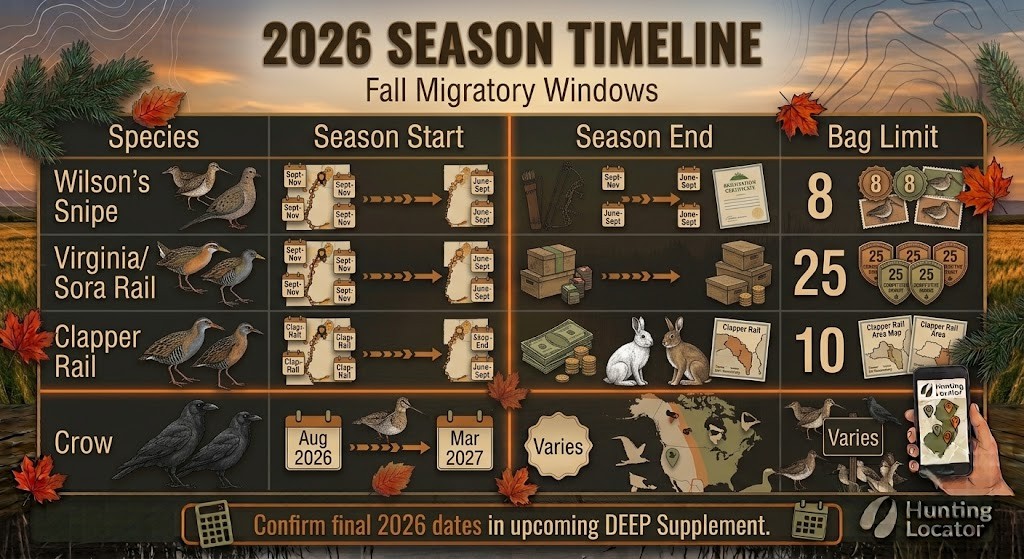
The Wilson’s Snipe season runs in two windows: September 3–October 25, 2025, and November 3–29, 2025, based on the current CT DEEP framework. New 2026 dates will be published in the upcoming official state guide — confirm before you book your trip.
One distinction worth knowing: there are no non-toxic shot requirements for woodcock, snipe, or crow in Connecticut. This surprises hunters who assume that because rails — often found in the same wetlands — require non-toxic shot, snipe must too. They don’t. But when hunting mixed marsh habitat, keep your shells straight. The Connecticut Migratory Bird Conservation Stamp is still required.
Snipe favor wet meadows, soft mud flats, and marsh edges during fall migration. Look for standing water, short emergent vegetation, and exposed muddy shorelines — the same habitat types benefiting from the 3,845 acres of wetland restoration funded by Connecticut Migratory Bird Conservation Stamp proceeds since 1994.
Virginia & Sora Rail Season (Plus Clapper & King Rail)
Rail seasons mirror the snipe framework: September 3–October 25, 2025, and November 3–29, 2025, with 2026 dates pending the upcoming CT DEEP guide.
Daily bag limits:
- 25 per day for Virginia and Sora rails
- 10 per day for Clapper rails (maximum of 1 King rail in that daily limit)
The compliance point that matters most: rails can only be hunted using non-toxic steel shot no larger than BB, or approved alternatives including Bismuth-tin alloy, Tungsten Polymer, tungsten-nickel-iron (Hevishot), or any other non-toxic shot approved by the U.S. Fish and Wildlife Service no larger than number two. If you’re hunting a marsh where both snipe and rails are present, you’re legally obligated to run non-toxic loads for any rails you might encounter — plan your ammunition accordingly.
The 1-King-rail sublimit within the Clapper rail bag makes correct species identification a legal requirement, not just good field practice. King rails are larger than Clappers, with more rufous coloring on the breast and bolder black-and-white barring on the flanks. Spend time with a reliable field guide before hunting coastal marsh areas where both species overlap.
Connecticut Crow Hunting Season
Crow hunting runs on a day-of-week schedule unlike any other species in this guide. The CT DEEP-established schedule for 2026 and early 2027 is:
- August 8 – October 9: Wednesdays, Fridays, and Saturdays
- October 17 – November 28: Wednesdays, Fridays, and Saturdays
- December 21 – March 20, 2027: Mondays through Saturdays
Sundays remain closed throughout. Unlike rails, no non-toxic shot is required for crow hunting. The Connecticut Migratory Bird Conservation Stamp is still required. Also worth knowing: while crow hunting from a stationary position, a hunter is exempt from the fluorescent orange clothing regulation.
Crow is the most accessible entry point in this guide. The season runs from August through March, the day-of-week schedule gives you regular hunting days, non-toxic shot isn’t required, and crow populations are abundant across Connecticut’s agricultural land and woodland edges. For hunters interested in how crow and other migratory seasons intersect with Connecticut waterfowl hunting, that guide covers the overlap in detail.
Connecticut Migratory Bird Licenses & Permits
Connecticut Hunting Licenses
Every hunter pursuing migratory birds in Connecticut needs a valid hunting license before anything else. Hunting licenses, stamps, and permits can be purchased 24/7 through the DEEP’s Online Outdoor Licensing System or at town clerk offices and select DEEP offices.
| License Type | Resident Cost | Non-Resident Cost | Notes |
|---|---|---|---|
| Adult Hunting License | $19 | $91.00 | Required for all hunters; base license for all species |
| Junior Hunting License (12–15) | Lower fee applies | N/A | Must be accompanied by an adult 18+ in the field |
| Connecticut Migratory Bird Conservation Stamp | $17 (adult 16+) / $9 (youth 12–17) | $17 (ages 12+) | Required for snipe, rail, and crow; includes HIP |
| Federal Duck Stamp | $25 | $25 | Required for waterfowl hunters 16+; confirm applicability to snipe/rail with CT DEEP |
Per the official CT DEEP licensing page, non-residents pay the same stamp fee as residents — $17 applies to all adult hunters regardless of state of residence.
Non-residents should note: to purchase a Connecticut hunting license, you must either show proof of Connecticut hunter education (or a recognized equivalent from another state or Canadian province) or have held a Connecticut resident license within the past five years. Have your home-state hunter education certification — digital or printed — accessible at purchase.
Connecticut Hunting Permits
Connecticut Migratory Bird Conservation Stamp (Includes HIP)
All migratory bird hunters — including 12 to 15-year-olds — are required to purchase and carry the current Connecticut Migratory Bird Conservation Stamp. It also serves as your HIP enrollment for the year. Purchase it online through the DEEP’s licensing portal, at town clerk offices, or at select outdoor equipment vendors.
HIP Enrollment
If you purchase your stamp at a third-party vendor rather than online, you must complete HIP screening questions yourself by calling 1-877-337-4868 or using the Online Hunter Reporting System. This has been in effect since 2020. Buying online through the DEEP portal handles HIP automatically.
Lottery Permits for State Land
Lottery permits for state land and controlled hunt areas may be applied for starting January 2, 2026, through the Online Outdoor Licensing System or select DEEP offices. If you’re rejected in the lottery, you may obtain a state land no-lottery permit as an alternative.
Junior Hunter Requirements
Junior hunters ages 12–15 must have a valid small game junior hunting license and a Connecticut Migratory Bird Stamp (including HIP), and must be accompanied by an adult at least 18 years of age. Hunters 16 and 17 who participate in training days must carry a valid hunting license, the Connecticut Migratory Bird Stamp, and a federal Migratory Bird Stamp.
Connecticut Migratory Bird Hunting: Where to Hunt
Best Public Lands
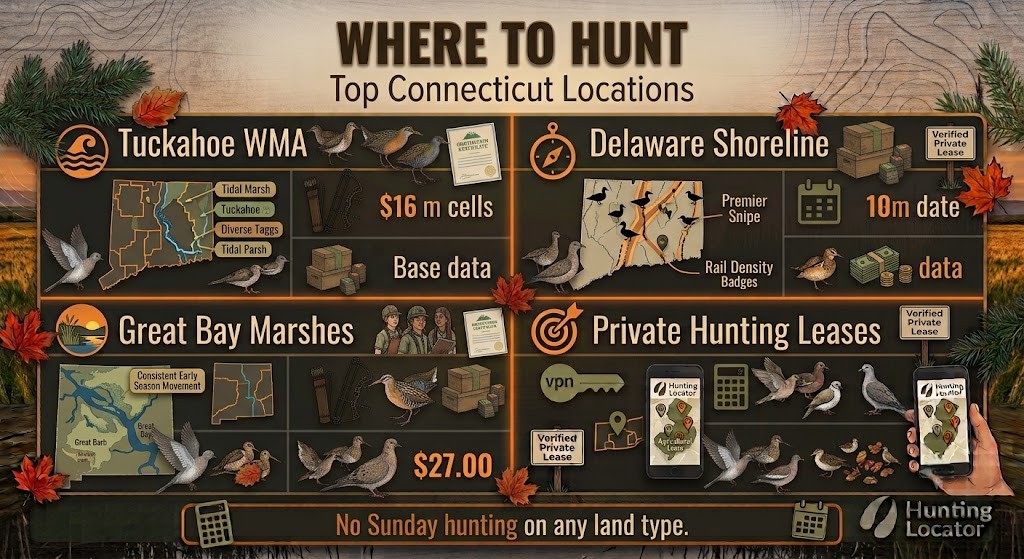
Connecticut manages over 120,000 acres of public hunting land, including state forests, wildlife management areas (WMAs), and state parks. No landowner permission is needed on designated public parcels, but you need the appropriate licenses and stamps. The CT DEEP Interactive Hunting Area Map is the most reliable tool for identifying legal hunting areas and any zones closed to certain species.
Habitat types to target on public land for migratory birds:
- Coastal marshes and tidal flats — Prime rail and snipe habitat during fall migration; look for areas near the Connecticut River mouth and Long Island Sound shoreline
- Freshwater wetlands and WMA impoundments — Managed water levels create ideal soft-mud feeding habitat for snipe during fall staging
- Agricultural field edges near woodland corridors — High-value crow habitat, particularly during the December–March season window
- River floodplains and sedge meadows — Classic Wilson’s Snipe habitat; look for soft, wet ground with short vegetation and exposed mud
- State forest clearcuts and early successional edges — Crow calling and decoying work well in open areas adjacent to roosting timber
Verify conditions at the CT DEEP Interactive Hunting Area Map before visiting any specific WMA, as individual areas may have zone restrictions, parking limitations, or seasonal closures that affect access.
Guided Hunts
Guided migratory bird hunts give you direct access to someone who already knows the ground, the birds’ timing, and the local regulations. For crow hunting specifically, a guide with a working decoy spread and electronic caller can make a significant difference in a morning’s results. Anyone providing hunting guide services in Connecticut is required to register annually, so confirm your guide’s registration status before booking.
What to look for when vetting a Connecticut migratory bird guide:
- Documented experience with the specific species you’re targeting — snipe, rail, and crow each require different setups and tactics
- Clear communication about which licenses and stamps you’re still responsible for purchasing yourself
- Transparent policies on group size, shooting hours compliance, and non-toxic shot requirements
- Current working knowledge of CT DEEP regulations for the season year
For non-resident hunters in particular, a one-day guided crow hunt early in your Connecticut experience can teach you more about land access, habitat, and calling sequences than months of remote scouting.
Private Land Hunting with Hunting Locator
Public land is a solid starting point, but productive marsh edges and crow roosts are often on private ground. A seasonal lease gives you predictable, exclusive access to specific habitat without competing with other hunters for the same areas. Lease arrangements can be structured to cover permitted species, shooting hours, party size, and season dates, giving both hunter and landowner clear expectations.
Hunting Locator connects hunters with landowners who are open to leasing or selling. The searchable database lets you browse available properties by state, game type, and acreage. Browse available Connecticut private land at huntinglocator.com/leases/state/connecticut/ — whether you’re looking for marsh ground for rails or agricultural land for crow hunting through the winter season.
Migratory Bird Hunting Tips for Connecticut
- Match your shot to the species — Rails require non-toxic shot; snipe and crow do not. If you’re hunting a marsh where both snipe and rails are present, run non-toxic loads for full compliance. Visit the Hunting Locator store for gear suited to migratory bird seasons.
- Hunt the tides for rails — Virginia and Sora rails become much more visible during high tide events that push them out of dense marsh grass into open edges. Time your hunts to rising and high tide.
- Use decoys and calls for crow — A realistic spread (owl, hawk, and crow decoys) combined with quality electronic calling produces the most consistent results. Motion decoys increase visibility. Set up on field edges or near known roost trees.
- Move slowly and methodically for snipe — Wilson’s Snipe hold tight and flush unpredictably. Walk grid patterns through wet meadows and marsh edges rather than following trails. A well-trained flushing dog improves harvest rates considerably.
- Scout before opening day — Connecticut’s migratory bird windows open in early September, when marsh vegetation is still thick. Visit target WMAs or leased ground ahead of the season to locate snipe probing areas, rail corridors, and active crow roost sites.
- Know the Sunday closure — Migratory bird hunting is closed on Sundays on all land types, including private land.
- Carry all your paperwork — Have your hunting license, Connecticut Migratory Bird Conservation Stamp, and HIP confirmation on you in the field. Non-resident hunters should also carry proof of their home-state hunter education certification.
- Use waders for rail and snipe habitat — Productive marsh hunting requires getting into wet, soft-bottomed ground. Quality knee-high or hip waders extend how long you can work that habitat.
More Resources from Hunting Locator
- Hunting in Connecticut — Complete Overview — Starting point for understanding Connecticut hunting broadly: seasons, regulations, and what the state offers across all species.
- Connecticut Waterfowl Hunting Season Guide — Duck and goose seasons in detail, with non-toxic shot requirements, zone breakdowns, and public land access.
- Connecticut Migratory Bird Hunting Season — Broader migratory bird coverage, including woodcock and other species beyond snipe, rails, and crow.
- Connecticut Turkey Hunting Season Guide — Permit draws, season structure, and public and private land options for spring bird hunting.
- Connecticut Upland Game Hunting Season Guide — Pheasant, grouse, and woodcock season dates, stocking locations, and access tips.
- Connecticut Small Game Hunting Season Guide — Rabbit, squirrel, and other small game seasons that often pair with migratory bird trips.
- Connecticut Deer Hunting Season Guide — Archery, firearm, and muzzleloader deer seasons for hunters planning a multi-species fall trip.
- Connecticut Coyote Hunting Season — Coyote hunting overlaps with many of the same winter dates as late crow season.
- Connecticut Private Land Leases — Browse Now — Browse available leases by location and acreage.
FAQ
Do I need a Federal Duck Stamp to hunt snipe and rails in Connecticut?
Waterfowl hunters 16 and older are required to purchase a Federal Duck Stamp in addition to the Connecticut Migratory Bird Conservation Stamp. The Federal Duck Stamp requirement is specifically tied to waterfowl. For snipe and rail hunters, confirm current applicability directly with CT DEEP before your season, as the guide language distinguishes between waterfowl hunters and migratory bird hunters broadly.
Can I hunt migratory birds on Sundays in Connecticut, even on private land?
No. Connecticut’s new Sunday hunting law, which went into effect October 1, 2025, explicitly does NOT apply to migratory bird hunting. Snipe, rails, crows, woodcock, ducks, and geese remain closed on Sundays on both public and private land. For crow hunters, legal hunting days are Wednesdays, Fridays, and Saturdays during the two early-season windows, and Mondays through Saturdays during the winter window.
What non-toxic shot do I need for rail hunting in Connecticut?
Rails can only be hunted using non-toxic steel shot no larger than BB, or approved alternatives including Bismuth-tin alloy, Tungsten Polymer, tungsten-nickel-iron (Hevishot), or any other non-toxic shot approved by the U.S. Fish and Wildlife Service no larger than number two. There are no non-toxic shot requirements for snipe or crow, but if you’re hunting mixed marsh habitat where both snipe and rails are present, run non-toxic loads for full compliance.
How does HIP registration work, and is it included with my stamp purchase?
The Connecticut Migratory Bird Conservation Stamp includes HIP enrollment. If you buy your stamp online through the DEEP’s Online Outdoor Licensing System, HIP is handled automatically. If you purchase your stamp at a third-party vendor, you must complete the HIP screening questions yourself by calling 1-877-337-4868 or visiting the Online Hunter Reporting System. Buying online is the simpler path.
What are the possession limits for migratory birds in Connecticut?
The field possession limit in Connecticut is one daily bag limit. No person may possess more than one daily bag limit while in the field or while returning from the field to their vehicle, hunting camp, or home. This applies to all migratory bird species covered in this guide.
Can a non-resident hunter access Connecticut public WMAs for migratory bird hunting?
Yes. Connecticut offers over 120,000 acres of public hunting land — including state forests, WMAs, and state parks — and non-residents may access these areas with the appropriate licenses and stamps. No additional non-resident land access permit is required for public ground. The same Sunday closure and shooting hours rules apply to all hunters on all land types.
Final Notes
Connecticut’s migratory bird season is short, schedule-dependent, and detailed enough that compliance mistakes are easy to make. Hunters who do the preparation — stamps purchased, HIP enrolled, shot matched to species, access secured before opening day — will find the state’s marshes and fields worth the effort. Connecticut sits on one of the continent’s most active migration corridors, and that shows in the bird numbers during peak fall windows.
The next step is locking down your ground. Browse available Connecticut hunting leases on Hunting Locator to find landowners ready to work with hunters this season.


