This Connecticut waterfowl guide pulls together what CT DEEP has published on the 2026–2027 season into one reference. We built it the way we build everything at Hunting Locator: start with the regulations that matter, then work through where you’ll actually hunt. It’s part of our broader Connecticut hunting coverage, written for lifelong residents and out-of-state hunters alike.
Here’s what’s covered:
- Exact 2026 season dates by species and zone (North vs. South of I-95), plus bag and possession limits
- The full license, stamp, and permit stack — with 2026 resident, non-resident, and junior costs
- Where to hunt legally: public WMAs, private-land leases through Hunting Locator, and guided options
Start with the fast facts below and bookmark them for reference during the season.

Connecticut Waterfowl Season at a Glance
Before anything else, figure out which side of Interstate 95 you’re hunting. Connecticut splits its waterfowl regulations into a North Zone and a South Zone. Per the North and South zone boundaries defined by CT DEEP, the North Zone covers everything above I-95 and the South Zone covers everything below it. Every date below depends on which zone you’re standing in.
Zone Callout: North Zone = north of I-95. South Zone = south of I-95. Check this before anything else.
| Species / Season Type | Zone | Start Date | End Date | Daily Bag Limit | Notes |
|---|---|---|---|---|---|
| Special September Canada Goose | North | Sept. 1, 2026 | Sept. 30, 2026 | 15 daily (45 possession) | Zone-dependent start date |
| Special September Canada Goose | South | Sept. 15, 2026 | Sept. 30, 2026 | 15 daily (45 possession) | Zone-dependent start date |
| Early Ducks/Mergansers/Coots | North | Oct. 10, 2026 | Oct. 17, 2026 | Ducks 6 daily (aggregate); Coots 15 daily | Zone-dependent end date |
| Early Ducks/Mergansers/Coots | South | Oct. 10, 2026 | Oct. 12, 2026 | Ducks 6 daily (aggregate); Coots 15 daily | Zone-dependent end date |
| Late Ducks/Mergansers/Coots | North | Nov. 7, 2026 | Nov. 11, 2026 & Nov. 14, 2026–Jan. 9, 2027 | Ducks 6 daily (aggregate); Coots 15 daily | Split segments |
| Late Ducks/Mergansers/Coots | South | Nov. 11, 2026 | Nov. 14, 2026–Jan. 19, 2027 | Ducks 6 daily (aggregate); Coots 15 daily | Split segments; longer South Zone window |
| Regular Canada Geese | Statewide | — | — | 2 daily (6 possession) | Follows regular season structure |
| Snow Geese | Statewide | Oct. 1, 2026 | Jan. 9, 2027 & Feb. 16, 2027–Mar. 10, 2027 | 25 daily (no possession limit) | Extended late-winter window |
For a resource that stays current year-round, bookmark our evergreen waterfowl companion guide alongside this seasonal breakdown.
Once your dates are set, the next question is what paperwork gets you into the marsh legally. Here’s the layered checklist — each piece is unpacked later in this guide:
- Firearms Hunting License (state)
- Connecticut Migratory Bird Conservation Stamp (includes HIP permit)
- Federal Duck Stamp (required for hunters 16+)
- Hunter education certification (prerequisite for first license)
For more on how these stamps fit into the broader migratory bird framework, see our migratory bird seasons guide. CT DEEP is the final word on these regulations — verify your dates and limits before you head out.
Connecticut Waterfowl Hunting Seasons
Connecticut structures its waterfowl seasons around the North/South zone split, with duck seasons broken into early and late segments rather than one continuous run. Shooting hours apply statewide: one-half hour before sunrise to sunset, with one exception during the September goose season, when hunters get an extra half hour past sunset, confirmed directly by CT DEEP. Knowing your zone and season segment is the difference between a legal hunt and a costly mistake.
Special September Canada Goose Season
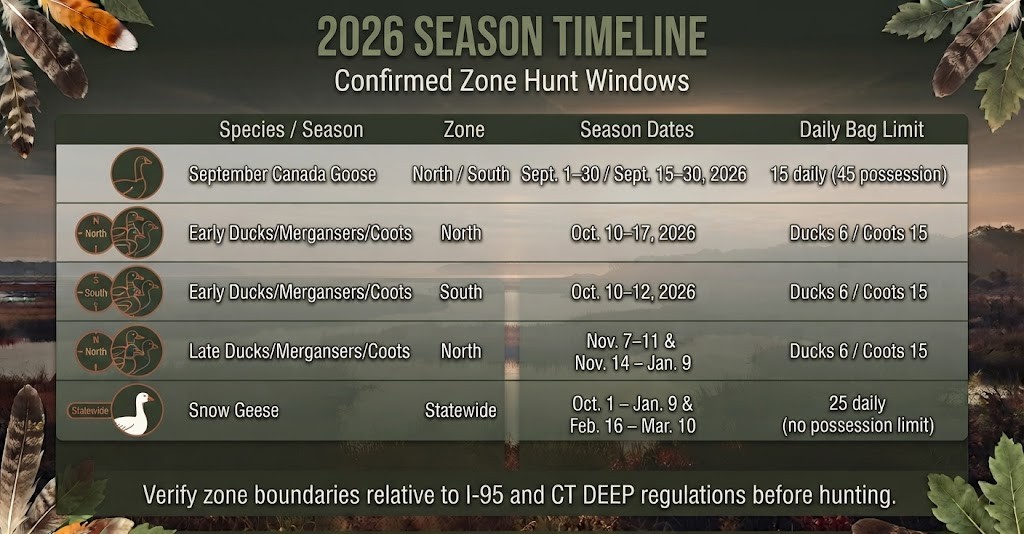
This early opportunity kicks off well before the rest of the waterfowl calendar, running Sept. 1–30, 2026 in the North Zone and Sept. 15–30, 2026 in the South Zone. The daily bag limit is 15 birds (45 in possession), and shooting hours extend a half hour past sunset — a good chance to fill the freezer before the main event begins.
Ducks, Mergansers & Coots (Early and Late Seasons)
The early duck season runs Oct. 10–17, 2026 in the North Zone and a shorter Oct. 10–12, 2026 window in the South Zone. The late season picks back up Nov. 7–11, 2026 and then again Nov. 14, 2026 through Jan. 9, 2027 in the North Zone, while the South Zone runs Nov. 11, 2026 and then Nov. 14, 2026 through the longer Jan. 19, 2027 close.
The daily duck limit of 6 is an aggregate limit — all ducks, mergansers, and sea ducks count toward that single number rather than each species getting its own allowance. Within that aggregate, species-specific sub-limits apply, including a cap of 4 sea ducks with additional limits on scoters, eiders, and oldsquaw. For the complete species-by-species sub-limit chart, consult CT DEEP’s full migratory bird guide directly, since these figures are refined annually.
Coots carry their own separate limit: 15 daily with a possession limit of 45.
Canada & Snow Goose Seasons
Regular Canada geese carry a daily bag limit of 2 (6 in possession), tighter than the September season, reflecting the shift into peak migration pressure. Snow geese offer one of the most generous limits in the state: 25 birds daily with no possession limit, across an extended window running Oct. 1, 2026 through Jan. 9, 2027, then reopening Feb. 16 through Mar. 10, 2027.
Scheduling matters too. Per Connecticut’s 2026 season changes, waterfowl may be hunted Tuesday, Wednesday, and Saturday during the regular state season. Once the regular season closes, Canada and snow goose hunting opens every day except Sunday, giving hunters extra opportunity to chase geese deep into winter.
Connecticut Waterfowl Licenses and Permits
Connecticut’s requirements build in layers — add one piece at a time and you won’t get tripped up. CT DEEP issues and enforces all of it, so their guidance is the final word if anything here needs clarifying.
Connecticut Hunting Licenses
| License / Stamp | Who It’s For | 2026 Cost |
|---|---|---|
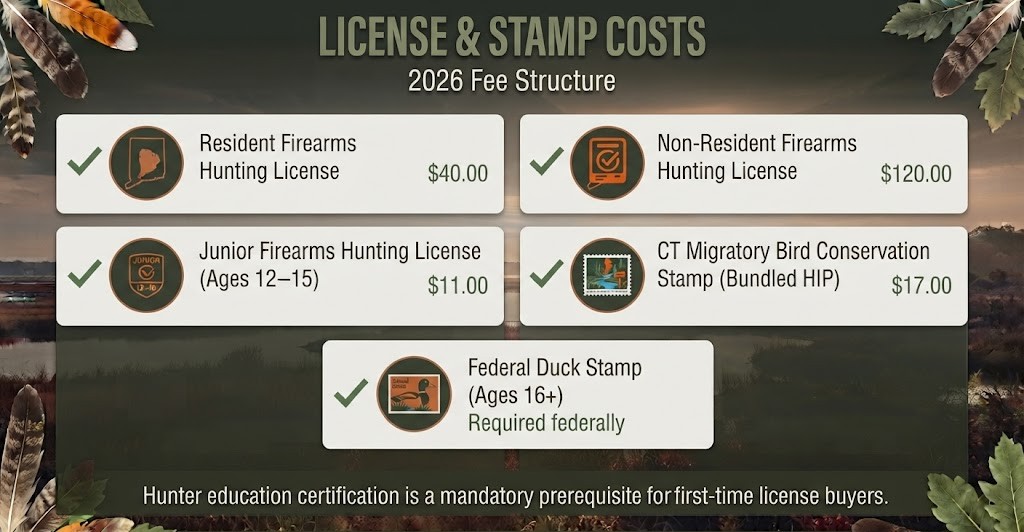
| Firearms Hunting License | Resident | $40 |
| Firearms Hunting License | Non-resident | $120.00 |
| Junior Firearms Hunting | Ages 12–15 (Resident & Non-resident) | $11.00 |
| Connecticut Migratory Bird Conservation Stamp | All migratory bird hunters (includes HIP permit) | $17.00 |
| Federal Duck Stamp | Required for all waterfowl hunters over 16 | Federal cost applies |
Traveling hunters should budget $120 for the non-resident Firearms Hunting License alone, before adding stamps — worth locking into trip planning early.
Hunter education certification is a prerequisite before you can purchase your first license, and non-residents typically need to show equivalent hunter-education certification from their home state. CT DEEP treats this as a non-negotiable first step, whether you’re a lifelong hunter moving states or a first-timer picking up the sport.
Connecticut Hunting Permits & Stamps
Once you know what you need, the acquisition order is straightforward:
- Complete hunter education (if you haven’t already) — this unlocks everything else.
- Buy your Firearms Hunting License — resident, non-resident, or junior, based on your situation.
- Add the Connecticut Migratory Bird Conservation Stamp — this automatically bundles your HIP permit (Harvest Information Program), used to collect harvest data from migratory bird hunters nationwide.
- Buy your Federal Duck Stamp — required for every waterfowl hunter 16 and older.
You can purchase these through Town Clerk offices, select outdoor equipment vendors, and online through the State of Connecticut’s Outdoor Licensing website.
If you’re getting a junior hunter (ages 12–15) into the field, they’ll need a small game junior hunting license plus the CT Migratory Bird Conservation Stamp, and must be accompanied by an adult at all times. Connecticut also runs two Junior Waterfowl Hunter Training Days in 2026 — Saturday, Oct. 3, and Saturday, Oct. 31 — and the Connecticut Waterfowl Association’s Waterfowl Hunter Mentoring Program pairs novice hunters, youth and adult alike, with experienced volunteer mentors. Our migratory bird seasons guide covers how these stamps interact with the wider framework.
A few legal specifics worth locking in before opening day: legal firearms are limited to shotguns 10 gauge or smaller with a 3-shell maximum capacity, and non-toxic shot is required statewide — steel no larger than BB, or approved bismuth, tungsten-polymer, or tungsten-iron alternatives.
Where to Hunt Waterfowl in Connecticut
Legal, productive ground is the foundation of a good season, and it’s often the hardest part to nail down, especially if you’re new to the state or watching public spots fill up faster every year. A few paths work depending on your situation.
Best Public Lands
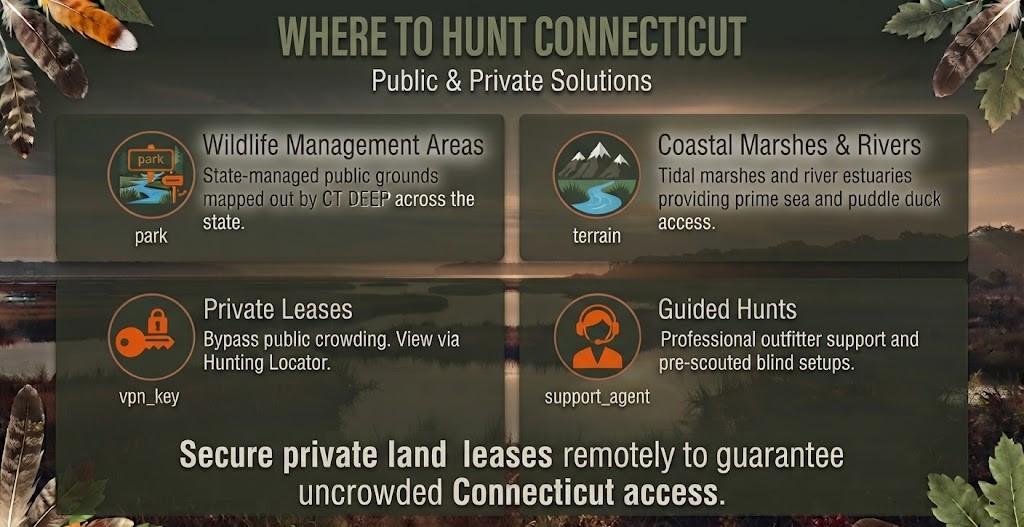
Connecticut offers a network of Wildlife Management Areas and other public grounds open to waterfowl hunting, all mapped out by CT DEEP. Check the official Connecticut waterfowl hunting areas map directly — it’s updated to reflect current access and closures. When scouting public options, look for:
- Coastal marshes with tidal flow, prime for sea ducks and puddle ducks alike
- River corridors and estuaries that concentrate migrating birds
- Managed impoundments specifically maintained for waterfowl habitat
Public marshes are a real option, but they get competitive fast once peak season hits — arrive early or expect company. That’s why many hunters start looking at private access as the season progresses.
Private Land Hunting with Hunting Locator
Leasing private land solves the crowding and access problems at once. You get ground that’s yours for the season, without racing another truck to the ramp at 4 a.m. or wondering if someone else beat you to your spot.
That’s where Hunting Locator comes in. We connect hunters directly with landowners across Connecticut who are ready to lease — or in some cases sell — their property for waterfowl hunting and beyond. Instead of cold-calling landowners or hoping a lead pans out, you get a vetted, searchable marketplace built for this problem specifically. Current Connecticut listings span a range of acreage and regions suited to waterfowl and other game, giving both residents and traveling hunters a real shot at guaranteed ground this season.
Browse Connecticut waterfowl leases to lock in your ground before the season fills up. Whether you’re a local hunter tired of competing for the same public marsh or a traveling hunter with a narrow window to make a trip count, securing land ahead of time removes a lot of the guesswork on opening day.
Guided Hunts
Guided hunts offer a turnkey option, especially useful for non-residents unfamiliar with Connecticut’s marshes or new hunters who want mentorship alongside the experience. A typical guided waterfowl hunt includes a pre-scouted blind setup, a decoy spread tailored to the day’s conditions, and a guide’s working knowledge of how birds are moving locally. Gear is sometimes included as well, which simplifies a first trip.
If you’re planning to return to Connecticut season after season, though, a lease often delivers better long-term value than repeat guided trips — you get the same familiarity with the ground without paying for a guide’s time on every hunt. Many hunters use a guided trip to learn an area, then move to leased land once they know what they’re looking for.
Waterfowl Hunting Tips
A safe, legal, productive season comes down to a handful of fundamentals:
- Scout Before You Set Up — Timing and location beat gear every time. Confirm your zone dates and shooting hours before you ever load the truck.
- Match Your Decoy Spread — Realistic spreads tailored to the species and water type you’re hunting will out-produce a generic setup every time.
- Shoot Legal, Shoot Clean — Stick to non-toxic shot (steel no larger than BB, or approved tungsten/bismuth alternatives), a 10-gauge-or-smaller shotgun, and a 3-shell maximum capacity.
- Dress for the Marsh — Quality waders and layered, concealing outerwear keep you comfortable and hunting longer through cold, wet mornings.
- Sharpen Your Calling — A confident, well-timed call sequence is often what turns a fly-by into a committed bird.
- Know Your Birds — Learn to identify species in flight so you stay within your sub-limits and avoid mistaking a protected species for a legal one.
- Prioritize Safety — Wear a PFD in the boat, maintain clear muzzle discipline, and share your hunt plan with someone before first light.
Once the fundamentals are down, the right gear makes a real difference. Check out the gear built for waterfowl season — waders, decoys, calls, blinds, and non-toxic loads, all in one place.
More Resources from Hunting Locator
Waterfowl season is one piece of a full Connecticut hunting calendar. These companion guides round out your planning across species and seasons:
- Hunting Locator homepage — Search leases nationwide by state, game type, and acreage.
- Connecticut leases — Browse and secure private waterfowl ground before the season fills up.
- Connecticut hunting hub — A big-picture overview of hunting opportunities statewide.
- Deeper evergreen waterfowl guide — Year-round waterfowl planning beyond this season’s specific dates.
- Broader migratory bird seasons — Full context on migratory bird rules and stamp requirements.
- Connecticut turkey hunting season — Plan your off-season turkey pursuit.
- Connecticut deer hunting season — Deer season dates and planning for the fall.
- Connecticut small game hunting season — Small game seasons, including junior license details.
- Connecticut upland game hunting season — Upland bird opportunities across the state.
- Connecticut coyote hunting season — Extend your season into the colder months.
- Hunting Locator store — Gear up with waders, calls, decoys, and non-toxic loads for the season ahead.
Frequently Asked Questions
Do I need a Federal Duck Stamp to hunt waterfowl in Connecticut?
Yes — every waterfowl hunter age 16 and older must carry a Federal Duck Stamp in addition to their state Firearms License and Connecticut Migratory Bird Conservation Stamp. Hunters under 16 are exempt from this federal requirement, per CT DEEP.
How much is a non-resident Connecticut waterfowl license?
Non-residents pay $120 for the Firearms Hunting License, plus $17 for the Connecticut Migratory Bird Conservation Stamp (which includes your HIP permit) and the separate Federal Duck Stamp. Budget for all three before your trip, since each is mandatory for legal waterfowl hunting in the state.
What’s the difference between the CT Migratory Bird Conservation Stamp and the Federal Duck Stamp?
The Connecticut Migratory Bird Conservation Stamp costs $17, bundles in your HIP permit, and funds state-level conservation efforts. The Federal Duck Stamp is a separate, federally required stamp for hunters 16 and older. Both are mandatory; one doesn’t substitute for the other.
What is HIP and do I have to sign up separately?
HIP stands for Harvest Information Program, a data-collection requirement for all migratory bird hunters nationwide. In Connecticut, it’s included automatically when you purchase your Connecticut Migratory Bird Conservation Stamp — no separate signup or purchase needed.
What are the 2026 Connecticut duck season dates?
Early duck season runs Oct. 10–17 in the North Zone and Oct. 10–12 in the South Zone. Late duck season runs Nov. 7–11 plus Nov. 14, 2026–Jan. 9, 2027 in the North Zone, and Nov. 11 plus Nov. 14, 2026–Jan. 19, 2027 in the South Zone. Check the table above for the full breakdown by zone.
Can a 12-year-old hunt waterfowl in Connecticut?
Yes — junior hunters ages 12–15 need a Junior Firearms License ($11), a valid small game junior hunting license, and the Connecticut Migratory Bird Conservation Stamp, and must be accompanied by an adult at all times. Connecticut also offers two Junior Waterfowl Hunter Training Days in 2026 (Oct. 3 and Oct. 31) plus a CWA mentoring program pairing young hunters with experienced volunteers.
The Final Shot
A good Connecticut waterfowl season comes down to a handful of decisions made before opening day: know your zone relative to I-95, lock in your exact dates, stack your licenses and stamps in the right order, hunt legal and ethical, and secure quality ground before the crowds do.
Before you head out, run through this checklist: verify your dates directly with CT DEEP, buy your full license stack, line up your land, and gear up for the conditions ahead. CT DEEP remains the final authority on every regulation in this guide, so double-check current rules before your first hunt of the season.
This guide is meant to take the guesswork out of your planning — land access included. Browse Connecticut waterfowl leases to lock in your ground for the season ahead.


