This Colorado waterfowl guide pulls every date, fee, and regulation from official sources and organizes them for residents and non-residents alike. For hunting access beyond Colorado, huntinglocator.com covers opportunities nationwide.
Here’s what’s covered:
- Season dates & bag limits for every duck and goose season and method, from Early Teal through the light goose conservation order
- Licenses, stamps, and requirements for residents and non-residents, including exact costs and the age thresholds that catch new hunters off guard
- Where to hunt — public land, private leases, and guided hunts — so you have a legal, productive spot lined up before opening day
Start with the quick facts below, then work through the details for a legal, successful season.
Quick Overview: Colorado Waterfowl Season at a Glance
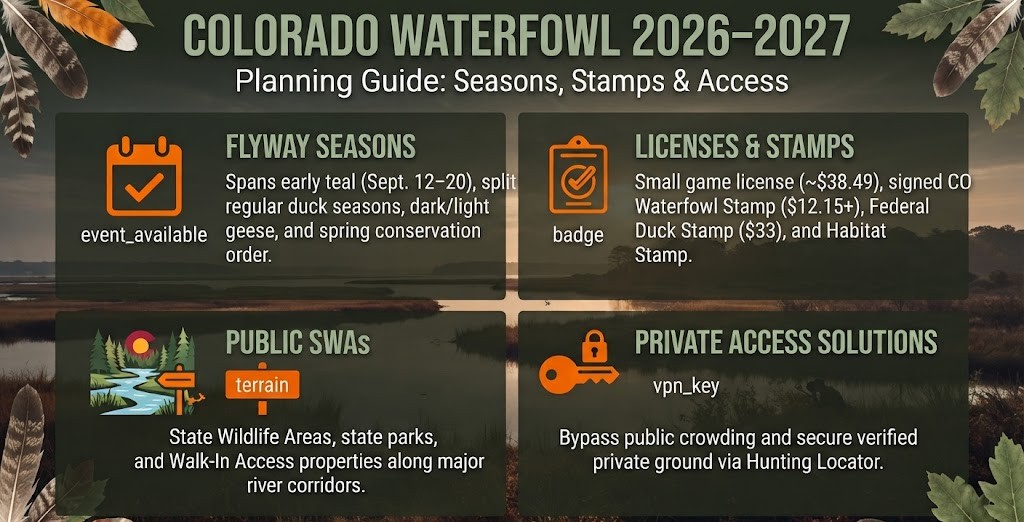
Colorado’s regular duck and coot season runs October 3–November 29, 2026, and December 24, 2026–January 30, 2027, with dark and light goose seasons extending into February. Colorado Parks and Wildlife’s official CPW waterfowl brochure is the definitive source for 2026 dates, fees, and regulations.
Here’s how the season breaks down by species and method:
| Species/Season | Season Type | Dates | Daily Bag Limit | Notes |
|---|---|---|---|---|
| Early Teal | Early season | Sep 12–Sep 20, 2026 | 6 daily | Blue-winged, green-winged, and cinnamon teal only |
| Regular Duck & Coot | Split season | Oct 3–Nov 29, 2026 & Dec 24, 2026–Jan 30, 2027 | 6 combined (Central Flyway); 4–5 in other zones | Coots included in the bag |
| Dark Goose | Regular | Nov 2, 2026–Feb 14, 2027 | ~5–15 daily, varies by zone | Canada geese and similar species |
| Light Goose | Regular | Oct 31, 2026–Feb 14, 2027 | Up to 50 daily in select zones | Snow, blue, and Ross’s geese |
| Light Goose Conservation Order | Special order | Feb 15–Apr 30, 2027 | No bag limits | Federal duck stamp not required |
Colorado divides its waterfowl hunting into distinct zones, and each zone runs its own split-season segments within these broader windows. Confirm your zone’s exact segment dates in the current CPW brochure before finalizing plans. For more detail on how zones and segments fit together, see our full Colorado waterfowl breakdown.
You’ll also need a handful of licenses and stamps to hunt legally:
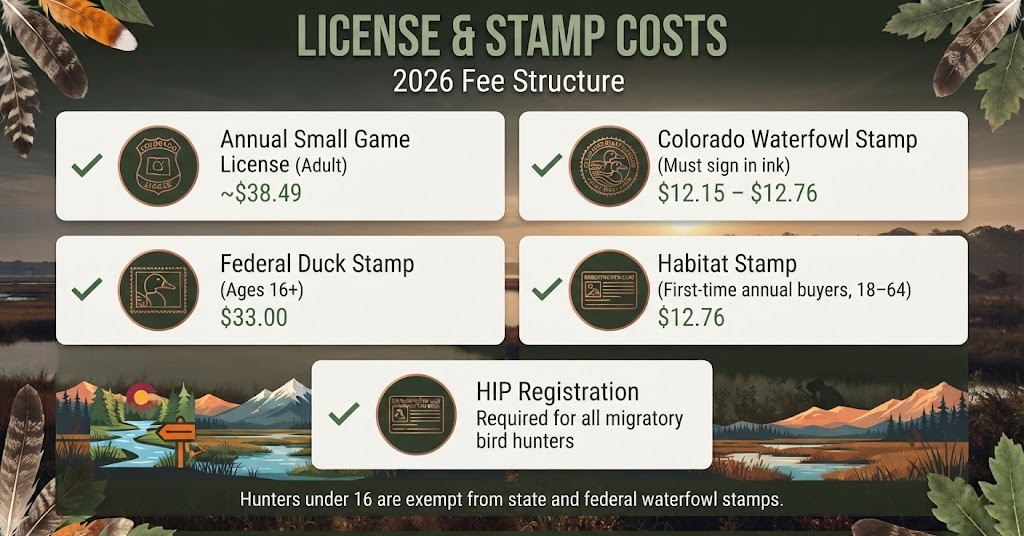
- Annual Small Game License — approximately $38.49 for adult residents
- Colorado Waterfowl Stamp — $12.15–$12.76, and it must be signed in ink to be valid
- Federal Duck Stamp — $33.00, required for all hunters age 16 and older
- Habitat Stamp — $12.76, required for first-time annual license buyers ages 18–64
- HIP registration — required for all migratory bird hunters, regardless of age
Hunters under 16 don’t need either the state waterfowl stamp or the federal duck stamp, which simplifies a young hunter’s first season. The sections below cover every requirement in detail, including the Central Flyway framework and how the split seasons work.
Colorado Waterfowl Hunting Seasons
Colorado sets its waterfowl seasons within federal frameworks rather than independently. Ducks and geese are migratory birds, so their seasons are set within federal frameworks under the U.S. Fish and Wildlife Service, and Colorado typically finalizes waterfowl dates later in the year than its big-game dates.
Colorado sits within the Central Flyway, one of four migratory corridors across North America, which is why bag limits and season structures are coordinated with federal guidelines rather than set purely at the state level. With that in mind, here’s each season individually — Early Teal, dark goose, and light goose — along with the details CPW builds in for each.

Early Teal Season
Early Teal season runs September 12–20, 2026, with a 6-bird daily limit. It’s the earliest window on Colorado’s waterfowl calendar, opening while summer heat still lingers over the marshes, and it targets blue-winged, green-winged, and cinnamon teal specifically. Teal often move through in tight, fast flocks alongside other early migrants, so species identification matters more here than in almost any other season — mistaking a look-alike for teal can put you over your limit before you realize it.
Regular Duck & Coot Season
Regular duck and coot season runs in two segments: October 3–November 29, 2026, and December 24, 2026–January 30, 2027, with a combined daily limit of 6 in the Central Flyway (4–5 in other specific zones). This is the backbone of Colorado’s duck season, covering the bulk of fall and winter migration.
Within that overall 6-bird limit, watch for aggregate sub-limits on certain species — hen mallards, pintails, canvasbacks, and redheads often have specific caps within the broader daily limit. One notable 2026 change: the pintail daily bag limit increased to three, up from previous seasons. Coot hunting falls under this same season, so if you’re working sloughs where coots are thick, they count toward this window.
Dark Goose Season
Dark goose season runs November 2, 2026–February 14, 2027, with limits varying by zone — typically 5 to 15 birds daily. “Dark geese” refers to Canada geese and similar species, distinguishing them from the light-colored snow and Ross’s geese covered next. Because limits shift by zone, confirm your specific zone’s numbers before heading out.
Light Goose Season & Conservation Order
Light goose season runs October 31, 2026–February 14, 2027, with a special conservation order running February 15–April 30, 2027, and no bag limits during that order.
The conservation order exists to help manage overpopulated snow and Ross’s goose numbers, and per CPW, a federal stamp is not required to take light geese during it. That lowers the barrier to entry compared with the regular season, making it a reasonable option for residents looking to extend their year and for non-residents planning a spring trip.
Colorado Waterfowl Licenses & Permits
Hunters 16 and older need a small game license, a signed Colorado Waterfowl Stamp, and a Federal Duck Stamp to hunt legally in Colorado. These requirements come from CPW and the U.S. Fish and Wildlife Service, and they need to be squared away before opening day.
A few details worth remembering: the age-16 threshold determines whether you need either stamp at all, the Colorado Waterfowl Stamp only counts once it’s signed in ink, and every migratory bird hunter — regardless of age — needs HIP registration. Here’s what each license and stamp costs and who needs it.
Colorado Hunting Licenses
Here’s how the core licenses and stamps break down by cost and requirement:
| License/Stamp | Cost | Who Needs It | Resident/Non-Resident |
|---|---|---|---|
| Annual Small Game License | ~$38.49 (adult) | All waterfowl hunters | Both (non-resident price varies — verify current CPW brochure) |
| Colorado Waterfowl Stamp | $12.15–$12.76 | Hunters 16+ | Both |
| Federal Duck Stamp | $33.00 | Hunters 16+ | Both |
| Habitat Stamp | $12.76 | First-time annual buyers, ages 18–64 | Both |
For non-residents, the annual small game license already includes the required Habitat Stamp, so there’s no separate purchase to track down. Exact non-resident pricing can differ from resident rates, so confirm the current figure in this year’s CPW brochure before you buy.
One detail hunters commonly miss: paying for the Colorado waterfowl stamp isn’t enough on its own — it must be signed in ink on your license to be valid in the field. Hunters under 16 don’t need either stamp, though age-specific rules are worth double-checking each season since they can shift.
Colorado Hunting Permits & Requirements
Getting set up to hunt waterfowl in Colorado for the first time follows a fairly simple sequence:
- Complete hunter education if required for your age group and residency status
- Buy your small game license through a CPW license agent or online
- Add the Colorado Waterfowl Stamp and sign it in ink immediately
- Purchase your Federal Duck Stamp through the U.S. Postal Service, CPW agents, or approved retailers
- Complete HIP registration, which is quick and typically bundled into your license purchase
Licenses, stamps, and brochures are available through CPW license agents statewide, online through the CPW website, and at CPW offices directly. Once you’re in the field, carry your license, your signed Federal Duck Stamp, and proof of HIP registration — those are the three documents a game warden will ask to see.
Where to Hunt Waterfowl in Colorado
Before you buy a single decoy, figure out where you can legally hunt. The biggest access mistake hunters make is assuming public-looking land is automatically open, when you actually need to sort out public versus private parcels, State Wildlife Area rules, seasonal closures, and local reservation requirements before you leave home. From there, you’ve got three main paths: public land, private leases, and guided hunts. Colorado hunting leases are often the fastest way to lock down reliable access once you know what you’re looking for.
Best Public Lands (SWAs)
Colorado’s State Wildlife Areas, state parks, state-trust lands, and Walk-In Access (WIA) properties offer genuinely strong waterfowl hunting — some spots rival what you’d find at a private duck club. This public land network is a solid starting point whether you’re a resident scouting new water or a visiting hunter without a lease lined up yet.
A few regions consistently stand out for waterfowl:
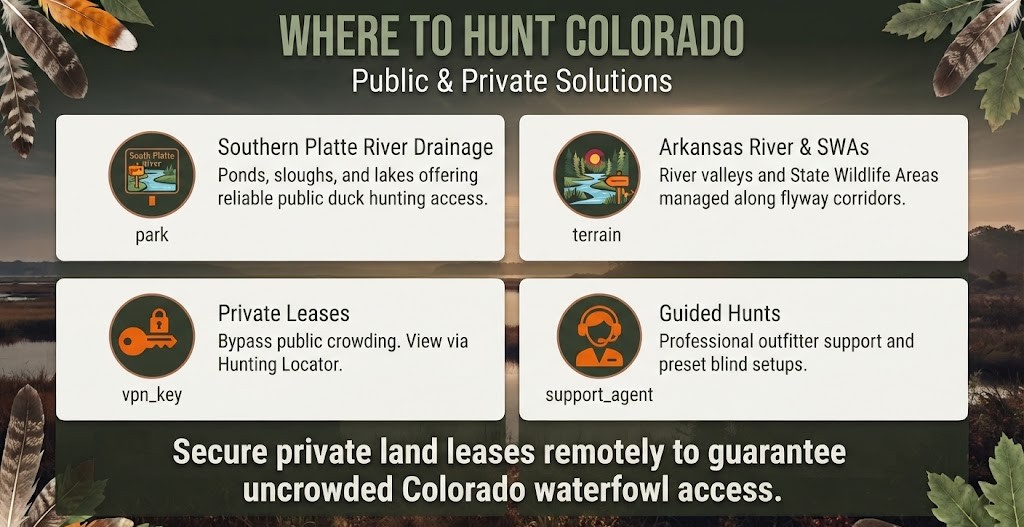
- The Southern Platte River drainage — ponds, sloughs, and lakes throughout this area provide reliable duck hunting with multiple public access points
- The Arkansas River drainage — river valleys here hold good numbers of ducks, and areas near rivers generally concentrate migrating waterfowl
- State Wildlife Areas near major flyway corridors — many SWAs are specifically managed to support healthy, huntable waterfowl populations
Rules, seasonal closures, and reservation requirements vary property by property, so verify the specifics for any SWA you’re planning to hunt before you head out.
Private Land Hunting with Hunting Locator
Public land is a solid starting point, but a spot that’s yours for the season offers something different. Leasing — or buying — private land for waterfowl hunting means less competition for prime spots, more control over how you manage your blind or pit, and one less variable when the alarm goes off at 4 a.m. on opening morning.
Hunting Locator connects you directly with Colorado landowners who are ready to lease or sell their land to hunters who’ll respect it. Whether you’re a resident tired of fighting crowds at public access points or a non-resident who needs access locked in before you set foot in the state, you can browse Colorado hunting leases and see what’s currently available, from small sloughs to larger river-bottom properties.
Guided Hunts
If you’d rather skip the scouting and access logistics, guided waterfowl hunts are a solid option — particularly for non-residents or beginners who want blinds, decoy spreads, and calling handled by someone who hunts that water every day.
Here’s a general breakdown of what’s typically provided versus what you’ll still need to bring:
What outfitters typically provide:
- Blinds, pits, or other concealment already set up on productive water
- A full decoy spread positioned by someone who knows the local birds
- Calling expertise and real-time reads on how birds are working that day
- Local access and scouting knowledge built from hunting the area regularly
What you’ll still need to bring yourself:
- Your own license, stamps, and HIP registration — outfitters don’t cover your legal requirements
- Nontoxic shot appropriate for your shotgun
- Weather-appropriate clothing and waders
- Your own shotgun, unless otherwise arranged
Guided hunts remove a lot of the guesswork, but the legal responsibility for having your license and stamps in order still falls on you.
Colorado Waterfowl Hunting Tips
Success in the marsh comes down to fundamentals — the right gear, the right setup, and knowing your birds. Here are the tips that make the biggest difference for a legal, ethical, and productive hunt.
- Master species identification — Study waterfowl identification guides before opening day, paying close attention to size, plumage patterns, bill shape, and flight characteristics. This keeps you legal and helps you avoid accidental over-limit mistakes on look-alike species.
- Start with a manageable decoy spread — A dozen floating mallard decoys is plenty for Colorado’s smaller sloughs, marshes, and rivers. You don’t need an elaborate spread to bring birds in close on most Colorado water.
- Pick a beginner-friendly call — A double-reed call is easier to blow than other options, and it’s worth spending time perfecting a single clean “quack” before you try anything more complicated in the field.
- Use nontoxic shot — Steel, tungsten, or HEVI-Shot is mandatory for waterfowl hunting in Colorado. Lead shot is never legal for migratory birds, so double-check your ammunition before you load up.
- Conceal with the right blind — Layout blinds and pit blinds offer some of the simplest, most effective concealment for hunters who are still getting comfortable with setups.
- Know your shooting hours — Waterfowl hunting typically runs from a half-hour before sunrise to sunset. Confirm exact times in the current CPW brochure, since they can shift slightly by date and location.
Quality gear makes a real difference in the field. When you’re ready to stock up, gear up in our store for everything from decoy spreads to blinds built for Colorado conditions.
More Resources from Hunting Locator
Planning a Colorado waterfowl season is just one piece of a bigger picture — here are trusted next steps to keep building your hunting access and knowledge.
- Platform home — Start here to find hunting access nationwide, whether you’re planning your next Colorado trip or scouting opportunities in another state.
- Full Colorado waterfowl deep-dive — The companion breakdown to this guide, with additional detail on Colorado’s waterfowl seasons.
- Colorado hunting hub — A broad overview of hunting opportunities across the entire state, beyond just waterfowl.
- Colorado sandhill crane hunting season — A waterfowl-adjacent migratory season worth knowing if you enjoy hunting birds on the wing.
- Colorado upland game hunting season — Pheasant, quail, and grouse opportunities to round out your fall.
- Colorado turkey hunting season — Spring and fall turkey season details for the state.
- Colorado pronghorn hunting season — Everything you need to plan a pronghorn hunt on Colorado’s plains.
- Colorado deer hunting season — Season dates and access info for Colorado’s mule deer and whitetail hunters.
- Colorado elk hunting season — A full breakdown of Colorado’s iconic elk seasons.
- Colorado moose hunting season — What to know about this limited, highly sought-after tag.
- Colorado black bear hunting season — Season structure and regulations for bear hunters.
- Colorado mountain lion hunting season — Details on Colorado’s mountain lion season and requirements.
Frequently Asked Questions
When is Colorado duck season for 2026?
Regular duck and coot season runs October 3–November 29, 2026, and December 24, 2026–January 30, 2027. Early Teal season opens even sooner, running September 12–20, 2026. These dates come from Colorado Parks and Wildlife, so confirm your specific zone’s dates in the current CPW brochure before finalizing plans.
Do I need a Federal Duck Stamp and a Colorado Waterfowl Stamp?
Yes — hunters 16 and older need both. The Colorado Waterfowl Stamp must be signed in ink to be valid, and you’ll also need a small game license underneath both stamps. CPW enforces all three requirements together, so skipping one leaves you unlicensed in the field.
How much does a Colorado waterfowl license cost?
An adult small game license runs approximately $38.49, the Colorado Waterfowl Stamp costs $12.15–$12.76, the Federal Duck Stamp is $33.00, and first-time annual license buyers ages 18–64 pay an additional $12.76 for the Habitat Stamp. Together, these cover everything a resident hunter needs to hunt legally.
What do non-residents need to hunt waterfowl in Colorado?
Non-residents need a Colorado small game license (which includes the required Habitat Stamp), the Colorado Waterfowl Stamp, the Federal Duck Stamp, and HIP registration. Once your paperwork is squared away, you can browse Colorado hunting leases to lock in reliable access before your trip.
What is the light goose conservation order?
It’s a special extended season running February 15–April 30, 2027, with no bag limits on light geese. Per CPW, a federal stamp is not required to take light geese during the conservation order, making it an accessible late-season option for both residents and non-residents.
What gear does a beginner waterfowl hunter need in Colorado?
Start with a dozen mallard decoys, a double-reed call, a simple layout or pit blind, and mandatory nontoxic shot like steel or tungsten. Shooting hours typically run from a half-hour before sunrise to sunset, so plan your morning around that window.
The Final Shot
Planning a successful Colorado waterfowl season comes down to three things: know your season dates and bag limits, get your license and stamps squared away — remembering the age-16 threshold and the signed-stamp requirement — and lock in legal access before opening day arrives. Confirm your zone’s exact dates in the current CPW brochure, make sure your license, stamps, and HIP registration are all in order, and secure your hunting spot, whether that’s public water or a private lease.
CPW remains the definitive source for exact dates, zone boundaries, and any late regulatory updates, so keep their brochure handy throughout the season. This guide is meant to save you the homework so you can focus on the hunt.
Ready to plan with confidence? Browse Colorado hunting leases today.


