California deer hunting represents both tremendous opportunity and significant complexity. With five distinct deer species (mule deer, blacktail, and other deer species) scattered across 34 different hunting zones, the Golden State demands more preparation than most Western hunts. But for those willing to learn the system, California delivers experiences that define what Western hunting is all about.
The state’s deer population has rebounded to approximately 430,000 animals after recent wet years, though individual zone management means success varies dramatically by location and hunter preparation. Recent developments, including the state’s first confirmed Chronic Wasting Disease cases, add new layers to hunt planning that every California deer hunter needs to understand.
Here’s what this guide covers to set you up for success:
- Complete breakdown of California’s zone system and 2025 season dates
- Essential licensing requirements and the premium tag draw process
- Where to find the best deer hunting opportunities across California’s varied terrain
Whether you’re a resident looking to unlock California’s zone system or a non-resident considering your first Golden State adventure, understanding these fundamentals will save you time, money, and disappointment in the field.
California Deer Season Zone System and 2025 Season Dates
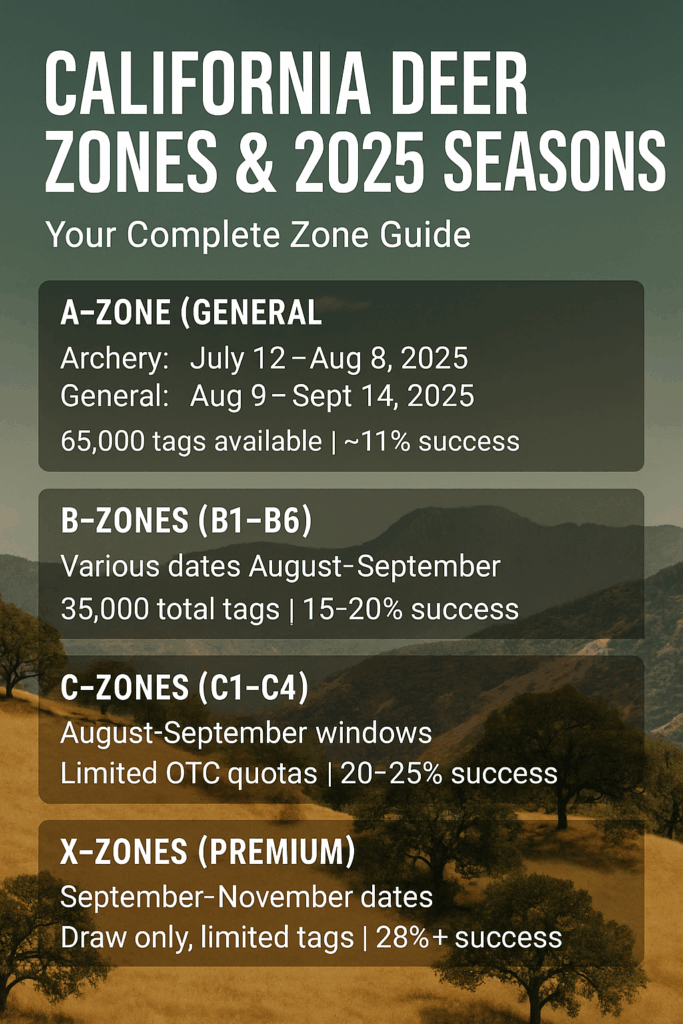
California’s deer hunting regulations operate on a zone-based system unlike any other Western state. The California Department of Fish and Wildlife manages deer through 34 distinct zones (A, B1-B6, C1-C4, D3-D19, X1-X12) plus over 30 special hunt opportunities. Each zone has specific season dates, tag quotas, and sometimes unique regulations that hunters must understand before applying.
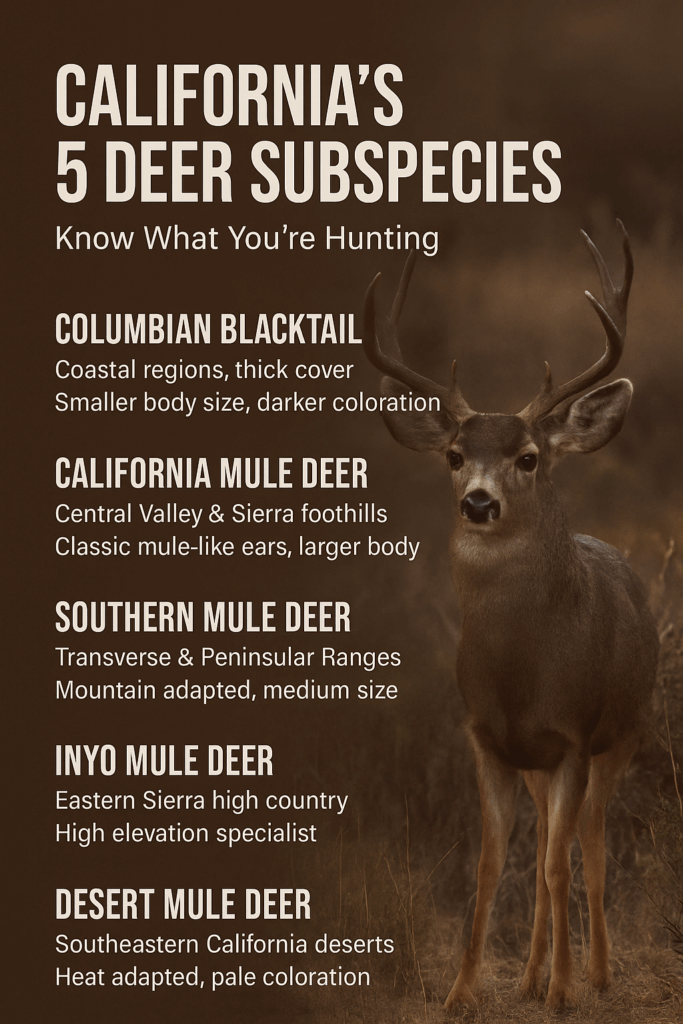
The complexity exists for good reason – California supports five subspecies of mule deer and blacktail, each adapted to different habitats and requiring tailored management. Columbian blacktail dominate the coastal regions, while California mule deer (Odocoileus hemionus californicus) occupy the Central Valley foothills and Sierra Nevada. Southern mule deer, Inyo mule deer, and Desert mule deer fill specific niches from the Transverse Ranges to the Mojave Desert.
| Zone Type | 2025 Season Examples | Tag Availability | Success Rates |
|---|---|---|---|
| A-Zone (General) | Archery: July 12 – Aug 8 General: Aug 9 – Sept 14 | Over-the-counter, 65,000 tags | ~11% (high pressure) |
| B-Zones | Varies by sub-zone B1-B6 different dates | OTC, 35,000 total | 15-20% average |
| C-Zones | Generally August-September | OTC, limited quotas | 20-25% average |
| D-Zones | August-October windows | Mix of OTC and premium | 25-35% average |
| X-Zones (Premium) | September-November | Draw only, limited tags | 28%+ average |
2025 Season Framework: The earliest hunting begins with A-zone archery on July 12, 2025, while the latest season extends to December 31, 2025 for select late archery opportunities. Most general rifle seasons open between August 9 and October 5, depending on the zone.
Essential Requirements for All Hunters:
- Valid California hunting license plus deer tag(s)
- Nonlead ammunition mandatory – certified copper or tungsten bullets only
- Hunter education certification (with limited exceptions)
- CWD sample submission required in zones D7, X9a, X9b, X9c following 2024 detections
California allows hunters to purchase two deer tags annually – providing multiple opportunities if you understand the system. However, premium X-zones and special hunts require entering the annual draw, with application deadlines typically in early June.
California Deer Hunting Seasons
A-Zone The Volume Opportunity
A-zone represents California’s largest deer hunting opportunity, with 65,000 tags available annually across a massive area spanning the Sierra Nevada foothills and Cascade Range. The 2025 archery season runs July 12 through August 8, followed by the general season August 9 through September 14.
Don’t let the 11% success rate fool you into thinking A-zone lacks quality deer. The challenge comes from the sheer size of the zone and hunting pressure, not absence of trophy potential. Successful A-zone hunting requires getting away from roads and popular camping areas. The deer are there – mature bucks just require more effort to locate.
A-zone strategy centers on elevation and water. Early season finds deer at higher elevations near permanent water sources. As temperatures cool and hunting pressure increases, deer move to traditional fall ranges in oak woodlands and brush country. Understanding these seasonal movements separates successful hunters from those who simply buy a tag and hope for the best.
The zone’s diversity offers something for every hunting style. Bowhunters can take advantage of the earlier season when deer patterns are more predictable, while rifle hunters benefit from cooler weather and the beginning of rutting activity. Either way, physical conditioning and quality optics are essential for A-zone success.
Premium X-Zones The Trophy Pursuit
X-zones represent California’s premier deer hunting opportunities, offering lower hunter density and higher success rates in exchange for the complexity of the draw system. These zones typically open in September and October when bucks are transitioning into rutting behavior and fall weather makes hunting more comfortable.
Draw odds vary dramatically by zone and hunter preference points. Some X-zones like X3b and X4 require multiple preference points for guaranteed draws, while others offer reasonable odds for hunters with minimal points. The CDFW harvest statistics show X-zone success rates averaging 28% or higher – nearly triple the A-zone average.
What makes X-zones special isn’t just the statistics – it’s the hunting experience. Lower hunter numbers mean deer behave more naturally, increasing your chances of encountering undisturbed animals during daylight hours. Many X-zones also coincide with the early rut period when bucks become more active and visible.
X-zone planning requires long-term thinking. Building preference points, studying harvest data, and understanding each zone’s characteristics takes time. But for hunters serious about consistently pursuing quality California mule deer, the premium zone system rewards patience and preparation.
Special Hunts and Opportunities
Beyond the standard zone system, California offers over 30 special hunt opportunities ranging from antlerless management hunts to limited-entry trophy areas. These include G-hunts (general special), A-hunts (apprentice), M-hunts (military), and J-hunts (junior) that provide additional chances for specific hunter groups.
Apprentice hunts deserve special attention for hunters new to California’s system. These hunts offer mentored opportunities with experienced hunters, helping newcomers navigate both the regulations and the terrain. Success rates on apprentice hunts often exceed standard zones due to the guidance factor.
Some of the most interesting opportunities come through late-season hunts and special management areas. These hunts often target specific population management goals, such as antlerless harvests in areas with high deer densities or late-season buck opportunities in zones with robust populations.
Licenses and Permits Navigating California’s System
California Hunting Licenses and Costs
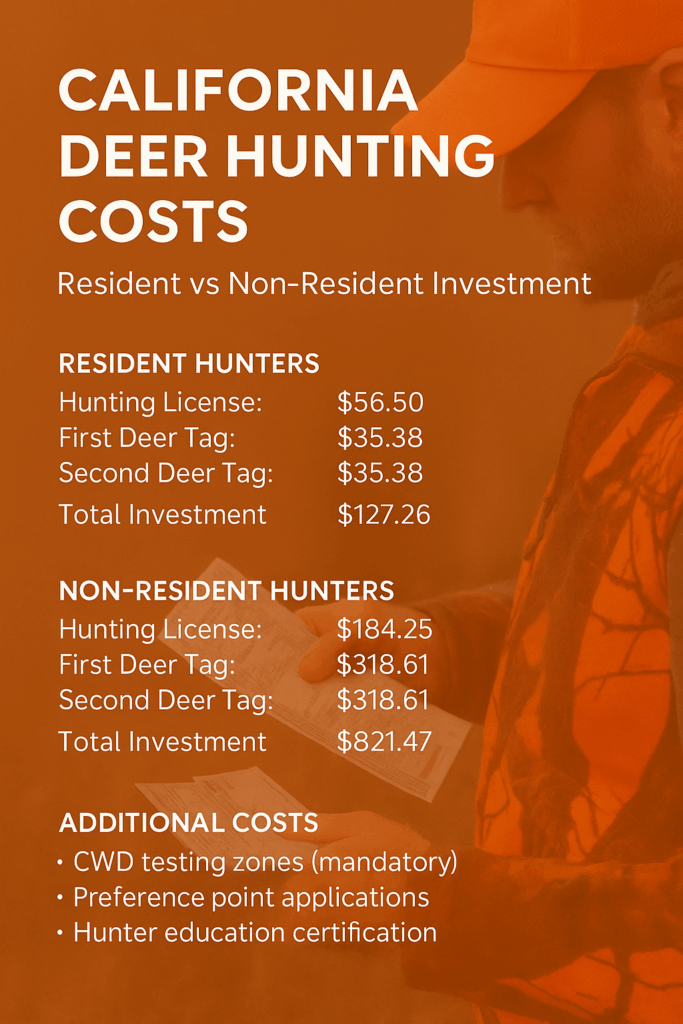
Every deer hunter needs a valid California hunting license, with costs varying significantly between residents and non-residents. Resident annual licenses cost approximately $56.50, while non-resident licenses run around $184.25 – a substantial investment that requires careful planning for out-of-state hunters.
Beyond the base license, deer tags cost $35.38 for residents and $318.61 for non-residents for each tag. Since California allows two deer tags annually, non-resident hunters could invest over $800 in tags alone before considering travel, lodging, and equipment costs. This investment underscores the importance of thorough preparation and realistic expectations.
Hunter education certification is required for most hunters, though some exceptions exist for older hunters or those with out-of-state certifications. California accepts hunter education from other states, but verification takes time – don’t wait until the last minute to confirm your eligibility.
The state’s online licensing system simplifies the purchase process, but understanding what you’re buying requires homework. Some zones require premium tags obtained through the draw, while others offer over-the-counter availability. Mixing up these requirements can derail hunting plans before they begin.
The Premium Tag Draw Process
California’s premium tag draw operates on a preference point system where unsuccessful applicants receive points that improve future draw odds. The 2025 application deadline falls on June 2, with results announced June 16. Leftover tags from unsuccessful draws go on sale July 2 for first tags and August 2 for second tags.
Preference points create long-term strategy decisions. Some hunters focus on building points for trophy zones like X3b or X12, while others apply for zones where they can draw with fewer points. Understanding point creep – the tendency for required points to increase over time – helps inform these decisions.
The system allows strategic flexibility through first and second tag options. Hunters can apply for a premium zone as their first choice while selecting a more attainable zone as backup. This approach maximizes hunting opportunities while still pursuing trophy potential.
Application strategy varies by hunting goals. Resident hunters often build points over several years for specific trophy zones, while non-residents might focus on zones they can draw immediately given the higher costs involved. Either approach requires understanding the data and trends behind each zone’s draw odds.
Chronic Wasting Disease Requirements
California confirmed its first CWD cases in May 2024, fundamentally changing deer hunting in affected areas. Hunters harvesting deer in zones D7, X9a, X9b, and X9c must submit samples for CWD testing – a new requirement that affects hunt planning and post-harvest procedures.
CWD sample submission is mandatory, not optional. Hunters in these zones must deliver samples to designated testing stations or face potential citations. The CDFW CWD webpage provides current testing station locations and procedures.
Understanding CWD goes beyond compliance – it represents a significant long-term challenge for Western deer hunting. The disease’s presence in California follows patterns seen in other Western states, where CWD has fundamentally altered deer management strategies. Staying informed about CWD developments helps hunters understand potential future regulation changes.
Prevention measures extend beyond testing requirements. Proper field care, avoiding brain and spinal tissue, and following transport regulations help prevent disease spread. These practices protect both deer populations and hunting opportunities for future generations.
Where to Hunt California Deer
Best Public Lands for Mule Deer Hunting
California’s national forests provide the backbone of public land deer hunting, offering millions of acres across diverse elevations and habitats. Los Padres National Forest, Sierra National Forest, and Mendocino National Forest all support substantial deer populations with varying access levels and hunting pressure.
National forest hunting requires understanding seasonal patterns and elevation changes. Early season often finds deer at higher elevations near water sources, while later seasons see movement to traditional winter ranges at lower elevations. Successful public land hunters learn these patterns through scouting and season-long observation.
Bureau of Land Management lands throughout California offer additional public hunting opportunities, often with less pressure than popular national forest areas. BLM lands frequently provide access to transition zones between different habitat types – areas that can concentrate deer movement during seasonal migrations.
State wildlife areas managed by CDFW offer some of California’s most productive deer hunting, though access rules vary by location. Some areas require reservations or special permits, while others operate on a first-come basis. These areas often receive active habitat management that can create exceptional hunting opportunities.
The key to public land success lies in effort and preparation. Most successful public land deer hunters invest significant time in preseason scouting, identifying water sources, travel corridors, and areas with minimal human pressure. This groundwork separates consistent success from occasional luck.
Guided Hunts and Professional Outfitters
Professional outfitters provide valuable services for hunters unfamiliar with California’s complex system. Quality outfitters throughout California offer everything from fully guided hunts to drop-camp services that provide access to private land with minimal guiding.
Guided hunts make particular sense for non-resident hunters facing high license costs and limited local knowledge. A good outfitter doesn’t just provide access – they offer years of accumulated knowledge about local deer patterns, seasonal movements, and effective hunting strategies specific to their area.
Different outfitters specialize in different hunting experiences. Some focus on trophy potential in premium zones, while others emphasize high success rates on mature bucks in less pressured areas. Understanding these differences helps match outfitter services with hunting goals and budgets.
The relationship between hunter and outfitter works best when expectations align with reality. Quality outfitters provide honest assessments of trophy potential, success rates, and physical demands. They understand that repeat clients and referrals depend on delivering the experience they promise, not overselling capabilities.
Private Land Hunting Access
Private land hunting often provides the most consistent success due to lower hunting pressure and active management. Many California ranches and farms support excellent deer populations while dealing with crop damage and other wildlife conflicts that create hunting opportunities.
Building relationships with private landowners takes time and genuine effort. Successful private land hunters often provide services beyond hunting fees – helping with ranch work, participating in habitat projects, or simply being reliable, respectful guests who enhance rather than complicate the landowner’s life.
California’s diverse agricultural landscape creates varied private hunting opportunities. Coastal ranch country supports blacktail populations, while Central Valley foothill ranches often hold California mule deer. Understanding how different agricultural practices affect deer populations helps identify productive areas.
If you’re seeking private hunting access, California hunting leases offer opportunities ranging from day hunts to season-long arrangements. These leases often provide exclusive access to properties that would otherwise be unavailable to the hunting public.
For hunters considering long-term investment, hunting land for sale in California includes properties specifically valued for their deer hunting potential. Ownership provides ultimate control over hunting timing, guest access, and habitat management decisions.
Hunting Locator connects serious hunters with landowners throughout California’s diverse deer hunting regions. Our platform facilitates relationships between hunters seeking quality access and property owners looking to share their land with responsible sportsmen. Whether you’re pursuing a weekend lease or considering property purchase, Hunting Locator’s network spans California’s premier deer hunting areas from the coastal ranges to the Eastern Sierra.
California Deer Hunting Tips
Decades of California deer hunting have taught hunters what separates consistent success from frustration in the Golden State’s challenging conditions:
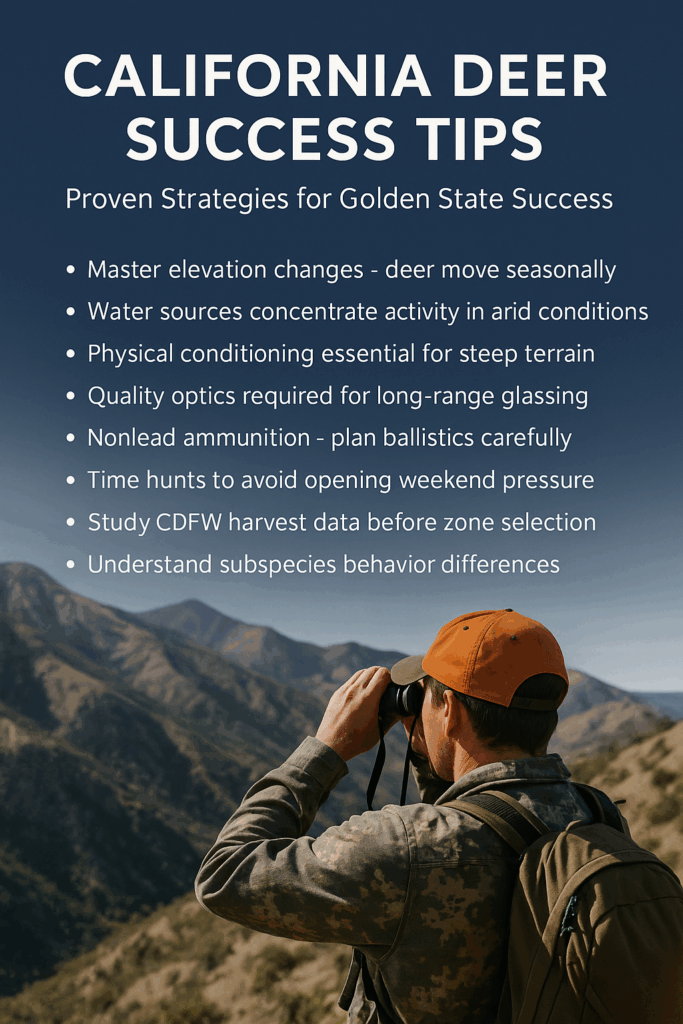
Master the Elevation Game – California deer hunting is elevation hunting. Early season pushes deer to higher elevations seeking cooler temperatures and water sources. As hunting pressure builds and weather cools, deer migrate to traditional fall ranges in oak woodlands and brush country. Successful hunters follow these elevation changes rather than hunting the same spots all season.
Water Sources Are Everything – In California’s often-arid environment, permanent water sources concentrate deer activity. Springs, stock tanks, and year-round creeks become focal points during dry years. Scout these areas during preseason to identify travel patterns and staging areas where deer feel secure.
Understand Subspecies Behavior – California mule deer in the Sierra foothills behave differently than coastal blacktail or desert mule deer. Blacktail stick to thick cover and require closer-range hunting, while high-country mule deer often feed in open areas that allow long-range glassing. Match your tactics to the subspecies you’re pursuing.
Physical Conditioning Matters – California’s steep terrain and often-hot conditions demand good physical conditioning. Many hunters underestimate the cardiovascular demands of hunting at elevation in challenging terrain. Poor conditioning limits your ability to reach productive areas and affects shot execution when opportunities arise.
Optics Are Non-Negotiable – Quality binoculars and spotting scopes are essential for California deer hunting. Much of the state’s terrain allows long-range glassing that can save miles of hiking. Invest in the best optics your budget allows and learn to use them effectively from good vantage points.
Plan for Nonlead Requirements – California’s mandatory nonlead ammunition rule requires different ballistics planning. Copper bullets often shoot differently than lead equivalents, requiring range time to verify zero and understand performance. Premium copper bullets like Barnes TSX or Nosler E-Tip deliver excellent performance when properly matched to your rifle.
Timing Within Seasons Matters – Even within legal seasons, timing affects success dramatically. Opening weekend often pushes deer into security cover where they remain for days. Mid-week hunting or waiting until pressure subsides can dramatically improve your chances of encountering undisturbed animals.
Study Harvest Data – CDFW publishes detailed harvest statistics that reveal which zones produce consistent success versus those with declining trends. Understanding these patterns helps avoid zones where populations have declined due to drought, fire, or other factors.
FAQ
When is deer season in California
California deer season dates vary by zone, with the earliest archery seasons starting July 12, 2025 in A-zone and latest seasons extending to December 31, 2025. Most general rifle seasons open between August 9 and October 5. Check the official CDFW season table for your specific zone dates.
How many deer tags can I buy in California
California allows hunters to purchase two deer tags annually – either two general tags for different zones or one general tag plus one premium draw tag. Tags must be purchased separately and each tag allows harvest of one deer. Non-residents pay significantly higher tag fees.
What caliber rifle is required for deer hunting in California
California requires centerfire rifles of .24 caliber or larger for deer hunting. Shotguns with slugs, centerfire handguns, and air rifles .30 caliber or larger are also legal. All ammunition must be certified nonlead – copper or tungsten bullets are required statewide.
Do I need special permits for CWD testing zones
Hunters in zones D7, X9a, X9b, and X9c must submit deer samples for Chronic Wasting Disease testing following California’s first confirmed cases in 2024. This is mandatory, not optional. Testing locations and procedures are available on the CDFW website.
What’s the difference between California’s deer subspecies
California supports five deer subspecies: Columbian blacktail (coastal regions), California mule deer (Central Valley and Sierra foothills), Southern mule deer (southern mountains), Inyo mule deer (Eastern Sierra), and Desert mule deer (southeastern deserts). Each adapted to specific habitats and elevation ranges.
Are preference points required for all California deer tags
Preference points are only required for premium X-zone tags and special hunts. Most A, B, C, and D zone tags are available over-the-counter without draws. X-zones use preference points to allocate limited tags, with some zones requiring multiple points for reasonable draw odds.
Can non-residents hunt California deer
Yes, but non-resident licenses cost $184.25 plus $318.61 per deer tag – significantly higher than resident fees. Non-residents compete in the same draws as residents but may want to focus on zones with reasonable draw odds given the investment required.
What’s the success rate for California deer hunting
Overall success rates average 17.8% statewide, but vary dramatically by zone. A-zone averages around 11% due to high pressure, while premium X-zones average 28% or higher. Success rates reflect both deer populations and hunting pressure levels in each zone.
The Final Shot
California deer hunting represents both tremendous opportunity and significant challenge. The state’s complex zone system, diverse subspecies, and varied terrain create hunting experiences that range from high-volume opportunity areas to world-class trophy zones. Success requires understanding the system, matching expectations to reality, and committing to the preparation that California’s deer demand.
The recent emergence of Chronic Wasting Disease adds new complexity to hunt planning, while California’s mandatory nonlead ammunition rule requires different approaches to ballistics and shot placement. These challenges haven’t diminished California’s appeal – they’ve simply raised the bar for serious deer hunters willing to adapt and learn.
Whether you’re building preference points for a premium X-zone hunt or exploring the vast opportunities in general zones, California rewards hunters who invest time in understanding the system. The state’s 430,000 deer provide genuine opportunity, but success comes to those who respect both the complexity of the regulations and the challenges of the terrain.
Remember that each hunt teaches valuable lessons about California’s deer, landscapes, and hunting opportunities. The morning you glass up a heavy buck in classic mule deer country, or the moment you arrow a coastal blacktail in thick timber, creates memories that justify every hour spent learning California’s intricate hunting system.
Ready to tackle California’s deer hunting challenge? Start with comprehensive California hunting information and discover why the Golden State continues to attract serious deer hunters despite its complexity. For those ready to expand their California hunting horizons, don’t miss opportunities like California’s excellent turkey hunting that can extend your time in the field.


