This Delaware waterfowl guide pulls together the confirmed 2026-2027 season dates, bag limits, licensing requirements, and land-access options in one place so you’re not tabbing between five websites the night before opening day trying to figure out if the teal zone covers your marsh or whether that public blind needs a lottery permit you forgot to enter.
Delaware sits in the Atlantic Flyway, which means birds move fast and the regulations reflect that with multiple season splits per species. Final regulatory authority rests with DNREC / Delaware Division of Fish and Wildlife, but this guide covers what residents and non-residents need to plan a legal season:
- Confirmed season dates and daily bag limits by species and method
- Licenses, stamps, and HIP registration requirements
- Where to hunt — public WMAs, private leases, and guided options
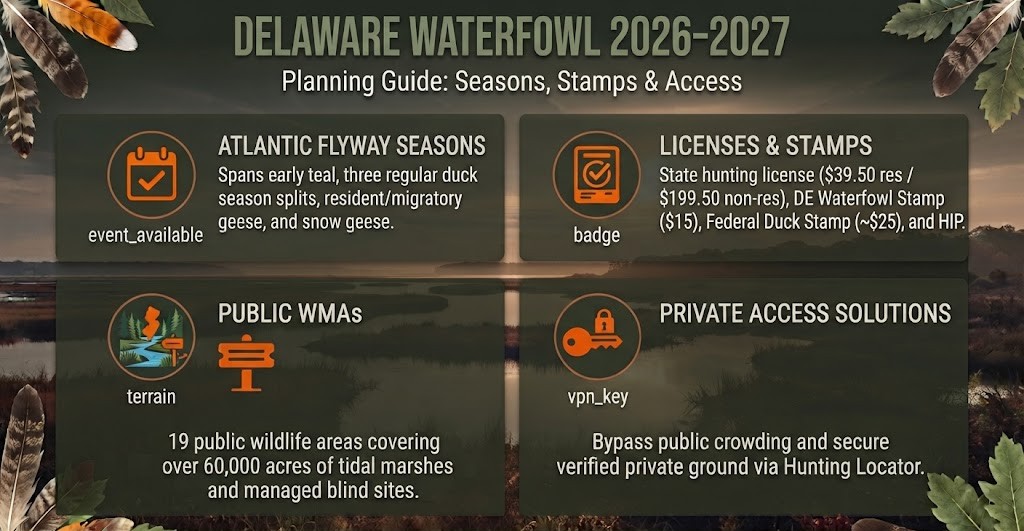
Quick Overview: Delaware Waterfowl Season at a Glance
The table below covers the fast facts; more detail follows in each section. Delaware permits Sunday hunting for waterfowl, which adds an extra day each weekend across the open season. For a deeper species-by-species breakdown, see our full Delaware waterfowl hunting season guide.
| Species | Season Type | Dates | Daily Bag Limit | Notes |
|---|---|---|---|---|
| Ducks (Regular) | Regular Season | Oct. 31–Nov. 7, Nov. 25–Nov. 29, Dec. 16–Jan. 31 | 6 (species sub-limits apply) | Three distinct segments |
| September Teal | Early Season | Sept. 5–Sept. 13 | 6 teal | Restricted to designated teal zone |
| Resident Canada Goose | Early Season | Sept. 1–Sept. 25 | Varies (see below) | Outside teal zone; varying segments inside |
| Migratory Canada Goose (incl. White-fronted) | Regular Season | Nov. 25–Nov. 29, Dec. 23–Jan. 31 | 2 | Separate rules from resident geese |
| Brant | Regular Season | Dec. 19–Jan. 2, Jan. 16–Jan. 30 | 1 | Niche coastal species |
| Snow Goose | Extended Season | Nov. 25–Jan. 31, Feb. 1–Feb. 6, Feb. 8–Mar. 10 | 25 | No possession limit |
| Youth/Veteran/Active Military | Special Hunt Days | Oct. 24, 2026 & Feb. 7, 2027 | Same as regular seasons | Two-day event |
These dates are compiled from confirmed 2026-2027 figures, but verify them against the official DNREC 2026-2027 Hunting & Trapping Guide before you head out.
Before you load the truck, check these:
- Delaware Hunting License — resident, non-resident, or junior tier (details below)
- Delaware Migratory Waterfowl Stamp — required age 16+
- Federal Duck Stamp — required age 16+
- HIP Registration — free, mandatory for all migratory bird hunters
- Hunter Education — required for anyone born after Jan. 1, 1967
Delaware Duck Hunting Seasons
Delaware’s duck season runs in multiple segments, starting with an early teal opportunity in September and continuing through a long winter stretch that ends in late January. Knowing which days are open and which bag limits apply on which days matters for staying legal and coming home with birds.

Regular Duck Season
The regular duck season runs across three confirmed segments: Oct. 31–Nov. 7, Nov. 25–Nov. 29, and Dec. 16–Jan. 31. Mark all three on your calendar, since missing a split can mean missing your best hunting days.
The daily bag limit is 6 ducks total, but several species carry their own sub-limits within that number:
- Mallards — 4 daily, no more than 2 hens
- Black ducks — 2 daily
- Pintail — 3 daily
- Canvasback — 2 daily
- Wood ducks — 3 daily
- Redheads — 2 daily
- Scaup — 1 daily, increasing to 2 per day from Jan. 12–Jan. 31
- Teal, shovelers, gadwall, wigeon, goldeneye, ring-necked ducks, bufflehead, ruddy ducks — 6 daily each
- Mottled duck — 1 daily
- Fulvous whistling-duck — 1 daily
- Sea ducks — up to 4 total daily, with a max of 3 scoters, 3 eiders (1 hen max), and 3 long-tailed ducks
You’re also allowed 5 mergansers daily (combined hooded, common, and red-breasted) and 15 coots daily.
The mid-January scaup increase illustrates why exact dates matter: hunt on Jan. 10 and your scaup limit is 1; hunt on Jan. 15 and it’s 2.
September Teal Season
Delaware’s early teal season runs Sept. 5–Sept. 13 and applies only within the designated teal zone, a defined area of the state where this early hunt is legal. Outside that zone the season doesn’t apply, so confirm the exact boundary against the DNREC guide before you set up.
Zones like this let regulators manage early migrations of specific species without opening the whole state to hunting pressure ahead of the main season. Hunting outside the boundary during teal season is a common and avoidable mistake.
Delaware Goose & Other Waterfowl Seasons
Goose hunting in Delaware splits into two categories: resident geese that live in the state year-round, and migratory geese that pass through with the broader Atlantic Flyway movement. Each operates under its own calendar and rules. For a broader look at how Delaware handles migratory species beyond waterfowl, see our Delaware migratory bird hunting season guide.
Resident Canada Goose Season
Resident Canada goose season runs Sept. 1–Sept. 25 outside the teal zone, with varying segments inside the September teal zone. These geese live in Delaware year-round and are hunted under separate rules from migratory Canada geese.
Resident and migratory Canada geese are easy to mix up: resident birds are targeted early, while migratory Canada geese (including White-fronted geese) arrive later under a different season structure, covered next.
Migratory Canada Goose (Including White-fronted)
Migratory Canada goose season, including White-fronted geese, runs Nov. 25–Nov. 29 and Dec. 23–Jan. 31, with a daily limit of 2 birds. The later timing reflects the actual migration patterns of birds moving south along the flyway.
Brant Season
Brant season runs Dec. 19–Jan. 2 and Jan. 16–Jan. 30, with a daily limit of 1 bird. Brant hunting is a niche pursuit in Delaware, concentrated in coastal areas where these smaller geese congregate.
Snow Goose Season
Snow goose season is Delaware’s longest and most generous window: Nov. 25–Jan. 31, Feb. 1–Feb. 6, and Feb. 8–Mar. 10, with a daily limit of 25 birds and no possession limit. Delaware, like many states along the flyway, manages snow geese with liberal limits because of their booming population.
Youth, Veteran & Active Military Hunt Days
Delaware sets aside special hunt days on Oct. 24, 2026, and Feb. 7, 2027, open to youth hunters, veterans, and active military personnel, with bag limits matching the regular seasons. This youth waterfowl hunt structure gives newer or underrepresented hunters a dedicated opportunity outside the main crowd.
These are specific calendar days rather than a broad window, so double-check them against the official DNREC 2026-2027 guide well before the date arrives.
Delaware Waterfowl Licenses & Permits
This section covers what you need, what it costs, and how residents and non-residents differ.

Delaware Hunting Licenses
Fee breakdown, from confirmed 2026 figures:
| License / Stamp | Cost |
|---|---|
| Resident Hunting License | $40 |
| Non-Resident Hunting License | $200 |
| Junior (ages 13–15) | $5.00 |
| Delaware Migratory Waterfowl Stamp (16+) | $15.00 |
| Federal Duck Stamp (16+) | ~$25.00 |
| HIP Registration | Free |
Planning a trip from out of state: expect roughly $240 total once you add the non-resident license, state stamp, and Federal Duck Stamp together. If a full-season license doesn’t make sense for a short trip, look into the 5-day non-resident waterfowl license instead. And if you’re already thinking about where you’ll hunt once you land in Delaware, browse Delaware hunting leases as part of your trip planning.
These fees are compiled from confirmed figures, but license costs and structures can shift year to year — verify current pricing with DNREC at the time of purchase.
Delaware Hunting Permits & Stamps
Two stamps are mandatory if you’re 16 or older, and they cover different requirements. The Delaware Migratory Waterfowl Stamp ($15) is a state-level requirement, while the Federal Duck Stamp (~$25) is required by federal law. You need both.
HIP registration is free, mandatory for every migratory bird hunter, and typically completed automatically when you purchase your license. You can also register directly through the DNREC migratory bird registration system or by phone if you need to set it up separately.
If you were born after Jan. 1, 1967, you’ll also need to complete a basic hunter education course before you can buy a license — no exceptions. Junior hunters ages 13–15 must complete the course, hold a certification card, and purchase a Delaware junior hunting license.
Getting set up generally follows this path:
- Complete hunter education (if required for your birth year) and get your certification card.
- Purchase your license online through DNREC, at an authorized retailer, or at a Division of Fish and Wildlife office.
- Add your stamps — the state Migratory Waterfowl Stamp and the Federal Duck Stamp, both required if you’re 16 or older.
- Complete HIP registration, which is free and usually finalized during the license purchase.
Where to Hunt Waterfowl in Delaware
Delaware’s flat terrain, tidal marshes, and coastal bays make it strong waterfowl country. The main decision is where to set up: public wildlife areas, private leases, or guided hunts, each with its own tradeoffs.
Best Public Lands
DNREC’s Division of Fish and Wildlife manages 19 public wildlife areas covering more than 60,000 acres. Access rules vary by location, so it’s worth understanding the system before you show up:
- Lottery permits — some areas require a lottery-based permit system for waterfowl blind access, so you’ll need to apply ahead of time
- First-come, first-served — other wildlife areas operate without a lottery, rewarding hunters who arrive early
- Check DNREC per area — rules differ site to site, so confirm the specific requirements for wherever you plan to hunt
- Designated blind sites — some public hunting areas restrict hunters to specific numbered blind locations rather than open-choice setups
Public land gets you into the game without a major investment, but popular spots can fill up fast during peak weekends, which is why more hunters treat private access as a complement to their public-land days.
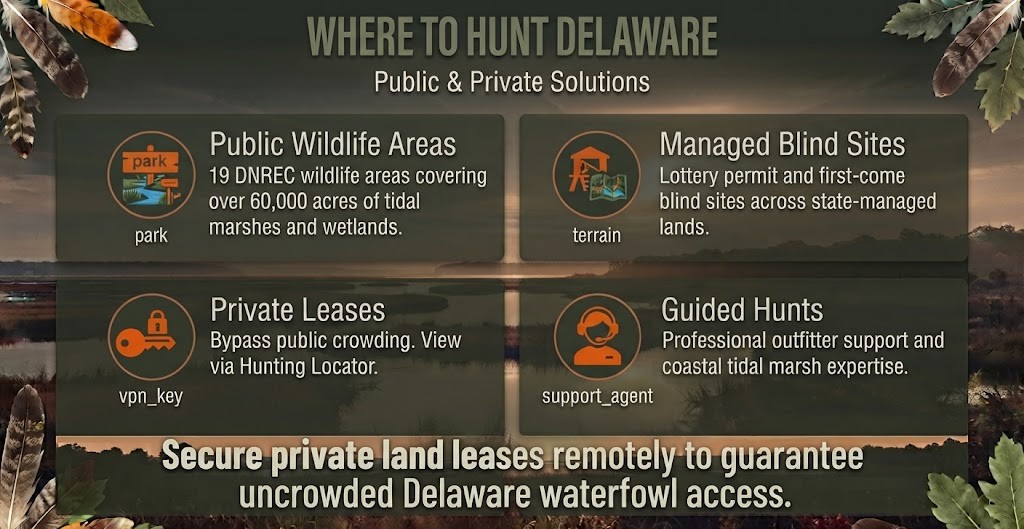
Private Land Hunting with Hunting Locator
Leasing private land gives you consistent, predictable access without competing for a spot every weekend, and for non-residents making the trip, it removes the guesswork of scouting unfamiliar public ground. Buying land outright is another option worth considering if Delaware waterfowl hunting is becoming a regular part of your seasons rather than a one-off trip.
This is where Hunting Locator comes in. We connect hunters directly with landowners across the state who are ready to lease or sell their land for hunting, cutting out the cold calls that used to define the search for private access.
Browse Delaware hunting leases and find land that matches your hunting style, whether you’re after a marsh blind for ducks or open fields for goose decoy spreads. The listings are updated and searchable whether you’re leasing for a season or looking to buy hunting land in Delaware outright.
Guided Hunts
A guided hunt makes sense in a few specific situations: you’re an out-of-state hunter unfamiliar with Delaware’s tidal marshes, you’re new to waterfowl hunting and want hands-on mentorship, or you don’t have time to scout productive water before your trip. A good guide brings local knowledge of tides, bird movement, and blind placement that would otherwise take seasons to learn on your own.
Pairing a private lease with local knowledge, whether from a guide or an experienced landowner, often combines reliable access with the on-the-ground insight that separates a mediocre hunt from a good one. Hunting Locator connects hunters with landowners and outfitters focused on ethical, well-prepared hunting, making it easier to find the right fit for your experience level and goals.
Delaware Waterfowl Hunting Tips
Success in the marsh comes down to preparation. A few fundamentals that consistently separate a slow morning from a good one:
- Scout tides and weather — Delaware’s coastal marshes shift constantly with tidal patterns and weather fronts, so the spot that produced birds last weekend might be dry or flooded out this weekend. Check conditions before you commit to a location.
- Match your decoy spread — set your decoys to reflect the species and conditions you’re actually targeting rather than using a generic spread every time out.
- Learn a basic call — you don’t need to be a champion caller to be effective. A reliable, beginner-friendly duck or goose call goes a long way toward pulling birds into range.
- Use proper concealment — a layout blind lets you lie flat and stay hidden in open marsh or field settings where there’s no natural cover, which is especially useful for goose hunting over decoys.
- Prioritize safety — wear a PFD at all times when hunting wetland environments. According to Delaware hunting safety regulations, drowning and hypothermia claim more hunters’ lives each year than gunshot wounds, so cold-water precautions matter as much as marksmanship.
Once you’ve got the fundamentals down, the Hunting Locator store carries decoys, calls, layout blinds, and cold-weather gear built for the conditions you’ll face on Delaware’s marshes.
More Resources from Hunting Locator
Planning a full Delaware season means more than waterfowl. Here’s where to go next for the rest of your hunting calendar and gear needs.
- Master state guide — Delaware hunting season guide — the complete overview of every season in the state
- Waterfowl deep dive — Delaware waterfowl hunting season — our companion guide with additional waterfowl detail
- Migratory bird seasons — Delaware migratory bird hunting season — covering dove, rails, snipe, and more beyond waterfowl
- Deer season — Delaware deer hunting season — dates and details for the state’s biggest big-game draw
- Turkey season — Delaware turkey hunting season — spring and fall turkey hunting information
- Small game season — Delaware small game hunting season — rabbit, squirrel, and other small-game opportunities
- Coyote season — Delaware coyote hunting season — year-round predator hunting details
- Delaware leases — Delaware hunting leases — find your private access today
- The store — Hunting Locator store — gear up with decoys, calls, blinds, and more
- Homepage — Hunting Locator — start your search for hunting land nationwide
FAQ
What are the 2026 Delaware duck season dates?
Delaware’s regular duck season runs in three segments: Oct. 31–Nov. 7, Nov. 25–Nov. 29, and Dec. 16–Jan. 31. There’s also a September Teal season from Sept. 5–Sept. 13 in the designated teal zone. Confirm these against the official DNREC 2026-2027 guide before you hunt.
How much is a non-resident Delaware waterfowl license?
A non-resident hunting license costs $199.50, plus the $15 Delaware Migratory Waterfowl Stamp and the ~$25 Federal Duck Stamp, roughly $240 total. If you’re only making a short trip, the 5-day non-resident waterfowl license is a more budget-friendly option.
What’s the difference between the state stamp and the Federal Duck Stamp?
The Delaware Migratory Waterfowl Stamp ($15) is a state-level requirement, while the Federal Duck Stamp (~$25) is required under federal law. Hunters 16 and older need both; one doesn’t substitute for the other.
Do I need HIP registration to hunt waterfowl in Delaware?
Yes. HIP registration is free and mandatory for every migratory bird hunter in Delaware, and it’s typically completed automatically when you purchase your hunting license.
Do I need hunter education to hunt in Delaware?
If you were born after Jan. 1, 1967, you must complete a basic hunter education course before buying a Delaware hunting license. Junior hunters ages 13–15 must also complete the course and carry their certification card.
Where can I hunt waterfowl in Delaware without fighting crowds?
DNREC manages 19 public wildlife areas covering 60,000+ acres, though some require lottery permits for blind access and popular spots can get crowded on peak weekends. For more consistent, private access, browse Delaware hunting leases through Hunting Locator.
The Final Shot
This Delaware Waterfowl Season Guide for 2026 brings together confirmed season dates, daily bag limits, required licenses and stamps, and land-access options, whether you’re a lifelong resident or making the trip from out of state for the first time.
Treat this guide as a planning hub, and give the official DNREC 2026-2027 Hunting & Trapping Guide a final check before your first day afield.
If crowded public blinds aren’t part of the season you want, discover your Delaware access and secure a spot that’s ready when you are.


