Here at HuntingLocator, we get it. Capturing great hunting footage isn’t about having the fanciest camera. It’s about having a mounting system that actually works when everything’s on the line.
This guide walks you through everything you need to document your hunts like a pro:
- Pre-hunt prep that sets you up for success (regulations, scouting, gear checks)
- The camera mounting gear that actually matters in the field
- Field tactics that get you the footage without blowing your hunt
- Post-harvest documentation that tells the complete story
Let’s dive into what separates hunters who get the shot from those who just talk about the one that got away.
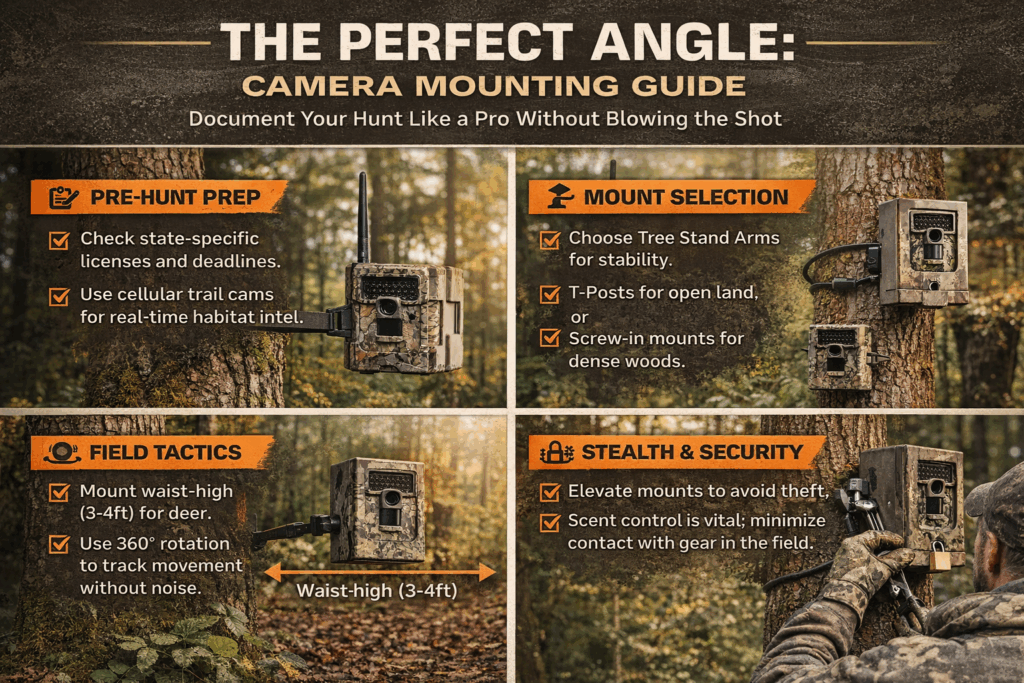
Know Before You Go: Essential Prep
Great hunting footage starts way before you ever touch a camera. You can’t document success if you’re not set up to succeed in the first place.
Regulations Check
Here’s something that’ll ruin your hunt faster than a blown shot: showing up without proper licenses. Research shows that “individual states retain control over resident and non-resident licensing systems, fee schedules, and particular hunting seasons.” Translation? What works in your home state might get you a hefty fine two states over.
Hunting regulations change every year, and they’re getting more complex. You need to check Hunter Education requirements, Harvest Record systems, and Game Check procedures. Non-resident hunters? You’re dealing with a whole different level of complexity.
Action: License and Tag Acquisition
Want a perfect example of why procrastination kills hunts? Illinois turkey permits require that “the application and any required supporting documents must be received and approved by close of business February 9, 2026.” Miss that deadline by one day? You’re done.
The state’s advice is blunt: “Do not wait until just before the hunting season.” Popular hunting spots have limited tags, and they go to hunters who plan months ahead, not weeks.
Scouting & Habitat
You can’t film what you can’t find. Successful hunting documentation starts with knowing where your target animals actually spend their time. Look for the obvious signs: fresh tracks, rubs, scat, feeding areas. But pay attention to the patterns too. Travel corridors between bedding and feeding areas, escape routes, and seasonal movement patterns.
Cellular trail cameras are game-changers here. Instead of hiking in every few days to check cards, you get real-time intel sent straight to your phone. You’ll know exactly when that big buck is moving through, and more importantly, you’ll know where to set up your camera mount for the best angles.
While you’re scouting, think like a filmmaker. Look for trees or terrain features that’ll give you stable mounting points with clear sight lines to your shooting lanes. The best camera mount in the world won’t help if it’s pointed at a wall of brush.
Physical & Gear Readiness
Carrying camera gear into the backcountry adds weight and complexity to your hunt. If you’re not in shape for your regular hunting load, adding 5-10 pounds of camera equipment is going to hurt. Start conditioning early, especially for mountain hunts or long pack-ins.
Your camera mounting system needs the same attention as your rifle scope. You wouldn’t head into the woods with untested optics, so don’t trust your once-in-a-lifetime shot to an untested camera mount.
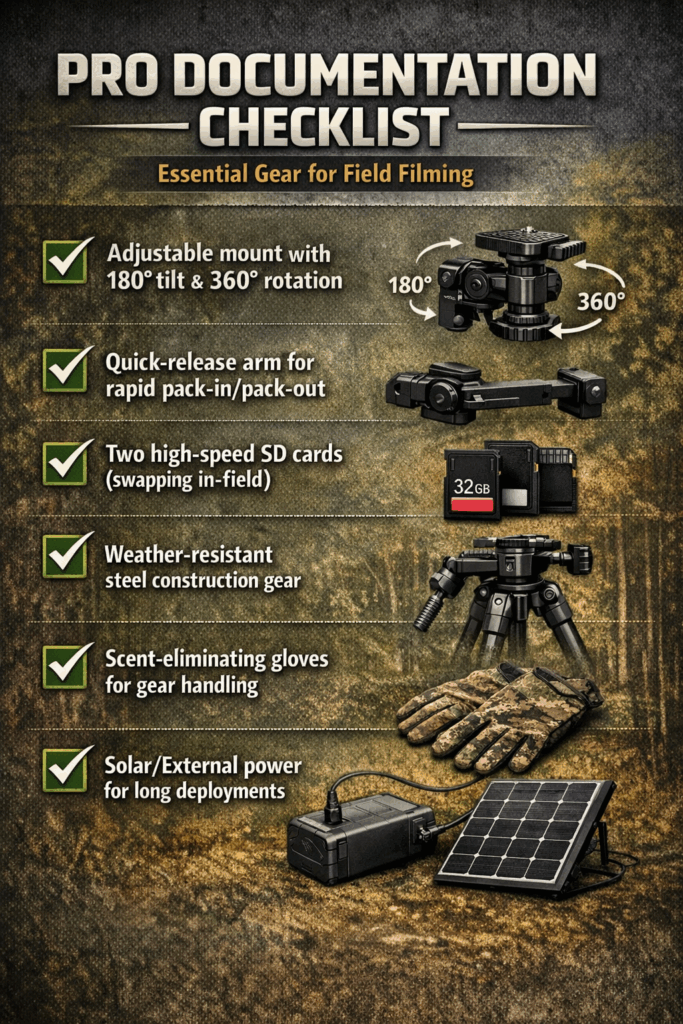
The Gear Advantage
Modern hunting isn’t just about rifles and calls anymore. Today’s successful hunters understand that reliable equipment prevents missed opportunities, and that includes documentation gear. Industry experts note that “camera arms have been a game changer for treestand hunters and allow self-filmers to ‘set it and forget it,’ which can be the difference between getting the shot off before the animal leaves your shooting lane or not.”
Think of adjustable camera mounts like quality optics. Just as you need a scope that holds zero through weather and recoil, you need a camera mount that stays locked on target no matter what Mother Nature throws at you. Professional mounting systems “unlock the ability to get the perfect field of view, keep that angle locked in no matter what the weather or wildlife throws at it.”
Quality documentation doesn’t require a film degree. It requires equipment that works as reliably as the rest of your hunting gear.
Core Gear Checklist: Our Top Recommendations
Every hunter’s gear list looks different depending on what they’re chasing and where they’re hunting it. But some categories are universal, especially when you want to document the experience properly.
Camera Mounting Solutions: The Documentation Difference
The difference between shaky, unusable footage and professional-quality hunting videos usually comes down to one thing: your mount. Common mounting mistakes include “stacking rocks or pieces of wood and balancing a camera on them” or “tying a camera to trees and branches with flagging tape, which makes it very difficult to get it level and pointed in the right direction.”
Adjustable camera mounts solve these problems by giving you purpose-built, stable platforms that adapt to whatever hunting scenario you’re facing. Quality camera stands “unlock the ability to get the perfect field of view, keep that angle locked in no matter what the weather or wildlife throws at it.”
Features That Actually Matter in the Field:
- 360° Rotation – You need to be able to track animal movement or change shooting direction without repositioning your entire setup
- Tilt Adjustment – Modern mounts offer “up to 180° tilt capabilities, giving you complete freedom to aim your cameras exactly where needed”
- Weight Capacity – Match your mount to your camera weight. For serious filmers, “for heavier cameras you’ll need a heavy duty camera arm”
- Quick-Release – Professional systems feature removable camera arms “segregating the system into two components that can easily fit in your pack or even a pocket”
- Weather Resistance – Quality mounts “hold firm even during wind gusts and heavy rain” with “steel construction that feels solid and lasts multiple seasons without loosening or rusting”
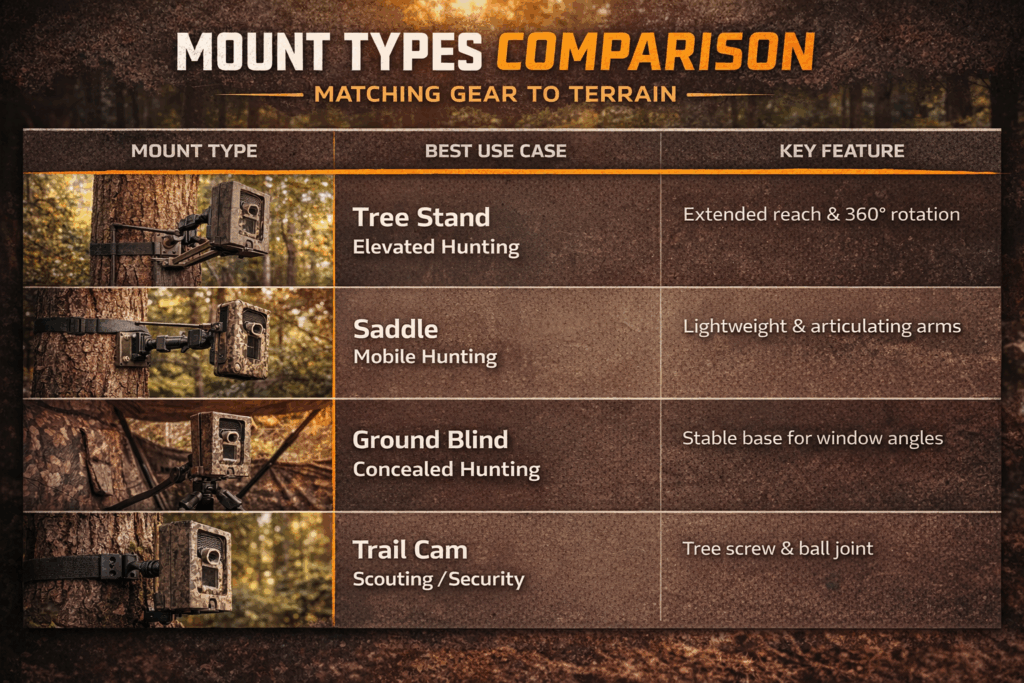
Mount Types Comparison:
| Mount Type | Best Use Case | Key Features | Weight Capacity | Ideal For |
|---|---|---|---|---|
| Tree Stand Mounts | Fixed elevated hunting | Clamp attachment, extended reach, full rotation | 10-15 lbs | Content creators, special hunts |
| Saddle Hunting Mounts | Mobile elevated hunting | Lightweight, compact, articulating arms | 5-10 lbs | Mobile self-filmers |
| Ground Blind Mounts | Concealed ground hunting | Window angles, stable base | 10-15 lbs | Traditional hunters |
| Trail Camera Mounts | Scouting and security | Tree screw attachment, ball joint | Camera-specific | All hunters for scouting |
Professional hunters emphasize that “different terrains require different setups—in dense woods, screw-in mounts shine for tight, controlled angles; in open farmland, T-post or clamp mounts offer flexibility; and for rocky or marshy terrain, strap mounts provide versatility without the need for drilling.”
Pro Tips: Positioning for the Perfect Angle
- Scout Your Shooting Lanes – Figure out where animals are likely to approach and position your mount to capture the kill zone without blocking your own shot
- Follow the Height Rule – Field and Stream recommends mounting “the camera on a tree or post at waist-high height, angled slightly downward to capture a wider field of view”
- Species-Specific Positioning – For best results, “for deer, position the camera 3 to 4 feet off the ground, angled slightly downward, and for larger game, mount higher—around 5 to 6 feet”
- Test Before You Hunt – Check your rotation and tilt range before your hunt to make sure everything moves smoothly and quietly when it counts
- Camouflage Strategically – Blend your mount and camera with natural materials or camo wraps
Ready to find the right mounting solution for your hunting style? Check out our trail camera mount collection to compare options and find what works for your setup.
Clothing & Layering
Proper camo and moisture-wicking layers aren’t just about comfort. They’re about staying focused enough to manage camera equipment without getting distracted by being too hot, too cold, or too wet. When you’re comfortable, you can concentrate on both hunting success and getting quality footage.
Scent control becomes even more important when you’re handling camera equipment. All that extra movement and gear handling can spread human scent around.
Weaponry & Ammunition
Consistent shooting form matters for more than just ethical harvests. It also makes for better footage. When you know exactly where to position your camera relative to your shooting position, you can capture both the shot and the animal’s reaction more effectively.
Practice with your complete setup before the hunt. Pay attention to how your shooting form affects camera positioning.
The Essentials
Navigation and safety gear (compass, GPS, first aid) plus field dressing tools (knives, gloves) remain fundamental whether you’re filming or not. But when you’re leaving trail cameras out for extended periods, equipment security becomes a real concern.
Elevated mounting “drastically reduces your chance of camera theft and spooking camera-shy game,” but for ground-level setups or high-theft areas, consider trail camera security boxes and locks to protect your investment.
For hunters using trail cameras for scouting or extended documentation, power management is critical. Long-term deployments benefit from reliable battery systems and solar panel supplements to keep cameras running all season.
Memory management matters too: “purchasing two SD cards for every camera makes it much easier to change cards in the field.” Storage planning shows that “you can run an 8-gigabyte card and take 14- to 22-megapixel pictures and get 3,000 to 4,000 images.”
Tactics & Strategy: Capturing the Hunt
Successful hunting documentation requires more than just sticking a camera on a tree and hoping for the best. The intersection of hunting skill and filming technique separates amateur footage from compelling content that actually captures what hunting is all about.
Peak Activity Times
Most game species move most during early morning and late evening, which creates both opportunity and challenge for hunters trying to document their experiences. Low-light conditions during peak activity times make stable mounting even more critical. Any camera shake gets amplified when there’s not much light to work with.
Plan your camera positioning around where you expect animals to move. That magic hour lighting can create stunning footage, but only if your camera mount can hold rock-steady during those crucial moments when animals are most likely to show up.
Wind & Scent Control
Wind direction affects both hunting success and camera positioning. Understanding prevailing wind patterns helps you position your camera mount to capture approaching animals while maintaining scent control. Experts recommend that hunters “wear gloves and minimize contact with surrounding vegetation” when setting up camera equipment to avoid leaving human scent.
Your camera mount positioning should work with your scent control strategy, not against it. Position cameras downwind of expected animal approaches when possible, and think about how your movement to adjust camera angles might affect your scent cone.
The Approach: Specific Techniques for Success
Different hunting methods need different camera mounting approaches:
Stand Placement: Tree stand hunters benefit most from camera arms that “allow self-filmers to ‘set it and forget it,’ which can be the difference between getting the shot off before the animal leaves your shooting lane or not.”
Still-Hunting: Mobile hunters need lightweight, quick-deploy mounting solutions that don’t compromise stealth or mobility.
Blind Hunting: Ground blinds offer excellent camera mounting opportunities with multiple window angles and stable platforms for extended filming.
Calling Strategies: When calling game, position cameras to capture both your calling setup and the animal’s approach route.
Shot Placement Documentation: Responsible hunters use camera footage to analyze shot placement and improve their skills. Proper camera positioning captures ethical shot zones and helps with post-shot analysis.
Post-Harvest Care: The Work After the Shot
The hunt doesn’t end with the shot, and neither does your documentation opportunity. Post-harvest care provides some of the most valuable and educational footage while showing ethical hunting practices and respect for the animal.
Tracking & Recovery
Quality camera mounts prove their worth during recovery efforts. Stable footage of blood trails and tracking signs creates educational content while documenting your hunting skills. Use your camera to record important tracking details: blood color and consistency, track patterns, environmental factors that help with recovery.
Document the recovery process respectfully, focusing on the skills and patience required for ethical hunting.
Field Dressing
Field dressing represents a crucial skill that many hunters want to preserve and share. Position your camera to capture the process clearly while maintaining respect for the animal. This documentation serves multiple purposes: preserving traditional knowledge, teaching proper technique, and showing the full commitment required for ethical hunting.
Focus on the practical aspects: proper knife techniques, meat care, and immediate steps that ensure quality table fare.
Transport & Processing
Document the journey from field to freezer, including proper meat handling, transportation methods, and processing decisions. This complete documentation tells the full story of ethical hunting and shows the commitment required to transform a successful hunt into quality food.
More Resources from Hunting Locator
HuntingLocator provides comprehensive resources to support every aspect of your hunting and documentation journey:
- Trail Camera Store – Complete selection of trail cameras for scouting and documentation, from basic models to advanced cellular units
- Cellular Trail Cameras – Real-time scouting updates and remote monitoring for serious hunters
- Camera Mounts – Professional mounting solutions for every hunting scenario
- Batteries and Solar – Extended power solutions for long-term deployments
- Security Solutions – Protect your investment with theft-deterrent solutions
FAQ
What’s the most important feature to look for in an adjustable camera mount?
According to professional hunters, the ability to “set it and forget it” is crucial. Look for mounts with 360° rotation, reliable locking mechanisms, and weather-resistant construction that won’t fail during critical moments.
How do I choose between different mount types for my hunting style?
Different terrains and hunting methods require different approaches: “in dense woods, screw-in mounts shine for tight, controlled angles; in open farmland, T-post or clamp mounts offer flexibility.” Consider your primary hunting locations and mobility needs when selecting a mount type.
Will using a camera mount affect my hunting success?
Experienced self-filmers acknowledge that “when you add a video setup, it will cost you opportunities,” but proper mounting systems minimize this impact. Quality camera arms are designed to stay out of your way while providing stable footage.
What camera height works best for different game species?
Field positioning experts recommend that “for deer, position the camera 3 to 4 feet off the ground, angled slightly downward, and for larger game, mount higher—around 5 to 6 feet” to capture optimal footage angles.
How do I prevent camera theft during extended deployments?
Elevated mounting “drastically reduces your chance of camera theft and spooking camera-shy game.” For additional security, use locking security boxes and choose less obvious mounting locations away from main trails.
What’s the best way to manage memory cards during long hunts?
Professional photographers recommend “purchasing two SD cards for every camera makes it much easier to change cards in the field.” This lets you swap cards quickly without missing critical activity periods.
The Final Shot
The perfect angle isn’t just about camera positioning. It’s about preparation, quality equipment, and understanding how documentation enhances rather than hurts your hunting experience. From pre-season scouting with trail cameras to capturing that moment of truth with adjustable mounts, every element works together to preserve memories that last a lifetime.
Whether you’re planning your first out-of-state adventure, building a hunting content library, or just wanting to share experiences with family, the right mounting solution makes all the difference. Quality adjustable camera mounts don’t just capture footage—they capture the essence of why we hunt, the skills we’ve developed, and the respect we have for the animals and landscapes that define our passion.
Ready to gear up for your best-documented hunting season yet? Visit our trail camera store today! We stock the camera mounts, trail cameras, and accessories you need to succeed both in the field and behind the lens.


