This Florida migratory bird guide puts everything about Florida’s migratory bird seasons in one place, so you can spend your time scouting instead of digging through scattered agency pages.
Season dates and bag limits are set annually by the Florida Fish and Wildlife Conservation Commission (FWC), working within frameworks established by the U.S. Fish & Wildlife Service. Everything here is aligned with those official sources, but duck seasons reset every year based on migration and population counts, so confirm final dates with FWC before you head afield. Once you’ve got the basics down, browse huntinglocator.com for more planning tools.
Here’s what’s covered below:
- Season dates & bag limits for every migratory species — dove, duck, goose, snipe, woodcock, and more.
- Licenses, permits & the Federal Duck Stamp — what you need and what it costs.
- Where to hunt — top public WMAs, private leases through Hunting Locator, and guided options.
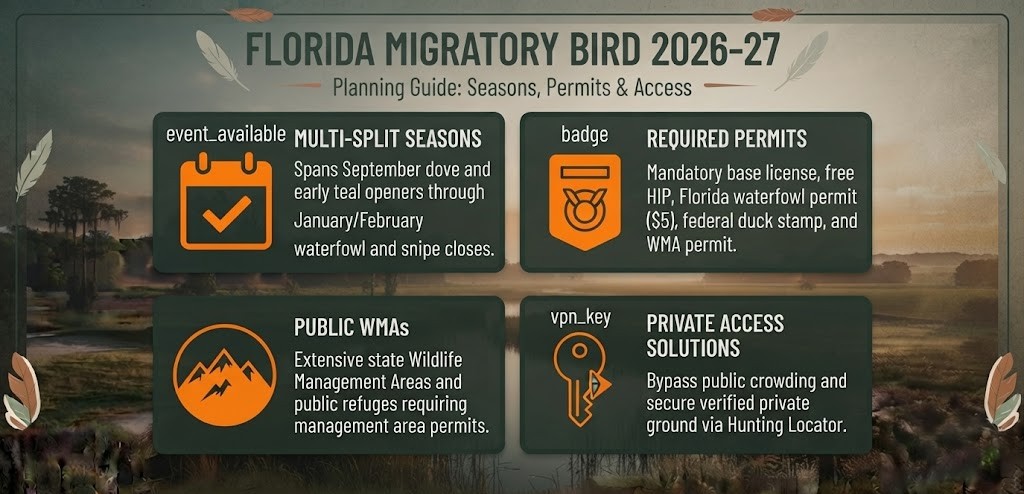
Quick Overview: Florida Migratory Bird Seasons at a Glance
If you just need the dates and limits, this table is your fast reference. Detailed breakdowns of each species group follow below.
| Species / Season | Season Dates | Daily Bag Limit | Key Notes |
|---|---|---|---|
| Mourning & White-Winged Dove | Sept. 26–Oct. 18; Nov. 14–Dec. 6; Dec. 19–Jan. 31 | $15 | Combined bag for both dove species |
| Duck (Early Teal/Wood Duck) | Sept. 19–23 | 6 (max 2 wood ducks) | Short, high-value early window |
| Regular Duck | Nov. 21–29; Dec. 12–Jan. 31 | $6 | Complex species-specific caps apply |
| Canada Goose | Sept. 5–27; Nov. 21–29; Dec. 1–Jan. 30 | 5 | Three separate season splits |
| Light Geese (Snow, Blue, Ross’) | Nov. 21–29; Dec. 12–Jan. 31 | 15 | Higher bag limit than Canada goose |
| Common Gallinule (Moorhen) | Sept. 1–Nov. 9 | 15 | Early-fall season only |
| Rails (King & Clapper) | Sept. 1–Nov. 9 | 15 | Coastal marsh species |
| Rails (Sora & Virginia) | Sept. 1–Nov. 9 | 25 | Higher limit than King & Clapper |
| Wilson’s Snipe | Nov. 1–Feb. 15 | 8 | Long season into mid-February |
| American Woodcock | Dec. 18–Jan. 31 | 3 | Short winter window |
| Coot | Nov. 21–29; Dec. 12–Jan. 31 | 15 | Aligns with regular duck splits |
Clear this checklist before heading out:
- Florida hunting license
- Migratory Bird Permit / HIP (no cost)
- Florida Waterfowl Permit ($5 — required for ducks, geese, mergansers)
- Federal Duck Stamp (~$30.50 — required for hunters age 16+)
- Management Area Permit ($26.50 — required if hunting wildlife management areas)
Species-specific season nuances are covered in more detail in our full migratory bird breakdown, which pairs well with this guide. Florida’s regulations are organized by zone, and while migratory bird season dates are generally statewide, check regional notes on WMA-specific access before you plan a trip.
Florida Migratory Bird Hunting Seasons
Florida’s migratory bird seasons run in multiple splits from early September through mid-February, organized here by species group. Waterfowl seasons reset every year based on migration and population data — unlike Florida’s multi-year turkey season cycle — so treat these dates as your 2026 planning baseline and confirm with FWC as opening day approaches.
Dove Season
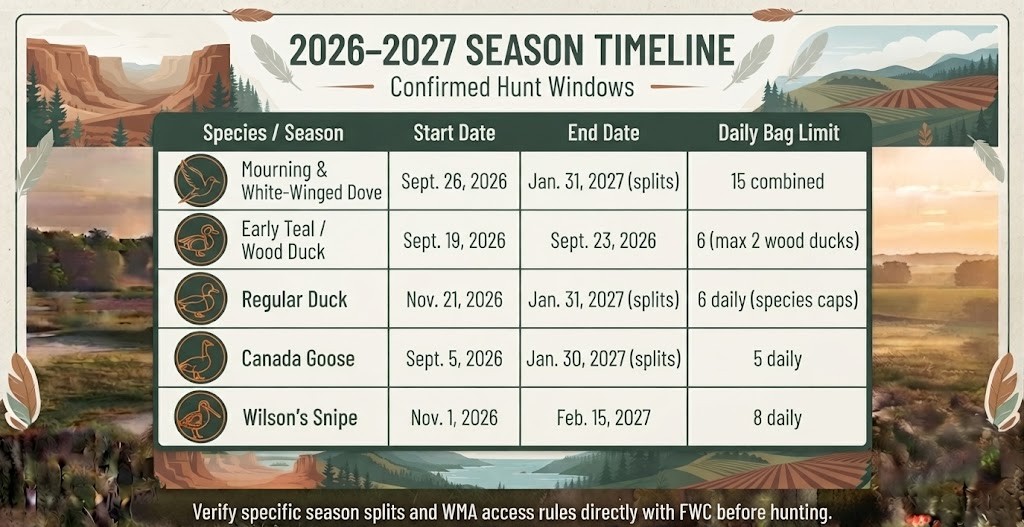
Dove season is the marquee event on most Florida hunters’ calendars, and 2026 brings three separate splits: September 26–October 18, November 14–December 6, and December 19–January 31. The daily bag limit is 15 mourning and white-winged doves combined. The September 26 opener is the single biggest planning priority of the fall — fields fill up fast, so lock in your spot well before that date.
Duck Seasons: Early Teal/Wood Duck & Regular Duck
The early season is short: September 19–23, five days to target teal and wood ducks before the main event. The daily bag limit during this window is 6 ducks, with no more than 2 wood ducks included in that total.
The regular duck season picks up later, running November 21–29 and then December 12–January 31. The core rule to remember: 6 ducks total per day.
Within that limit, certain species carry their own sub-caps, meaning not all 6 birds in your bag can be the same high-demand species. This aggregate-vs-species-cap system protects vulnerable duck populations while still allowing a full bag for common species. Correct identification in the field is what keeps you legal — if you’re unsure of a bird in hand, err on the side of caution before you count it toward your limit.
For a deeper dive into duck and goose strategy, dates, and identification tips, check out our Florida waterfowl season guide.
Goose Seasons: Canada & Light Geese
Canada goose season runs across three splits — September 5–27, November 21–29, and December 1–January 30 — with a daily bag limit of 5. Light geese, which include snow, blue, and Ross’ geese, run November 21–29 and December 12–January 31, with a daily bag limit of 15.
Canada goose hunters get an early September window that light goose hunters don’t. Light goose hunters get a bag limit three times larger once their season opens.
Other Migratory Birds: Gallinule, Rails, Snipe, Woodcock & Coot
Several underhunted species offer good opportunities well into February, often with less competition than dove or duck season.
| Species | Season Dates | Daily Bag Limit |
|---|---|---|
| Common Gallinule (Moorhen) | Sept. 1–Nov. 9 | 15 daily |
| Rails (King & Clapper) | Sept. 1–Nov. 9 | 15 daily |
| Rails (Sora & Virginia) | Sept. 1–Nov. 9 | 25 daily |
| Wilson’s Snipe | Nov. 1–Feb. 15 | 8 daily |
| American Woodcock | Dec. 18–Jan. 31 | 3 daily |
| Coot | Nov. 21–29; Dec. 12–Jan. 31 | 15 daily |
Wilson’s snipe hunting runs all the way to February 15, one of the longest windows on the calendar and a good option if you’re looking to extend your season after the main duck and dove dates wrap up.
Florida Migratory Bird Licenses and Permits
Getting your licenses and permits right once means you’re covered for the rest of the season. FWC is the licensing authority, and the requirements below apply whether you’re chasing dove in September or snipe in February. For a broader look at how these requirements apply across Florida’s hunting seasons overall, that guide is a useful companion piece.
Florida Hunting Licenses
| License Type | Cost | Best For |
|---|---|---|
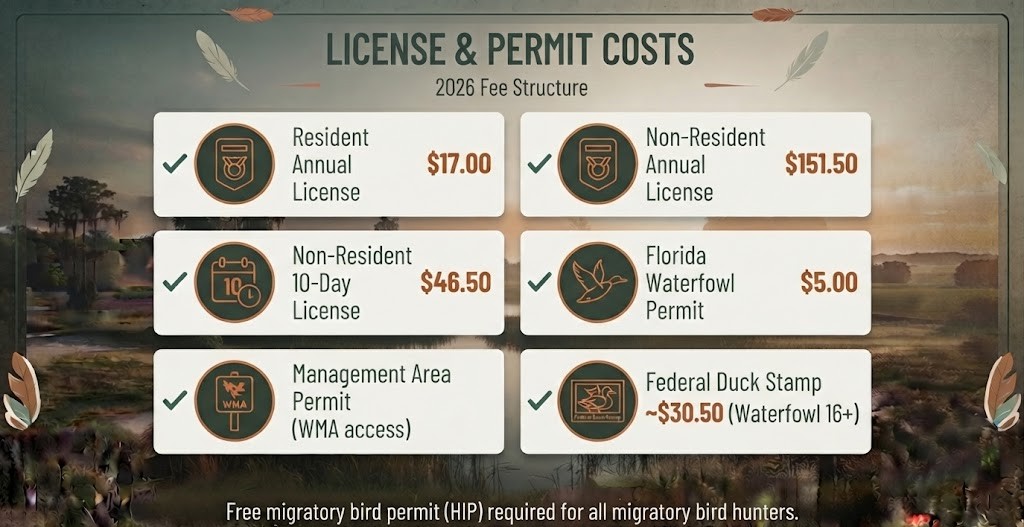
| Resident annual hunting license | $17 | Florida residents |
| Non-resident annual hunting license | $151.50 | Out-of-state hunters planning a full season |
| Non-resident 10-day license | $46.50 | Short trips and single-visit hunters |
If you’re traveling in from out of state for a single trip, the 10-day license is the money-saver — no reason to pay for a full year if you’re only hunting one weekend or a short stretch of the season. Hunter education requirements may apply depending on your birth date and hunting history, and licenses are available through county tax collectors or FWC’s online licensing system.
Florida Hunting Permits
Beyond your base license, migratory bird hunting requires a specific stack of permits and stamps:
| Permit / Stamp | Cost | Who Needs It | Purpose |
|---|---|---|---|
| Migratory Bird Permit (HIP) | No cost | All migratory bird hunters | Required registration for all migratory bird hunting |
| Florida Waterfowl Permit | $5.00 | Duck, goose, merganser hunters | State waterfowl endorsement |
| Federal Duck Stamp | ~$30.50 | Hunters age 16 and older | Federal Duck Stamp requirement set by the U.S. Fish & Wildlife Service |
| Management Area Permit | $26.50 | WMA hunters | Access to wildlife management areas |
You can pick up these permits from county tax collectors, online through FWC’s licensing system, or by phone. HIP registration is free and completed automatically when you purchase your license — no separate application needed.
One detail worth flagging for anyone planning a trip to a specific WMA: some named wildlife management areas restrict non-resident hunters during the first nine days of certain seasons. If you’re traveling from out of state, check the specific WMA’s rules before you build your itinerary around it.
These three things are separate but connected: your license grants the basic right to hunt, the Federal Duck Stamp is a federal add-on specifically for waterfowl, and permits like the HIP, Waterfowl Permit, and Management Area Permit cover specific activities or locations. You need all the ones that apply to your hunt — none substitute for the others.
Where to Hunt Migratory Birds in Florida
Once your paperwork is squared away, the next question is where you’re actually going to hunt. Florida hunters generally have three paths: public land (affordable but often crowded), private leases (your own space, your own schedule), and guided hunts (turnkey access with less legwork). Most hunters end up using a mix.
Best Public Lands (WMAs)
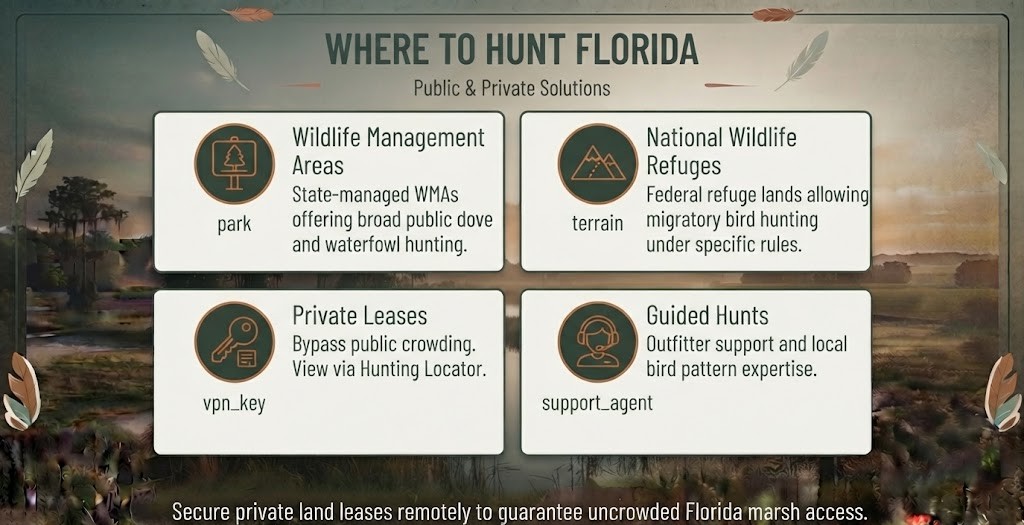
Wildlife Management Areas are the backbone of public migratory bird hunting in Florida, and access requires a Management Area Permit ($26.50) on top of your regular license and permits. Migratory bird hunting is also allowed on some public small game hunting areas and federal National Wildlife Refuges within the state.
- WMAs offer the broadest public access for dove, duck, and other migratory species, typically requiring the Management Area Permit for entry.
- Public small game hunting areas provide additional public opportunities beyond the standard WMA system.
- Federal National Wildlife Refuges in Florida allow migratory bird hunting under specific federal and state rules.
Public land gets the job done, but popular WMAs can get crowded fast during the dove opener, with hunters competing for the same fields and flight lines. That’s exactly the situation that makes private access worth considering.
Private Land Hunting with Hunting Locator
If public land crowding isn’t how you want to spend opening weekend, private access changes the equation — your own field, your own schedule, no one else’s decoys fifty yards from yours.
There are two ways to go about it: leasing private land for the season, or buying hunting land outright for long-term access you control year after year. Leasing gives you flexibility and a lower upfront commitment, a good fit if you’re testing a new area or don’t want a long-term obligation. Buying is the deeper investment — land you can pass down over time. Both paths get you off crowded public ground and into a spot where success feels earned rather than fought over.
This is where Hunting Locator comes in. It’s a platform built to connect hunters directly with landowners who are ready to lease or sell hunting land, without cold calls or driving around looking for “for lease” signs. Browse verified listings, connect directly with landowners, and secure your spot before the season gets away from you.
You can currently look through current Florida hunting leases to see what’s available for the 2026 season — properties suited to dove fields, duck marshes, and goose habitat across the state. Whether you’re a resident looking for land closer to home or a non-resident planning a destination hunt, these listings are open to both.
Browse Florida hunting leases and see what’s available before dove season fills up your options.
Guided Hunts
For hunters who’d rather show up and hunt than manage land logistics, a guided hunt is worth considering. Guides bring local knowledge of bird patterns and legal shooting areas, and that on-the-ground expertise shortens the learning curve.
Guided hunts tend to suit two types of hunters:
- Out-of-state hunters unfamiliar with Florida’s geography, water systems, and regional bird patterns who want local expertise on their side.
- New hunters looking for a lower-stress first outing where someone experienced can walk them through the process from setup to shot.
If you’d rather have your own space and set your own pace instead of hunting alongside a guide, leasing private land remains a strong alternative.
Florida Migratory Bird Hunting Tips
Success in the field comes down to a handful of fundamentals that hold true across species and seasons.
- Scout Before You Shoot: Locate feeding and flight patterns ahead of opening day. Dove favor fields with reliable seed sources, while waterfowl gravitate toward accessible water with good cover nearby.
- Match Your Gear to the Bird: Fast-flying doves and diving ducks call for different loads and choke setups. The right combination improves clean, ethical harvests and reduces wasted shots.
- Set a Realistic Decoy Spread: For ducks and geese, a natural, well-placed spread consistently outperforms sheer volume.
- Know Your Species: Correct identification keeps you legal under the duck sub-caps discussed earlier, and it helps you avoid costly violations that can end a season early.
- Time It Right: Early morning and late afternoon are typically the most productive windows. Plan your hunt around legal shooting hours and peak bird movement.
Having the right equipment matters as much as knowing the regulations. You can gear up at the Hunting Locator store for decoys, ammunition loads suited to your target species, and blinds and calls built for Florida conditions. Reliable gear paired with good scouting is what gets birds in the bag.
More Resources from Hunting Locator
- Florida migratory bird hunting — the primary deep-dive companion to this guide, with extended species detail.
- Florida waterfowl hunting — focused duck and goose strategy, identification, and season structure.
- Florida hunting seasons overview — the broad Florida hunting hub covering every game category in the state.
- Year-round Florida hunting — a breakdown of what you can legally hunt in Florida every month of the year.
- Florida deer hunting — season dates and tactics for whitetail hunters.
- Florida alligator hunting — permits and dates for Florida’s unique gator season.
- Florida furbearer hunting — trapping and furbearer season details for the state.
- Florida turkey hunting — spring and fall turkey season guide.
- Florida hunting leases — browse current private-land access options across the state.
- Hunting Locator store — gear up with the right equipment before the season opens.
Frequently Asked Questions
What licenses and permits do I need to hunt ducks in Florida?
You’ll need a Florida hunting license, the no-cost Migratory Bird Permit (HIP), the Florida Waterfowl Permit ($5), and a Federal Duck Stamp (~$30.50 for hunters 16 and older). If you’re hunting on a wildlife management area, add the Management Area Permit ($26.50). FWC administers these state-level requirements.
Do I need a Federal Duck Stamp to hunt migratory birds in Florida?
Yes — if you’re hunting waterfowl and are age 16 or older, the U.S. Fish & Wildlife Service requires a current, signed Federal Duck Stamp alongside your state license and permits. It costs approximately $30.50. Dove hunters do not need the Duck Stamp, since it applies specifically to waterfowl.
What is the Migratory Bird Permit (HIP)?
The Migratory Bird Permit, also known as HIP (Harvest Information Program), is a no-cost registration required for anyone hunting migratory birds in Florida. It’s completed automatically when you purchase your hunting license and helps wildlife agencies track harvest data used to manage bird populations.
How much is a non-resident Florida hunting license?
A non-resident annual license costs $151.50, or you can opt for a 10-day license at $46.50. The 10-day option makes sense if you’re only planning a short trip rather than a full season of hunting.
What are the Florida dove season 2026 dates?
Florida’s 2026 dove season runs in three splits: September 26–October 18, November 14–December 6, and December 19–January 31, with a daily bag limit of 15 mourning and white-winged doves combined. Confirm final dates with FWC before heading out, as season structures can be adjusted.
What is the difference between a hunting license, a stamp, and a permit?
Your license grants the basic legal right to hunt in Florida. The Federal Duck Stamp is a specific federal requirement for waterfowl hunters age 16 and older. Permits — like the HIP, Florida Waterfowl Permit, and Management Area Permit — cover specific activities or locations. All of these work together, and you need whichever ones apply to your particular hunt.
How do the complex duck bag limits work?
The daily limit is 6 ducks total, but species-specific sub-caps apply within that number — for example, only a limited number of certain species may count toward your 6. Correct species identification in the field is essential to stay legal, and it’s worth confirming current species caps with FWC before your hunt.
The Final Shot
Between now and opening morning, the to-do list comes down to three things: know your season dates, complete your license and permit stack, and lock down where you’re actually going to hunt. Skip any one of those, and you’re either breaking the law or standing in a crowded field wishing you’d planned ahead.
Confirm your season dates directly with FWC, purchase your license and required permits, and secure your land access before the crowds show up. That last step is often where hunting trips get decided one way or the other.
This guide is built around the most current, verified data available, but Florida’s migratory bird regulations — especially duck seasons — reset annually. Give FWC’s official season page a final check before your hunt.
Hunting Locator is built to be a single hub for this legwork — season dates, licensing details, and land access — all under huntinglocator.com. With dove season opening September 26, now’s the time to browse Florida leases and get your spot locked in before that first field fills up.


