In a recent season, 7,313 hunters applied for 850 Georgia alligator permits. Most went home without a tag. That kind of demand makes the Georgia alligator quota hunt one of the most competitive draws in the Southeast, and it means hunters who want a 2026 tag need to start preparing months before opening night.
This guide covers the quota lottery, licensing requirements, and land access for both residents and non-residents. Two things stand between you and a Georgia gator: drawing one of those quota permits and finding productive water to hunt.
Here’s what this guide covers:
- The official 2026 Georgia alligator season dates, bag limit, legal hunting hours, and zone-by-zone size rules
- The complete license and quota permit process — including the sequencing mistake that trips up non-residents every season
- Where to legally hunt: public WMAs, guided outfitters, and private land access through Hunting Locator
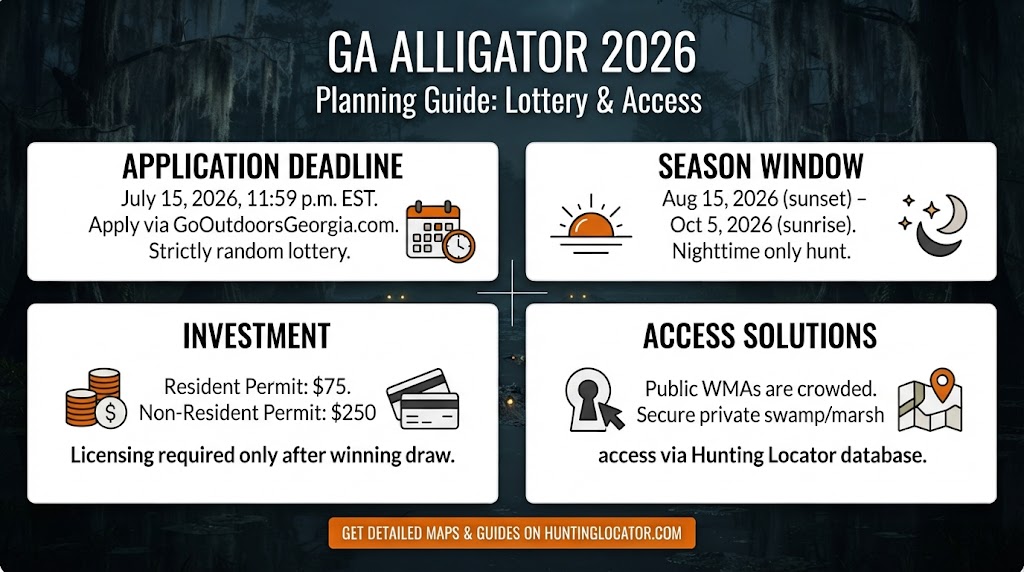
Quick Overview: Georgia Alligator Hunting at a Glance
All data in this section comes directly from Georgia DNR’s official alligator hunting page and Georgia’s official alligator regulations. This is a quota hunt. Permits are awarded by random drawing, application windows are firm, and demand consistently exceeds supply.
| Element | Details |
|---|---|
| Species | American Alligator |
| Season Type | Quota Hunt (lottery draw) |
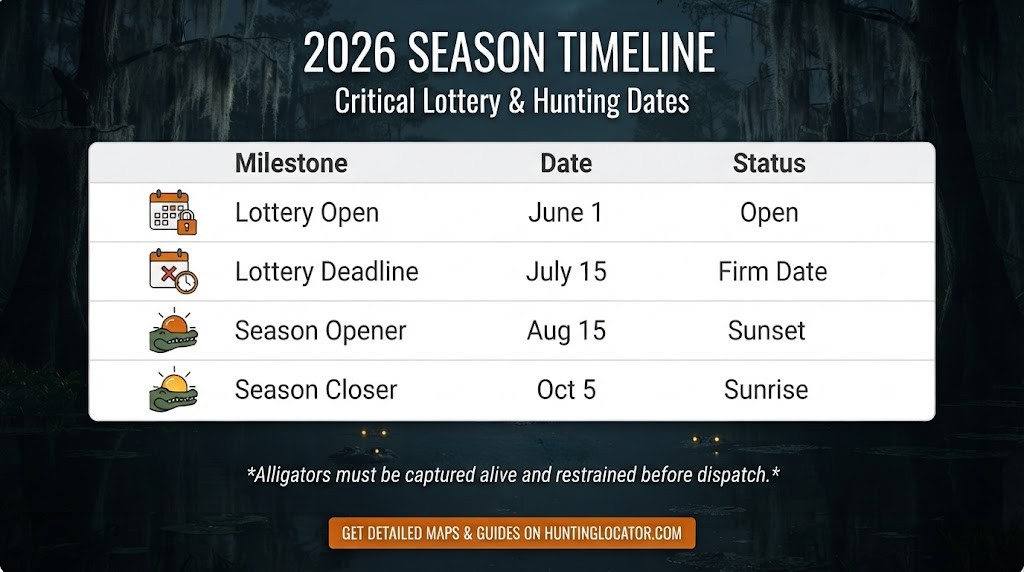
| 2026 Season Dates | Aug 15, 2026 (sunset) – Oct 5, 2026 (sunrise) |
| Legal Hours | Sunset to sunrise (nighttime only) |
| Bag Limit | One (1) alligator per quota permit |
| Minimum Size | ≥48 inches, Zones 1–9; ≥96 inches in Zone 1A (Lake Walter F. George) |
| Application Deadline | 11:59 p.m. EST, July 15 — apply at GoOutdoorsGeorgia.com |
| Quota Permit Cost | $75 resident / $250 non-resident |
| Harvest Reporting | Georgia Game Check within 24 hours of harvest |
| Hunt Zones | 11 management zones, each with its own quota |
Every hunter must have the following before going into the field:
- A valid Georgia hunting license (lifetime and honorary license holders are exempt)
- A quota alligator harvest permit (awarded via the July 15 lottery draw)
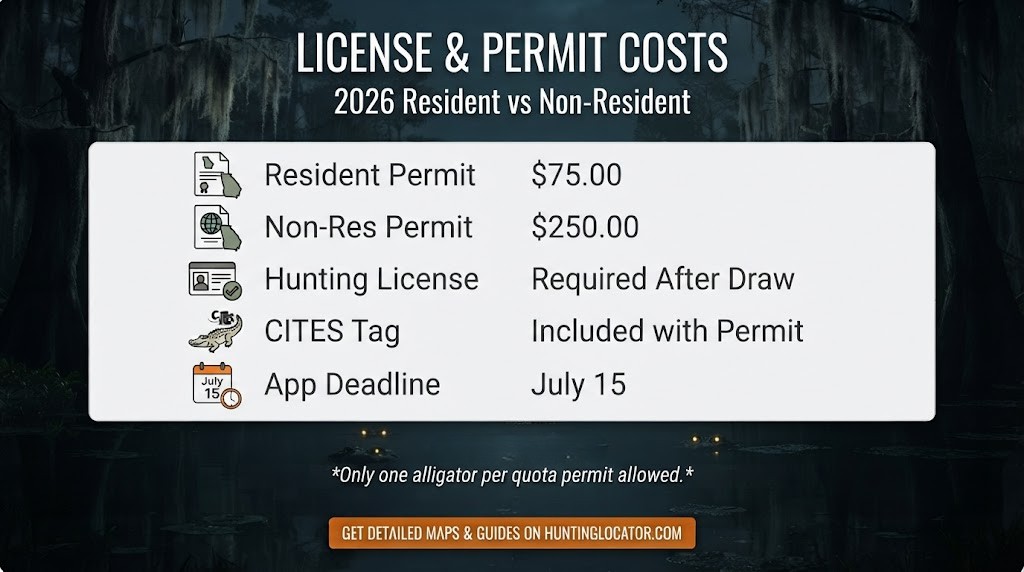
- A CITES tag (mailed automatically after drawing a permit)
- A valid hunting license held by any person actively assisting in the hunt
One important detail: a hunting license is not required to apply for the quota — only to hunt once drawn. Have your license in hand before the season opens so you’re not scrambling after drawing a permit.
Georgia Alligator Hunting Seasons
Georgia manages its alligator harvest through a single statewide season — there are no separate archery, firearms, or primitive-weapons seasons as with deer. What structures the hunt instead is a system of zone-specific quotas and strict nighttime-only hours. To hunt legally in 2026, you need to know when the season runs, when you can legally be on the water, and which zone your permit covers.
The 2026 Season Dates and Why They Shift
Georgia’s official alligator regulations anchor the season to a formula rather than fixed calendar dates: the season runs “from sunset on the day immediately preceding the 3rd Saturday in August through sunrise the day immediately following the 1st Sunday in October.” Applied to the 2026 calendar, that produces the window of August 15, 2026 (sunset) through October 5, 2026 (sunrise).
Because the dates are formula-based, they shift slightly year to year. Don’t assume the same dates carry over — recalculate against the current calendar or verify directly with Georgia DNR before making travel or lease arrangements.
Legal Hunting Hours: A Nighttime Hunt
Georgia alligator hunting runs sunset to sunrise, and that’s not just a regulatory requirement — it reflects how the hunt works in practice. Hunters locate alligators after dark by spotting their reflective eye-shine with a light source, which is legal during the hunt. The most productive window tends to be the hours immediately after sunset and before midnight, when gator activity peaks and eye-shine is easiest to pick up across open water. Slow, quiet boat movement across likely holding water produces better results than covering ground quickly.
Hunt Zones and Quotas
Georgia’s official regulations divide the state into 11 management zones, each assigned its own quota of harvest permits. Your drawn permit is zone-specific — you may only hunt the zone for which you were selected.
Georgia’s alligator population of approximately 200,000–250,000 animals occupies the area along and south of the fall line — roughly the corridor running through Columbus, Macon, and Augusta. That geography defines where the zones are concentrated and where the most productive habitat exists.
Two zone-specific rules are worth highlighting before you apply. Zone 1A (Lake Walter F. George) carries a 96-inch minimum size requirement — double the 48-inch standard that applies in Zones 1–9. Zone 8A (Fort Stewart) operates under its own separate lottery within the DNR framework, with 30 individual harvest tags allotted for 2026. Know your specific zone’s rules before you apply, not after.
Georgia Alligator Licenses and Permits
The licensing and permit structure for Georgia alligator hunting follows a specific sequence. Getting that sequence wrong can disqualify you or cost money on licenses you can’t yet legally use. Here’s what licenses are required, what the quota permit costs, and the exact steps to apply.
Georgia Hunting Licenses
To legally hunt alligators in Georgia after drawing a permit, you must hold a valid Georgia hunting license. Per Georgia’s official regulations, lifetime and honorary license holders are exempt, but all other hunters — residents and non-residents — must have a valid license before going into the field. Anyone actively assisting in the hunt must also hold a current Georgia hunting license.
The key distinction: a hunting license is not required to apply for the quota lottery — only to hunt once selected. Don’t purchase your license before you draw, and don’t wait until after drawing to get one.
Quota permit costs are fixed:
| Quota Alligator Harvest Permit | Cost |
|---|---|
| Resident | $75 |
| Non-Resident | $250 |
For current Georgia hunting license pricing by type and residency, visit GoOutdoorsGeorgia.com directly. License fees vary by type and are subject to change. The permit costs above ($75/$250) are confirmed accurate for 2026.
Georgia Alligator Permits: How to Apply
The Georgia alligator permit application process is electronic, deadline-driven, and resolved by random drawing. There is no preference-point system that guarantees selection — but with two preference points, hunters saw 76% draw odds for Zone 4 in a recent season, while high-demand zones may require five or six points to draw consistently. Zone selection matters.
Follow these steps to apply for your 2026 Georgia alligator quota permit:
- Apply during the application window (June 1 – July 15) at GoOutdoorsGeorgia.com. Applications must be received no later than 11:59 p.m. EST on July 15 to be eligible.
- Rank your preferred hunt zones in order of preference. Research zone competition levels before submitting — some zones are far more competitive than others.
- Wait for the random computer drawing. Selection is per zone; each applicant may be selected for only one zone.
- If selected, your quota permit and CITES tag are mailed directly to you. CITES tags must be locked through the skin within 6 inches of the tip of the tail, used only once, and remain attached to the hide until it is tanned, taxidermy mounted, or exported from the state.
- Purchase your Georgia hunting license — only after being selected. This is the sequencing rule that catches hunters off guard every season.
Critical Watch-Out: Per the permit sequencing rule: “You must be selected for an alligator permit prior to purchasing any of the other licenses.” Apply first. Draw the permit. Then buy the license.
Georgia DNR also states explicitly that anyone submitting false information or more than one application will be disqualified and may be excluded from future hunts for two years.
Georgia Alligator Hunting: Where to Hunt
Finding legal, productive water is the second major challenge after drawing a permit. Quota permit holders have three primary options — public WMAs, guided outfitters, and private land — each with distinct tradeoffs in cost, access, and competition.
Best Public Lands for Georgia Alligator Hunting
Public land hunting is available to quota permit holders across Georgia’s WMAs, but with real limitations. WMAs within legal zones are open to alligator hunting only when that WMA has open small-game dates coinciding with the alligator season — and some WMAs are specifically closed to alligator hunting altogether.
Primary public hunting options worth evaluating for 2026:
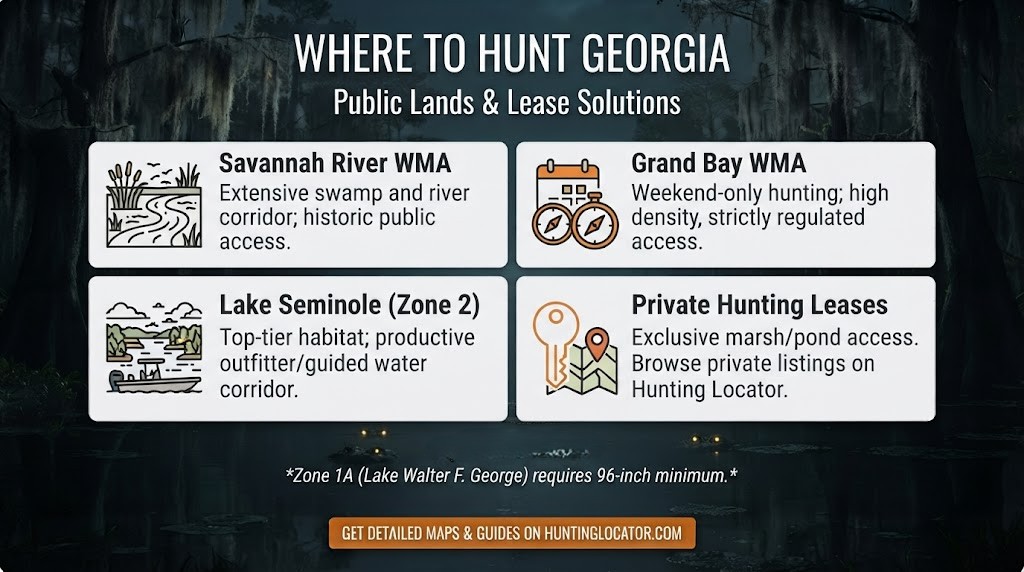
- Savannah River WMA — A well-known destination where hunters have historically camped and hunted the river corridor, offering extensive swamp and backwater habitat
- Grand Bay WMA — Open to quota permit holders but restricted to weekend hunting only, which concentrates pressure significantly
- Zone 4 public waters — Zone 4 draws strong competition for its alligator density, but limited public access pushes many hunters toward private land
- Zone 8A (Fort Stewart) — Operates under its own separate lottery with 30 tags allotted; hunters must navigate Fort Stewart’s application process independently
- Coastal marshes and southern Georgia river systems — South Georgia’s wetland network holds healthy alligator populations and offers access points for quota permit holders willing to do the legwork
Guided Hunts
For non-residents and first-timers, a guided hunt removes most logistical unknowns — local knowledge, boat access, equipment, and regulatory compliance all come with a professional guide. Georgia’s guide community is small relative to demand, making early outfitter contact important.
Most guide services handle on-water logistics, provide legal equipment, and coach clients from spotting to dispatch. The quota permit remains the hunter’s responsibility — guides do not apply on your behalf.
Private Land Hunting with Hunting Locator
Public WMA availability is limited, and pressure is real — 7,313 applicants competed for just 850 permits in a recent season. Even hunters who draw a quota permit can find themselves on crowded public water with uncertain results. Private land access changes that equation.
Per Georgia’s official guide, hunting on private property requires written permission from the landowner, which you must carry while hunting. Finding the right landowner with the right water is the harder part. Properties with productive alligator habitat typically include farm ponds, coastal marshes, river bottomlands, and swamp corridors in South Georgia — the same areas where quota pressure is highest and public access most limited.
A private lease gives you exclusive access to water that isn’t shared with other permit holders, so you can scout on your own schedule and hunt without competing for space. Hunting clubs can strategically rotate which member applies with preference points each season, ensuring the group tags a Georgia gator every year — an approach that works well alongside a consistent private lease.
Hunting Locator connects hunters with landowners who want to lease or sell hunting land. Rather than cold-calling or relying on word-of-mouth, you get access to a searchable database of available properties organized by state, game type, and acreage. For Georgia alligator hunters, browse Georgia hunting leases on Hunting Locator to find properties with the water access and habitat that justify the investment in a quota permit.
Alligator Hunting Tips for Georgia Success
Georgia’s alligator quota hunt rewards preparation. Here are the most important tactical considerations for making the most of your 2026 tag:
- Scout your zone before opening night — Alligator habitat in Georgia concentrates along and south of the fall line, in marshes, swamps, and slow-moving water. Learn the layout of your specific zone before the season opens so you’re not navigating unfamiliar water in the dark.
- Hunt early in the season — The season opens August 15 when water temperatures are warm and gators are actively moving. Early-season hunting consistently produces more sighting opportunities than the cooler weeks approaching October.
- Master the eye-shine technique — The Georgia DNR guide explains that alligators are located at night by sweeping a light source slowly across the water. A red or orange glow indicates a gator; practice distinguishing gator eye-shine from other animals before your hunt night.
- Understand the legal capture sequence — Per Georgia regulations, alligators must be captured alive and restrained by a rope before being dispatched. You cannot shoot a free-swimming alligator. Have your snatch hook, harpoon, or hook-and-line setup rigged and ready before attempting dispatch.
- Know your dispatch options — Georgia law allows a bangstick or any caliber handgun for dispatch, aimed at the base of the skull once the gator’s head is at or below the surface. A .22 rifle is not legal. Know this before you load the boat.
- Know your zone’s size rules — The 48-inch minimum applies in most zones, but Zone 1A (Lake Walter F. George) requires a 96-inch minimum. Measuring incorrectly in the field is a violation with real consequences.
- Apply your CITES tag immediately at harvest — Georgia DNR requires the CITES tag be locked through the skin within 6 inches of the tail tip at the moment of harvest. Possession of an untagged hide is prohibited.
- Report within 24 hours — Georgia Game Check is mandatory within 24 hours of harvest, through the Go Outdoors GA app or online. Record your confirmation number on the harvest record.
- Keep your boat setup functional and uncluttered — Nighttime water hunting requires a stable, quiet platform; a powerful spotlight or headlamp; snatch hooks and harpoons rigged and ready; and your dispatch weapon properly secured. Clutter and noise cost you shots.
- Hunt with a group — Your quota permit allows as many assistants as you want. More eyes sweeping the water means more gators spotted, and an experienced partner can handle the boat while you manage the catch. All assistants must hold valid Georgia hunting licenses.
More Resources from Hunting Locator
- Hunting Locator — Georgia Hunting Leases — Browse private land lease listings across Georgia, including properties with water access for alligator and other game. Connect directly with landowners ready to lease or sell.
- Georgia Hunting Season Guide — A complete overview of every Georgia hunting season. Start here when planning your full 2026 calendar.
- Georgia Deer Hunting Season Guide — Detailed coverage of Georgia’s whitetail seasons, zones, and regulations.
- Georgia Turkey Hunting Season Guide — Season dates, public land access, and private lease options for Georgia spring turkey.
- Georgia Bear Hunting Season Guide — Regulations, zones, and access details for Georgia’s black bear season.
- Georgia Waterfowl Hunting Season Guide — Season dates, public land access, and private lease guidance for Georgia duck and goose hunting.
- Georgia Migratory Bird Hunting Season Guide — Dove, woodcock, and other migratory species with season dates and regulations.
- Georgia Small Game Hunting Season Guide — Squirrel, rabbit, quail, and more — Georgia’s small game seasons complement any big-game or alligator trip.
- Georgia Feral Hog Hunting Guide — Hogs are year-round fair game in Georgia. This guide covers where and how to hunt them.
- Georgia Furbearer Hunting Season Guide — Regulations and access information for trappers and hunters pursuing Georgia’s furbearer species.
- Hunting Locator Store — Equipment for your Georgia alligator hunt, from lighting and restraint tools to boat gear and dispatch equipment.
Frequently Asked Questions
When does the 2026 Georgia alligator season open and close?
The 2026 Georgia alligator quota season opens at sunset on August 15, 2026, and closes at sunrise on October 5, 2026. These dates are calculated from the regulatory formula anchoring the season to the third Saturday in August and the first Sunday in October. Legal hunting hours are sunset to sunrise only — daytime hunting is not permitted.
What is the bag limit for Georgia alligator hunters?
The bag limit is one (1) alligator per quota permit holder for the entire season. A harvested alligator must measure at least 48 inches (snout to tail tip) in Zones 1–9, or at least 96 inches in Zone 1A (Lake Walter F. George).
How much does a Georgia alligator permit cost?
The quota alligator harvest permit costs $75 for residents and $250 for non-residents. A separate Georgia hunting license is also required once drawn; visit GoOutdoorsGeorgia.com for current license pricing by type and residency.
How do I apply for a Georgia alligator quota permit?
Applications are submitted electronically at GoOutdoorsGeorgia.com during the June 1 – July 15 window. You’ll rank preferred hunt zones by preference, and a random computer drawing selects permit holders per zone. If drawn, your harvest permit and CITES tag are mailed to you. Do not purchase a hunting license until after you’ve been selected — this sequencing requirement applies to all hunters, and non-residents in particular get tripped up by it.
Can I hunt alligators on any public land in Georgia with a quota permit?
Not automatically. Per Georgia regulations, WMAs are open to alligator hunting only when they have open small-game dates coinciding with the alligator season — and some WMAs are specifically closed to alligator hunting. Grand Bay WMA is restricted to weekend hunting only. Verify the specific rules for your zone’s public lands before hunting.
What happens after I harvest a Georgia alligator?
You have 24 hours to report your harvest through Georgia Game Check — via the Go Outdoors GA app or online at GoOutdoorsGA.com. Record the confirmation number on your harvest record. Your CITES tag must already be locked through the skin within 6 inches of the tail tip at the time of harvest and must remain attached to the hide until it is tanned, taxidermy mounted, or exported from the state.
The Final Shot
The Georgia alligator quota hunt is achievable for hunters who prepare ahead of time — but the tags are limited, the competition is real, and the application window won’t wait. Apply strategically, follow the sequencing rules, and get your land access sorted before August 15. If you’re still working out where to hunt, Hunting Locator’s Georgia lease listings give you direct access to private landowners with water worth hunting — no cold calls, no guesswork, just properties available to the right hunter at the right time.


