This Georgia bear guide covers what you need to hunt bear legally in Georgia this season: zone dates, license and permit costs, and where to find good ground. Hunting Locator put it together to consolidate the 2026 framework in one place and connect you to land, gear, and guidance. All season data here reflects the current regulatory framework and should be verified at GeorgiaWildlife.com before you head afield.
Specifically, this guide covers:
- 2026 season dates by zone and hunting method, from Northern Zone archery through the Central Zone’s single-day hunt
- License, permit, and harvest-record requirements, including resident and non-resident fees
- Where to hunt — public wildlife management areas plus private lease access through Hunting Locator
Quick Overview
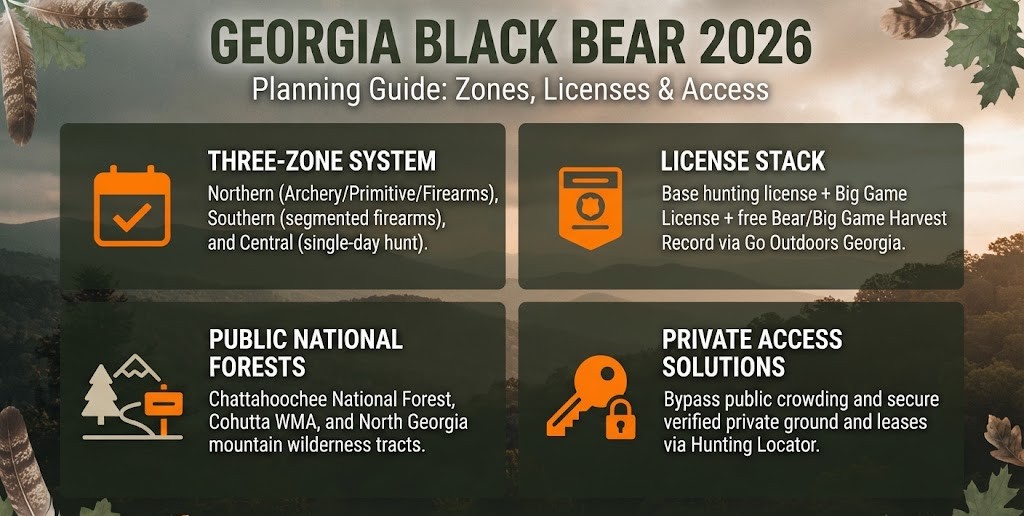
Georgia manages black bear hunting across three zones — Northern, Central, and Southern — each with its own season structure, weapon windows, and bag limit rules. This three-zone framework determines when, where, and how you can legally hunt, so it’s worth understanding before anything else.
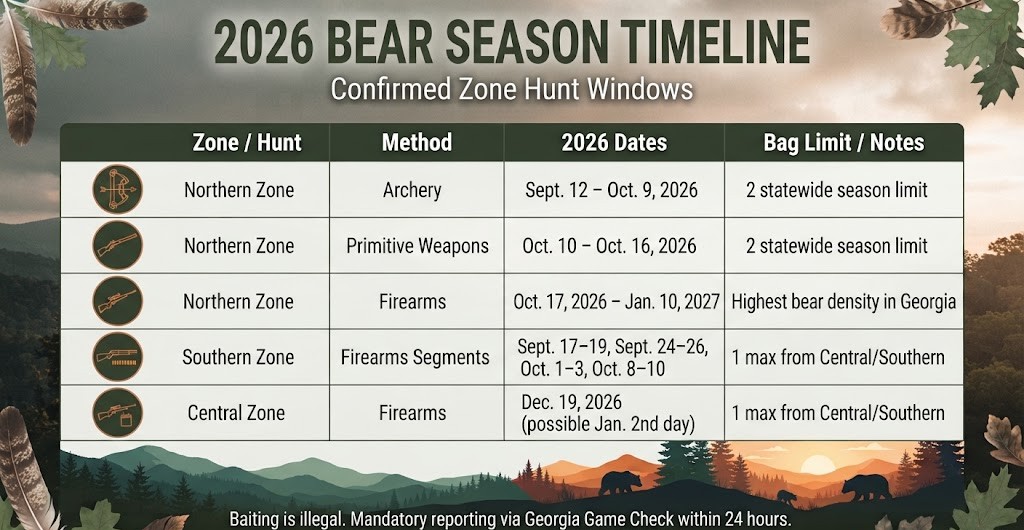
| Zone/Hunt | Method | 2026 Dates | Bag Limit | Key Notes |
|---|---|---|---|---|
| Northern Zone | Archery | Sept. 12 – Oct. 9 | 2 statewide season limit | Highest bear density in Georgia |
| Northern Zone | Primitive Weapons | Oct. 10 – Oct. 16 | 2 statewide season limit | Follows archery window |
| Northern Zone | Firearms | Oct. 17 – Jan. 10 | 2 statewide season limit | Longest method window |
| Southern Zone | Firearms | Select segments: Sept. 17–19, Sept. 24–26, Oct. 1–3, Oct. 8–10 | 1 max from Central/Southern combined | Designated coastal/southern counties only |
| Central Zone | Firearms | Dec. 19 (possible 2nd day in January) | 1 max from Central/Southern combined | Second day triggered if fewer than 6 female bears harvested |
| Dog-Bear Quota Hunt | Dogs (Chattahoochee & Chestatee WMAs) | Oct. 3 – Oct. 11 | Counts toward statewide limit | Requires advance quota application |
Verify before you hunt: regulations can shift year to year, so confirm final 2026 dates and county-specific details at GeorgiaWildlife.com before you plan your trip. For more detail, see our full Georgia bear guide.
Every bear hunter in Georgia — resident or non-resident — needs a few pieces of paperwork before heading into the woods:
- A base hunting license — required before pursuing any game in Georgia
- A Big Game License — a required add-on specifically for bear, deer, and turkey
- A free Bear/Big Game Harvest Record — your official documentation for tagging and reporting a harvest
- Mandatory Georgia Game Check reporting — every harvested bear must be reported within 24 hours
Georgia Bear Hunting Seasons
Georgia’s bear seasons run concurrent with the corresponding Georgia deer season dates, which is a useful shortcut if you already track deer season timing. Bear season layers its own zone-specific rules, weapon windows, and quota requirements on top of that. Here’s the 2026 breakdown, zone by zone. As always, this reflects Georgia DNR’s official season structure — verify final dates at GeorgiaWildlife.com before you lock in plans.
Northern Zone Season
The Northern Zone is Georgia’s bear hunting heartland, and its three method windows run back to back. The zone holds an estimated 3,000 black bears, the densest population in the state, with the Chattahoochee National Forest’s roughly 750,000 acres and Cohutta WMA standing out as prime habitat.
- Archery (Sept. 12 – Oct. 9) — the earliest opportunity, before firearms pressure builds
- Primitive Weapons (Oct. 10 – Oct. 16) — a short, week-long window
- Firearms (Oct. 17 – Jan. 10) — the longest segment, running deep into winter
Most harvested bears in the Northern Zone fall in the 150-to-300-pound range, though the region’s dense mountain forests can hold considerably larger animals. This is Georgia’s most productive bear country by a wide margin.
Southern Zone Season
The Southern Zone runs firearms-only, with specific multi-day segments in designated coastal and southern counties rather than one long window: Sept. 17–19, Sept. 24–26, Oct. 1–3, and Oct. 8–10, 2026. These windows are short and tightly defined, so confirm which counties are open before planning a trip. The Southern Zone’s bear population is considerably smaller — roughly 800 bears statewide in South Georgia — so plan around the specific segment dates rather than expecting a long open season.
Central Zone Season
The Central Zone offers a single firearms day — Dec. 19, 2026 — in select counties, with a possible second day in January if fewer than 6 female bears are harvested statewide during the primary hunt. That trigger is a conservation tool DNR uses to manage harvest pressure on breeding females and keep the population healthy for future seasons.
The dog-bear quota hunt on the Chattahoochee and Chestatee WMAs is a separate, method-based opportunity running Oct. 3 – Oct. 11, 2026. Unlike the general zone seasons, it’s a limited quota hunt: hunters must apply in advance, and eligibility, deadlines, and zone-specific rules are set by Georgia DNR. If you want to hunt bear with dogs, treat the application timeline as a priority item on your 2026 checklist, and confirm current quota details at GeorgiaWildlife.com.
Georgia Bear Licenses and Permits
Hunting bear legally in Georgia means stacking the right license tiers plus a free harvest record. Everything is purchased through the Go Outdoors Georgia portal; for the bigger statewide picture beyond bear, see our Georgia hunting season guide.
The progression is straightforward: start with your base hunting license, add the Big Game License (required for bear, deer, and turkey), and round it out with your free Harvest Record. Non-residents follow the same stack — there’s no separate “bear tag” or bear-only permit.
Georgia Hunting Licenses
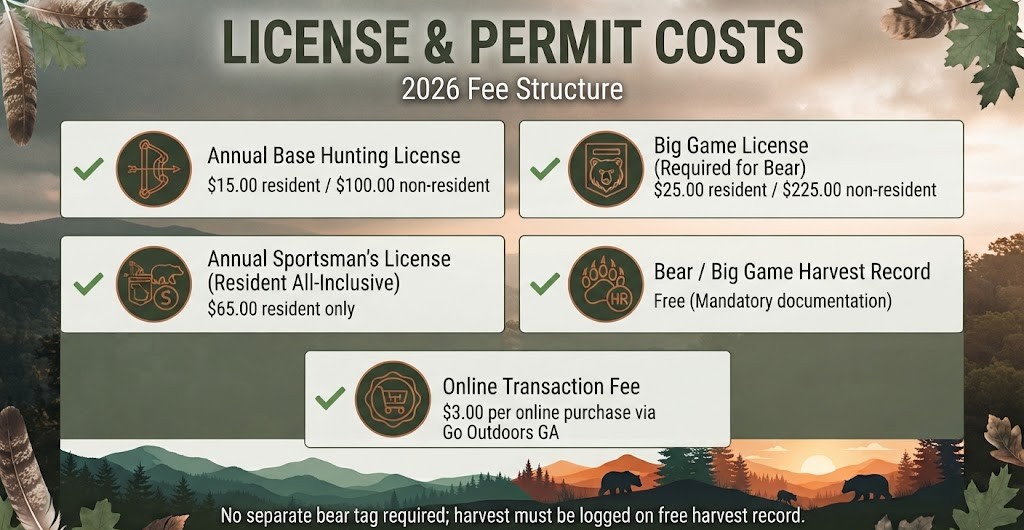
| License Type | Resident Fee | Non-Resident Fee |
|---|---|---|
| Annual Hunting License (Base) | $15 | $100 |
| Big Game License (Required for bear) | $25 | $225.00 |
| Annual Sportsman’s License (All-inclusive) | $65.00 | Not Offered (must buy separate tiers) |
| Bear/Big Game Harvest Record | Free | Free (Required) |
Non-residents should note that the all-inclusive Sportsman’s License isn’t available — you’ll need to buy the base license and Big Game License separately, bringing your total license cost to $325 before any harvest record or transaction fees. Resident landowners hunting their own property are generally exempt from state license requirements, though this exemption doesn’t extend to non-residents or leased ground.
All fees run through Go Outdoors Georgia, and online transactions carry a $3.00 fee. As with season dates, license fees are subject to change — confirm current pricing at the official portal before you buy.
Georgia Bear Permits & Harvest Record
There’s no separate “bear tag” in Georgia — the requirement is your free Bear/Big Game Harvest Record combined with mandatory Game Check reporting. Georgia Game Check is the state’s official system for logging harvested game, and it’s how DNR tracks bear harvest data across zones to manage future seasons. Every harvested bear must be reported through Game Check within 24 hours of harvest.
Here’s the process from start to finish:
- Create or log in to your Go Outdoors Georgia account — the official portal for all license and permit purchases.
- Purchase your base Annual Hunting License — required before any other tier.
- Add the Big Game License — the required add-on tier for bear, deer, and turkey.
- Obtain your free Bear/Big Game Harvest Record — no cost, but mandatory.
- Carry your license and harvest record afield, and report any harvest via Georgia Game Check within 24 hours.
Georgia law strictly protects female bears with cubs and any bear under 75 pounds. Those protections apply regardless of zone or method, so know what you’re looking at before you take the shot.
Where to Hunt Bear in Georgia
Georgia offers two paths for bear hunters: public wildlife management areas, accessible with a valid license but often competitive during peak windows, and private leased land, which trades that competition for exclusive, lower-pressure access. Both have a place in a 2026 game plan.
Best Public Lands
Georgia’s WMA system gives hunters extensive public bear access with nothing more than a valid hunting license — more than 100 WMAs statewide offer some form of big-game hunting.
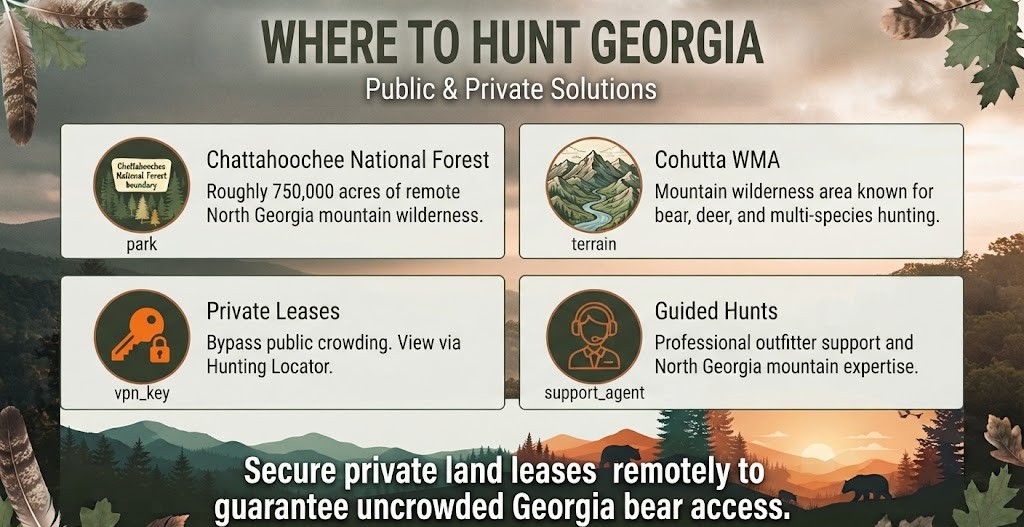
- Chattahoochee National Forest — roughly 750,000 acres of North Georgia mountain wilderness, offering remote, low-pressure bear country for hunters willing to hike in.
- Cohutta WMA — a mountain wilderness area known for bear alongside deer, turkey, and grouse, making it a solid multi-species option.
- Chattahoochee & Chestatee WMAs — home to the 2026 dog-bear quota hunt (Oct. 3–11), a distinct opportunity for hunters who want to pursue bear with dogs.
- Northern high-density counties — Union, Rabun, Towns, and Lumpkin hold some of the densest bear populations in the state, making them strong starting points for public-land scouting.
Private Land Hunting with Hunting Locator
Anyone who’s hunted Georgia WMAs during peak bear season knows the drill — competing for parking, dealing with quota draws, sharing pressure-sensitive ground with hunters who beat you to the ridge. Private leased land gives you exclusive or semi-exclusive access without the crowd.
Georgia hunters typically choose between leasing and buying. Seasonal or annual leases offer flexible access at a lower upfront cost — typical Georgia hunting leases run roughly $3 to $15 per acre annually, though pricing varies based on location, acreage, game quality, and amenities. Timber-company leases and other long-term arrangements are common structures in the state, giving hunters consistent, year-after-year access to the same ground. Buying land outright offers permanent ownership and long-term control over your bear country, though it requires a larger upfront investment.
This is where Hunting Locator comes in. Hunting Locator connects you directly with landowners across Georgia who are ready to lease or sell quality bear-hunting ground — no middleman, no cold calls to strangers. You search by region, acreage, and game type, and connect directly with the people who control the land.
Browse current Georgia hunting leases to see what’s available in bear country right now — properties range from smaller tracts near prime Northern Zone counties to larger acreage suited for a season-long lease. Compare a few options and reach out to landowners directly when you find ground that fits your season.
Guided Hunts
For non-resident hunters or anyone new to bear hunting, a guided hunt can shortcut a lot of the learning curve. A good guide brings local knowledge of terrain, food sources, and bear movement patterns that take years to build on your own, along with established land access and a working understanding of Georgia’s zone-specific regulations.
The value of a guided hunt is mostly in the confidence it buys — you’re not guessing which zone rules apply or scouting unfamiliar ground blind. Whether you’re weighing a guided hunt, a private lease, or a public-land trip, Hunting Locator’s platform connects hunters with the landowners, outfitters, and access options that fit their experience level and goals.
Bear Hunting Tips
Success in Georgia’s bear woods comes down to preparation: knowing your zone, respecting the regulations, and having the right gear for the terrain. Here are the fundamentals that matter most heading into the 2026 season.
- Know your zone cold — Confirm exactly which zone and counties you’re hunting, and match your method to the correct open window. Dates differ sharply between Northern, Central, and Southern zones, and a mistake here can end your season before it starts.
- Hunt the mast — Bears key heavily on food sources, and North Georgia’s mountain habitat produces strong hard and soft mast crops. Scout oak flats and berry patches before the season opens to find where bears are actually feeding.
- Respect the protections — Never take a female bear with cubs or any bear under 75 pounds. These protections are strictly enforced and central to legal bear hunting in Georgia.
- Skip the bait — Baiting bears is illegal in Georgia, so build your strategy around legal scouting, natural food sources, and smart stand placement instead.
- Report fast — Log your harvest through Georgia Game Check within 24 hours, no exceptions. This keeps you compliant and supports the data DNR uses to manage future seasons.
- Gear for the mountains — North Georgia’s terrain is steep, remote, and unforgiving on unprepared gear. Reliable boots, quality optics, layered clothing, and solid pack-out equipment matter more here than in flatter country. See the Hunting Locator store for gear built for mountain bear hunts.
More Resources from Hunting Locator
Georgia’s hunting calendar runs deep, and bear season is just one piece of it. Explore more of Hunting Locator’s Georgia-specific content and platform tools below.
- Georgia deer hunting season — Deer and bear seasons run concurrently in many zones, so this guide is a natural companion piece for planning both.
- Georgia feral hog season — Hogs run year-round in Georgia, making them a good option to pair with a bear hunting trip.
- Georgia turkey hunting season — Another big-game license species worth understanding if you’re building a multi-species season.
- Georgia small game season — A good option for filling downtime between bear hunts.
- Georgia alligator hunting season — A Southern Zone opportunity for hunters exploring beyond big game.
- Georgia waterfowl hunting season — Covers duck and goose seasons across the state’s flyways.
- Georgia migratory bird season — Broader coverage of migratory species regulations.
- Georgia furbearer hunting season — Details on trapping and furbearer opportunities statewide.
- Statewide Georgia season guide — The big-picture resource covering every major Georgia season in one place.
- Dedicated Georgia bear guide — For more bear-specific detail and updates.
- Hunting Locator homepage — Explore the full platform connecting hunters with land, guides, and outfitters nationwide.
- Browse Georgia leases — See current private-land leasing opportunities across the state.
- Shop hunting gear — Gear up for bear season with equipment built for Georgia’s terrain.
Frequently Asked Questions
Do I need a permit to hunt bear in Georgia?
You don’t need a separate bear permit or tag. You need a base hunting license, a Big Game License, and the free Bear/Big Game Harvest Record. All three are purchased through Go Outdoors Georgia.
What is the bear bag limit in Georgia for 2026?
The statewide limit is 2 bears per season, with no more than 1 coming from the Central or Southern zones combined. It’s illegal to take a female bear with cubs or any bear under 75 pounds.
How long do I have to report a harvested bear?
You must report your harvest through Georgia Game Check within 24 hours. Game Check is Georgia’s mandatory harvest-reporting system, required for every bear taken statewide, regardless of zone.
Is bear baiting legal in Georgia?
No, baiting bears is illegal in Georgia. Hunters need to rely on legal scouting techniques, natural food sources like mast crops, and smart stand placement instead.
Can non-residents hunt bear in Georgia?
Yes, and there’s no draw required for most bear hunting opportunities. Non-residents need the base hunting license ($100), the Big Game License ($225), and the free harvest record, all purchased through Go Outdoors Georgia.
What’s the difference between the base license and Big Game License?
The base Annual Hunting License covers general hunting privileges, while the Big Game License is the required add-on tier for pursuing bear, deer, or turkey. Both are required to legally hunt bear in Georgia.
The Final Shot
Georgia’s 2026 bear season comes down to knowing your zone, stacking the right licenses, and locking in access to quality ground. With Northern Zone archery, Southern Zone firearms segments, the Central Zone’s single-day hunt, and the dog-bear quota hunt all on the calendar, there’s a path into bear country for most kinds of hunters — resident or non-resident, public-land regular or private-lease planner.
Before opening day, purchase your license stack through Go Outdoors Georgia, and verify the final 2026 dates and county-specific rules at GeorgiaWildlife.com. Regulations can shift, and confirming the details ahead of time is worth the ten minutes it takes.
Hunting Locator connects hunters with landowners directly, cutting out the guesswork of finding access. If crowded WMAs and quota competition have you looking for something better this season, access to the best bear-country leases tends to move quickly once archery season nears. Find your Georgia bear lease before opening week.


